


Ancona
what to see in ancona, a city with 99,000 inhabitants. Discover 5 main attractions like the Duomo di San Ciriaco and Trajan’s Arch. Plan your visit.
Discover Ancona
Ancona, the capital of the Marche region with a population of 98,356 inhabitants and situated at 16 m above sea level, stands out as an important port and cultural center on the Adriatic coast. Founded by the Greeks of Syracuse in the 4th century BC, the city has maintained a strategic role over the centuries thanks to its elbow-shaped geographical position, from which its ancient name Ἀγκών (Ankṓn) derives.
Those wondering what to see in Ancona will discover a historical heritage ranging from the Roman era to the Middle Ages, up to more recent architecture, all concentrated in a dynamic urban context.
The city offers its visitors an itinerary rich in discoveries, from imposing monumental works to sea views that define its character.
History and Origins of Ancona
The founding of Ancona dates back to the 4th century BC, when Greek colonists from Syracuse chose this elbow-shaped promontory to establish a commercial emporium.
The name itself, Ἀγκών (Ankṓn), which in Greek means “elbow,” perfectly describes the conformation of its natural harbor. The Greek presence left traces in the culture and early urban structures, laying the foundations for the development of a settlement that would become crucial for maritime trade in the Adriatic.
During the 2nd century BC, Ancona became a Roman colony, gaining greater importance especially under Emperor Trajan, who expanded its port, making it one of the safest and busiest in the empire.
As a testament to this glorious period, the Arch of Trajan, erected in 115 AD, celebrates the emperor and his contribution to the city’s development.
After the fall of the Western Roman Empire, Ancona came under Byzantine rule, becoming part of the Maritime Pentapolis and maintaining relative autonomy, a period that influenced local architecture and traditions, as can also be observed in neighboring villages like Mercatello sul Metauro, which shares a historical heritage linked to central dominations.
The Middle Ages saw Ancona establish itself as a free maritime commune, contending for supremacy over the Adriatic with Venice and Ragusa. The city resisted numerous sieges, including those by Frederick Barbarossa in the 12th century, demonstrating its strong identity and capacity for self-governance.
Subsequently, it entered the orbit of the Papal States, while long retaining special commercial privileges and a certain autonomy.
Only with the Unification of Italy in the 19th century did Ancona lose its status as a free port, but it continued to play a strategic role as a railway and maritime hub for the Marche region, undergoing profound urban transformations that have defined its current appearance.
What to see in Ancona: main attractions
For those wondering what to see in Ancona, the city offers a journey through centuries of history and architecture, from Roman remains to medieval and modern works. Its main attractions are located between the historic center and the panoramic areas, guaranteeing a variety of experiences that combine culture, art, and breathtaking views of the Adriatic Sea.
Cathedral of San Ciriaco
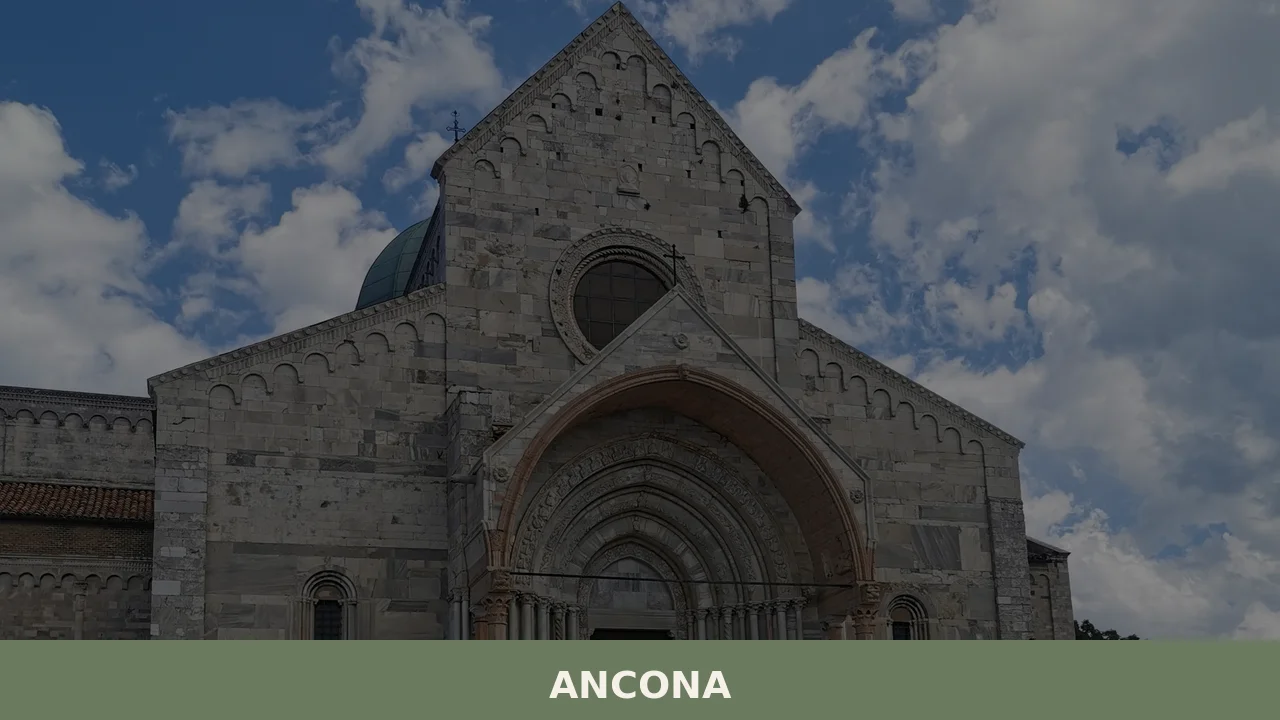
Ancona Cathedral, dedicated to Saint Ciriaco, patron saint of the city whose feast is celebrated on May 4th, stands majestically on Guasco Hill, Ancona’s highest point.
This dominant position offers a panoramic view of the port and the city below, making it a landmark visible from every direction. Its architecture is a harmonious fusion of Romanesque and Gothic styles, with Byzantine elements testifying to the various construction phases between the 9th and 13th centuries.
The main facade features a Gothic portal decorated with stylophor lions sculptures and bas-reliefs, while the Greek-cross interior is embellished with Byzantine capitals and sacred artworks, including the Chapel of the Crucifix and the Chapel of the Madonna.
Arch of Trajan
Located in the port of Ancona, the Arch of Trajan is one of Italy’s best-preserved Roman monuments and represents one of the main answers to the question of what to see in Ancona.
Erected in 115 AD by the architect Apollodorus of Damascus, the Parian marble arch celebrates Emperor Trajan for the expansion of the port and the construction of the Via Traiana, which connected Benevento to Brindisi. The arch, over 18 meters high, stands on a podium and features a single archway flanked by Corinthian columns. Originally, it was decorated with bronze statues of the emperor, his wife Plotina, and his sister Marciana, now lost.
Its position at the entrance to the port underscores Ancona’s strategic and commercial importance in the Roman Empire.
Mole Vanvitelliana (Lazaretto)
The Mole Vanvitelliana, also known as the Lazaretto, is an imposing pentagonal building designed by architect Luigi Vanvitelli and completed in 1743.
Built on an artificial island within the port of Ancona, its original function was that of a lazaretto, a quarantine place for goods and people arriving by sea, and also a warehouse for merchandise.
The structure includes a central courtyard and a neoclassical temple dedicated to Saint Rocco, protector from the plague. Today, the Mole Vanvitelliana is a lively cultural center hosting exhibitions, events, concerts, and recreational activities. Its size and distinctive architecture make it a significant example of 18th-century engineering and a must-see point of interest.
Church of Santa Maria della Piazza
The Church of Santa Maria della Piazza is another architectural gem in Ancona’s historic heart, a remarkable example of Romanesque architecture. Built between the 11th and 13th centuries, the church stands on the remains of earlier early Christian and Roman basilicas, whose foundations are still visible in the excavations below. The richly decorated facade features a portal carved with biblical scenes and floral motifs, flanked by blind arches and pilasters.
The three-nave interior preserves original elements and precious frescoes.
Its location in one of the city’s oldest squares makes it a focal point for understanding Ancona’s historical stratification and its urban development over the centuries.
Passetto and War Memorial
Passetto is a residential district of Ancona known for its monumental staircase that descends to the beach and for the majestic War Memorial.
The latter, erected in the 1930s and a work by architect Guido Cirilli, is an imposing white stone hemicycle overlooking the sea, dedicated to the fallen of the First World War. The Passetto area offers one of Ancona’s most famous views, with its caves carved into the rock and used as boat sheds.
It is an ideal place for a panoramic walk, to enjoy the sea breeze, and to admire the Adriatic coastline, an experience that enriches the list of what to see in Ancona, especially during the summer months.
Typical Cuisine and Products of Ancona
Ancona’s gastronomic tradition reflects its coastal location and the richness of its Marche hinterland, skillfully combining flavors from the sea and the land. Local cuisine is characterized by fresh ingredients and recipes passed down from generation to generation, often linked to seasons and holidays. The influence of the sea is predominant, with a wide variety of fish and seafood forming the basis of many dishes.
Among Ancona’s typical dishes, Stockfish Ancona Style (Stoccafisso all’anconetana) holds a place of honor.
Prepared with soaked stockfish (dried cod), potatoes, tomato, black olives, capers, and anchovies, it is slow-cooked to enhance its flavors.
Equally famous is the Ancona Style Fish Soup (Brodetto all’anconetana), a fish soup that, unlike other regional variants, uses thirteen different species of fish, including scorpionfish, weever, smooth-hound, and red mullet, cooked in a flavorful broth with tomato, vinegar, and chili pepper.
The Wild Mussels of Portonovo (Moscioli selvatici di Portonovo), mussels that grow spontaneously on the Conero rocks, are another specialty to savor, often prepared marinara style or gratinéed. As for land-based dishes, Vincisgrassi is a rich and complex lasagna, with a ragù made from mixed meats, chicken giblets, and truffle, testifying to the robustness of Marche cuisine.
Regarding certified products, at the moment there are no specific DOP, IGP, PAT, DOC, or DOCG certifications for this area in the database. However, the local cuisine utilizes high-quality raw materials from the surrounding territory.
Daily fishing ensures very fresh fish, while the hinterland provides olive oils, seasonal vegetables, and pork used for artisanal cured meats, elements that contribute to the richness of Ancona’s culinary heritage.
Festivals, Events, and Traditions of Ancona
Ancona celebrates its patron saint, Saint Cyriacus of Jerusalem, on May 4th with a festival that involves the entire community.
The celebrations include religious rites in the Cathedral of San Ciriaco, processions through the streets of the historic center, and moments of civil gathering.
During this day, the city comes alive with markets, stalls selling typical products, and shows, offering visitors the the opportunity to immerse themselves in local traditions and experience the festive atmosphere that characterizes the event.
In addition to the patron saint’s festival, Ancona hosts the Sea Festival (Festa del Mare) on the first Sunday of September, an event that pays homage to the city’s historic maritime vocation.
During this celebration, a sea procession takes place with decorated boats, culminating in the blessing of the waters and the commemoration of those lost at sea. The event is accompanied by music, dances, and tastings of fresh fish products, strengthening the bond between Ancona and its port.
Other cultural and gastronomic events follow throughout the year, often linked to seasonal products or historical anniversaries, but for specific details, it is always advisable to consult the official website of the Municipality of Ancona.
When to visit Ancona and how to get there
The best time to visit Ancona is from late spring to early autumn, roughly from May to September. During these months, the weather is mild and sunny, ideal for exploring outdoor attractions, enjoying the Conero beaches, and participating in summer events. Spring offers pleasant temperatures and lush blooms, while summer is perfect for those seeking the sea and beach activities.
Autumn, with its warm colors, allows you to appreciate the city with fewer crowds, while still maintaining favorable weather for cultural strolls.
Ancona is well-connected and easily accessible from various directions.
Those arriving by car can use the A14 Adriatica highway, with the “Ancona Nord” and “Ancona Sud” exits leading directly into the city. Ancona Centrale train station is an important hub in the national railway network, with direct connections to and from major Italian cities. For those who prefer to fly, Ancona-Falconara “Raffaello Sanzio” Airport is located about 18 km from the city center, offering national and international flights. From there, it is possible to reach Ancona by train, bus, or taxi.
For updated timetables and connections, it is advisable to consult the official websites of transport companies or the Trenitalia portal.
Those wishing to explore the Marche region can consider Ancona as a starting point for itineraries that also include other plain villages, such as Auditore or Frontone, both located in the same province and easily accessible.
These villages offer an additional perspective on Marche’s history and culture, enriching the travel experience in the region.
For more information about the city, the official website of the Municipality of Ancona is www.comuneancona.it.
| Starting Point | Distance | Estimated Time |
|---|---|---|
| Bologna | 200 km | 2 hours |
| Rome | 290 km | 3 hours and 30 minutes |
| Milan | 420 km | 4 hours and 30 minutes |
Where to stay in Ancona
Ancona, being a city of considerable size and an important tourist and commercial center, offers a wide range of accommodation options, suitable for different needs and budgets.
In the historic center and in the immediate vicinity of the port, you can find hotels of various categories, from boutique hotels with sea views to more traditional establishments.
Many of these hotels are located in renovated historic buildings, offering an experience that combines modern comforts with the charm of local architecture.
For those who prefer a more intimate atmosphere, the city and its surroundings offer numerous bed & breakfasts and guesthouses, often privately run, which allow for a more authentic hospitality experience. In the surrounding areas, especially towards the Conero Park, agriturismi (farm stays) and holiday homes are also available, ideal for those seeking a stay closer to nature and the tranquility of the Marche countryside, while remaining a short distance from Ancona’s urban attractions. The variety of accommodation solutions ensures that every visitor can find the most suitable option for their stay.
Photo Gallery of Ancona
Do you have photos of Ancona?
Share your photos of the village: the best ones will be added to the official gallery, with your credit.
Send your photos



📝 Incorrect information or updates?
Help us keep the Ancona page accurate and up to date.