

Rising majestically in the heart of Piazza dei Miracoli, the Battistero di San Giovanni in Pisa stands as one of the most remarkable examples of Romanesque architecture in Italy. This extraordinary circular baptistery, dedicated to Saint John the Baptist, has captivated visitors for over eight centuries with its stunning blend of architectural styles, breathtaking acoustics, and rich religious significance. As the largest baptistery in all of Italy, this magnificent structure completes the sacred quartet of monuments in Pisa’s famous square, alongside the iconic Leaning Tower, the grand Cathedral of Santa Maria Assunta, and the peaceful Camposanto Monumentale. Whether you’re a passionate architecture enthusiast, a history buff seeking to understand medieval Tuscany, or simply a curious traveler exploring the wonders of Italy, the Battistero di San Giovanni offers an unforgettable journey through time, art, and spiritual devotion that will leave you in absolute awe.
Historical Background of the Battistero di San Giovanni
The fascinating history of the Battistero di San Giovanni Pisa spans several centuries, reflecting the city’s golden age as a powerful maritime republic. Understanding its historical context helps visitors appreciate not just its architectural beauty but also its profound cultural and religious significance within medieval Italian society.
Origins and Construction Timeline
Construction of the Pisa Baptistery began in 1152 under the direction of architect Diotisalvi, whose name is inscribed on two pillars inside the building. The project was incredibly ambitious for its time, requiring substantial financial resources that came largely from Pisa’s flourishing maritime trade. The original design followed the Romanesque style that was prevalent throughout Tuscany during the 12th century, characterized by rounded arches, robust columns, and harmonious proportions.
However, the construction process took an extraordinarily long time to complete—nearly 200 years. This extended building period resulted in an intriguing architectural evolution that visitors can observe today. By the time the upper sections were being constructed in the 13th century, the Gothic style had become fashionable in Italy, leading to the incorporation of pointed arches, elaborate pinnacles, and intricate sculptural decorations that contrast beautifully with the simpler Romanesque lower levels.
The Architects Behind the Masterpiece
Several distinguished architects contributed to the Battistero di San Giovanni over its lengthy construction period. After Diotisalvi established the foundational design, Nicola Pisano took over the project around 1260, introducing significant Gothic elements and creating the extraordinary pulpit that remains one of the building’s greatest treasures. His son, Giovanni Pisano, continued the work, adding the elaborate sculptural decorations on the exterior that showcase the evolution of Italian Gothic sculpture.
The dome was finally completed in the 14th century, though modifications and restorations continued for several more centuries. This collaborative effort across generations of master craftsmen resulted in a uniquely harmonious building that seamlessly blends different architectural languages into a coherent and visually stunning whole.
Architectural Features of the Pisa Baptistery
The architecture of the Battistero di San Giovanni represents a masterful fusion of styles that makes it unique among Italian religious buildings. Every element, from its distinctive dome to its ornate portals, demonstrates the exceptional skill of medieval craftsmen and the wealth of the Pisan Republic.
Exterior Design and Dimensions
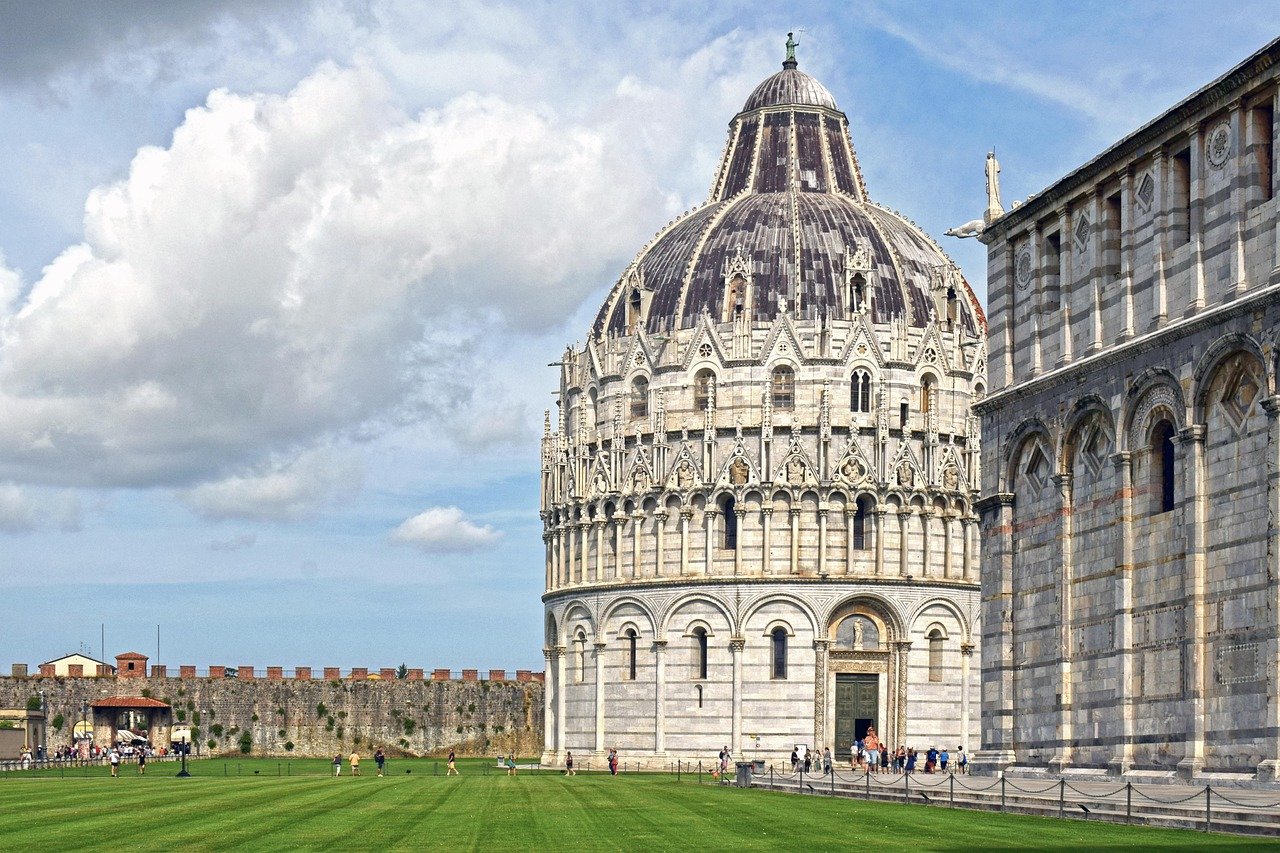
The Battistero di San Giovanni boasts impressive dimensions that make it the largest baptistery in Italy. The structure stands approximately 54.86 meters tall with a circumference of 107.24 meters, creating a commanding presence in Piazza dei Miracoli. The exterior is divided into distinct horizontal bands that clearly show the transition from Romanesque to Gothic architecture.
The lower level features elegant blind arcading—a series of decorative arches attached to the wall—typical of Pisan Romanesque style. Above this, a magnificent loggia of slender columns creates a gallery that encircles the entire building, supported by graceful pointed Gothic arches. The uppermost level displays elaborate Gothic gables, pinnacles, and an array of sculptural decorations that catch the Tuscan sunlight beautifully throughout the day.
The Unique Dome Structure
One of the most distinctive features of the Pisa Baptistery is its unusual dome, which appears conical from the outside but reveals a pyramidal inner structure. This innovative double-dome construction was an engineering marvel of its time, consisting of an inner cone-shaped dome visible from inside and an outer truncated cone that creates the building’s characteristic silhouette. The dome is crowned by a small cupola topped with a bronze statue of Saint John the Baptist, gleaming golden against the blue Tuscan sky.
The roof covering was originally made entirely of lead tiles, but during restoration work, the side facing the cathedral was replaced with terracotta tiles due to the expense of lead. This gives the dome a distinctive two-toned appearance when viewed from certain angles, adding another layer of visual interest to this already extraordinary structure.
The Ornate Portals
The Battistero di San Giovanni features four entrance portals, with the main entrance facing the cathedral. This principal portal, created in the mid-12th century, showcases exceptional Romanesque sculpture with its carved jambs depicting the twelve months of the year and various biblical scenes. The bronze doors feature intricate reliefs that narrate stories from the life of Saint John the Baptist and Christ.
The eastern portal, known as the Porta della Vergine, displays beautiful Byzantine-influenced reliefs and demonstrates the artistic connections between Pisa and the Eastern Mediterranean during the medieval period. These portals serve not merely as entrances but as elaborate visual narratives that prepared medieval worshippers spiritually before entering the sacred space within.
Interior Treasures of the Battistero
While the exterior of the Battistero di San Giovanni impresses with its architectural grandeur, stepping inside reveals an equally remarkable interior space filled with artistic masterpieces and an atmosphere of profound spirituality. The relative simplicity of the interior decoration allows visitors to appreciate the pure architectural forms and the exceptional artworks they contain.
The Magnificent Pulpit by Nicola Pisano
Undoubtedly the greatest treasure within the Pisa Baptistery is the extraordinary pulpit carved by Nicola Pisano between 1255 and 1260. This hexagonal marble pulpit represents a revolutionary moment in the history of Italian sculpture, marking the transition from medieval artistic conventions toward the naturalism that would later flourish in the Renaissance.
The pulpit rests on seven columns—three standing on lion sculptures that symbolize the triumph of Christianity over paganism, three on plain bases, and a central column featuring figures representing the theological virtues. The parapet displays five magnificent relief panels depicting scenes from the life of Christ: the Nativity, the Adoration of the Magi, the Presentation at the Temple, the Crucifixion, and the Last Judgment.
What makes Pisano’s work revolutionary is his incorporation of classical Roman sculptural techniques, likely inspired by ancient sarcophagi he had studied in Camposanto nearby. The figures display a naturalism, emotional depth, and three-dimensional quality that was unprecedented in medieval Italian art, earning Nicola Pisano recognition as a pioneer who paved the way for Renaissance sculpture.
The Baptismal Font
At the center of the Battistero di San Giovanni stands the impressive octagonal baptismal font, created by Guido Bigarelli da Como in 1246. The font’s octagonal shape carries profound symbolic meaning—eight representing resurrection, new beginnings, and the eighth day of creation in Christian theology. The elaborate carvings around the font include geometric patterns and floral motifs typical of the Cosmatesque style that flourished in medieval Italy.
Originally, baptisms were performed by full immersion, which explains the font’s substantial size. A smaller font, added later for infant baptisms, stands on a raised platform in the center of the larger structure. This arrangement allowed the sacrament of baptism to continue being administered as religious practices evolved over the centuries.
The Interior Architecture
The interior of the Baptistery of Pisa is organized across two levels. The ground floor features twelve massive columns and pillars that alternate in a rhythmic pattern, supporting elegant arches and creating a spacious central area flooded with natural light from the windows above. A gallery level, accessible by a spiral staircase, encircles the interior and offers spectacular views of the space below.
The stark white marble interior creates a luminous, almost ethereal atmosphere that contrasts with the elaborate exterior decoration. This simplicity was intentional, designed to focus attention on the sacred ritual of baptism and the remarkable artworks that adorn the space. The pavement features intricate geometric marble inlays that add subtle decorative interest while maintaining the overall sense of harmonious simplicity.
The Famous Acoustics of the Pisa Baptistery
Beyond its visual splendors, the Battistero di San Giovanni is celebrated for its extraordinary acoustic properties, which have amazed visitors for centuries. The unique dome structure creates acoustic phenomena that must be experienced firsthand to be fully appreciated.
Understanding the Echo Effect
The acoustics of the Pisa Baptistery result from the precise mathematical proportions of the dome and the reflective properties of the marble surfaces. When a note is sung or played inside the building, it reverberates for an astonishingly long time—up to 12 seconds—creating an otherworldly echo effect. The dome acts as a natural amplifier, projecting sound throughout the interior space with remarkable clarity.
Every 30 minutes, a custodian demonstrates these acoustic properties by singing a series of notes that harmonize with their own echoes, creating spontaneous polyphonic music from a single voice. This demonstration has become one of the most memorable experiences for visitors to the Battistero di San Giovanni, offering a glimpse into how the space might have sounded during medieval religious ceremonies.
Historical and Religious Significance of the Acoustics
The exceptional resonance within the baptistery was not accidental. Medieval builders understood that sacred spaces should engage all the senses, and the acoustic properties would have enhanced the spiritual impact of baptismal ceremonies. Gregorian chants and religious hymns would have filled the space with heavenly harmonies, creating an atmosphere of divine presence that strengthened the spiritual significance of the baptismal ritual.
Today, occasional concerts and special events take advantage of these remarkable acoustics, allowing visitors to experience medieval music in its intended setting. These performances represent a living continuation of the building’s original purpose as a space where sound and spirituality intersected.
The Battistero within the Piazza dei Miracoli UNESCO Site
The Battistero di San Giovanni forms an integral part of the Piazza dei Miracoli (Square of Miracles), a UNESCO World Heritage Site since 1987. Understanding the baptistery’s relationship with the other monuments in this remarkable ensemble enhances appreciation of its significance within medieval religious urban planning.
The Sacred Geography of the Square
The arrangement of buildings in Piazza dei Miracoli was carefully planned to represent the journey of Christian life. The Battistero stands at the beginning of this spiritual path, symbolizing the entry into Christian faith through baptism. From there, the faithful would proceed to the Duomo di Pisa (Cathedral), where they would worship throughout their lives. Finally, the Camposanto Monumentale (Monumental Cemetery) represents the end of earthly existence and the hope of resurrection.
The Torre Pendente (Leaning Tower), originally built as the cathedral’s campanile, adds vertical emphasis to this horizontal procession, its bells calling the faithful to worship. Together, these four structures create one of the most visually stunning and spiritually meaningful architectural ensembles in the world.
Architectural Harmony and Differences
While each building in Piazza dei Miracoli has its distinct character, they share common architectural elements that create visual harmony. The use of white Carrara marble, the distinctive Pisan Romanesque style with its blind arcading and tiered loggias, and the recurring geometric motifs tie the ensemble together despite the different construction periods.
The Battistero di San Giovanni actually echoes the design of the cathedral’s eastern end, creating a visual dialogue between the two structures. Both feature similar patterns of blind arches and decorative columns, though the baptistery’s circular form and Gothic additions give it a unique identity within the ensemble.
Visiting the Battistero di San Giovanni: Practical Information
Planning a visit to the Battistero di San Giovanni Pisa requires some practical knowledge to make the most of your experience. The following information will help you prepare for an enriching visit to this extraordinary monument.
Opening Hours and Tickets
The Pisa Baptistery is open daily throughout the year, though hours vary by season. During summer months (April to September), the monument is typically open from 8:00 AM to 8:00 PM, while winter hours are usually 9:00 AM to 6:00 PM. It’s advisable to check the official Opera della Primaziale Pisana website for current hours before your visit.
Tickets can be purchased for the baptistery alone or as part of combined tickets that include access to other Piazza dei Miracoli monuments. Combination tickets offer better value if you plan to visit multiple sites. Online booking is recommended, especially during peak tourist season, to avoid long queues and ensure entry at your preferred time.
Best Times to Visit
To fully appreciate the Battistero di San Giovanni without overwhelming crowds, consider visiting early in the morning or late in the afternoon. The interior is most beautiful when natural light streams through the upper windows, typically occurring in the late morning hours. Timing your visit to coincide with the acoustic demonstration (every 30 minutes) is highly recommended.
Spring and autumn offer the most pleasant weather conditions for exploring Piazza dei Miracoli, with comfortable temperatures and smaller crowds than the summer months. Winter visits can also be rewarding, as the monuments take on a different character under soft winter light, and you’ll often have more space to contemplate these architectural treasures.
Tips for an Enhanced Experience
Consider hiring a licensed local guide or joining a guided tour to gain deeper insights into the history and art of the baptistery. Knowledgeable guides can point out details you might otherwise miss and explain the complex symbolism of medieval religious art. Audio guides are also