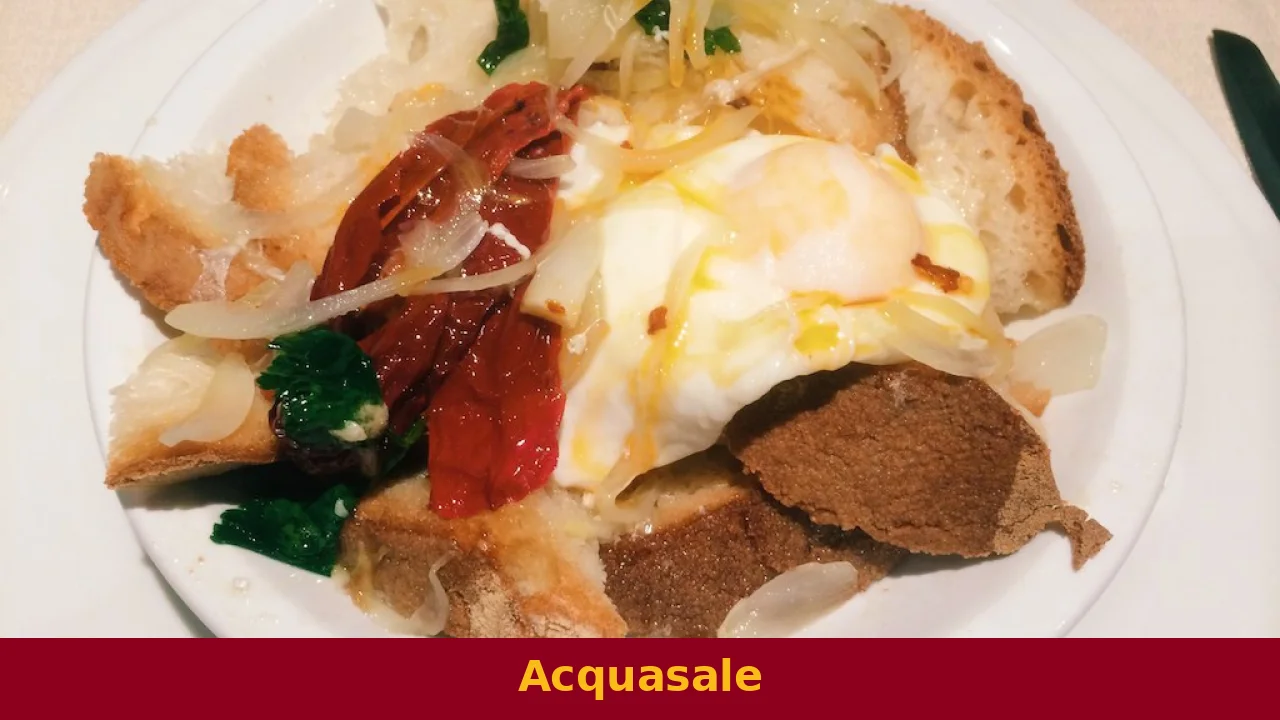
The Puglian acquasale, a name that immediately evokes simplicity and ancient wisdom, is a dish that encapsulates the essence of the Mediterranean diet and the farming tradition of Puglia. This humble, yet profoundly flavorful preparation, is much more than a simple meal: it is a liquid narrative of resources from a past era, a broth…
The Puglian acquasale, a name that immediately evokes simplicity and ancient wisdom, is a dish that encapsulates the essence of the Mediterranean diet and the farming tradition of Puglia. This humble, yet profoundly flavorful preparation, is much more than a simple meal: it is a liquid narrative of resources from a past era, a broth that warms the body and heart, handed down from generation to generation. Acquasale, with its basic ingredients, invites a rediscovery of the genuine flavors of a region where the land and sea offer generous bounty.
Acquasale, also known as Acquasala, or by local variants such as “Acquasale cu ll’ove” (typical of the Gargano coast and other coastal areas) and “cialdèdde”, is a traditional dish of Puglian gastronomy. It is a simple soup, born from the need to nourish farmers and less affluent families with few available ingredients. The heart of the dish is bread, usually stale, cut into small pieces and immersed in a hot broth. This “broth” is prepared by boiling water with the addition of fresh tomatoes, parsley, and extra virgin olive oil. Once ready, it is poured over the bread and further seasoned with oil and, if desired, with grated spicy cheese. Its simplicity is its strength, an example of how Puglian cuisine can transform humble ingredients into a comforting and nutritious meal.
The history of Acquasale is deeply rooted in the peasant cuisine of Puglia, a context where ingenuity and frugality were essential virtues. This dish was the typical dinner for farmers who, in the evening, lacking other provisions, prepared Acquasale to satisfy their hunger. Its origins are well-documented by local gastronomy scholars. Cosmai, in his 1985 book “Leggende e tradizioni biscegliesi”, describes the recipe and its tradition in detail, highlighting its profound connection to the territory. Sada also discusses it extensively in “Cucina pugliese di poveri” (1973) and later in “Cucina pugliese alla poverella” (1991), specifying how it was one of the four main dishes for “popolo minuto” families during times of economic hardship. Sada also mentions the “Acquasale cu ll’ove” variant, prepared particularly by fishing families along the Gargano coast, who enriched the dish with an egg for a greater protein intake, demonstrating the recipe’s adaptability to available resources and different areas of the region. Acquasale thus represents a page in Puglia’s social and economic history, a symbol of resilience and a food culture that values every resource.
Acquasale is a product whose area of origin spans the entire Puglia region. This means its preparation and consumption are widespread from north to south, from the Adriatic coasts to the Ionian Sea, from the Murgia hinterland to Salento. Its nature as a “poor” dish and the simplicity of its ingredients directly reflect the agricultural resources of the Puglian territory: the abundance of extra virgin olive oil, sun-ripened tomatoes, wild aromatic herbs, and homemade bread.
The widespread diffusion of Acquasale testifies to a shared gastronomic culture, connecting coastal communities to those inland through common flavors. Imagining Acquasale means visualizing the wheat fields, ancient olive groves, and flourishing vegetable gardens that dot the Puglian landscape. Each ingredient tells a story of its place of origin, be it a juicy tomato from Tavoliere or a Pecorino cheese from the Murge.
This unbreakable bond with the territory makes Acquasale a culinary experience that goes beyond simple food, inviting exploration of the various facets of traditional products from PUGLIA. Walking through the alleys of towns like Vieste, with its sea view, or among the trulli of Alberobello, one can perceive the cultural and environmental context that gave rise to this dish.
The preparation of Acquasale is a ritual of simplicity and few steps, precisely handed down. The process begins with creating the broth that will form the dish. In a pot, water is brought to a boil. To this, fresh tomatoes, cut into pieces or crushed, chopped parsley, and a generous drizzle of extra virgin olive oil are added. Everything is left to boil for the necessary time for the flavors to meld and for the water to acquire the aroma and color of the ingredients.
Meanwhile, the bread is prepared. Traditionally, stale bread was used, cut into small pieces and arranged at the bottom of a deep plate or bowl. Once the broth is ready and hot, it is poured directly over the bread, which absorbs the liquid and softens. The dish is then completed with an additional drizzle of raw extra virgin olive oil and, for those who appreciate bold flavors, a sprinkle of grated spicy cheese, which adds a note of character.
This essential and direct preparation methodology enhances the quality of the basic ingredients, demonstrating how great cuisine can also arise from the utmost simplicity.
Acquasale is distinguished by a sensory profile that expresses the genuineness of its components. To the nose, one immediately perceives the fresh scent of ripe tomato and the herbaceous aroma of parsley, with a fruity and slightly spicy note imparted by the extra virgin olive oil.
On the palate, the taste is balanced and enveloping. The bread, softened by the hot broth, offers a pleasant texture and merges with the slightly acidic freshness of the tomato. Parsley contributes an aromatic note that cleanses the palate, while olive oil contributes its roundness and a slightly bitter and peppery aftertaste. The addition of spicy cheese, if present, imparts a more intense savoriness and a touch of vibrancy. The dish’s temperature, served hot, amplifies the perception of aromas and flavors, making it a comforting meal.
From a nutritional standpoint, as indicated by the source, Acquasale has an energy value of approximately 197 kcal per 100 grams of edible portion, providing an adequate caloric intake for a light yet substantial meal. It is a dish that celebrates the purity of Mediterranean flavors and the functionality of basic ingredients.
Acquasale is primarily a standalone dish, a complete meal in its simplicity, ideal for a light lunch or a summer dinner. Its versatile nature, however, allows for some variations and contemporary culinary applications. Traditionally, as already mentioned, the “Acquasale cu ll’ove” version was enriched with an egg, often cooked directly in the broth or added at the end, for a greater protein intake, especially in coastal areas. This variant can be replicated for those desiring a more substantial dish.
It can be served as a rustic appetizer in smaller portions, perhaps in individual glasses or small bowls, to begin a Puglian-themed meal. Its freshness also makes it suitable as a light side dish for fish or white meats. Some might appreciate the addition of other seasonal fresh herbs or vegetables, such as finely chopped red onion or cucumbers, for an even more summery and crisp touch. The essence of Acquasale, however, lies in its ability to evoke the primary flavors of the land, so modifications should always be carefully considered so as not to distort its identity. It is an invitation to rediscover the pleasure of simple and genuine flavors.
Acquasale is a unique product for several reasons that extend beyond the simple recipe. Its uniqueness lies primarily in its history and its profound connection to Puglian culture. It is not just a dish, but a symbol of the frugality and ingenuity of past generations, capable of creating a nutritious and flavorful meal with few, yet excellent, local ingredients. In an era where complexity often dominates gastronomy, Acquasale stands out for its authenticity and its ability to highlight the quality of raw ingredients without artifice.
Its “region-wide” diffusion testifies to a shared and deeply rooted gastronomic tradition, which has kept alive the memory of a past of labor and limited resources. It is a clear example of how “poor cuisine” is actually a cuisine rich in meaning, history, and true flavors. Tasting Acquasale means having an experience that directly connects the palate to the land, history, and people of Puglia. It represents a bridge between the past and the present, a way to keep alive a culinary tradition that, despite its simplicity, has much to tell.
Acquasale is recognized as a Traditional Agri-food Product (PAT) of Puglia, an important certification that highlights its cultural and gastronomic value. This recognition was formalized with its inclusion in the national list of PATs in 2021, confirming its relevance and long-standing tradition in the territory.
Inclusion in the PAT list ensures that Acquasale is a product whose preparation and preservation are consolidated over time, according to local customs and practices. Despite its simplicity, the PAT is a seal of quality and authenticity that enhances Italian traditional food products.
Furthermore, the product has been the subject of promotion and enhancement initiatives, such as the regional project “Biodiversità delle specie orticole della Puglia – BiodiverSO”, within the framework of PSR Puglia 2007-2013, Measure 214/4 sub-action “Progetti integrati per la biodiversità”. This demonstrates the region’s commitment to preserving and promoting not only the dish itself, but also the ingredients that form its base, linked to the territory’s biodiversity. Such initiatives contribute to safeguarding the historical memory and gastronomic richness of Puglia.
To savor authentic Acquasale and immerse yourself in Puglian gastronomic culture, the best way is to visit the region directly. As a dish from the farming tradition, it can be found in many agriturismi throughout Puglia, where it is often prepared with zero-kilometer ingredients, guaranteeing freshness and a genuine flavor. These locations offer not only the opportunity to taste Acquasale but also to enjoy a complete rural experience, in contact with local agricultural production.
Even in more traditional trattorias and osterias, especially those offering cuisine tied to old recipes, Acquasale may appear, particularly during warmer months, as a light and refreshing dish. Since it is not a packaged product for purchase, its tasting is intrinsically linked to the culinary experience of the moment.
For those wishing to replicate the recipe at home, the basic ingredients – homemade bread, fresh tomatoes, parsley, and extra virgin olive oil – are easily available in local Puglian markets. Visiting a market like that of Vieste or the local markets near Alberobello allows one to purchase fresh and quality products, essential for an authentic Acquasale.
Discovering Acquasale is an invitation to explore Puglia, its flavors, and its traditions, an experience that goes beyond a simple meal and transforms into a journey through the history and culture of this land of great allure.
📷 Photo: Rocco Lucia · CC BY 2.0 · All credits →
In Bisuschio, in the province of Varese, economic activity linked to ceramic production developed starting from the 18th century, with local kilns contributing to the manufacture of tableware and bricks for the area. This hillside village, located 370 meters above sea level, offers a view of the Prealpine landscape and nearby lakes. For those wondering […]
At 275 meters above sea level, in the province of Pesaro and Urbino, lies Mercatino Conca, a settlement with 1,033 residents. The name itself, “Mercatino” (meaning “little market”), suggests a historical commercial function, likely linked to its position in the Conca river valley, a crossroads for trade and activities since ancient times. For those wondering […]
Discover Isola del Piano, a charming village in Marche, Italy. Explore its rich history, organic traditions, stunning landscapes, and authentic Italian culture.
📝 Incorrect information or updates?
Help us keep the Acquasale page accurate and up to date.


