Perched nearly 800 meters above the Adriatic on the rugged spine of the Gargano promontory, Monte Sant’Angelo is one of those rare places where heaven and earth seem to touch. If you’re searching for the perfect Monte Sant’Angelo weekend itinerary, you’ve found it: two days that weave together a UNESCO-listed sacred grotto, a labyrinth of white medieval alleyways, and one of Europe’s oldest forests. This isn’t your typical beach-and-aperitivo weekend in Puglia — it’s a journey into the spiritual heart of southern Italy, where pilgrims have climbed since the fifth century and ancient beeches still block out the sun. To get a full picture of everything this extraordinary hilltop village offers, explore Monte Sant’Angelo in our complete village guide before you pack your bags.
The most convenient gateway is Foggia, reachable by high-speed train from Rome, Naples, or Bari. From Foggia, take the SS89 toward Manfredonia and then follow the winding SP55 up to Monte Sant’Angelo — roughly 60 km and about 1 hour 15 minutes of increasingly dramatic scenery. If you’re driving down the A14 motorway, exit at Foggia or Cerignola Est. For those without a car, Ferrovie del Gargano operates daily bus services from Foggia’s train station directly to Monte Sant’Angelo, with a travel time of approximately 90 minutes. During summer, additional connections run from Manfredonia and other Gargano towns.
For the most immersive experience, book a room in the Rione Junno, the ancient quarter of tightly packed white stone houses just steps from the sanctuary. Several family-run B&Bs here offer charming rooms with vaulted ceilings and rooftop views that stretch all the way to the sea. If you prefer countryside tranquility, the agriturismi scattered along the road toward the Foresta Umbra provide generous breakfasts featuring local cheeses, homemade preserves, and freshly baked bread. Whichever you choose, book early for spring and autumn weekends — the village is small and the best rooms fill up fast.
Begin your Monte Sant’Angelo weekend itinerary where millions of pilgrims have begun theirs — at the Sanctuary of San Michele Arcangelo. Inscribed as a UNESCO World Heritage Site in 2011 as part of the serial property “The Longobards in Italy: Places of Power,” this is no ordinary church. Instead of climbing toward an altar, you descend a broad stone staircase deep into a natural limestone cave where, according to tradition, the Archangel Michael appeared four times between 490 and 493 AD.
Inside the grotto, the air is cool and charged with centuries of devotion. Your eyes will adjust to find the celebrated bronze doors, cast in Constantinople in 1076; the elegant episcopal throne carved from white marble; and the serene statue of the Archangel standing atop the main altar. Take your time here. The layers of Lombard, Norman, and Angevin architecture stacked above the cave tell the story of a site that has been continuously sacred for over 1,500 years.
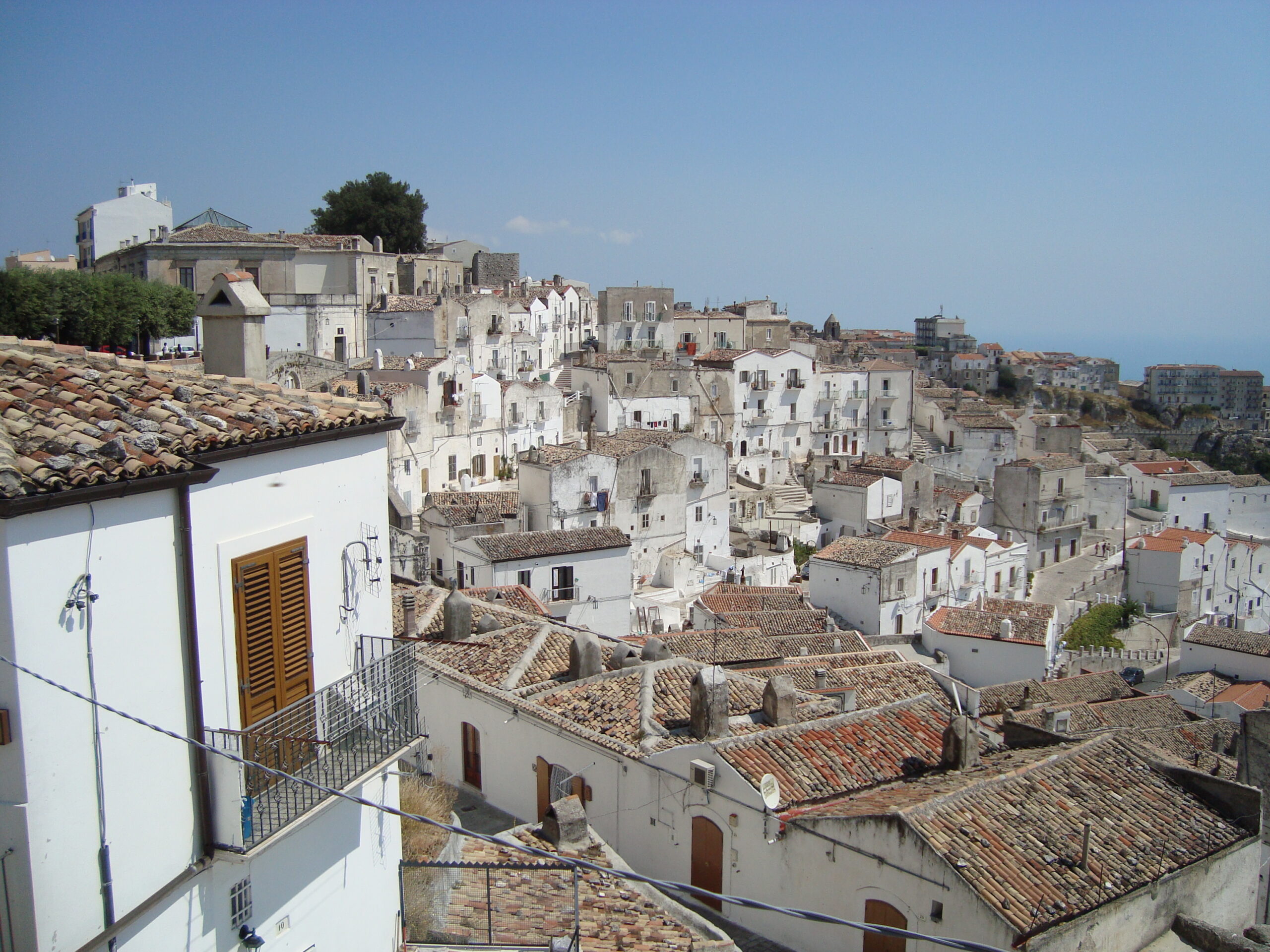
After the grotto’s spiritual intensity, step back into the sunlight and lose yourself in the Rione Junno. This is the oldest neighborhood in Monte Sant’Angelo — a tight weave of whitewashed row houses, steep staircases, and arched passageways that feels virtually unchanged since the Middle Ages. Laundry dries on lines strung between balconies, cats doze on warm stone, and every turn reveals a new sliver of blue sky or distant sea.
From the Junno, follow the signs uphill to the Norman-Swabian-Aragonese Castle, a fortress that has been expanded by virtually every power that ruled the Gargano. Explore the courtyard, visit the small Museo Lapidario with its collection of carved stone fragments, and then step out onto the ramparts. The panoramic view from here — sweeping across the Gulf of Manfredonia and, on clear days, all the way to the distant mountains of Basilicata — is one of the most breathtaking in all of Puglia.
As twilight settles over the rooftops, find a table at one of the village’s cozy trattorias and dive into the flavors of the Gargano. Don’t miss these local specialties:
After dinner, take a slow evening passeggiata through the lamplit streets. The quiet magic of Monte Sant’Angelo after dark is something you won’t soon forget.
On day two, trade sacred stone for sacred woodland. A 20-minute drive from Monte Sant’Angelo brings you to the Foresta Umbra, the ancient green heart of the Gargano National Park. The name means “Forest of Shadows,” and the moment you step beneath its canopy of towering beeches, maples, and centuries-old yew trees, you’ll understand why — even on the brightest summer day, a cool, cathedral-like dimness prevails.
Several well-marked trails suit different fitness levels:
Whichever trail you choose, keep your eyes peeled for roe deer, woodpeckers, and, if you’re very lucky, the elusive Gargano wildcat.
Before leaving the forest, stop at the Centro Visitatori near the main parking area. Its small but well-curated naturalistic museum displays the flora, fauna, and geology of the Gargano, giving context to everything you’ve just experienced on the trail. On your drive back toward Monte Sant’Angelo, pull over at the marked belvedere points along the SP528 — the vistas open up dramatically as you climb out of the forest, offering sweeping views over the Adriatic coast toward Mattinata and the sea stacks of Vieste.
A weekend in Monte Sant’Angelo is a journey of contrasts — the hushed, candlelit mystery of the Archangel’s Grotto on one day, the sun-dappled silence of an ancient forest on the next. It’s a place where spirituality isn’t abstract but carved into living rock, and where nature doesn’t perform for tourists but simply endures, magnificent and unhurried. Few corners of Italy pack this much depth into just two days.
Ready to start planning? Save this itinerary for your next trip to Puglia, and visit our complete guide to Monte Sant’Angelo for even more details on what to see, eat, and experience in this unforgettable Gargano village. Then keep exploring — the most beautiful borghi of Italy are waiting.