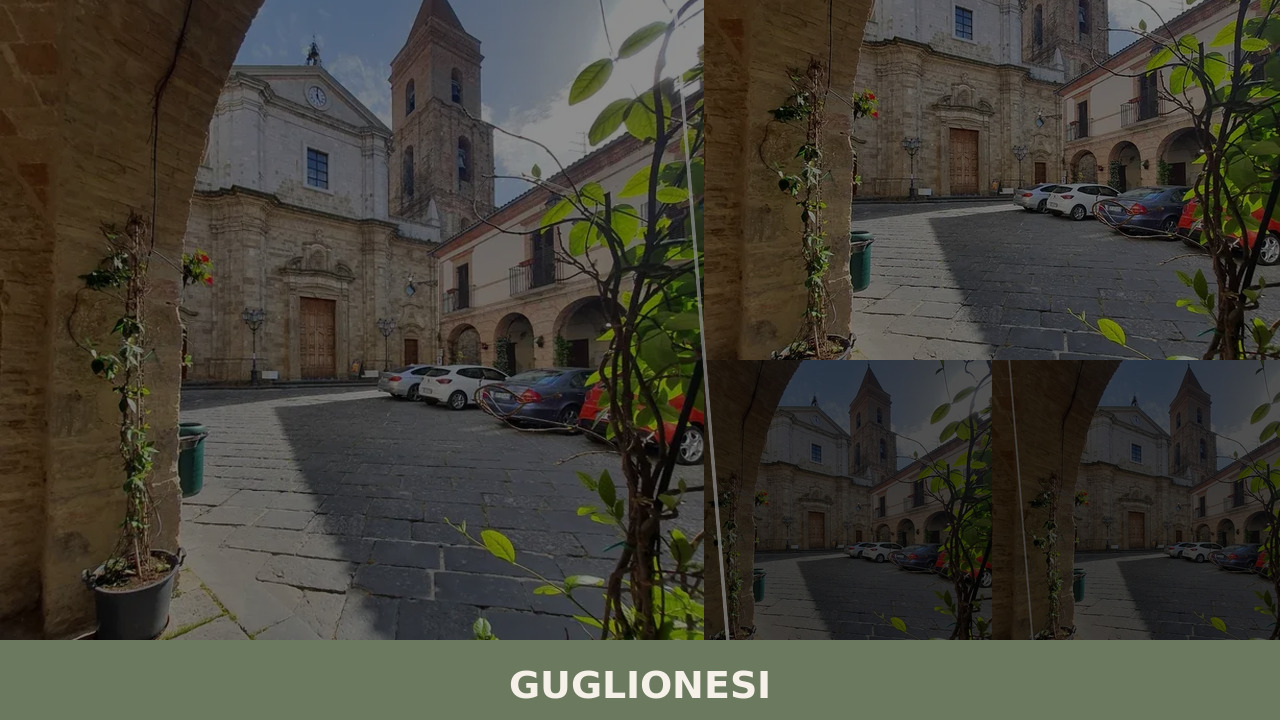
A hill town of nearly five thousand people in Campobasso province, Guglionesi offers Romanesque churches, Samnite archaeological traces, and wide Adriatic views across the Biferno valley.
Morning light falls across the wide central piazza in long, amber slabs, catching the worn basalt paving stones still damp from a street-sweeper’s hose. A bar owner cranks open a metal shutter; espresso steam drifts into cold hill-town air at 369 metres above sea level. Guglionesi, a settlement of just under five thousand people in the province of Campobasso, wakes slowly, its silhouette sharp against the Adriatic horizon to the northeast. For anyone wondering what to see in Guglionesi, the answer begins here — in the unhurried rhythms of a Molise hill town that has been continuously inhabited for well over two thousand years.
The origins of Guglionesi reach back to pre-Roman Samnite culture. Archaeological finds in the surrounding countryside — fragments of terracotta, sections of polygonal wall — suggest a fortified settlement existed here before the Roman conquest of Samnium in the third century BCE. The name itself has been debated by scholars for generations: one hypothesis ties it to a Lombard personal name, “Gulfo” or “Gulione,” reflecting the period between the sixth and eighth centuries when Lombard lords carved fiefdoms across southern Italy. Another, less widely accepted theory, links it to the Latin gulium, a thorny shrub common on these hillsides.
Through the medieval period, Guglionesi passed between Norman, Swabian, and Angevin rulers — a pattern typical of Molise’s fragmented feudal history. The town held strategic value: its elevated position offered clear sightlines toward the Adriatic coast and the Biferno river valley, making it a natural watchtower along routes connecting the interior highlands to coastal trading posts. By the thirteenth century, Guglionesi had established itself as a market town with a degree of autonomy, its economy built on grain, olive oil, and livestock.
The cult of Sant’Adamo, the town’s patron saint, has shaped civic identity since at least the medieval era. According to local tradition, Adamo was a bishop or hermit whose relics were brought to the town, though precise historical documentation remains scarce. What is certain is that his feast day became — and remains — the central event of the communal calendar, binding Guglionesi’s religious life to its public one in a way that persists visibly today.
The main parish church anchors the upper part of town with a Romanesque portal that has survived successive restorations. Inside, the nave preserves a series of painted panels and carved stone details dating to various centuries, layered one over another like a geological cross-section of local devotion. The bell tower, visible from several kilometres away, serves as Guglionesi’s most recognisable landmark.
Set at a lower elevation than Santa Maria Maggiore, San Nicola offers a quieter, more austere interior. The church’s façade displays elements characteristic of the transitional period between Romanesque and early Gothic styles found in several towns across the Molise interior. A carved stone lintel above the entrance rewards close inspection — figures and motifs worn smooth by centuries of weather and touch.
Walking the narrow streets of the centro storico, the built fabric shifts between medieval stonework and modest eighteenth-century additions. The Palazzo Ducale, once the seat of Guglionesi’s feudal lords, stands as the most substantial civic building, its proportions reflecting the ambitions of local nobility. Archways frame unexpected views toward the distant Adriatic, and the residential lanes hold a density of carved doorways and iron balconies that repay slow, attentive walking.
At the edges of town, particularly along the eastern perimeter, the terrain drops away and the landscape opens. On clear mornings, the view extends from the cultivated Biferno river plain to the Adriatic coastline near Termoli, roughly 30 kilometres to the northeast. In late afternoon, the light shifts to copper and the topography — rolling, treeless, cut by shallow valleys — recalls the bone-dry interior of central Sicily more than any stereotype of mainland Italy.
In the agricultural land surrounding Guglionesi, scattered archaeological remains testify to continuous habitation since the Samnite period. While no single excavated site rivals the scale of major national monuments, the fragments — sections of wall, ceramic shards surfacing after ploughing, traces of road alignment — compose a quiet, cumulative record. The municipality of Guglionesi can provide information on current access and any ongoing survey work.
Guglionesi sits at the intersection of Molise’s pastoral uplands and its olive-growing coastal strip, and the local table reflects both. Extra virgin olive oil produced here is firm, green-gold, and peppery at the back of the throat — a product of cultivars adapted to the calcareous soils and moderate altitude. Bread, baked in large loaves from locally milled durum wheat, remains a daily staple rather than an artisanal novelty. Pasta shapes like cavatelli and fusilli are formed by hand and served with slow-cooked ragù of pork or lamb, or with turnip greens and anchovy — dishes that link this hillside to the Adriatic fishing coast just below.
Pork holds a central place in the preserving calendar. Families still cure sausages, ventricina — a coarse, chilli-laced salami typical of lower Molise — and various cuts of cured lard during winter. Local wine, though produced in small quantities, draws on the Tintilia grape, an autochthonous Molise variety that gained DOC recognition and produces a dark, tannic red suited to the region’s robust cooking. Restaurants and trattorias in the centre serve these dishes in straightforward settings: expect paper tablecloths, house wine in ceramic jugs, and portion sizes calibrated for people who work the land.
The feast of Sant’Adamo, celebrated on May 2nd, transforms Guglionesi into a town-wide procession of religious devotion and communal celebration. Streets fill with marching bands, the statue of the patron saint is carried through the historic centre, and temporary food stalls line the piazza. This is the single day when Guglionesi is most visibly, emphatically itself — the population swells with returning emigrants and visitors from surrounding towns. Outside the festival, May and June bring warm, clear days ideal for walking the countryside, when wildflowers cover the uncultivated margins of olive groves. September and October offer a second window: the light softens, the olive harvest begins, and temperatures settle into a comfortable range around 18–22°C. Mid-summer — July and August — can push past 35°C on exposed hillsides, and many locals retreat indoors during the central hours. Winter is quiet and occasionally cold, with temperatures at this altitude dropping close to freezing, though snowfall is infrequent.
By car, Guglionesi is reached most directly from the A14 Adriatica motorway: exit at Termoli-Molise and follow the SS647 inland for approximately 25 kilometres. The drive from Campobasso, the provincial and regional capital, covers about 65 kilometres and takes roughly one hour along the SS647 through the Biferno valley. From Naples, allow approximately two and a half hours (around 200 km) via the A1 and then cross-country roads through the Molise interior. Rome is roughly three hours distant by car (approximately 280 km), following the A1 south to the A14 junction.
The nearest railway station with regular service is Termoli, on the Adriatic main line connecting Bologna to Lecce; from Termoli, local buses or a short taxi ride reach Guglionesi. The closest commercial airport is Pescara (Abruzzo International Airport), about 120 kilometres to the north, which handles domestic and limited European flights. Naples Capodichino, approximately 200 kilometres to the southwest, offers a wider range of international connections. There is no direct rail link to Guglionesi itself, so a car provides the most practical means of exploring both the town and the broader territory.
Guglionesi belongs to a constellation of small, historically layered settlements across the Molise landscape — places where the rhythms of agriculture and religious observance still set the pace of daily life. To the northeast, the fortified coastal town of Termoli sits directly on the Adriatic, its medieval borgo vecchio jutting into the sea behind a Swabian castle wall. The contrast with Guglionesi is immediate: salt air instead of hill-town stillness, fishing boats instead of olive groves, yet the two towns share centuries of economic and familial connection along the Biferno corridor.
Inland, the terrain climbs toward settlements that feel more remote, more folded into the Apennine foothills. Larino, roughly 15 kilometres to the south, holds a Roman amphitheatre and a cathedral with one of the finest Gothic portals in southern Italy — a town whose monumental ambitions once outstripped its size. Together, these villages form a transect through Molise that moves from coast to ridge, each place defined by its elevation, its exposure, and the particular quality of light that falls across its stones in the late afternoon.
A hilltop village of 4,814 inhabitants in the province of Campobasso, Riccia reveals medieval streets, a Norman castle, and one of Molise's most celebrated food festivals.
Campomarino straddles a Molise hilltop and the Adriatic shore. Explore its Arbëreshë heritage, three historic churches, and the unspoiled coast of Campomarino Lido.
A complete guide to Tavenna in Molise: its medieval stone centre, parish church, panoramic hillside views, and the quiet rhythms of inland southern Italy.
📝 Incorrect information or updates?
Help us keep the Guglionesi page accurate and up to date.