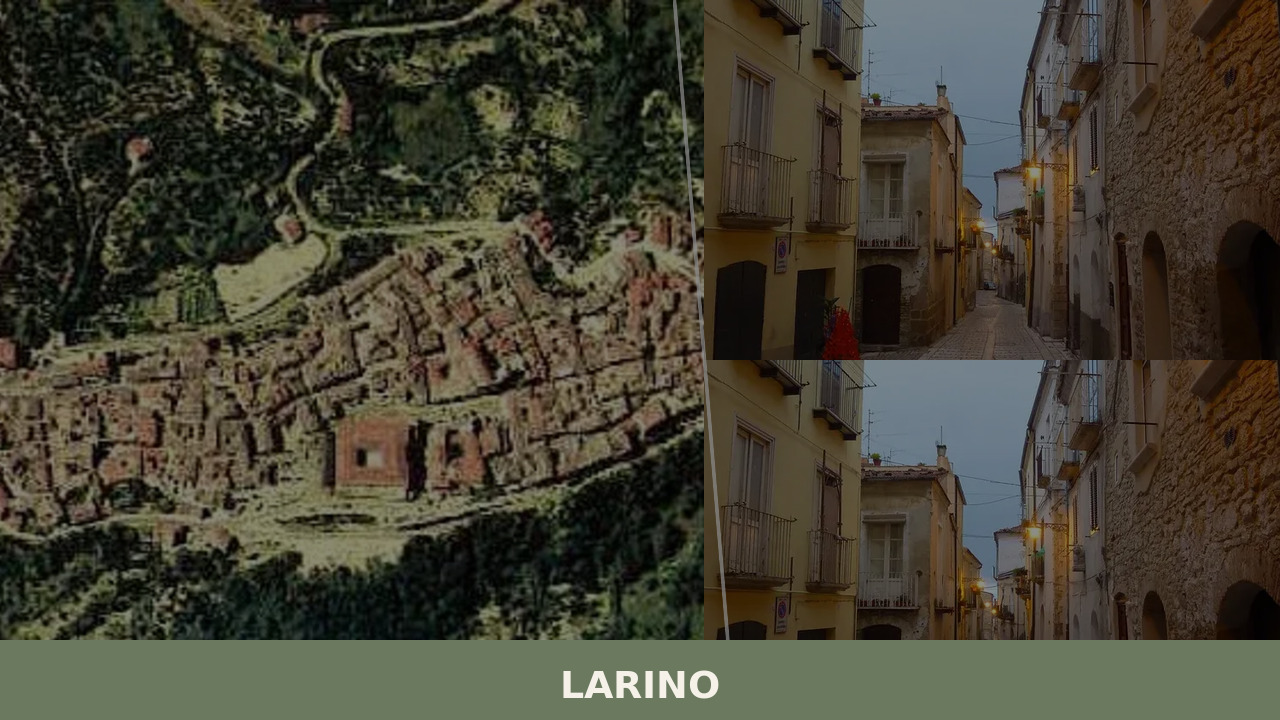
A layered town of Roman ruins and medieval stone in the Molisan countryside. Here is everything to see in Larino, from its amphitheatre to the Festa di San Pardo.
Morning light falls across the worn travertine steps of Larino’s cathedral, and from somewhere below the old quarter, the smell of woodsmoke and roasting peppers drifts upward through narrow lanes. This is a town of 6,366 inhabitants set at 341 metres above sea level in the province of Campobasso, where Roman amphitheatres and Norman stonework coexist with working farms and weekly markets. Understanding what to see in Larino requires slowing down — walking its layered streets the way you’d read geological strata, one century at a time.
The origins of Larino reach deep into pre-Roman Italy. The ancient settlement, known as Larinum, was a significant centre of the Frentani, an Italic people who occupied the coastal and interior hills between the Biferno and Fortore rivers. The town appears in the writings of Cicero, who defended a citizen of Larinum — Aulus Cluentius Habitus — in a celebrated murder trial in 66 BC. That legal case, preserved in Cicero’s Pro Cluentio, remains one of the most detailed accounts of provincial Roman life and places Larinum firmly in the historical record. The Roman municipium of Larinum prospered through agriculture and its position along routes connecting the Adriatic coast to the interior Apennines.
After the fall of Rome, the town endured the familiar cycle of Lombard and then Norman rule. The Normans consolidated its defences and established the administrative structures that would define medieval Larino. The construction of the cathedral in the early fourteenth century — under the direction of local ecclesiastical authorities — marked the town’s emergence as a spiritual centre for the surrounding countryside. Successive earthquakes, particularly those of the fifteenth and eighteenth centuries, damaged parts of the old fabric, but each time the town rebuilt, incorporating earlier fragments into new walls.
Through the early modern period, Larino served as a bishopric, its diocese covering a wide stretch of the Molisan lowlands. The town’s identity remained agricultural and ecclesiastical, largely untouched by the industrialisation that reshaped northern Italian cities. This continuity — sometimes called stagnation by outsiders — is precisely what preserved the layers of architecture and ritual that define the town today.
Completed in 1319, the Cathedral of San Pardo anchors Larino’s upper town with a Gothic-Romanesque façade carved from local limestone. The rose window and the intricately sculpted portal — depicting biblical scenes framed by vine-leaf motifs — reward close inspection. Inside, the nave retains its original proportions, with fragments of medieval frescoes still visible along the side chapels. It is the spiritual heart of the town’s annual procession for San Pardo.
On the town’s eastern edge, partially reclaimed from farmland during twentieth-century excavations, the remains of a first-century AD amphitheatre trace an ellipse roughly 98 metres along its major axis. The lower tiers of seating are still legible in the stone, and archaeologists have identified entry corridors and service tunnels beneath the arena floor. It could once hold an estimated 12,000 spectators — a measure of Larinum’s importance in the Roman period.
The Ducal Palace, rebuilt in the eighteenth century on earlier Norman and Angevin foundations, now serves as the seat of Larino’s municipal government. Its façade of coursed ashlar stone and broad balconies overlooks the main piazza. The interior courtyard, accessible during office hours, reveals older masonry in its lower courses — a physical record of the building’s medieval predecessors layered beneath Baroque symmetry.
Discovered during construction work in the twentieth century, this complex includes well-preserved polychrome floor mosaics from a Roman villa, featuring geometric patterns and marine imagery. The site, located near the amphitheatre, offers tangible evidence of the domestic wealth that characterised Larinum’s elite. Protective roofing now shields the mosaics, and interpretive panels outline the villa’s probable layout and function.
Set on a quieter street below the cathedral, the Church of San Francesco dates to the late medieval period and retains a simple stone portal typical of Franciscan austerity. Inside, a series of wooden altarpieces and painted panels from the sixteenth and seventeenth centuries line the nave. The church’s cloister, partly ruined, opens onto a small garden where the town’s older residents gather on warm afternoons.
Larino’s cooking belongs to the broader Molisan tradition: rural, legume-heavy, and shaped by the rhythms of grain cultivation and sheep husbandry. Cavatelli — small hand-rolled pasta made from semolina and water — appear at nearly every table, often dressed with a slow-cooked ragù of pork or with broccoli rabe and garlic. Pallotte cace e ove (fried balls of cheese and egg in tomato sauce) are a peasant dish elevated by simplicity. The surrounding countryside produces excellent Molisan extra-virgin olive oil, pressed from Gentile di Larino olives — a local cultivar valued for its mild, grassy flavour with a faint peppery finish.
The Tintilia grape, indigenous to Molise and now protected under DOC regulation, yields a structured red wine with notes of dark cherry and dried herbs that pairs naturally with the region’s grilled lamb and aged cheeses. Small trattorias around Piazza Duomo and along Corso Principale serve these dishes without much ceremony — handwritten menus, house wine in ceramic jugs, and portions calibrated for people who have been working since dawn. The weekly market, held on Wednesday mornings, spreads across the lower piazza with seasonal produce, local salumi, and wheels of caciocavallo cheese aged in nearby cellars.
Late May is the defining moment in Larino’s calendar. The Festa di San Pardo, held on May 25–27, involves a procession of ox-drawn carts — carri — decorated with elaborate floral arrangements, winding through the streets to the cathedral. It is one of the oldest continuously observed festivals in southern Italy, a spectacle of devotion and craftsmanship that draws participants from across Molise. The sound of the wooden cartwheels on stone, the bellowing of oxen, and the dense fragrance of cut flowers pressed into geometric patterns on the carts create a sensory experience difficult to replicate elsewhere.
Summer temperatures at 341 metres are warm but less oppressive than on the coast — July and August average highs around 30°C. Autumn, particularly October, brings clear skies and the olive harvest, a good season for walking the surrounding countryside without crowds. Winters are cool, occasionally dipping below freezing, and the town empties to a quiet rhythm that appeals to those who prefer solitude. For most visitors, the window from late April through mid-June offers the best combination of mild weather, active local life, and access to the town’s monuments without reservation or queue.
Larino lies in the eastern part of Molise, roughly 30 kilometres from the Adriatic coast. By car, the most direct route from the A14 Adriatic motorway is via the exit at Termoli or Poggio Imperiale, followed by a drive inland along the SS87 or provincial roads — a journey of approximately 30–40 minutes. From Campobasso, the regional capital, Larino is about 65 kilometres east, reachable in just over an hour by car along the SS647 (Bifernina). Naples is approximately 180 kilometres to the southwest, a drive of roughly two and a half hours via the A1 and then cross-country roads through the Molisan interior.
Larino has a small railway station on the Termoli–Campobasso line operated by Trenitalia, with several daily services connecting to both cities, though schedules are limited and journey times can be slow. The nearest airport with regular commercial flights is Pescara (Abruzzo International Airport), approximately 130 kilometres to the north. Naples Capodichino airport, with a wider range of domestic and European connections, is the alternative for those willing to drive farther. A car is strongly recommended for exploring the town’s surroundings and the wider Molisan countryside.
Larino sits within a constellation of small Molisan towns that share its layered history but each project a distinct character. To the south, Casacalenda occupies a hilltop ringed by oak and olive groves, where an open-air contemporary art trail winds through the surrounding forest — an unlikely pairing of rural landscape and international sculpture. Its small historical centre preserves churches and palazzi from the seventeenth and eighteenth centuries, and the town serves as a useful base for exploring the Liscione reservoir and the Biferno river valley below.
Further into the Molisan interior, Guardialfiera looks out over the artificial lake that bears its name, a body of water created by a dam on the Biferno in the 1970s. The town’s medieval core, clustered around a Romanesque cathedral, has the quiet density of a place shaped by centuries of ecclesiastical authority. Together, these villages — Larino, Casacalenda, Guardialfiera — form a triangle that captures the essential Molisan experience: small populations, deep histories, and landscapes that have changed less in the past hundred years than almost anywhere else in western Europe.
📝 Incorrect information or updates?
Help us keep the Larino page accurate and up to date.


