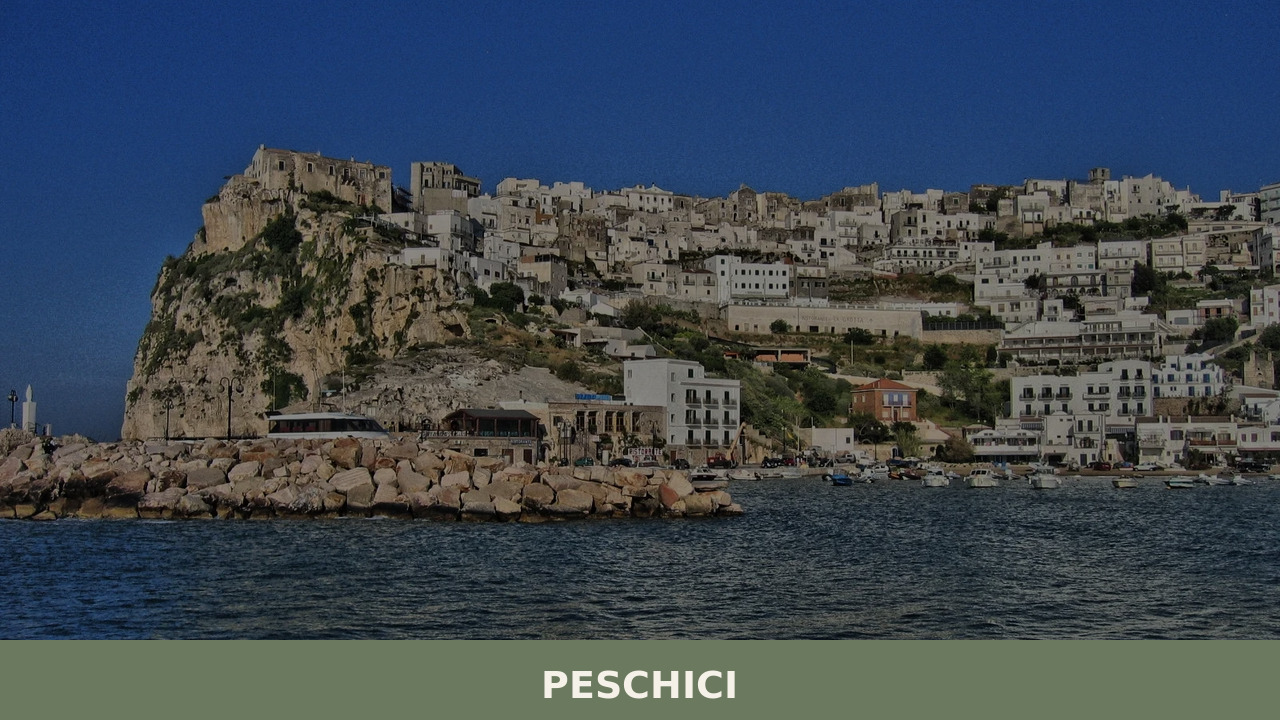

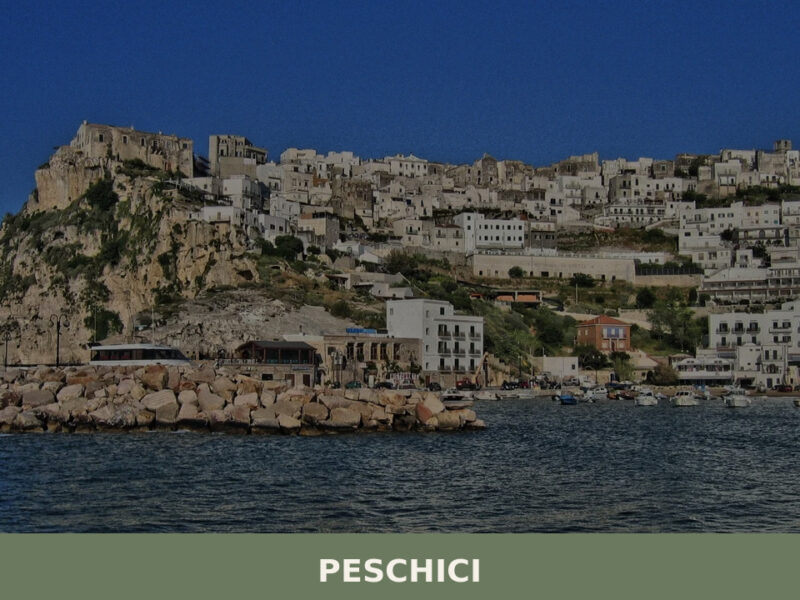
White limestone rises from the Adriatic at Peschici, a village of stone staircases and salt-worn façades where the sea wind shapes daily rhythm. At ninety metres above sea level, the old core clusters on a rocky spine, its narrow alleys turning sharp against the slope. Light falls at angles that change with the hour—morning soft on the eastern flank, afternoon harsh on stone facing west. This is a place where geography does not forgive; the coast demanded settlers who could hold to stone and anchor themselves to stone in return.
Peschici village in Apulia sits in Foggia Province on the Gargano Peninsula’s northeastern edge, home to 4,276 residents. The village draws visitors to its mediaeval town fabric and the surrounding Adriatic coastline, where agricultural land meets limestone cliffs. Internal links to nearby settlements like Carpino and Cagnano Varano reveal a wider network of Gargano villages, each with distinct character.
The Medieval Core and Local Identity
The documented history of Peschici is sparse in detail but firm in outline. The village took its present form as a coastal settlement of modest size, its economy bound to the sea and the agricultural hinterland of the Gargano. The architecture and street pattern reflect centuries of incremental growth rather than a single founding moment—a typical shape for southern Adriatic villages that grew defensively and organically. The layout prioritises stone stability over geometric order; alleys compress and expand according to the rock beneath.
Sant’Elia is the patron saint. Local devotion centres on the saint’s feast, marking religious rhythm within the community calendar and shaping the rhythm of public gathering and tradition. The relationship between saint, settlement and calendar remains a core feature of identity in Apulian villages, where faith and territory interweave across generations.
Stone, Church and Public Space
The Parish Church and Central Square
The village centre organises itself around religious and civic focal points typical of Apulian settlements. The parish church serves as the primary architectural landmark and gathering place, standing at the heart of the old town where narrow streets converge. Its position reflects the medieval logic that placed the sacred at the centre of community life, with domestic and economic functions arranged in concentric rings around it. The square before the church functions as the only significant open space in the compressed medieval core, essential for markets, processions and public assembly.
The Coastal Boundary
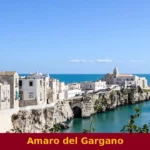
Cliffs and beach form the village’s northern and eastern limits. This limestone margin has shaped settlement patterns for centuries—the sea provided subsistence and trade routes, while the rocky coast offered natural defence. Modern visitors descending to the shoreline encounter a landscape quite different from the inland core; the water and rock speak a different temporal language, one measured in tidal cycles and seasonal storms rather than human generations. Access points to the waterfront remain limited, preserving the town’s elevated isolation.
Regional Food Culture and Agricultural Roots
Peschici sits within Foggia Province, a territory recognised across the European Union for distinctive food production. The province holds several protected designations of origin and geographical indication—among them Limone Femminello del Gargano (protected geographical indication), the characterful lemons of the Gargano plateau, and Arancia del Gargano (also PGI), citrus fruit grown on the same limestone soils that shelter the village itself. These are not exotic imports but the direct product of local soil and climate, harvested and processed by neighbouring farmers and cooperatives.
Beyond protected products, the province maintains a strong tradition of prepared foods rooted in Apulian foodways: dried pasta sauced with garlic and oil, fried vegetables, bread-based dishes and preserved fish from the Adriatic. These elements form the daily table in Peschici, connecting the village to both agricultural heartland and maritime resource. The village’s small population means that food culture remains embedded in household practice rather than abstracted into restaurants or markets; visitors interested in regional food will find it most authentically at family tables and in occasional village festivals.
Seasons, Access and Practical Visits
Peschici is reachable by car or bus from the province’s main city of Foggia and from other Gargano settlements. The coastal position means spring and autumn offer ideal light and temperature, while summer attracts beach-focused visitors and winter can bring rough seas and limited accommodation. The village remains small and car-dependent; if arriving without private transport, advance planning of bus connections is necessary.
| Departure Point | Distance | Approximate Time |
|---|---|---|
| Foggia (provincial capital) | 80 km | 90 minutes by car |
| Apricena (Tavoliere) | 35 km | 50 minutes by car |
| Carpino (Gargano) | 18 km | 25 minutes by car |
The Gargano Peninsula is known throughout Apulia as the region’s thumb—jutting north into the Adriatic with its own climate, crops and historical trajectories distinct from the flat Tavoliere plains to the south. Peschici occupies the peninsula’s northeastern flank, where this distinction is most pronounced.
Visitors should expect a village of working residents rather than tourist infrastructure. Accommodation is limited; most visitors stay in nearby towns or resort areas along the coast. The old town is best explored on foot in the early morning or late afternoon, when light is gentler and the alleys less exposed. If you arrive by car, parking is challenging in the medieval core; peripheral lots serve as practical alternatives. The village’s official website provides current contact information and administrative details for those requiring formal visitor services.
The broader Gargano region—accessible from Peschici via neighbouring villages like Carpino—offers walking trails, beaches and protected natural areas. Cultural tourism in this corner of Apulia emphasises landscape, regional food and religious routes rather than major monuments; Peschici functions as one node in a wider constellation of small settlements, each offering distinct perspectives on Gargano life and territory.

 Mountain