Cercivento, a Carnic Alps village of 635 inhabitants at 607 metres, offers historic churches, wartime memorials, and alpine trails in Friuli Venezia Giulia.
Morning mist lifts off the But River valley and the first light catches the slate rooftops of Cercivento, a settlement of 635 souls at 607 metres above sea level in the Carnic Alps of Friuli Venezia Giulia. The air carries woodsmoke and the faint percussion of a fountain in the lower hamlet. Church bells mark the hour from a tower visible across both frazioni — Cercivento di Sopra and Cercivento di Sotto. For anyone wondering what to see in Cercivento, the answer begins with this stillness, and with a landscape that has shaped human life here for centuries.
The name Cercivento likely derives from the Latin circum ventum — “around the wind” — a reference to the exposed position of the settlement at the confluence of Alpine air currents funnelling through the Carnic valleys. The area has been inhabited since pre-Roman times; the Carnic Alps served as a transit corridor between the Adriatic lowlands and the territories beyond the Alpine ridge, and communities along the But valley acted as waypoints for trade and seasonal grazing.
During the medieval period, Cercivento fell within the jurisdiction of the Patriarchate of Aquileia, the powerful ecclesiastical state that governed much of Friuli from the late sixth century until 1420, when the Republic of Venice absorbed the territory. The village’s dual structure — an upper and a lower hamlet — reflects a common pattern in Carnic settlements, where families dispersed along the slopes to maximise access to arable terraces and pastureland. Parish records and church foundations in the area date back several centuries, indicating a continuous and deeply rooted community life.
Cercivento gained a sombre chapter in modern Italian history during the First World War, when four young soldiers from the village — Andrea Ortis, Silvio Galantin, Florindo Calligaro, and Basilio Matiz — were executed by the Italian Army in 1916 on charges of mutiny after they refused to carry out what they considered a suicidal assault. Their case became a symbol of the broader injustices of Italian military justice during the conflict, and efforts to rehabilitate their memory have continued into the twenty-first century.
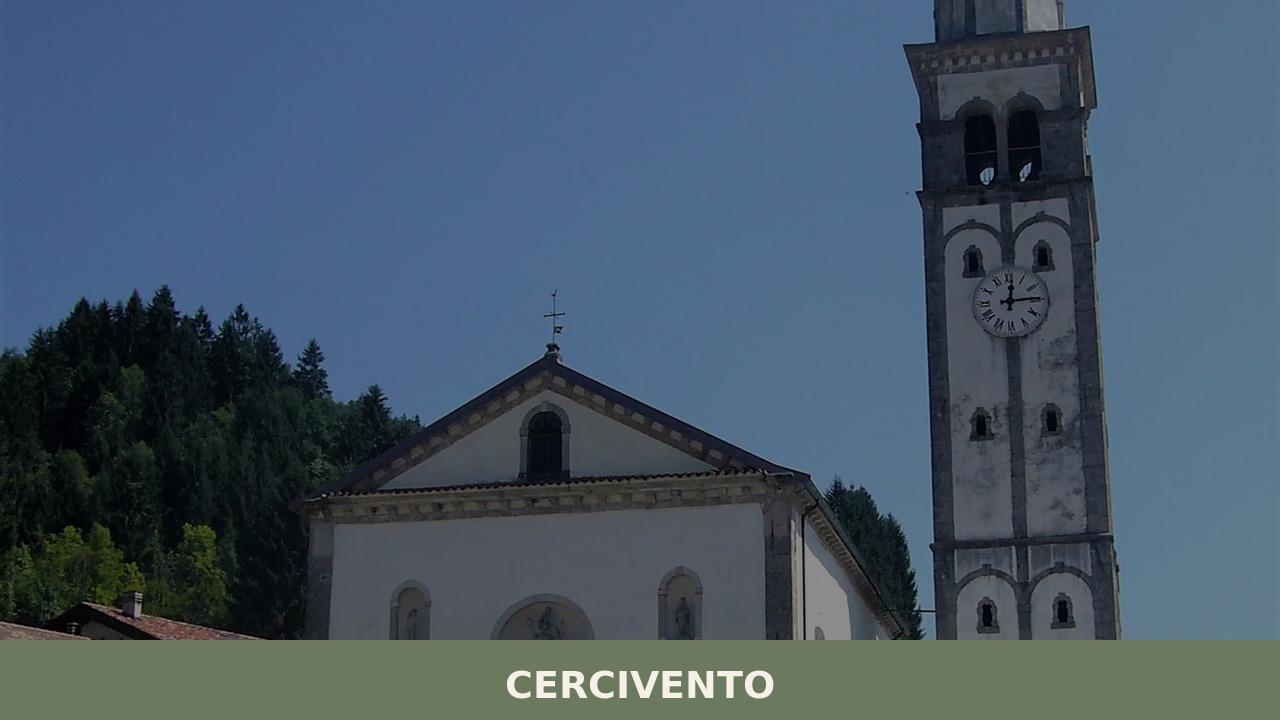
The parish church of San Martino Vescovo stands as the architectural anchor of Cercivento di Sotto. Its bell tower, visible from across the valley floor, rises above a structure that has been rebuilt and modified over the centuries. Inside, the church preserves devotional artworks and a spatial quietness characteristic of Carnic parish churches — solid stone walls, worn wooden pews, and the scent of old incense embedded in plaster.
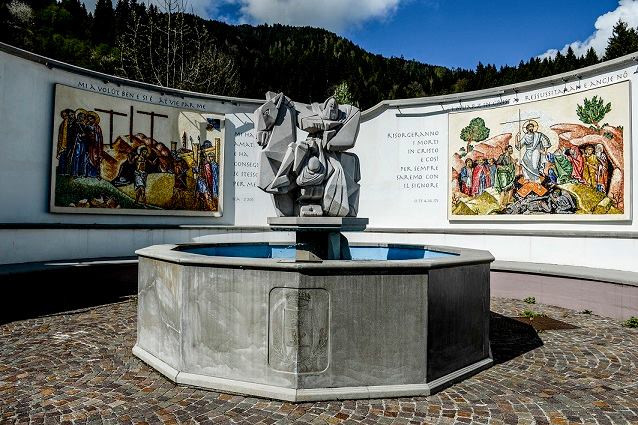
Among the more unexpected works of sacred art in the Carnic Alps, the Passion and Resurrection mosaics offer a vivid narrative cycle rendered in coloured tesserae. Their presence in a small mountain village speaks to a tradition of artistic patronage that extended well beyond the major urban centres of Friuli, reflecting the deep religious life of these Alpine communities.
The upper hamlet rewards those willing to walk uphill. Stone houses with external wooden balconies — designed for drying hay and storing firewood — line narrow lanes. Several buildings feature carved lintels with dates and initials, a Carnic tradition marking the year of construction and the family who built the home. The settlement pattern is compact, an adaptation to steep terrain and harsh winters.
Cercivento sits at a point where the But valley opens enough to permit wide views of the surrounding ridgelines. Walking paths follow old mule tracks along the river and up into the alpine meadows above the village. These trails, used for centuries by shepherds and woodcutters, connect to the broader network of the Carnic Alps hiking routes, including paths that reach the Austrian border.
A memorial commemorating the four Cercivento soldiers executed during the First World War serves as a quiet place of reflection at the edge of the village. It is not a grand monument but a deliberate act of local memory — a small community insisting that these men be remembered not as mutineers but as victims of a military system indifferent to their lives.
The cooking of Cercivento belongs to the broader Carnic culinary tradition, one shaped by altitude, limited arable land, and long winters. Cjarsòns — half-moon shaped pasta parcels filled with a sweet-and-savoury mixture of ricotta, herbs, raisins, and sometimes cocoa or cinnamon — are the signature dish of the Carnic Alps, dressed in melted butter and smoked ricotta. Frico, a crisp disc of aged Montasio cheese cooked with potatoes, is another staple, alongside polenta served with wild game, mushrooms, or the sharp local cheeses produced in the valley’s small dairies.
The province of Udine produces Montasio DOP cheese, and the Carnic valleys are known for their smoked ricotta and for cured meats such as speck and prosciutto aged at altitude. In Cercivento itself, dining options are limited to small trattorie and agriturismi that serve seasonal menus — expect bean soups in autumn, barley stews in winter, and foraged herbs in spring. Portions are generous; pretension is absent.
Summer — from June through September — offers the most accessible conditions. Days are long, the trails are clear of snow, and the alpine meadows above the village are in full colour. July and August bring the warmest temperatures, though evenings at 607 metres remain cool enough for a jacket. This period also coincides with local festivals and the seasonal opening of mountain huts along the higher trails.
Autumn is quieter and arguably more atmospheric: the beech and larch forests on the surrounding slopes turn copper and gold, and the village settles into a rhythm unbroken by visitors. Winter transforms the valley into a silent, snow-bound landscape — beautiful but demanding, with limited services. Spring, when snowmelt swells the But River and wildflowers push through the thawing pastures, rewards patient travellers willing to accept unpredictable weather and occasional road closures at higher elevations.
Cercivento lies in the upper But valley, in the Friuli Venezia Giulia region, within the province of Udine. By car, it is reached via the SS52bis road, which runs north from Tolmezzo — the main commercial town of Carnia, roughly 20 kilometres to the south. From Udine, the drive takes approximately one hour (about 70 km) via the A23 motorway toward Tarvisio, exiting at Carnia-Tolmezzo and continuing north along the valley road.
The nearest railway station is Carnia, located in the Tolmezzo area on the Udine–Tarvisio line. From there, local buses serve the upper valley, though schedules are infrequent outside peak hours. The nearest major airport is Trieste–Friuli Venezia Giulia Airport (Ronchi dei Legionari), approximately 130 km to the southeast. Venice Marco Polo Airport lies roughly 190 km to the southwest. A car is strongly recommended for flexibility in this part of the Alps.
The mountains and valleys of Friuli Venezia Giulia contain dozens of small communities where landscape and human settlement exist in close, often ancient, dialogue. To the south and east of the Carnic Alps, Bordano — known throughout Europe as the “village of butterflies” — occupies a dramatic position above the Tagliamento River gorge. Its painted house facades and a dedicated butterfly house draw naturalists and curious travellers year-round, making it an unexpected counterpoint to the austere stone hamlets of the upper valleys.
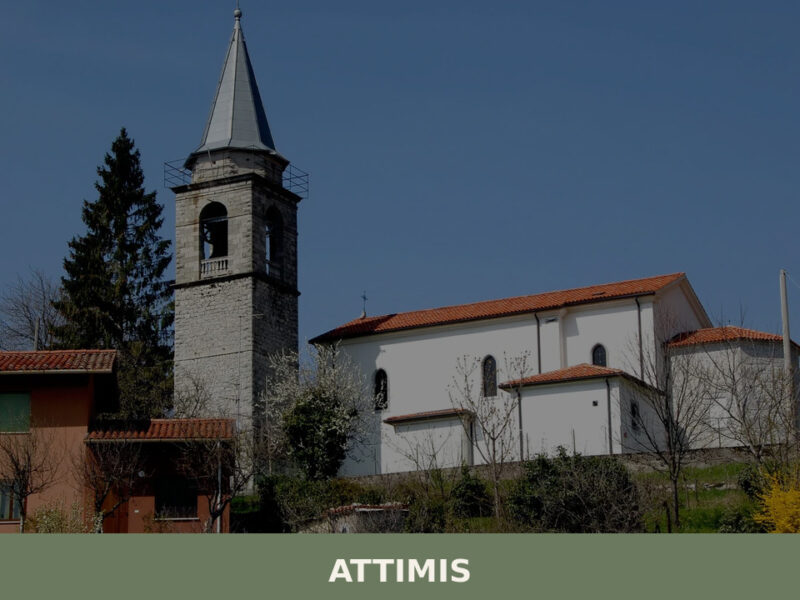
Further into the pre-Alpine foothills, Attimis preserves the ruins of two medieval castles — upper and lower — that once controlled access to the Torre valley. It is a village where the layered history of Friuli is visible in the stonework: Roman foundations, Lombard influences, Patriarchal-era fortifications. Together with Cercivento, these communities form a constellation of small places that reward slow travel and genuine attention.
📝 Incorrect information or updates?
Help us keep the Cercivento page accurate and up to date.