


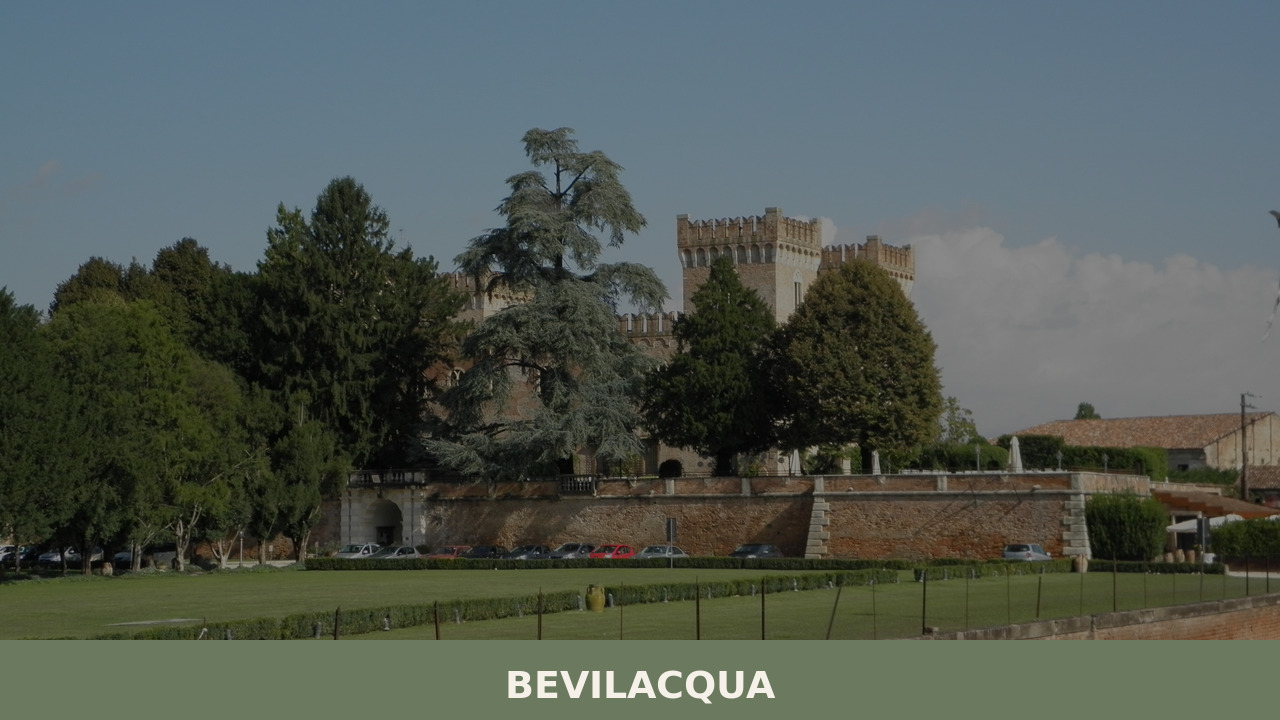
Bevilacqua
A castle rising over the Fratta River, fewer than 1,800 inhabitants, and the quiet agricultural heart of the Veronese plain. Here’s what to see in Bevilacqua.
Discover Bevilacqua
Morning fog lifts off the Fratta River in slow, pale sheets, revealing brick walls the colour of dried clay. A castle tower rises above the treeline — not ruined, not museum-sterile, but occupied, its windows catching early light. The air smells of damp earth and cut grass. Bevilacqua is a village of fewer than 1,800 people in the province of Verona, a place most travellers pass without stopping. That’s a miscalculation. If you’re wondering what to see in Bevilacqua, start by standing on the bridge over the Fratta and looking north. The answer begins there.
History of Bevilacqua
The name itself carries a story. “Bevilacqua” translates literally as “drink the water” — a surname that became a place, tied to the noble family who held dominion here for centuries. The Bevilacqua family, prominent in Veronese politics from the medieval period onward, shaped the village’s identity as thoroughly as the river shaped its geography. Their presence is documented from at least the 13th century, and their influence extended well beyond this small patch of the Veneto plain.
The village’s strategic position in the lowlands south of Verona made it a site of repeated military interest. The original fortification dates to the 14th century, a period when the Scaliger lords of Verona were consolidating power across the region. The castle was built not as a residence but as a defensive stronghold, its moat fed by the waters of the Fratta. Over subsequent centuries, the structure was damaged, rebuilt, and eventually transformed from a military installation into a aristocratic dwelling — a trajectory common across the Veneto but unusually well-preserved here.
By the 19th century, the castle had passed through several hands and undergone a significant neo-Gothic restoration that gave it the romantic, turreted profile visible today. The village around it remained agricultural, its rhythms dictated by rice paddies, grain fields, and the seasonal flooding of the plain. That agricultural character persists. Bevilacqua never industrialised in any meaningful way, which is precisely why its historical fabric survives largely intact.
What to see in Bevilacqua: 5 must-visit attractions
1. Castello di Bevilacqua
The 14th-century castle dominates the village skyline with four corner towers and a crenellated profile that owes as much to 19th-century neo-Gothic restoration as to medieval origins. Today it operates as a hotel and event venue, but visitors can appreciate its moated exterior and brick facades from the surrounding grounds and the bridge over the Fratta River. The sheer scale of it — set against a village of under 1,800 — creates an almost disproportionate visual drama.
2. Chiesa Parrocchiale (Parish Church)
The village parish church stands as the spiritual counterpart to the castle’s secular authority. Its interior contains altarpieces and devotional works characteristic of rural Veneto churches — less spectacular than Verona’s basilicas but more intimate. The bell tower punctuates the flat horizon and serves as a navigational reference point from the surrounding fields.
3. The Fratta River and its banks
The Fratta is not a dramatic watercourse — it moves slowly through flat terrain, bordered by willows and thick grass. Walking its banks south of the village reveals the landscape that sustained Bevilacqua for centuries: irrigated fields, drainage channels, and a stillness rarely found this close to Verona. Herons and egrets are common along the quieter stretches.
4. Villa Nichesola and rural architecture
Scattered through and around Bevilacqua, several historic rural villas and farmsteads reflect the Veneto tradition of villa-estate architecture. These aren’t Palladian show-pieces but working properties where landowners managed agricultural holdings. Their proportions — low, horizontal, built of local brick — tell you more about daily life in the Veronese plain than any museum panel.
5. The surrounding agricultural landscape
The flat terrain extending in every direction from Bevilacqua is itself a point of interest. Rice cultivation, introduced centuries ago in the low-lying areas of the Veneto, once dominated here. Cycling or walking the farm roads between Bevilacqua and neighbouring villages reveals a patchwork of crop fields, irrigation ditches, and scattered farmsteads that has changed remarkably little in outline over the past two centuries.
Local food and typical products
The cuisine of Bevilacqua belongs to the broader tradition of the Veronese plain — hearty, grain-based, shaped by proximity to water and flat agricultural land. Rice features prominently: risotto all’isolana, a local variation cooked with pork and beef, reflects the area’s historic rice cultivation. Polenta remains a staple, served alongside stewed meats, cured salami, and seasonal vegetables. The province of Verona also contributes notable DOP and IGP products, including Vialone Nano rice and Monte Veronese cheese, both found on local tables.
Dining options in a village this size are limited but sincere. A handful of trattorias and agriturismi in the surrounding countryside serve fixed menus that follow the season — asparagus in spring, pumpkin in autumn, game in winter. The Castello di Bevilacqua itself hosts a restaurant. For a wider selection, the nearby towns of Montagnana and Legnago offer more variety, but eating in Bevilacqua means eating without performance — food prepared for locals, priced accordingly, and served without ceremony.
Best time to visit Bevilacqua
The Veneto plain can be brutally hot in July and August, with humidity thickening the air until the horizon shimmers. Spring — late March through May — is the most comfortable season: the fields green up, temperatures hover in the mid-teens to low twenties Celsius, and the light has a clarity that disappears in summer haze. Autumn brings fog, which can either frustrate a visit or transform it; the castle emerging from morning mist is an image that rewards patience and an early start.
Local festivals and sagre (food fairs) tend to cluster in the warmer months, typically between May and October. These small-scale events — often centred on a single ingredient or dish — offer the most unguarded view of village life. Check with the Municipality of Bevilacqua for current schedules. Winter visits are quiet to the point of solitude, but the flat landscape under low grey skies has its own austere appeal, particularly for photographers.
How to get to Bevilacqua
Bevilacqua sits in the southern part of the province of Verona, accessible via the A31 motorway (Valdastico Sud) with exits at Montagnana or Noventa Vicentina, depending on direction of approach. From Verona, the drive is approximately 50 kilometres southeast — roughly 45 minutes by car. From Venice, count on about 100 kilometres and just over an hour via the A4 and then south on secondary roads.
The nearest train station with regular service is Montagnana, roughly 10 kilometres to the northeast, on the Mantova–Monselice line. Connections are infrequent by northern European standards, so checking schedules in advance is essential. The closest major airport is Verona Villafranca (Valerio Catullo), about 60 kilometres northwest. Venice Marco Polo airport is a viable alternative at roughly 110 kilometres. A car is effectively necessary for exploring Bevilacqua and its surroundings with any flexibility.
More villages to discover in Veneto
Bevilacqua belongs to a Veneto that most visitors never encounter — the flat, agricultural south of the region, far removed from the alpine drama of the north. Yet the contrast is itself a reason to explore further. From the rice fields of the Veronese lowlands, the terrain rises steadily northward through the foothills of the Prealps and into the Dolomites, where Cortina d’Ampezzo occupies a world that feels like a different country entirely — granite peaks, pine forests, and air that bites at altitude.
The value of visiting both ends of this spectrum is understanding that Veneto is not a single landscape but a layered territory. The same region that produces the alpine culture of Cortina d’Ampezzo also produces the quiet, river-laced plains where Bevilacqua has stood for seven centuries. Travelling between them — whether in a single trip or across multiple visits — reveals the full range of what this corner of Italy contains.
In Veneto More villages to discover
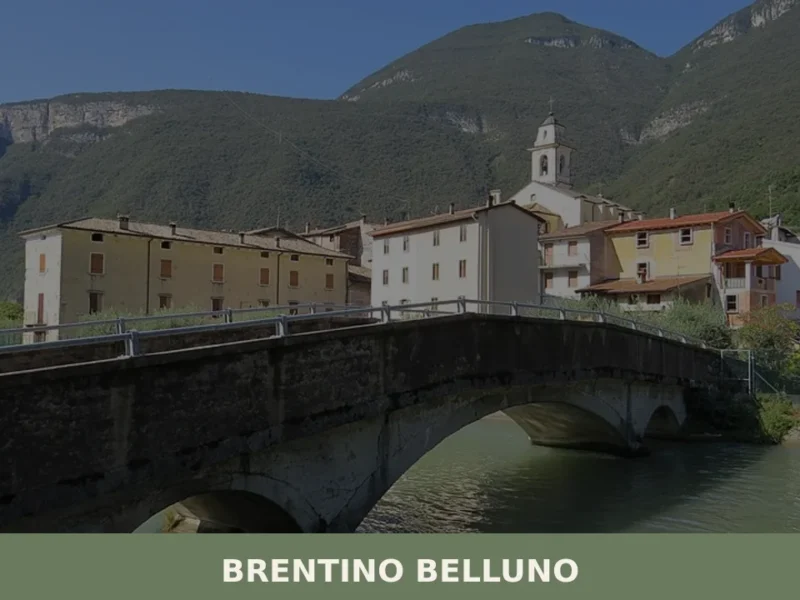
Brentino Belluno
At 137 metres above sea level, where the Adige Valley narrows between Monte Baldo and the Lessini Mountains, Brentino Belluno is a municipality of 1,363 inhabitants created in 1929 through the administrative merger of two distinct settlements: Brentino, on the left bank of the Adige, and Belluno Veronese, clinging to the eastern slope of Monte […]
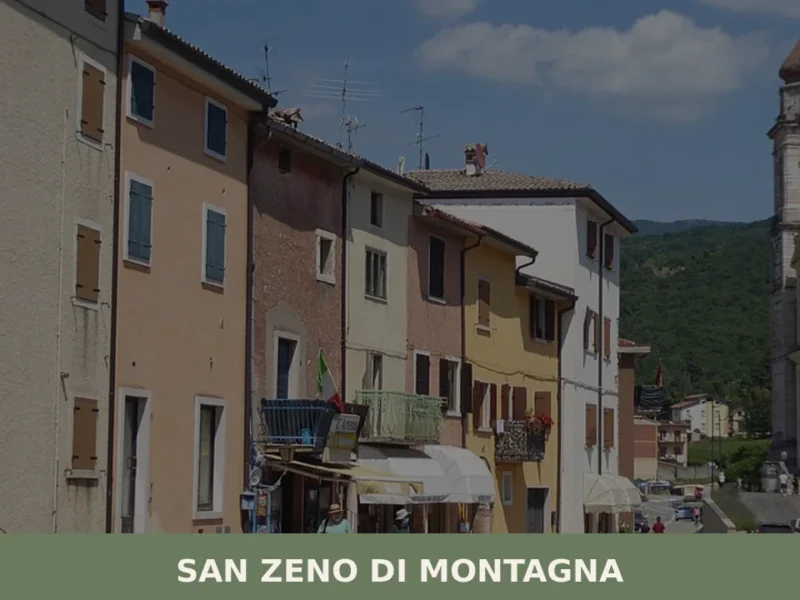
San Zeno di Montagna
At 680 metres above sea level, on the eastern slope of Monte Baldo, San Zeno di Montagna has 1,376 inhabitants spread across a constellation of contrade — Lumini, Castello, Villanova, Ca’ Montagna — each retaining its own architectural and topographic identity. The municipal territory extends from 300 to 2,200 metres in altitude, a range that […]
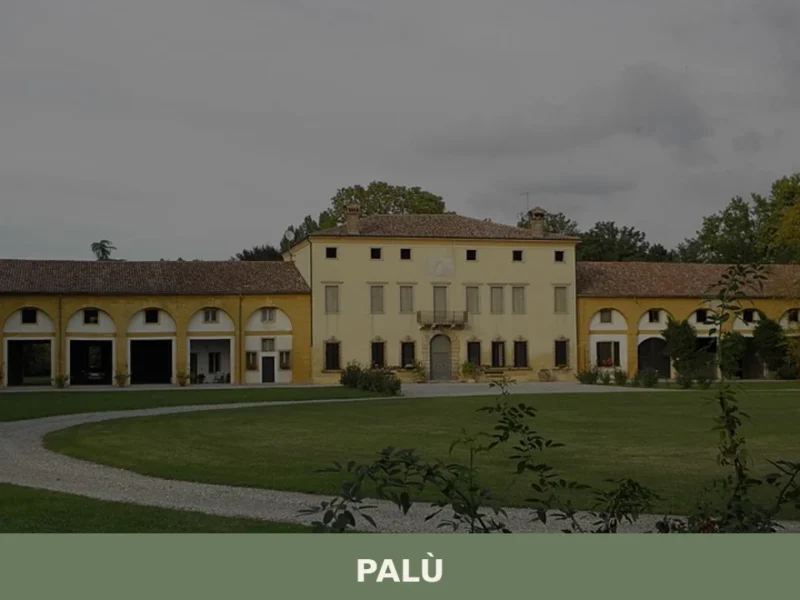
Palù
Palù has 1,266 inhabitants and occupies a stretch of the Veronese plain between the municipalities of Zevio and Ronco all’Adige, roughly fifteen kilometres south-east of the provincial capital. Its territory, covering just 8.5 square kilometres, is crossed by a network of drainage ditches and reclamation canals that still define the geometry of fields planted with […]
📝 Incorrect information or updates?
Help us keep the Bevilacqua page accurate and up to date.