


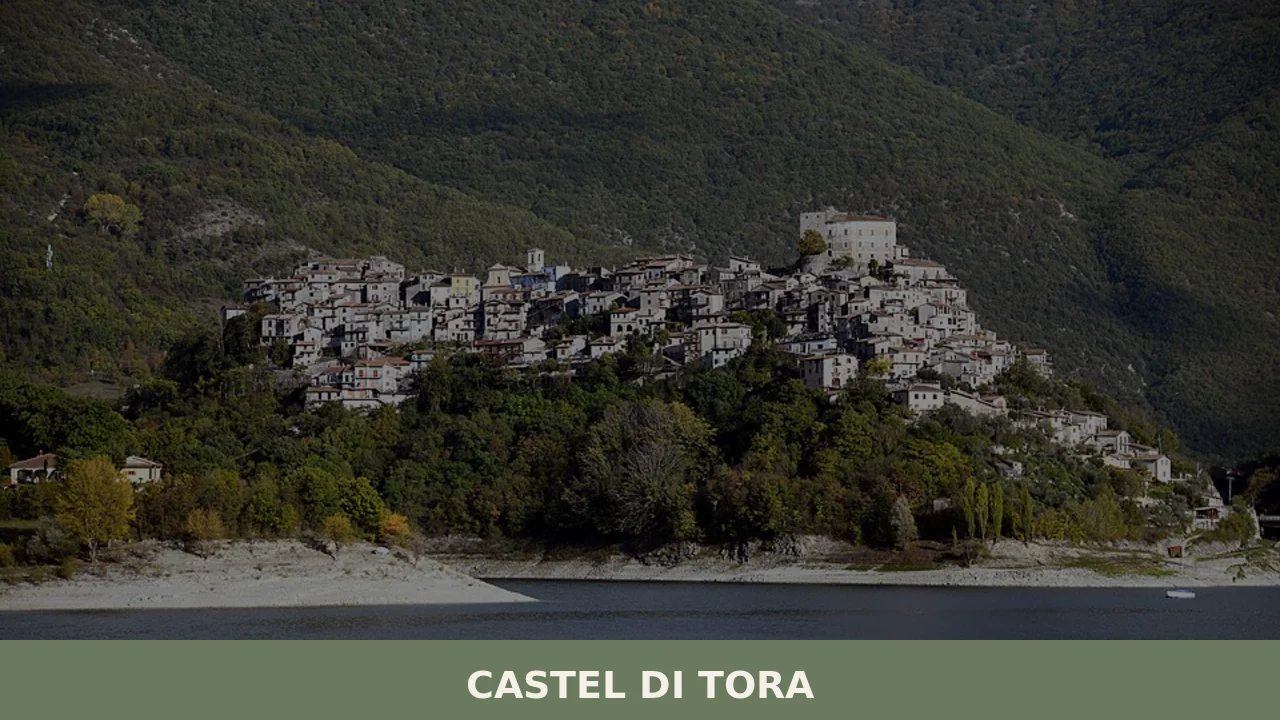
Castel di Tora
What to see in Castel di Tora: medieval village at 607 m above Lago del Salto, 292 residents, 3 PAT-certified products. Plan your visit with our complete guide.
Discover Castel di Tora
At 607 metres above sea level, overlooking Lago del Salto in the heart of the Sabina Reatina, Castel di Tora has a current population of 292 and stands as one of the clearest vantage points over the mountains of Lazio.
Anyone looking to understand what to see in Castel di Tora should start with its geography: the village occupies a rocky spur that rises directly above the artificial lake formed by the dam built on the Salto river in 1940, which fundamentally reshaped the entire valley.
This dual character — mountain village and lakeside settlement at once — defines every aspect of the place: its architecture, its economy, its local products and the rhythm of its seasons.
History and Origins of Castel di Tora
The earliest documented references to the settlement point to a medieval castrum that controlled the territory of the Valle del Salto, one of the communication routes between the Sabina and Abruzzo.
The place name “Tora” most likely derives from the Latin root turris, indicating the defensive function this site has performed since the early Middle Ages.
The natural configuration of the spur, protected on multiple sides, made it well suited for a community that needed to guard against raids from the mountains while also monitoring traffic along the river valley below.
Throughout the medieval period, the village passed under the control of various noble families who competed for dominance over the interior Sabina. The defensive structures — traces of which remain clearly visible in the fabric of the historic centre — point to a period of consolidation between the 12th and 14th centuries, when local castles were integrated into a system of territorial control that fell partly under the jurisdiction of the Diocese of Rieti.
The urban layout of the village, with houses pressed tightly against one another along the perimeter of the spur, follows a precise defensive logic that is still legible today as you walk through the old core.
The most radical transformation in the village’s recent history came in 1940, when the construction of the dam on the Salto river created the artificial lake of the same name.
Several hamlets and settlements in the valley were submerged, and the local community had to adapt to a completely altered landscape.
Castel di Tora, however, retained its original profile on the spur, and the new presence of the lake gradually became a central element of local identity, reshaping both the economy and the daily habits of its inhabitants. The municipality belongs to the Province of Rieti, and its territory, classified as a mountain settlement, has one of the lowest population densities in the entire region.
What to See in Castel di Tora: Main Attractions
The Historic Centre and Medieval Defensive System
The old core of Castel di Tora preserves its medieval layout with remarkable coherence.
Walking the narrow streets that follow the shape of the spur, you encounter stone houses built flush against one another, with arched doorways and windows kept deliberately small in keeping with the construction logic of the era.
The remains of the original defensive structures, including sections of the perimeter wall, are still readable in the way the settlement is arranged.
Anyone who explores this built environment quickly understands that the village was conceived as a single unified organism rather than a collection of separate buildings.
The View over Lago del Salto
Lago del Salto, created in 1940 with the construction of the dam on the river of the same name, can be seen in its full extent from the higher points of the village. It is worth climbing to the natural viewpoints that open along the perimeter of the spur to take in the expanse of water and the outline of the surrounding mountains.
With a surface area of approximately 13 square kilometres, the lake is one of the largest artificial lakes in central Lazio, and the view it offers changes considerably with the seasons — from the high spring waters to the lower levels of summer.
The Parish Church of Sant’Anatolia
The church dedicated to Sant’Anatolia, martyr and patron saint of the village, is the principal religious building in Castel di Tora.
The feast day is celebrated every year on 10 July, and the church serves as both the spiritual and the urban focal point of the community. Its architecture reflects the layered character typical of rural churches in Lazio, with interventions that accumulated from the medieval period through to the modern era.
The interior preserves decorative elements and furnishings of interest to anyone with an eye for the minor sacred art of the Sabina region.
The Mountain Territory and Hiking Trails
The municipal territory of Castel di Tora extends across a mountainous area that offers several hiking routes through woodland and high-altitude Mediterranean scrub.
Those looking for direct contact with the landscape of the Sabina Reatina can follow paths connecting the village to the higher parts of the area, with elevation changes accessible to walkers without specialist experience.
The local wildlife includes species typical of the central Apennines, and the vegetation changes noticeably with altitude, shifting from the sparse scrub of the drier slopes to the coppice woodland at higher elevations.
The Hamlets and Smaller Settlements of the Area
The municipality of Castel di Tora includes several hamlets and smaller nuclei scattered across the surrounding territory, which complete the picture of a dispersed settlement pattern characteristic of the mountains of Lazio. Exploring these smaller places means encountering rural architecture, votive shrines, historic bridges and abandoned agricultural structures that document how the land in the Salto valley has been used over time.
Those who travel between these hamlets by car or on foot find a continuously shifting landscape, with views of the lake and mountains alternating at every bend in the road.
Traditional Food and Local Products of Castel di Tora
The local cuisine of the Castel di Tora area belongs fully to the gastronomic tradition of the Sabina and the Reatino, a territory where sheep and pig farming have historically shaped everyday eating habits.
The isolation of the mountain environment and the scarcity of intensive agricultural resources directed local cooking towards preservation techniques, the full use of farmed animals and the incorporation of wild herbs gathered from high-altitude pastures.
This approach runs through the most representative dishes of the area, which favour simple ingredients and long, slow cooking.
Among the most deeply rooted dishes in the local tradition are legume soups made with spelt, lentils and beans grown on the hillsides of the Sabina, often enriched with rendered guanciale and wild aromatics. Pasta with guanciale, prepared in different forms depending on what ingredients are available each season, is a constant reference in home cooking across the area.
Lamb and kid, grilled or braised with local herbs, round out a culinary repertoire built around the produce of mountain farming.
In colder months, polenta with sausages was the staple food of farming families throughout the area.
In terms of certified products, the territory is associated with three specialities recognised at national level under the PAT designation (Traditional Agri-food Products).
Cacio fiore (PAT) — municipalities: Rieti, Rome, Viterbo, Frosinone, Latina — is a fresh, soft-paste cheese made from whole sheep’s milk, coagulated using an extract of wild artichoke in a technique of great antiquity. Guanciale (PAT) — municipalities: Rieti, Rome, Viterbo, Frosinone, Latina, L’Aquila, Teramo, Pescara, Chieti — is produced from the pig’s cheek, dry-cured with salt, pepper and aromatics, then aged for a minimum of sixty days.
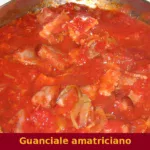
Guanciale amatriciano (PAT) — municipalities: Rieti — is the variant specific to the Reatino territory, tied to the tradition of Amatrice and its surrounding villages, and distinguished by the addition of chilli pepper to the curing mix.
Autumn is the best season for buying local products, when dairy and cured meat production peaks as the animals return from the last grazing of the year.
The small food shops in the village and neighbouring hamlets are generally the most direct source for local products without going through intermediaries. The village festivals and local fairs held during the summer offer opportunities to try traditional preparations in a convivial setting.
Festivals, Events and Traditions of Castel di Tora
The most important celebration for the community is the feast of Sant’Anatolia, the martyr venerated as the patron of the village, held every year on 10 July.
Anatolia is a figure from the ancient Christian martyrology, and her cult is widespread across several municipalities of the Reatino, reflecting a devotion rooted in the medieval evangelisation of the Sabina.
The patron feast is the main gathering event for the local community and for the many former residents who return to the village during the summer: the solemn mass, the procession through the streets of the historic centre and the communal celebrations together make up a day that retains a strongly collective character.
As in many mountain villages in Lazio, the calendar of local traditions is closely tied to the agricultural and pastoral cycle.
The summer months concentrate the main events, drawing on the presence of visitors and those who come to spend time on the shores of Lago del Salto. Village festivals — with stalls selling local products, live music and outdoor food — represent a moment for keeping collective practices alive that might otherwise fade in a community of just 292 people.
The memory of traditions connected to farming and pastoral life is also kept going through the recovery of recipes and craft techniques passed down from one generation to the next.
When to Visit Castel di Tora and How to Get There
The best period for visiting the village runs from May to September.
In spring the vegetation is at its most vigorous and Lago del Salto reaches its highest water levels, producing a particularly striking panorama from the viewpoints in the historic centre. Summer brings the patron feast and a greater sense of activity, as visitors arrive from towns and cities across Lazio and from Rome.
Those who prefer a quieter visit without crowds will find autumn the ideal time: temperatures remain mild through October, the woodland is at its most colourful and the cured meats and cheeses of the season are available in local shops. Winter, with frequent snowfall at 607 metres, brings long silences and visually arresting snowy landscapes, but requires care on the mountain roads, which can be difficult to negotiate.
To reach Castel di Tora by car, the most convenient route from Rome follows the Via Salaria towards Rieti.
From Rieti, continue towards Borgorose and the Valle del Salto, following signs for the lake. The distance from Rome is approximately 100 kilometres, with a journey time of around an hour and a half depending on traffic. From Rieti the village can be reached in about 40 minutes.
There is no railway station in the village: the nearest one is Rieti, served by the Roma Tiburtina line.
For further information on local roads and municipal services, you can consult the Castel di Tora municipal website.
To plan a journey by train, the reference portal is Trenitalia, where you can check connections to Rieti and local bus services into the Valle del Salto.
Other Villages to Explore in Lazio
Those who have enjoyed a visit to Castel di Tora and want to explore more of inland Lazio will find a number of villages across the region that share similar qualities — medieval history, mountain settings and high-quality surrounding landscapes.
Worth including in a wider itinerary are Lubriano, a village in the Tuscia area of Viterbo set on a tufa plateau with remarkable views over the Tiber valley, and Gradoli, which overlooks Lago di Bolsena and preserves a Farnese palace of considerable historical and artistic interest.
Both offer an environmental and architectural context of real quality, with visitor numbers that remain modest compared to the region’s better-known destinations.
Extending the exploration further, Bassano in Teverina offers a well-preserved medieval core in the lower Tuscia, with towers and walls that recall the defensive structures visible at Castel di Tora.
Finally, Proceno, on the border between Lazio and Tuscany, rounds off a circular itinerary through smaller villages that have maintained their historical coherence without giving way to modern development.
Linking these four villages in a three- or four-day route allows you to move through very different landscapes — from the Sabina mountains to the tufa country of the Tuscia — while always remaining at a human scale that allows for an unhurried and thorough visit.
In Lazio More villages to discover
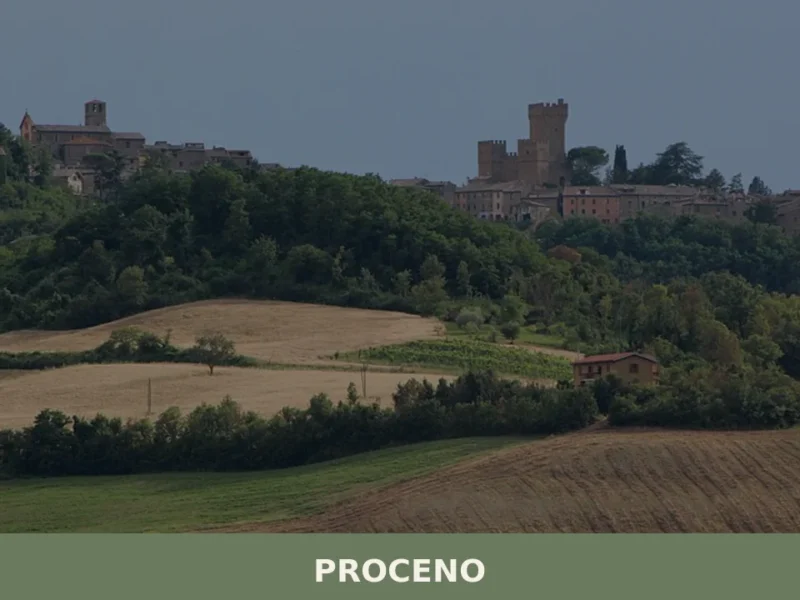
Proceno
A 418 meters above sea level, in northern Lazio, the village of Proceno developed around a Fortress documented as early as the 12th century. This architectural element, central to the settlement’s development, still defines the structure of the historic center today. With a population of 519 inhabitants, Proceno is part of the Viterbo Tuscia region, […]
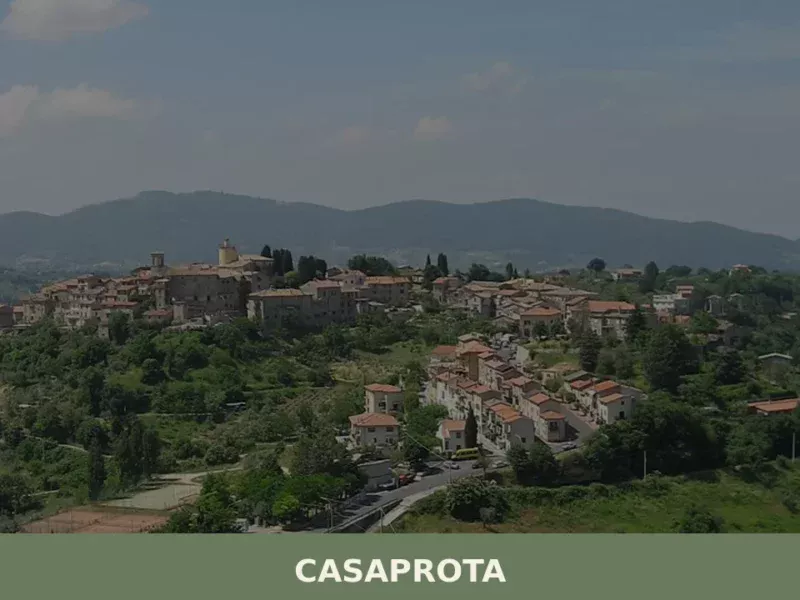
Casaprota
Discover Casaprota, a charming village in Lazio, Italy. Explore its history, culture, and scenic landscapes in the heart of the Italian countryside.
Castelnuovo di Farfa
What to see in Castelnuovo di Farfa: 1,032 inhabitants at 358 m in the Sabina. Explore the medieval castle, San Nicola church and PDO cacio fiore. Plan your visit now.

📝 Incorrect information or updates?
Help us keep the Castel di Tora page accurate and up to date.