


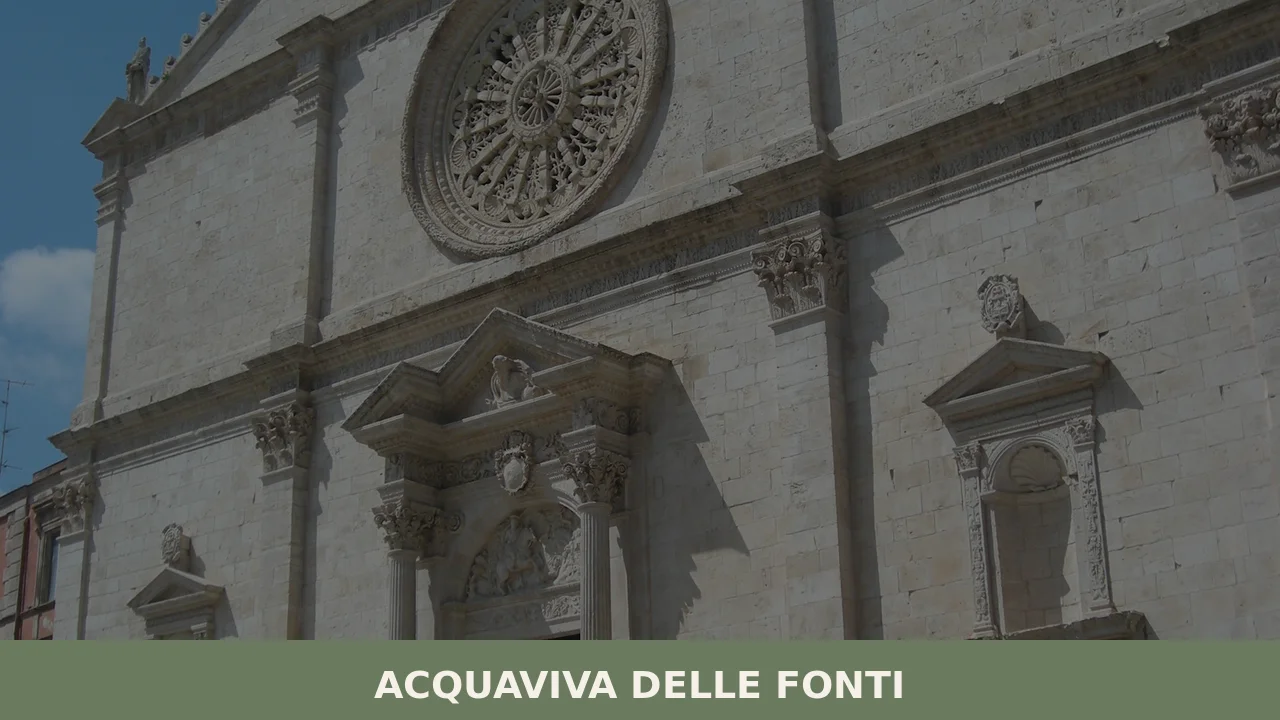
Acquaviva delle Fonti
Beneath the main square of Acquaviva delle Fonti, water still flows. This is not a figure of speech: a network of underground aquifers runs through the limestone subsoil of this town in the Murge hills near Bari, feeding cisterns and wells that for centuries determined both the wealth and the very name of the town. […]
Discover Acquaviva delle Fonti
Beneath the main square of Acquaviva delle Fonti, water still flows. This is not a figure of speech: a network of underground aquifers runs through the limestone subsoil of this town in the Murge hills near Bari, feeding cisterns and wells that for centuries determined both the wealth and the very name of the town. At 300 metres above sea level, with almost twenty thousand inhabitants spread between a compact historic centre and a countryside dense with almond, olive and cherry trees, Acquaviva is a place where geology dictated urban planning and the economy followed water availability. Understanding what to see in Acquaviva delle Fonti means reading a territory built around one precise resource: water, and everything that derived from it.
History and origins of Acquaviva delle Fonti
The place name is transparent and well documented: Acquaviva derives from the Latin Aqua viva, an expression used in the Middle Ages to indicate perennial springs, as distinct from stagnant or rain water.
The addition “delle Fonti” was made official in 1862, after the Unification of Italy, to distinguish this Apulian town from other municipalities with the same name. The springs in question are the aquifers of the Murge subsoil, which surfaced at multiple points across the territory and fed a water supply system already active in Roman times. Remains of Messapian and Peucetian settlements found in the area confirm that the site was frequented well before the medieval foundation, most likely linked to the constant availability of drinking water in a karst area where the resource was far from guaranteed.
The first certain mention of the inhabited centre dates to the Norman period, between the 11th and 12th centuries, when Acquaviva became a fief of the De Acquaviva family, who took their surname from the town and made it the nucleus of their territorial power. In 1196 the centre was elevated to a county. The De Acquaviva family — later Acquaviva d’Aragona — governed the fief for over three centuries, transforming it into one of the most important centres in the Terra di Bari.
In 1508 the fief passed to the De Mari counts, then to the Acquaviva d’Aragona counts of Conversano, who maintained control until the abolition of feudalism in 1806. The Cathedral, consecrated in the 12th century and rebuilt in its current form between the 16th and 18th centuries, remains the key monument of this long feudal phase, together with the Palazzo De Mari that dominates the historic centre.
During the 19th century, Acquaviva experienced significant population growth linked to the expansion of specialised agriculture — particularly the cultivation of the red onion, now the most distinctive agricultural product of the area. During the Risorgimento, the town took part in the uprisings of 1848, with documented episodes of Bourbon resistance. In the 20th century, emigration towards northern Italy and abroad reduced the population, which has nonetheless stabilised at around 19,938 inhabitants today. Notable figures associated with the town include the jurist and patriot Nicola Ferrara and the painter Carlo Rosa (1613–1678), an exponent of southern Caravaggism, whose works are held in churches and collections across Puglia and beyond.
What to see in Acquaviva delle Fonti: 5 key attractions
1. Cathedral of Sant’Eustachio
The Cathedral of Sant’Eustachio, facing Piazza Vittorio Emanuele at the core of the historic centre, is the main monument of Acquaviva. The current building, the result of 16th- and 18th-century reconstructions over a 12th-century Romanesque structure, features a late-Renaissance façade in local limestone and a three-nave interior. The bell tower, over 40 metres tall, is visible from several kilometres across the surrounding plain. Inside, the cathedral holds canvases from the Neapolitan school and an 18th-century organ. The cathedral is the seat of the diocese and is dedicated to Sant’Eustachio the Martyr, co-patron of the town together with the Madonna di Costantinopoli.
2. Palazzo De Mari (Palazzo Marchesale)
A few metres from the cathedral stands Palazzo De Mari, also known as Palazzo Marchesale or Palazzo dei Principi, built in the 16th century by the De Mari family, who had received the fief in 1508. The building is arranged around an internal courtyard with a two-level loggia, characterised by stone columns and round arches. The main façade, facing the square, features a rusticated portal and balconies with wrought-iron railings. The palazzo underwent modifications in the 18th century and today houses municipal offices and exhibition spaces. Its imposing mass still defines the urban layout of the historic centre.
3. Church and Convent of San Domenico
Along Via Roma stands the Church of San Domenico, erected in the 16th century with an adjoining convent of the Dominican friars. The church retains a carved limestone portal and a single-nave interior with Baroque side altars decorated in stucco. Among the works on display are canvases attributed to the workshop of Carlo Rosa. The convent cloister, with its portico on squat columns and central well, is one of the most quiet and architecturally coherent spaces in the town. The complex was restored during the 20th century and is now used for cultural events and temporary exhibitions.
4. Clock Tower
The Clock Tower of Acquaviva delle Fonti rises at the highest point of the historic centre, beside the municipal building. Built in the 19th century on a pre-existing medieval watchtower, it reaches a height of approximately 28 metres and features a ceramic dial visible from much of the town. The structure, in squared limestone blocks, is crowned by a belfry with bells that until the post-war period marked working hours in the fields. From the base of the tower, the narrowest alleys of the historic centre branch out, where houses still have stone portals and internal courtyards with cisterns for collecting rainwater.
5. Hypogea and underground cisterns
The subsoil of Acquaviva is traversed by a system of hypogea and cisterns carved into the limestone rock, used since the medieval period for collecting and distributing groundwater. Some of these underground spaces have been rediscovered and made partially accessible during restoration works in recent decades. The largest cisterns lie beneath the houses of the historic centre, connected to one another by tunnels that formed a rudimentary yet effective aqueduct. Visiting these spaces offers a concrete understanding of what the town’s name means and of the direct relationship between water resources, urban settlement and agricultural survival in the Apulian Murge.
What to eat in Acquaviva delle Fonti: local cuisine and traditional products
The cuisine of Acquaviva delle Fonti reflects the town’s position on the south-eastern edge of the Murge, a transitional zone between the Bari coastal plain and the inland plateau. The dominant crops — durum wheat, olives, almonds, onions, cherries — form the base of available ingredients, while proximity to the Gargano area and the Salento has encouraged long-standing gastronomic exchanges. The local culinary tradition is the peasant cooking of the Terra di Bari, with dishes built around cereals, legumes, wild greens and lamb, prepared using slow-cooking techniques and seasoned almost exclusively with extra virgin olive oil.
The dish that best represents the territory is the red onion of Acquaviva delle Fonti, a local variety with a flattened shape and sweet flavour, eaten raw in salads, baked in the oven or stuffed with stale bread, capers and olives.
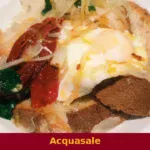
Acquasale (PAT), a cold soup of stale bread soaked with water and dressed with raw tomato, onion, oregano and olive oil, is the quintessential poor dish, consumed by labourers during days of work in the fields and still present on summer tables. Oven-baked lamb with potatoes Lecce-style (PAT), also known as Auniceddhru allu furnu, is the celebratory dish: lamb arranged in a baking tray with potatoes, cherry tomatoes, onions and pecorino, slow-cooked in masonry ovens.
Among the products certified as Traditional Agri-food Products of Puglia linked to the territory and the Murge tradition, worth mentioning are Wild asparagus (PAT), gathered between March and April in uncultivated land and scrubland at the edges of farmed fields, eaten in frittatas or boiled with oil and lemon, and Asparagus preserved in oil (PAT), a traditional conserve prepared after boiling in vinegar and packaging in local extra virgin oil.
Lamb Gravina-style (PAT), stewed with vegetables and cheese, documents the connection with nearby Gravina in Puglia and the pastoral tradition shared across the entire Murge area. Desserts include Africani (PAT), small pastries made with cocoa and toasted almonds, probably of conventual origin.
The red onion of Acquaviva is the star of a dedicated festival held every year between late June and early July, with tastings, food stalls and cooking demonstrations in the square. The Wednesday weekly market, in Piazza Garibaldi, is the best place to buy onions, almonds, oil and preserves directly from local producers. During the patron saint festivities in May and September, temporary food stalls along the main corso offer baked goods and traditional sweets.
The area falls within the production zone of Gioia del Colle DOC, a denomination covering red and rosé wines from Primitivo grapes grown on limestone soils between 200 and 400 metres in altitude.
The Primitivo from this zone, less concentrated than that of the Taranto plain, has more prominent tannins and a structure that makes it well suited to pairing with lamb dishes and onion-based recipes. Amaro del Gargano (PAT), an infusion of wild herbs, is a digestif widespread across northern Puglia and also found on the menus of Acquaviva’s restaurants.
When to visit Acquaviva delle Fonti: the best time of year
Its position at 300 metres in altitude on the Murge ensures summers that are less humid than on the Bari coast, with average July temperatures around 26–28 °C, while winters are cool with lows that can drop below zero between December and February. Spring, particularly between April and May, is the period when the surrounding countryside reaches peak bloom — almond and cherry trees above all — and coincides with the feast of the Madonna di Costantinopoli on 20 May, a central moment in the religious and civic life of the community.
The first Tuesday of March and the first Tuesday of September mark the two celebrations dedicated to the patron Sant’Eustachio, with processions, festive illuminations and brass band concerts in the square.
Summer brings the longest evenings and the red onion festival between June and July, but it is also the busiest period. Those who prefer to explore the historic centre at a leisurely pace and find restaurant availability without waiting should aim for September and October, when the heat eases and the wineries open for the first tastings of the new Primitivo. In winter Acquaviva is quieter, but Christmas brings markets and living nativity scenes in the alleys of the historic centre, with an intimate atmosphere suited to those seeking slow, unhurried tourism.
How to reach Acquaviva delle Fonti
Acquaviva delle Fonti is located approximately 30 km south of Bari, reachable by car from the A14 Bologna–Taranto motorway via the Bari Sud or Gioia del Colle exit, continuing on the SS96 state road or the SP236 provincial road. From Taranto the distance is around 55 km, from Matera 60 km.
Bari-Palese Airport (Karol Wojtyła) is 40 km away and connects to major Italian and European cities; from the airport it is possible to hire a car or take a bus to Bari Centrale station and continue by train.
The Acquaviva delle Fonti railway station, on the Ferrovie del Sud Est line (now Ferrovie Appulo Lucane and FSE), connects the town with Bari and Putignano in journey times of between 30 and 50 minutes depending on the service. The regional bus services SITA and Ferrovie del Sud Est cover routes to neighbouring towns — Cassano delle Murge, Santeramo in Colle, Gioia del Colle — with reduced frequency at weekends. For exploring the countryside and nearby municipalities, a car remains the most practical and flexible option.
Other villages to discover in Puglia
From Acquaviva delle Fonti it is possible to put together an Apulian itinerary linking the interior with the coast. Heading south-east, in just over an hour you reach Brindisi, an Adriatic port whose history is intertwined with the Crusades, the Via Appia and maritime trade with the East. Brindisi offers a completely different register from Acquaviva: monuments linked to seafaring, an urban waterfront, the Swabian Castle and the Roman Column that marked the terminal point of the Via Appia. The combination of the Murge hill town and the port city allows you to cross, in just a few dozen kilometres, two distinct versions of Puglia — the rural interior and the mercantile coast.
In the opposite direction, heading north along the Adriatic strip into the province of Foggia, lies Chieuti, a small settlement of Arbëreshë origin founded by Albanian communities in the 15th century.
Chieuti preserves linguistic and ritual traditions specific to the Albanian minority in Italy, with Easter celebrations following the Byzantine rite and a dialect still partially in use. The journey from Acquaviva to Chieuti — around 200 km, entirely on motorway — allows you to gauge the cultural variety of Puglia, a region where within a few hours’ drive the language, architecture, landscape and food traditions change entirely. For up-to-date information on events and services, it is worth consulting the official website of the Municipality of Acquaviva delle Fonti and the dedicated page on Touring Club Italiano.
In Apulia More villages to discover
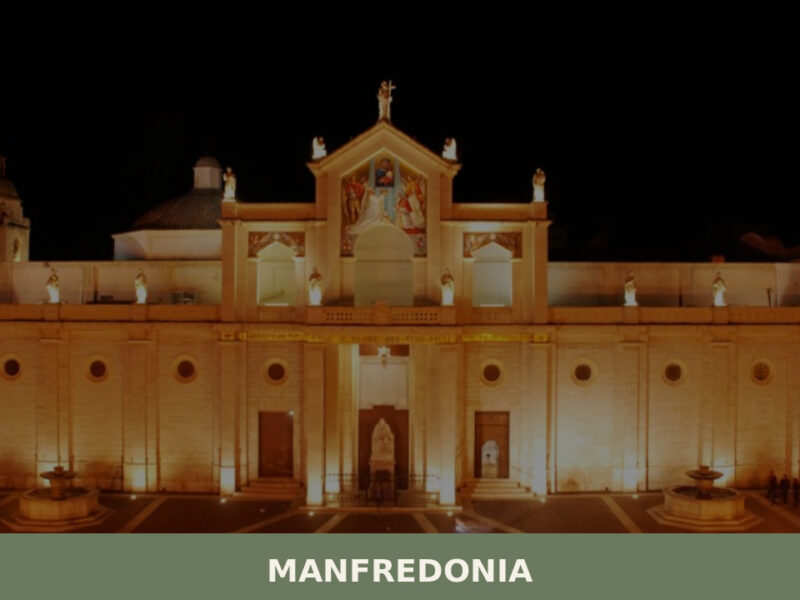
Manfredonia
A port city founded by King Manfred on the Gargano coast, Manfredonia holds a medieval castle, pre-Roman carved stele, and one of Puglia's oldest carnivals.
Motta Montecorvino
A 651-inhabitant hilltop village in Puglia's Daunia hills, Motta Montecorvino rewards slow visitors with medieval lanes, long views over the Tavoliere plain, and robust mountain cooking.
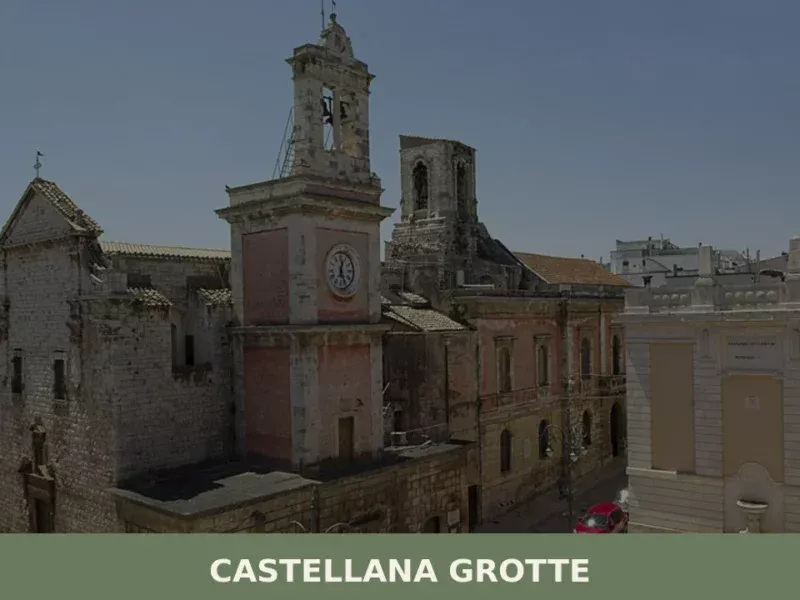
Castellana Grotte
In 1938, speleologist Franco Anelli descended for the first time into a karst chasm a few kilometres from the town centre, revealing to the world an underground system stretching over three kilometres — one of the most extensive in Europe. That discovery permanently transformed the identity of an agricultural municipality on the south-eastern Murgia, placing […]
🧀 Italian traditional products

📝 Incorrect information or updates?
Help us keep the Acquaviva delle Fonti page accurate and up to date.