


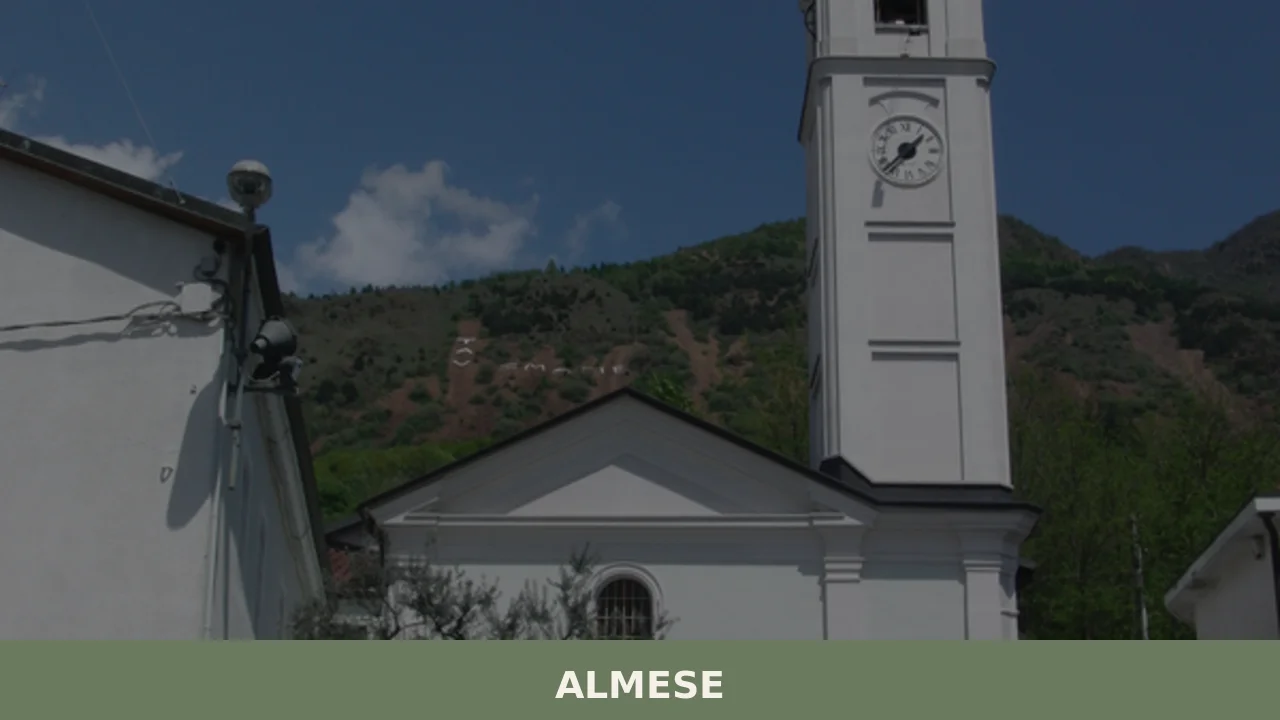
Almese
In 1029, a document from the Abbey of Novalesa recorded the name Almese for the first time, linked to a series of land holdings in the lower Val di Susa. That place name — probably derived from a Celtic or pre-Latin word connected to alpine pastures — appears in a territory that already served as […]
Discover Almese
In 1029, a document from the Abbey of Novalesa recorded the name Almese for the first time, linked to a series of land holdings in the lower Val di Susa. That place name — probably derived from a Celtic or pre-Latin word connected to alpine pastures — appears in a territory that already served as a hinge between the Turin plain and the Alpine valleys. Today, anyone wondering what to see in Almese will find a municipality of 6,377 inhabitants spread at 364 metres of altitude across the morainic hills on the right bank of the Dora Riparia: a place where orchards, remnant vineyards and rural clusters form a landscape whose historic agrarian structure remains clearly legible, just a few kilometres from the metropolitan area of Turin.
History and origins of Almese
The area on which Almese stands was already inhabited in pre-Roman times, as indicated by finds of artefacts attributed to Celto-Ligurian populations settled along the Val di Susa corridor. With the Roman conquest and the construction of the Via delle Gallie, the valley floor became a strategic transit axis towards the Alpine passes of Montgenèvre and Mont Cenis. However, the first stable settlements attributable to the Almese territory are documented only in the early Middle Ages, when Benedictine monks from Novalesa and the Sacra di San Michele exerted a pervasive influence over the surrounding lands. The diploma of 1029, in which Emperor Conrad II confirmed the properties of the Novalesa abbey, represents the oldest reference to the place name “Almesium”. The root of the name remains a matter of debate among linguists: some connect it to the Celtic *alm-, related to the concept of pasture or grassy height; others propose a derivation from the Latin almus, meaning fertile or nourishing. Both hypotheses, on closer inspection, describe a reality consistent with the geography of the place: a productive hillside terrace, south-facing, sheltered from northerly winds by the mountain chain behind it.
During the feudal period, the territory of Almese came under the control of the lords of Avigliana and subsequently the counts of Savoy, who consolidated their dominion over the lower Val di Susa between the 12th and 13th centuries. In 1295, a deed of enfeoffment attests to Almese’s dependence on the marquisate of Susa, with the Bertrandi family among the documented local vassals. The presence of multiple scattered settlement clusters — the hamlet of Rivera, the hamlet of Milanere, the main village itself — reflects a settlement pattern typical of Piedmontese hill areas, where each fraction organised itself around a church, a communal oven and a system of irrigation channels. Medieval land fragmentation left lasting traces in local place names and in the distribution of rural chapels, some of which are still visible along the paths connecting the hamlets. In the 16th and 17th centuries, Almese suffered the consequences of the wars between France and Savoy that repeatedly devastated the Val di Susa: looting, troop movements, requisitioning of harvests. The predominantly farming community reorganised itself each time around the cultivation of cereals, chestnuts and vines.
The 19th century brought decisive transformations. The opening of the Fréjus railway in 1871, with the Turin–Modane line, changed the economic geography of the valley: although the nearest station was at Avigliana, Almese benefited from the increase in traffic and the development of small-scale manufacturing. The 20th century saw progressive residential growth in the municipality, accelerated after the Second World War by its proximity to Turin. Today Almese retains a dual identity: on one hand a residential centre within the metropolitan area, on the other a hillside agricultural community with a network of paths, farmsteads and rural buildings that document its productive history. The official website of the Municipality provides up-to-date information on initiatives to promote the local historical heritage.
What to see in Almese: 5 key attractions
1. Parish Church of the Nativity of the Blessed Virgin Mary
Located in the centre of the main village, the church dedicated to the Nativity of the Blessed Virgin Mary — patron saint of Almese, celebrated on 8 September — is the focal point of community life. The current building, the result of 18th-century alterations to an earlier structure, features a façade in Piedmontese Baroque style with pilaster strips and a curvilinear tympanum. Inside, it preserves a polychrome marble high altar and several devotional paintings attributed to local workshops of the 18th century. The single nave, with a barrel vault, maintains the sober proportions typical of valley parish churches. The square in front offers a starting point for any visit to the village.
2. Villa Colombatto and the Milanere park
The Milanere complex, along the road connecting Almese to Villar Dora, includes the 18th-century Villa Colombatto, an elegant building surrounded by a park with centuries-old trees and a system of tree-lined avenues. The green area, partly open to the public, contains cedars of Lebanon, plane trees and oaks that reach considerable heights, creating a dense, layered canopy. The park is used for cultural events and is one of the municipality’s green lungs. The size of the garden and the botanical quality of the species make it a place of both landscape and naturalistic interest, particularly suited to walks in spring and autumn.
3. Chapel of San Mauro in the Rivera hamlet
In the Rivera hamlet, the chapel dedicated to San Mauro bears witness to the spread of Benedictine worship in the lower Val di Susa. The building, of modest dimensions, retains architectural elements dating to the Romanesque period, including masonry of locally quarried stone blocks and a small bellcote. Its position — on a gentle rise overlooking the valley floor — makes it visible from the surrounding hillside paths. Rivera itself is worth a stop: the old core of the hamlet features stone houses with wooden balconies and lose stone-slab roofs, typical of rural Val di Susa construction, still well preserved in several sections.
4. Vineyard Trail and hillside route towards Monte Musinè
A network of paths departs from the upper hamlets of Almese and heads towards the slopes of Monte Musinè (1,150 m), an isolated peak visible from much of the Turin plain. The route passes through areas once planted with vines — of which dry-stone walls and terracing remain — and stretches of mixed woodland with chestnuts, sessile oaks and hornbeams. CAI waymarking allows hikers to reach the summit of Musinè in about two and a half hours from the valley floor. From the top, on clear days, the view extends from the Turin hills to Monviso. The total elevation gain is around 750–800 metres, with steep sections in the summit area.
5. Votive pillars and roadside shrines
Scattered along the farm tracks and paths between the hamlets, the votive pillars of Almese form a minor but significant itinerary. These are masonry shrines, often plastered and frescoed with images of the Virgin Mary or saints who protect the harvests, dating from the 17th to the 19th century. Some contain ex-votos in metal foil. Their distribution follows the old connecting routes between one hamlet and another, marking crossroads, fords and property boundaries. A municipal survey has catalogued over a dozen of them, making them legible as a devotional map of the Almese agricultural territory.
Traditional cuisine and local products
The food tradition of Almese reflects the municipality’s position between the cereal-growing plain and the piedmont hills. The dish that best represents this borderland location is bagna cauda, a Piedmontese preparation based on garlic, salt-cured anchovies and olive oil, traditionally consumed in the cold months with raw and cooked vegetables: cardoons, preserved peppers, Jerusalem artichokes. The area also produces chestnut soup with milk and rice, a legacy of an economy in which the chestnut tree — widespread on the hillsides — provided an alternative flour to cereals. Polenta, in versions made from otto file maize flour or coarse bramata, accompanies stews and braised meats in the winter months, often cooked in a copper pot using the slow-cooking technique with a wooden ladle. Among first courses, agnolotti del plin — pasta filled with braised meat, pinched closed by hand — are the benchmark of festive Piedmontese cooking in the Almese area as well.
Local products belong to the agri-food system of the Province of Turin. Toma Piemontese DOP, a semi-cooked cow’s milk cheese produced throughout the region, is available in both fresh and aged forms at dairies in the valley. The proximity to the production zone of Vino Valsusa DOC — a denomination covering the municipalities of the lower and middle Val di Susa — makes it possible to find red wines based on Avanà, Becuet and Barbera, grape varieties that are indigenous or historically rooted in the valley, vinified by small wineries with limited production. Among desserts, torcetti — leavened butter-and-sugar biscuits in an elongated ring shape — and paste ‘d meliga (dry biscuits of maize flour and butter) are a constant presence in local pastry shops. Chestnut honey and wildflower honey, produced by beekeepers in the surrounding hills, complete a food landscape closely tied to the territory. The Wikipedia page dedicated to Almese provides further details on local traditions.
On the subject of festivals and food events, the Almese calendar includes appointments linked to the seasonality of local products. The patron saint’s feast on 8 September, dedicated to the Nativity of the Blessed Virgin Mary, traditionally includes food stalls and communal dinners in the squares. In autumn, the chestnut harvest and the grape harvest provide occasions for local produce markets. The Almese area also takes part in the circuit of Val di Susa fairs, where alpine pasture cheeses, cured meats and preserves have dedicated exhibition spaces. Those looking for restaurants and agriturismi can consult the municipal website for up-to-date information on active establishments in the area.
When to visit Almese: the best time of year
Its hillside location at 364 metres of altitude gives Almese a temperate-continental climate with warm summers cooled by the valley breeze and moderately cold winters, with temperatures regularly dropping below zero between December and February. Spring — from April to June — is the most suitable period for hiking: the flowering of the hillside meadows and the renewed growth of the chestnut trees make the trails towards Musinè especially enjoyable, with daytime temperatures between 15 and 25 degrees. Summer can be hot on the valley floor, but the higher elevations offer relief. Autumn, between September and November, combines the patron saint’s feast on 8 September with the foliage of the broadleaf woods and the mushroom and chestnut season: it is probably the period of greatest landscape and gastronomic interest.
Winter, though less frequented by visitors, offers the advantage of proximity to the Val di Susa ski resorts (Bardonecchia, Sauze d’Oulx and Sestriere are reachable in just over an hour by car) and the possibility of walks on snow-covered paths on sunny days. For those planning a visit to coincide with specific events, it is advisable to check the updated calendar on the Municipality’s website, as the dates of festivals and events may vary from year to year. The weekend closest to the patron saint’s feast is in any case the moment of greatest community activity.
How to reach Almese
Almese can be reached by car from Turin by taking the A32 Turin–Bardonecchia motorway and exiting at the Avigliana Ovest toll gate; from there, the provincial road leads to the centre in about five minutes. The distance from the Piedmontese capital is approximately 25 kilometres, which can be covered in 30–35 minutes also along the state road 24 del Monginevro, which crosses the entire lower Val di Susa. From Milan, the motorway route via the A4 and A32 takes about two hours to cover the 170-kilometre distance.
The nearest railway station is Avigliana, served by the SFM3 line of Turin’s metropolitan rail service, with frequent trains to Torino Porta Nuova (journey time approximately 35–40 minutes). From Avigliana, Almese is about 5 kilometres away, reachable by local bus or taxi. Turin-Caselle airport is approximately 40 kilometres away, a 40–50 minute drive via the ring road and motorway. For those arriving from Milan Malpensa airport, the distance is approximately 190 kilometres, equivalent to about two hours of motorway travel. The Touring Club Italiano includes useful information on roads and accommodation in the Val di Susa.
Other villages to discover in Piedmont
Visitors to Almese who wish to deepen their knowledge of Piedmont’s hill country can build an itinerary taking in centres that differ in character and vocation but share a position on gentle slopes and the persistence of a recognisable agricultural fabric. Andezeno, in the eastern Turin hills between Chieri and Castelnuovo Don Bosco, offers a vine-covered landscape where Freisa finds one of its most favourable zones: its roads among rows of vines and farmsteads make an ideal complement to the piedmont dimension of Almese, with a route of about 50 kilometres that crosses the entire metropolitan area of Turin from west to east. The settlement structure of Andezeno — with its compact historic core on the hilltop — stands in clear contrast to the scattered hamlet pattern typical of the lower Val di Susa, making a comparison between the two places instructive for understanding the different forms of Piedmontese hillside settlement.
Moving northward, Albiano d’Ivrea offers another chapter in the region’s hill country history: here the landscape is shaped by the Ivrea morainic amphitheatre, a geological formation that has moulded an undulating territory dotted with lakes and ridges. The distance from Almese is approximately 75 kilometres, which can be covered in just over an hour along the A5 Turin–Aosta motorway. Combining the three villages in a two- or three-day itinerary produces a cross-section of Piedmont’s hill country that traverses the Val di Susa, the Turin hills and the Canavese, linking distinct natural environments, food traditions and architectural forms that nevertheless belong to the same sub-Alpine farming civilisation. It is a route that reveals the complexity of a region too often reduced to the circuits of the Langhe and Monferrato alone, and one that deserves to be travelled slowly, stopping at local markets and village trattorias.
In Piedmont More villages to discover
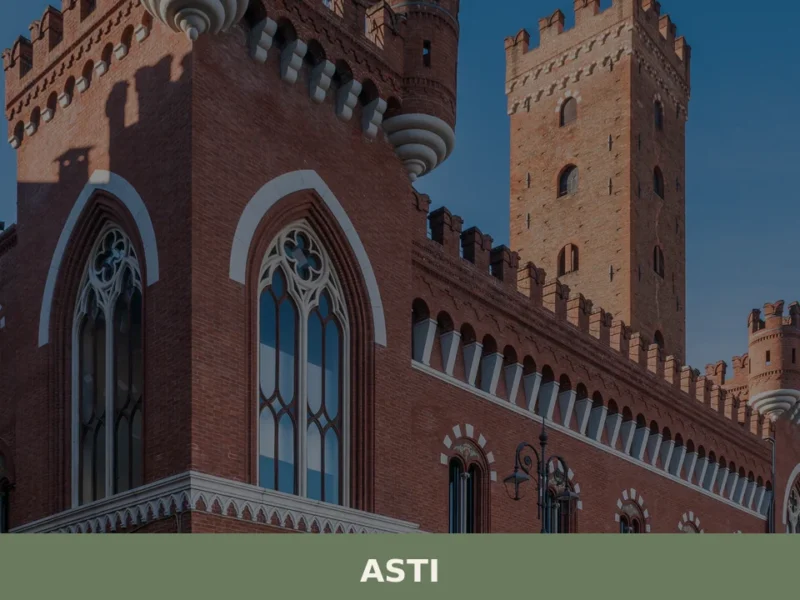
Asti
What to see in Asti: a city of 73,421 residents at 123m. Explore the Gothic Cathedral, Torre Rossa, Palazzo Alfieri and Barbera d'Asti DOCG. Plan your visit now.
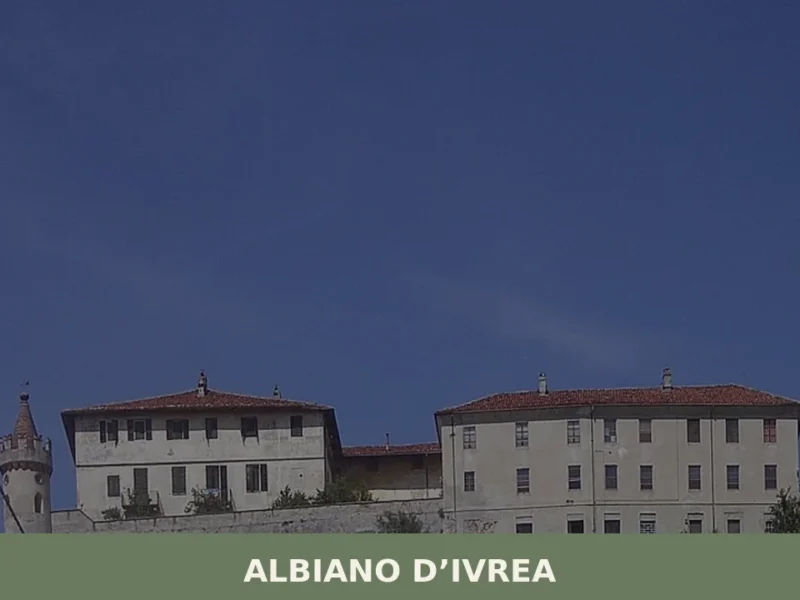
Albiano d’Ivrea
At an elevation of 230 metres, on the left bank of the Dora Baltea, Albiano d’Ivrea has 1,628 inhabitants spread between the main settlement and the hamlets scattered across the Canavese countryside. The municipal territory extends over a hilly strip that slopes down towards the plain, shaped by the moraine deposits of the Ivrea Morainic […]
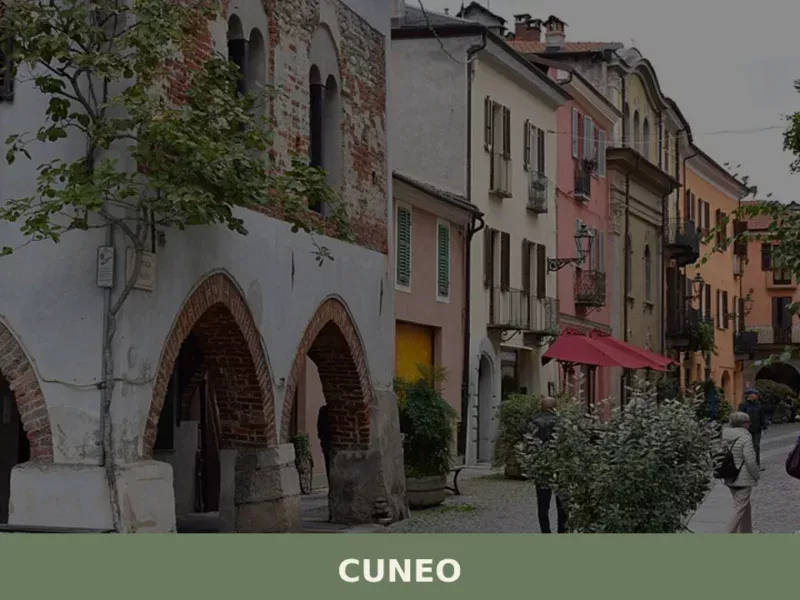
Cuneo
What to see in Cuneo: 55,744 residents at 534m, historic arcades, Piazza Galimberti and the Cuneese al Rum. Plan your visit with this complete city guide.

📝 Incorrect information or updates?
Help us keep the Almese page accurate and up to date.