


Trani
What to see in Trani, a city at 7m altitude: Discover its iconic Cathedral and Swabian Castle. Explore the historic port and Sant’Anna Synagogue Museum.
Discover Trani
Trani, with its population of 54,941 inhabitants and an altitude of 7 m a.s.l., stands out on the Apulian coast as a historical and cultural crossroads, a living testament to the dominations and commercial exchanges that have shaped its identity over the centuries.
The city, belonging to the province of Barletta-Andria-Trani, offers a rich experience for those wishing to explore its artistic heritage and local traditions.
For those wondering what to see in Trani, the town presents architecture that reflects its different eras, from Roman vestiges to imposing medieval structures, up to the Renaissance and Baroque influences that enrich the urban fabric.
Its natural harbor, always the hub of city life, has fostered the development of a deep maritime culture and a vibrant economy, making it a point of reference in the Mediterranean.
History and Origins of Trani
The origins of Trani are rooted in ancient times, with some theories attributing it a pre-Roman ancestry, although the first concrete historical evidence places it as a Roman settlement, under the name of *Turenum* or *Tirenum*.
During the period of the barbarian invasions, the city suffered various devastations, but managed to maintain a certain relevance thanks to its strategic position on the Adriatic Sea.
Trani’s true flourishing began with the arrival of the Lombards, who included it in the Duchy of Benevento, and subsequently with the Byzantines, under whom it experienced an initial period of economic and cultural prosperity, consolidating its role as a commercial port of primary importance.
The 11th century marked the beginning of a golden age for Trani, particularly under Norman rule.
It was during this period, specifically in 1063, that the *Ordinamenta Maris* were promulgated, a maritime code that regulated trade and navigation in the Mediterranean, recognized as one of the oldest and most significant in Europe.
The city became a lively center of exchange, attracting merchants from all parts of the Mediterranean basin, including a flourishing Jewish community that substantially contributed to its wealth and cultural development.
The construction of the Cathedral of San Nicola Pellegrino, begun in 1099, is a tangible symbol of this period of great religious and civil fervor, consolidating the city’s identity as a port for pilgrims and merchants.
Trani’s peak of power was reached under the Swabian dynasty, particularly with Emperor Frederick II, who in the 13th century strengthened its defenses and increased its prestige.
He had the imposing Swabian Castle erected in 1233, a testament to his strategic interest in the city and its port.
After the Swabians, Trani passed under Angevin, Aragonese, and, for a brief period in the 15th century, Venetian control, each leaving its architectural and cultural mark.
The various dominations, despite alternating fortunes, never completely undermined Trani’s role as a maritime and commercial center, keeping alive its vocation as a port city open to exchanges and external influences, in a context similar to that of Gioia del Colle, also home to an important Frederician castle.
What to see in Trani: main attractions
Trani offers a range of attractions that enchant visitors, combining history, architecture, and sea views.
Those visiting the city for the first time will wonder what to see in Trani, and the answer can be found among its streets, its monuments, and its fascinating seafront.
Every corner tells a story, every building testifies to the passage of different eras and cultures, making exploration a rich and engaging experience.
The city boasts a well-preserved cultural heritage, inviting long walks and unexpected discoveries.
Cathedral of San Nicola Pellegrino
The Cathedral of San Nicola Pellegrino, an unequivocal symbol of Trani, stands majestically directly on the sea, representing one of the most valuable examples of Apulian Romanesque architecture.
Its construction began in 1099, on a pre-existing church dedicated to Santa Maria della Scala, and it was consecrated in 1143, although work continued for several centuries.
The facade, made of local pinkish-white limestone, reflects in the waters of the port, creating a spectacle of rare beauty.
The interior of the cathedral is divided into three naves and preserves important artistic testimonies, including the pulpit and the crypts below.
The crypt of San Nicola, that of Santa Maria, and the hypogeum of San Giorgio are accessible to visitors, offering a journey through centuries of history and devotion.
The bell tower, a full 59 meters high, was built between 1230 and the 14th century and is characterized by its square tower structure ending in an octagonal spire.
From its summit, one can enjoy an unparalleled panoramic view of the city, the port, and the entire Adriatic coast.
A particularly interesting element is the finely carved rose window on the facade.
The cathedral visit experience includes exploring its depths, where the crypts preserve frescoes and remains of older structures, offering a unique perspective on the historical stratification of the place.
The light filtering through the windows and the silence of the underground environments contribute to creating an atmosphere of profound spirituality and contemplation.
Swabian Castle
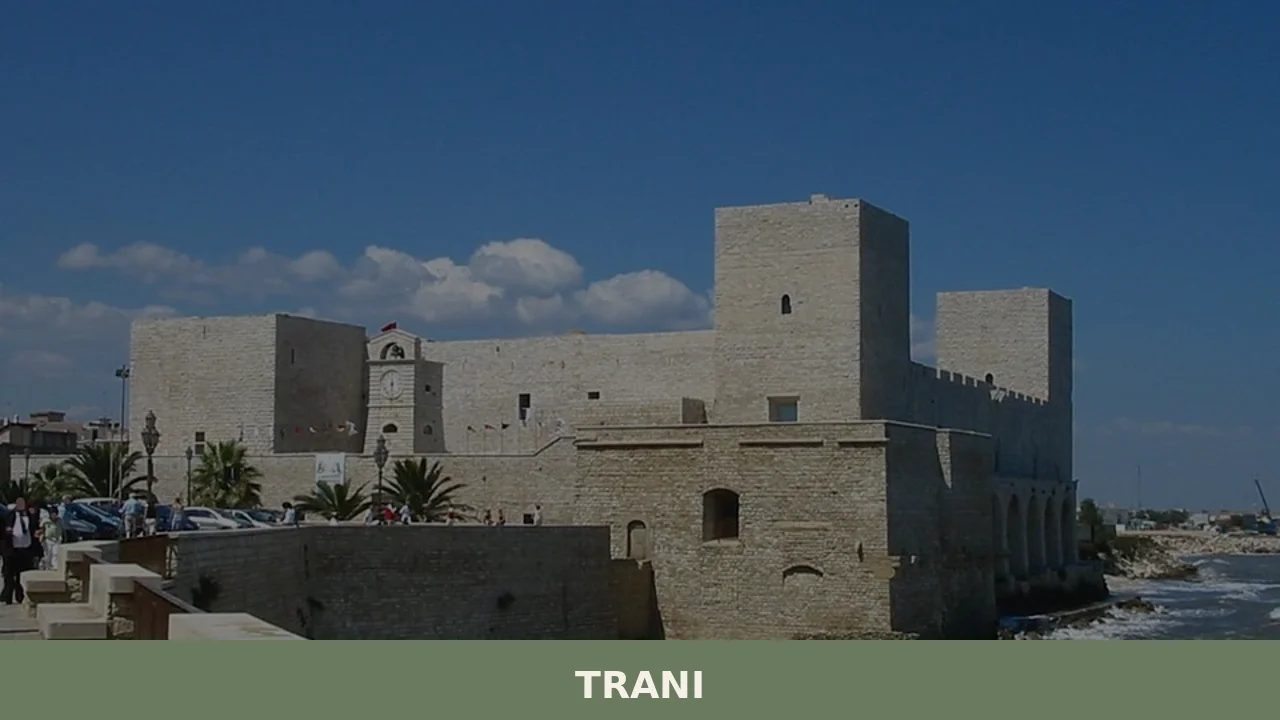
Trani’s Swabian Castle, an imposing fortress commissioned by Emperor Frederick II of Swabia, was built between 1233 and 1249 with the aim of defending the coast and controlling the port.
Its quadrangular architecture, with four massive corner towers and a central courtyard, reflects the canons of Swabian military architecture.
Originally surrounded by a moat, now partly filled in, the castle has undergone modifications and restorations over the centuries, adapting to various functions, including that of a prison.
Its strategic position, a few steps from the cathedral and the sea, makes it a focal point in the city’s landscape.
Currently, the Swabian Castle is open to the public and hosts cultural events, exhibitions, and display routes that illustrate its history and events.
Visitors can walk the ramparts, explore the internal halls, and admire the mighty wall structure, which has withstood centuries of bad weather and sieges.
The view from the castle over the port and the cathedral is particularly striking, offering highly impactful photographic glimpses.
The robustness of its construction and its millennia-old history make it a must-see for anyone wishing to delve into the city’s past and understand what to see in Trani from a historical-military point of view.
Port of Trani
The Port of Trani is not just a maritime infrastructure, but the true beating heart of the city, a place where history, daily life, and scenic beauty merge harmoniously.
For centuries, this natural harbor has represented Trani’s main communication and trade route, facilitating exchanges with the East and the rest of the Mediterranean.
Along its quays, historic buildings, restaurants, and cafes overlook, creating a lively and welcoming atmosphere, especially in the evening hours.
Fishing boats and pleasure crafts animate the waters, while the lighthouse, with its light, guides navigators and adds a romantic touch to the panorama.
Walking along the port’s promenade offers the opportunity to observe the activities of fishermen, savor the sea breeze, and admire the Cathedral reflected in the water.
Numerous boats offer excursions along the coast, allowing visitors to discover hidden coves and enjoy the view of Trani from the sea.
The port is also the ideal starting point for exploring the historic center, with its narrow streets and picturesque corners.
Its historical and economic importance, combined with its undeniable beauty, makes it one of the main attractions for anyone wanting to discover the essence of Trani and understand its indissoluble link with the sea.
Sant’Anna Synagogue Museum
The Sant’Anna Synagogue Museum testifies to the rich and complex history of Trani’s Jewish community
Recently, a meticulous restoration has brought its original function back to light, and today it houses a museum that tells the story and Jewish culture in Trani, also serving as a place of worship for the local Jewish community.
The museum displays archaeological finds, historical documents, and liturgical objects that illustrate the daily life, traditions, and contributions of Jews to Trani society.
The building’s structure itself, with its medieval architectural features, offers a deep immersion into the past.
The presence of this synagogue-museum is fundamental for understanding the multiculturalism that has characterized Trani for centuries and that has contributed to its economic and cultural development.
A visit is an opportunity to reflect on the importance of coexistence between different faiths and cultures, and to discover a lesser-known but equally fascinating aspect of Trani.
Monastery of Santa Maria di Colonna
The Monastery of Santa Maria di Colonna is located on a small rocky peninsula north of Trani, offering an environment of peace and contemplation with breathtaking views of the sea and the city.
This ancient Benedictine complex, founded in the 11th century, represents a remarkable example of Romanesque architecture.
Its isolated position, reachable via an isthmus, once gave it a defensive character, with robust walls protecting it from attacks by sea.
The church, dedicated to Santa Maria, features architectural elements typical of Apulian Romanesque, with a sober facade and an evocative interior.
Over the centuries, the monastery has undergone various transformations and restorations, but has kept its historical charm intact.
Today it is a place of great cultural and scenic interest, a destination for excursions and walks.
Visitors can explore the monastic environments, admire the church, and enjoy the tranquility of the place, away from the city bustle.
The view from the peninsula of Trani’s skyline, with its cathedral and castle, is particularly picturesque at sunset.
The Monastery of Santa Maria di Colonna is an attraction that combines history, architecture, and nature, offering a different perspective on what to see in Trani and its surroundings.
Typical Cuisine and Products of Trani
Trani’s cuisine, like that of all Puglia, is deeply rooted in Mediterranean tradition, characterized by the use of fresh and genuine ingredients from the land and sea.
Historical influences, from Greek and Roman to Arab and Norman dominations, have contributed to creating a varied and flavorful gastronomic repertoire.
Extra virgin olive oil, cereals, seasonal vegetables, and fresh fish are the cornerstones of a diet that prioritizes the simplicity and quality of raw ingredients.
Proximity to the sea guarantees an abundance of seafood, while the hinterland offers legumes, vegetables, and excellent quality meats.
Among Trani’s typical dishes, fish-based preparations stand out, such as the seafood risotto, orecchiette with turnip greens, a classic of Apulian cuisine, and octopus in pignata, slow-cooked in an earthenware pot with tomato and spices.
Meat-based dishes are also plentiful, such as baked lamb with potatoes, and stuffed or gratinéed vegetables.
Fresh pasta, often homemade, accompanies many dishes, enhancing simple yet flavorful sauces.
Traditional desserts, often linked to religious festivities, include cartellate and sweet taralli, prepared with simple ingredients like flour, sugar, and oil.
Trani also boasts several certified products that enrich its gastronomic offerings.
These include Acquasale (PAT) — municipalities: Trani, Barletta, Bisceglie, a simple but nutritious preparation based on soaked bread, tomato, oil, and oregano, perfect for summer.
For festive occasions or a hearty breakfast, you’ll find Africani (PAT) — municipalities: Trani, Andria, Corato, sweets made from eggs and sugar, with a light, foamy texture.
Nature also offers Wild Asparagus (PAT) — municipalities: Trani, Molfetta, Ruvo di Puglia, harvested in spring and used in omelets, risottos, or as a side dish, and Asparagus in Oil (PAT) — municipalities: Trani, Canosa di Puglia, Minervino Murge, a way to preserve the flavor of this precious vegetable throughout the year.
Festivals, Events, and Traditions of Trani
Life in Trani is marked by a rich calendar of festivals and events deeply rooted in history and popular devotion.
The most cherished and widely attended festival is dedicated to Saint Nicholas the Pilgrim, the city’s patron saint, solemnly celebrated on June 2nd.
This observance commemorates the arrival of the saint’s relics in Trani in 1094 and his subsequent canonization.
The celebrations include a striking sea procession, during which the saint’s statue is carried on a boat, followed by a fleet of decorated vessels, re-enacting his journey.
The procession culminates with the return to land and a parade through the streets of the historic center, accompanied by musical bands, illuminations, and fireworks that light up the night sky over the harbor.
Beyond the patron saint’s festival, Trani hosts various cultural and gastronomic events throughout the year that attract visitors from all over.
During the summer, the city comes alive with open-air concerts, theatrical performances, and film festivals, often set against the evocative backdrops of the Cathedral or the Swabian Castle.
Local food festivals (sagre), dedicated to typical local products, offer the opportunity to savor the culinary specialties of Trani’s and Puglia’s tradition, celebrating the region’s rich food and wine culture.
These occasions represent an authentic way to experience the city, connect with its traditions, and appreciate the hospitality of its inhabitants, within a context that values its historical and cultural heritage.
When to visit Trani and how to get there
The best time to visit Trani extends from late spring to early autumn, roughly from May to September.
During these months, the Mediterranean climate offers sunny days and pleasant temperatures, ideal for exploring the historic center, strolling along the port, and enjoying the beaches.
Summer, in particular, is rich in cultural events and lively evenings, but it can also be the busiest tourist period.
Those who prefer a quieter visit can opt for the months of May, June, or September, when the climate is mild and the crowds less intense, allowing for a more serene appreciation of the city’s beauties.
The presence of attractions like the sea makes Trani a suitable destination for those seeking a holiday that combines culture and seaside relaxation.
To reach Trani, there are several well-connected transport options. Those arriving by car can take the A14 motorway (Bologna-Taranto) and exit at Trani, which is a few kilometers from the city center.
The city is also served by the national railway network, with Trani station located along the Adriatic line, connecting important centers like Bari and Foggia.
For those who prefer to fly, the nearest airport is Bari Karol Wojtyła, about 35-40 km away, well connected by local buses and trains.
An alternative, though more distant, is Foggia Gino Lisa airport, about 80-90 km away.
For detailed information on timetables and connections, it is advisable to consult the official website of the Municipality of Trani or transport company portals.
Those visiting Trani can extend their itinerary towards Poggio Imperiale, which offers an interesting perspective on the Apulian hinterland.
| Starting point | Distance | Estimated time |
|---|---|---|
| Bari | 45 km | 40-50 min |
| Foggia | 85 km | 1 h 10 min |
| Matera | 100 km | 1 h 20 min |
Where to stay in Trani
Trani offers a variety of accommodation solutions suitable for every need, from luxurious hotels with sea views to comfortable B&Bs in the historic center, as well as apartments and holiday homes for those seeking greater autonomy.
Numerous establishments are located a short walk from the main attractions, such as the Cathedral and the port, allowing guests to fully experience the city’s atmosphere.
Many hotels and B&Bs are housed in historic buildings, offering an authentic and charming experience, with modern amenities and warm hospitality.
For those desiring a more immersive stay, agriturismo options are also available in the immediate vicinity, allowing guests to enjoy the tranquility of the Apulian countryside without straying too far from urban conveniences.
The choice of accommodation depends on personal preferences and the type of experience desired.
Those seeking luxury and high-end services will find hotels with pools and spas, while those preferring a more intimate and familiar atmosphere can opt for the numerous bed & breakfasts, often managed by locals who offer useful tips about the city. It is advisable to book in advance, especially during the peak summer season and for important events, to ensure availability and the best rates. Trani’s accommodation facilities are well integrated into the urban fabric and offer an excellent base for exploring not only the city but also the surrounding villages and the beauties of the province of Barletta-Andria-Trani.
Photo Gallery of Trani
Do you have photos of Trani?
Share your photos of the village: the best ones will be added to the official gallery, with your credit.
Send your photosGetting there
Via Tenente Luigi Morrico, 76125 Trani (BT)





📝 Incorrect information or updates?
Help us keep the Trani page accurate and up to date.