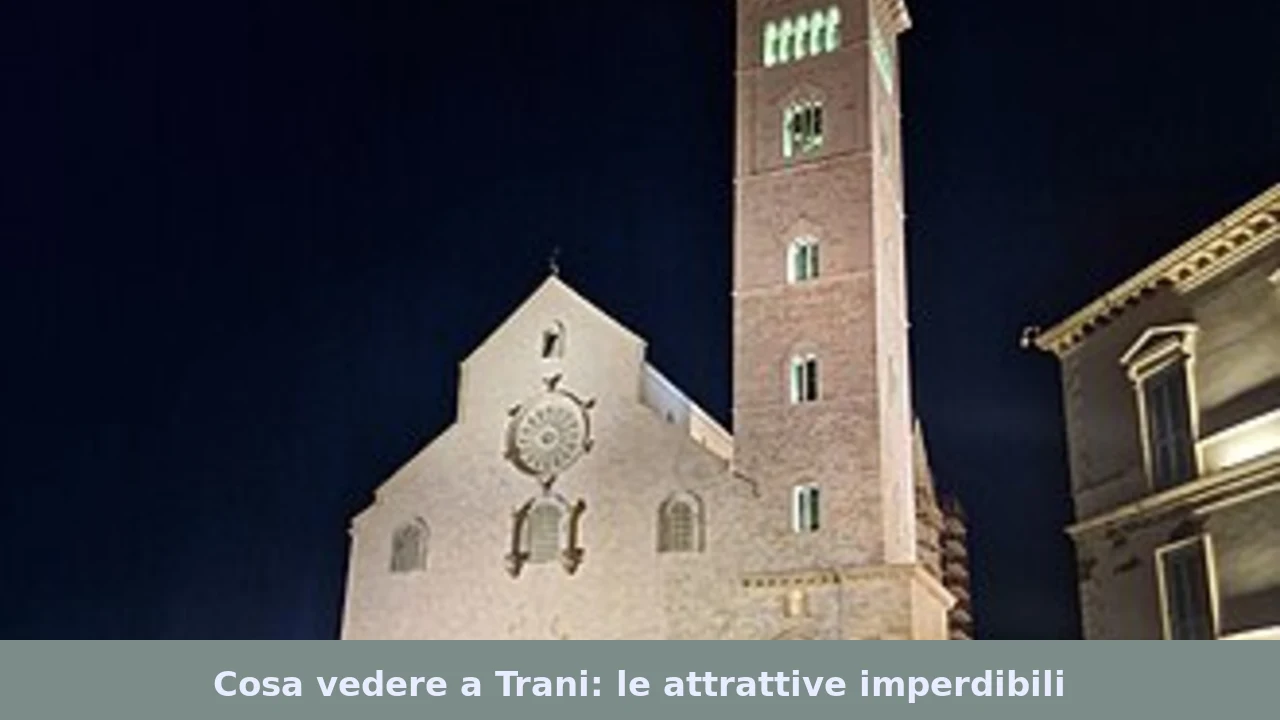
Inaugurated in its first constructive phase in 1099, the Cathedral of San Nicola Pellegrino represents one of the main answers to the question of what to see in Trani, distinguishing itself for its imposing Romanesque structure and its unique position close to the Adriatic Sea. This sacred building, dedicated to a young Greek pilgrim, is a symbol of the Apulian city and a significant example of Romanesque architecture in Southern Italy.
Its history is deeply intertwined with the events of the territory, offering visitors a cultural and spiritual experience of great relevance.
The Genesis and Documented History of the Cathedral of San Nicola Pellegrino
The history of Trani Cathedral is rooted in a specific event of 1094, when Nicola, a young Greek pilgrim on his way to Rome, died in the city after being mistaken for a madman due to his religious fervor. The local population, witnessing alleged post-mortem miracles, immediately venerated him as a saint, and Pope Urban II sanctioned his canonization. The decision to build a new cathedral in his honor was taken shortly after, with work beginning in 1099, on an already sacred and layered site.
The chosen site for the new cathedral was not accidental: it stood on a pre-existing church dedicated to Santa Maria della Scala, which in turn was built on the remains of a 6th-century early Christian hypogeum, known as the church of San Giorgio. This stratification of places of worship gives the building remarkable historical depth, allowing exploration of centuries of devotion and architecture. The construction of the Romanesque cathedral continued for several decades, reflecting the techniques and prevalent style in Puglia during that period, characterized by a fusion of local and oriental influences.
The completion of the main structure occurred gradually, with the consecration of the crypt in 1143 and the upper basilica around 1180.
The facade, with its large rose window and sculpted portals, began to take shape in these years, incorporating decorative elements typical of Apulian Romanesque. A distinctive element, the famous bronze doors, were created in 1175 by Barisano da Trani, a master founder also active in Ravello and Monreale. These doors, decorated with biblical scenes and figures of saints, represent a masterpiece of medieval art and a focal point of access to the basilica.
The construction of the majestic bell tower, separated from the main body of the church, began later, around 1230, and was completed in 1239. This bell tower, rising approximately 59 meters, is a later addition but perfectly integrated into the general style, significantly contributing to the cathedral’s silhouette. To further explore the historical and artistic events of this monument, one can consult the entry dedicated to the Cattedrale di Trani on Wikipedia, which offers a detailed account of its origins and development through the centuries.
Iconic Architecture by the Sea: Distinctive Features
The Cathedral of San Nicola Pellegrino stands out for its Apulian Romanesque architecture, characterized by the use of Trani stone, a local pinkish-white limestone that gives the building a particular luminosity, especially under sunlight. Its position, almost at water level on Trani’s harbor, makes it a visible landmark from afar and a landscape element of great impact. The main façade, facing west, features a large central rose window and three portals, the largest of which is framed by the famous bronze doors.
The bell tower, erected on an arch that served as a passage for pilgrims and merchants, is a standalone structure separate from the basilica, an architectural detail rather unusual for the era.
It develops over four levels, lightened by biforas (two-light windows) and triforas (three-light windows), and culminates with a conical dome. Its construction is attributed to Nicolaus Sacerdos and his son Arcangelo, as attested by inscriptions found on site. Its height and slender shape make it the tallest bell tower in Puglia, a true lighthouse for seafarers and a symbol of the city.
Inside, the cathedral features a basilical plan with three naves, divided by columns and pillars supporting round arches. The central nave is taller and wider than the side ones, and natural light filters through the high-set windows. Although the original ceiling was replaced in a later period, the overall structure maintains the sobriety and majesty typical of Romanesque architecture.
The matronei, galleries above the side naves, offer a different perspective on the church’s interior and attest to the complexity of its design.
The semicircular apse closes the central nave, housing the high altar and the main liturgical elements. The internal decorations, while not excessively lavish, include sculptural elements and fragments of frescoes that tell the history and devotion of the place. The light penetrating through the windows, filtered by the light stone, creates an atmosphere of contemplation, inviting appreciation of the architectural lines that define this sacred space.
A Vertical Journey: From the Basilica to the Crypt and the Hypogeum
Visiting the Cathedral of San Nicola Pellegrino means embarking on a true journey through history and architecture, exploring not only the upper basilica but also the underground levels that reveal its most ancient origins. From the main nave, one accesses the Crypt of San Nicola Pellegrino, an evocative space that preserves the relics of the patron saint. This crypt, consecrated in 1143, is a masterpiece of Apulian Romanesque architecture, with elegant columns and sculpted capitals supporting groin vaults.
The atmosphere here is one of deep contemplation, accentuated by the dim light and the solemnity of the spaces.
Inside the crypt, one can observe the urn containing the remains of Saint Nicholas, an object of veneration for the faithful. The walls and columns still show traces of medieval frescoes which, although deteriorated by time, offer glimpses of the original decorative richness. The crypt’s structure is remarkably articulated, with a succession of naves and chambers creating an almost labyrinthine path, inviting careful exploration of every architectural and historical detail. The feeling of being in a place that has witnessed centuries of prayer is palpable.
Even deeper, one finds the Hypogeum of San Giorgio (St. George), the 6th-century early Christian church that represents the oldest core of the entire complex. This space is accessible from the crypt and reveals the foundations upon which successive churches were built. Here, one can admire remnants of original floor mosaics and masonry structures that bear witness to the presence of a much older place of worship.
The hypogeum offers tangible evidence of the first Christian communities in Trani, a direct link to the city’s spiritual roots.
A visit to these underground levels is fundamental to fully understand the complexity and historical depth of the cathedral. Each layer tells a part of Trani’s history, from its early Christian origins to the medieval devotion to San Nicola Pellegrino. This journey from sacred to sacred, through architectures from different eras, is an experience that goes beyond simple aesthetic admiration, engaging the visitor in a dialogue with the past and faith.
Why the Cathedral of San Nicola Pellegrino is a Landmark
The Cathedral of San Nicola Pellegrino represents a cultural and spiritual landmark for several reasons, which go beyond its undoubted architectural beauty. Its position on the coast, with its façade reflected in the Adriatic, creates an iconic image that has become the very symbol of Trani. This location is not only evocative but also testifies to the city’s strategic and maritime importance in the Middle Ages, when the cathedral served as a spiritual and visual beacon for sailors and pilgrims arriving by sea.
From a historical-architectural point of view, the cathedral is an excellent example of Apulian Romanesque, a style that blends Lombard, Byzantine, and Saracen elements, reflecting the cultural richness of Southern Italy.
The use of Trani stone, the mastery of its sculptures, and the complexity of its stratification into three superimposed churches (the Hypogeum of San Giorgio, Santa Maria della Scala, and the current Cathedral) make it a unique case study. Every detail, from Barisano’s bronze doors to the isolated bell tower, tells a story of craftsmanship and faith that has spanned centuries.
Furthermore, the figure of San Nicola Pellegrino and the devotion he generated are central elements in its importance. The story of the young pilgrim, his canonization, and the construction of such a magnificent temple in his honor highlight the deep bond between the Tranese community and its spirituality. The cathedral is not just a building, but a place of memory and worship that continues to inspire and welcome faithful and visitors from all over the world, offering an experience that combines sacred art with the contemplation of the seascape.
A visit to this monumental complex is an opportunity to understand the history of Puglia, its art, and its traditions.
Those seeking an immersion in medieval culture and architecture will find in the Cathedral of San Nicola Pellegrino a place that fully satisfies these expectations, offering concrete details and verifiable historical narration. It is a place where human ingenuity and devotion have merged to create a work that withstands time and continues to speak to visitors.
Practical Information for Visiting the Cathedral
If you wish to visit the Cathedral of San Nicola Pellegrino in Trani, it’s useful to know some practical information to best organize your experience. Opening hours may vary depending on the time of year and liturgical celebrations, so it’s advisable to consult the official website of the Diocese of Trani-Barletta-Bisceglie for the latest updates.
Generally, the cathedral is open both in the morning and in the afternoon, with a break at lunchtime, but specific events or restorations might alter access to certain areas, such as the crypt or the hypogeum.
Upon arrival, you might notice that the main entrance of the basilica is often used for services, while access for tourist visitors may be signposted differently, sometimes through a side portal or an entrance dedicated to the underground paths. We recommend dedicating at least an hour and a half to your visit to calmly explore all levels: the upper basilica, the crypt of San Nicola, and the hypogeum of San Giorgio. For a more in-depth experience, you might consider joining a guided tour, which can enrich your historical and artistic understanding of the place.
Regarding accessibility, the upper basilica is generally accessible, but access to the crypt and hypogeum involves stairs and sometimes irregular paths, which might present difficulties for people with reduced mobility. Bring comfortable shoes with you, especially if you intend to explore the lower levels. The cathedral is located in the heart of Trani’s historic center, a short walk from the port. If you arrive by car, it is advisable to park in designated areas outside the historic center and reach the cathedral on foot, enjoying a stroll along the waterfront.
Remember to maintain respectful behavior inside the place of worship, especially during celebrations.
Don’t forget your camera: the light inside and the view from outside, with the sea in the background, offer opportunities for memorable shots. For further details and to check updated opening hours, we suggest you consult the official website of the Diocese of Trani-Barletta-Bisceglie, which provides institutional information on openings and activities.
The Cathedral of San Nicola Pellegrino in Trani is a place where history, art, and spirituality meet in a unique setting. For those who wish to discover more about Trani and its many facets, from monuments to local traditions, we invite you to explore the complete village profile on Villages Italy. There you will find a broader overview of the city’s attractions and the details that make it a destination of interest in the Apulian tourist landscape.