

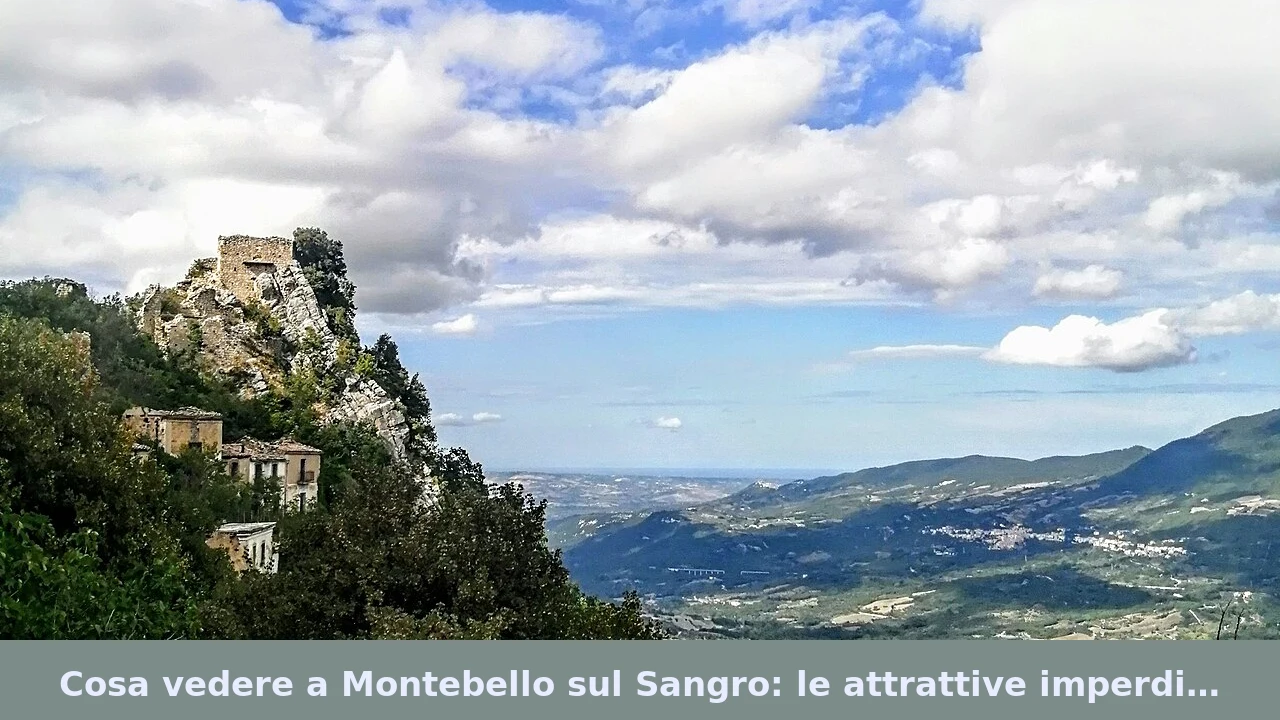
Montebello sul Sangro, a small Abruzzese municipality in the province of Chieti, has just over a hundred inhabitants and stands out for its elevated position. Those asking what to see in montebello sul sangro will find a concrete answer in its views over the valley below. The village, in fact, offers a series of vistas that allow one to take in a vast stretch of the Sangro River and its basin.
These observation points are not just a feast for the eyes, but also a key to understanding the history and geography of this corner of Abruzzo.
Origins of Montebello and the View of the Sangro Valley
The history of Montebello sul Sangro is intrinsically linked to its topography, a factor that has always made its panoramas over the Sangro Valley of primary importance. The village, originally known simply as Montebello, developed in a dominant position, chosen not by chance but for strategic reasons. This location allowed for extensive visual control over the surrounding territory, crucial in past eras for the defense and surveillance of the communication routes that crossed the valley.
Historical documents and archaeological finds, though fragmentary, suggest a human presence in the area since antiquity. The Sangro Valley, in fact, has been a crossroads of peoples and cultures, from the Caraceni, an ancient Samnite population, to the Romans. The ability to observe the entire valley from Montebello provided a significant tactical advantage, allowing for early detection of any incursions or troop movements.
To learn more about the history of the village and its context, you can consult the entry Montebello sul Sangro on Wikipedia.
Over the centuries, the village maintained its function as a privileged observation point. The fortifications and defensive structures, of which some traces remain today, were often oriented to maximize visual range over the valley. This not only served military purposes but also allowed monitoring of agricultural and pastoral activities taking place along the river, making the views of the Sangro Valley not just a defense, but also a tool for territorial management.
Geographical Features Revealed by the Panoramas
The panoramas offered by Montebello sul Sangro are not just beautiful to contemplate, but serve as a true open-air geography lesson. From the various perspectives of the village, one can clearly distinguish the winding course of the Sangro River, making its way through the Abruzzese hills and mountains.
This river, one of the longest and most important in the region, has been and still is a vital element for the local ecosystem and economy, and seeing it from above helps to understand its impact on the landscape.
Observing the valley, one can identify the different geological formations that characterize it, from the flatter and more fertile areas, traditionally dedicated to agriculture, to the steeper slopes covered by forests. In the distance, on clear days, the gaze can extend to the foothills of the Majella, the “mother mountain” of Abruzzo, and the Majella National Park. This overview allows one to grasp the complexity of the territory, where human hands and natural forces have interacted for millennia.
The particular conformation of the terrain, with its hills and depressions, has influenced the distribution of human settlements and productive activities. From Montebello’s viewpoints, it is possible to identify other small villages and hamlets that dot the valley, each with its own history and peculiarities.
This perspective helps to contextualize Montebello sul Sangro not as an isolated entity, but as an integral part of a larger and interconnected territorial system, where each element plays a role in the overall picture of the Sangro Valley.
Observation Points and the Village Architecture
Within Montebello sul Sangro, various corners and structures offer unique opportunities to appreciate the panoramas over the Sangro Valley. There isn’t a single designated point, but rather a series of views that reveal themselves as you walk through the village streets. The very urban planning of the historic center was partly influenced by the desire to best exploit the elevated position, creating glimpses and openings that frame the vistas.
One of the most significant places is the main square, often a gathering and social hub, which opens towards the valley. Here, the architecture of the houses and civic buildings serves as a natural frame, directing the gaze towards the horizon. Even the remains of ancient walls or towers, where present, offer elevated platforms from which to enjoy an even broader perspective. These architectural elements, although testaments to a defensive past, today contribute to defining the panoramic experience.
Another area of great interest is the churchyard of the Church of San Ciriaco.
This church, like many in hilly contexts, was built in a position that not only makes it visible from afar but also offers worshippers and visitors a privileged view. The square in front of the church is often a place where one can rest peacefully, letting the gaze wander among the curves of the Sangro and the mountain peaks. The orientation of some windows or balconies of private buildings, although not accessible to the public, suggests how much the view of the valley was a sought-after element in the design of local homes.
Guide to Visiting the Panoramas of the Sangro Valley
Visiting Montebello sul Sangro to appreciate its panoramas over the Sangro Valley requires minimal planning to optimize the experience. The village is small and can be explored on foot, but knowing some practical details can make the visit more pleasant and profound. Those seeking an authentic perspective on the Abruzzese territory will find here an ideal opportunity to connect with local geography and history.
To reach Montebello sul Sangro, you can arrive by car, following signs from the SS652 “Fondovalle Sangro”.
The road is well-maintained and already offers some interesting glimpses along the way. There are no train stations directly in the village, so a car remains the most convenient means of transport. Once you arrive, it is advisable to park in the designated areas at the entrance to the inhabited center and continue on foot, given the nature of the streets and the tranquility one wishes to preserve.
How much time is needed for a visit? To calmly admire the panoramas, explore the observation points, and perhaps take some photographs, you can consider a timeframe of 1-2 hours. This allows for an unhurried stroll, to linger where the view is most striking, and to enjoy the atmosphere of the place. The best time to visit is spring or autumn, when the colors of the vegetation are more vivid and the climate is mild.
In summer, the days are long and allow you to admire the valley in a different light, but it is advisable to avoid the hottest hours.
Here are some useful tips for your visit:
- Wear comfortable shoes, suitable for walking on roads and paths.
- Bring a camera to capture the views.
- Check the weather forecast: a clear day will enhance the depth of the panorama.
- Inquire about any local events or festivals that might enliven the village during your visit.
For further information on the region and tourist opportunities in inland Abruzzo, you can consult the official website of Abruzzo Tourism.
The Value of the Sangro Valley Panoramas
The panoramas over the Sangro Valley offered by Montebello sul Sangro represent a significant experience for several reasons. It is not simply a beautiful view, but an observation point that condenses the history, geography, and resilience of the Abruzzese territory. Every glance towards the valley is an invitation to reflect on the past, when these heights were silent sentinels of a constantly transforming world.
The value of these panoramas also lies in their ability to offer a unique perspective on the relationship between man and the environment.
The valley, with its cultivated fields, its villages, and its infrastructure, is the result of centuries of interaction. From the heights of Montebello, one can perceive the scale of these interventions and how they fit into the natural context. This overall vision fosters a deeper understanding of the territory and its dynamics.
Furthermore, the panoramas over the Sangro Valley from Montebello sul Sangro offer an opportunity for a reflective pause. Away from the hustle and bustle of cities, the silence and the breadth of the view invite contemplation. It is a place where the mind can wander, following the course of the river or the lines of the mountains, finding a sense of calm and connection with an authentic and little-altered environment.
For those seeking destinations that offer these sensations, exploring villages like Carpineto Sinello, Luco dei Marsi, or Fallo can further enrich your itinerary.
What is the best time to admire the panoramas?
The best time to admire the panoramas over the Sangro Valley is spring or autumn. In these seasons, the climate is mild and the vegetation offers a rich palette of colors, making the view particularly striking. Even clear winter days can provide crisp views of the snow-capped peaks.
Are the panoramic points easily accessible?
Yes, the main points from which you can enjoy the panoramas are easily accessible on foot within the historic center of Montebello sul Sangro. There are no particularly challenging paths, making the visit suitable for everyone.
Are the panoramas also visible in the evening?
Certainly. In the evening, the panoramas over the Sangro Valley take on a different appearance, with the lights of the surrounding towns dotting the darkness and the profile of the mountains silhouetted against the sky.
It is an experience to consider for those who love nocturnal atmospheres.
If you wish to know every detail of Montebello sul Sangro and plan your visit optimally, we invite you to explore the complete profile of the village. You will find additional information to help you discover every facet of this place here.