Morning mist lifts off the Biscubio river and the medieval bridge emerges in grey stone, its arches still carrying the weight of six centuries. A bell tower marks the hour above terracotta rooftops, and the smell of woodsmoke mixes with damp earth from the surrounding Apennine slopes. At 493 metres above sea level, this small […]
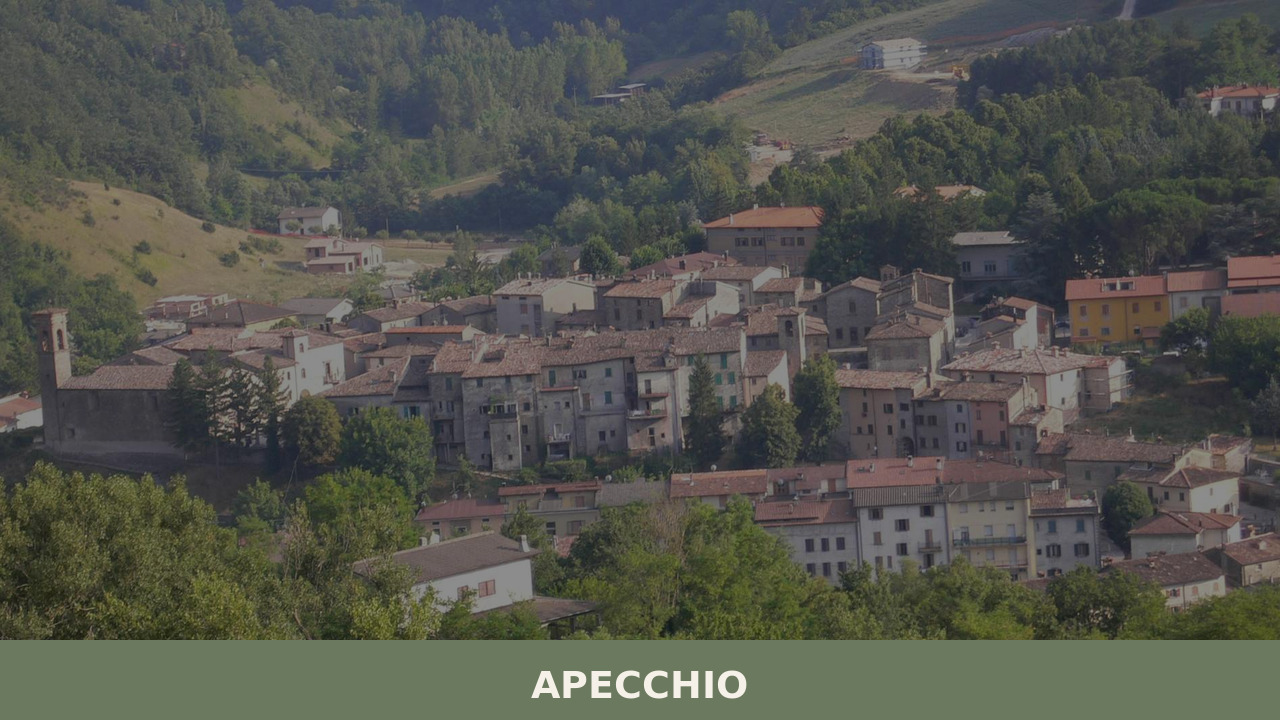
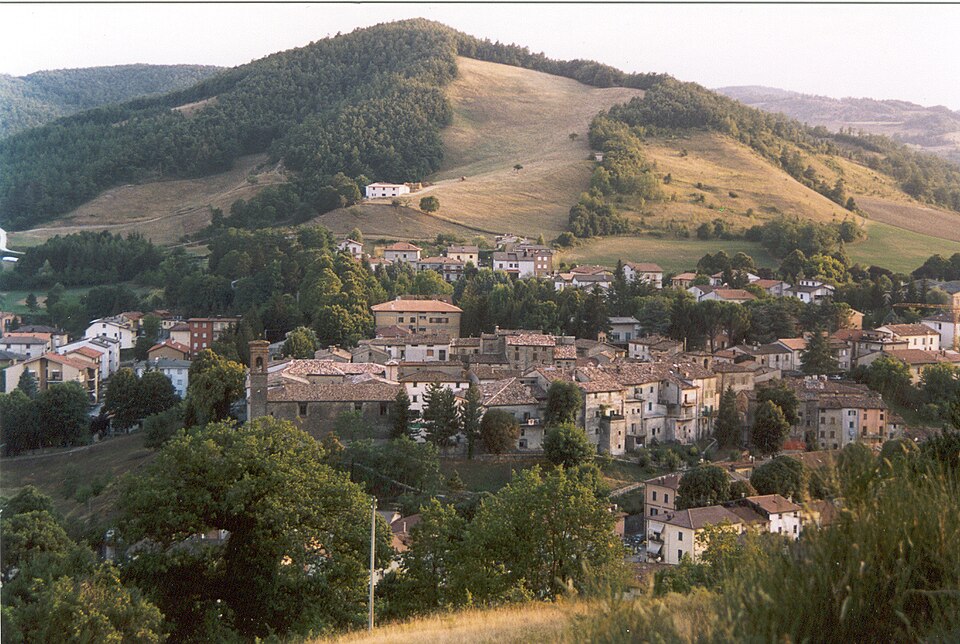
Morning mist lifts off the Biscubio river and the medieval bridge emerges in grey stone, its arches still carrying the weight of six centuries. A bell tower marks the hour above terracotta rooftops, and the smell of woodsmoke mixes with damp earth from the surrounding Apennine slopes. At 493 metres above sea level, this small commune of 1,704 inhabitants in the province of Pesaro e Urbino holds more layers than its modest size suggests. Understanding what to see in Apecchio requires slowing down — walking its cobbled lanes, reading its walls, tasting its soil.
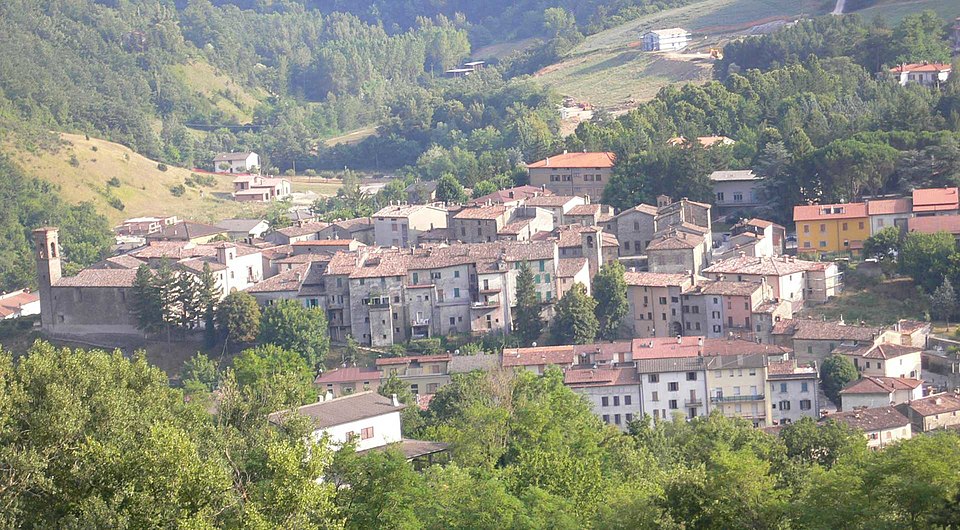
The name Apecchio likely derives from the Latin apex, meaning summit or peak — a reference to the elevated terrain on which the earliest settlement was established. Roman presence in the upper Biscubio valley is attested by archaeological fragments, but the village as a recognisable entity took shape during the early medieval period, when fortified settlements spread across the Marche Apennines as defensive outposts between coastal powers and the inland Duchy of Urbino.
From the fourteenth century onward, Apecchio fell under the dominion of the Ubaldini family, a Ghibelline dynasty of Tuscan origin that governed the territory as an imperial fief. The Ubaldini shaped the village’s built environment — its palazzo, its church renovations, its defensive walls — and maintained control for roughly three centuries. Their rule ended in the seventeenth century when the fief was absorbed into the Papal States, a transition that brought administrative uniformity but gradually diminished Apecchio’s strategic importance.
Through the centuries that followed, Apecchio settled into the rhythms of agricultural life common to the inland Marche: chestnut harvesting, livestock grazing, small-scale cultivation of grain and legumes on terraced hillsides. The village’s relative isolation preserved its medieval core largely intact, a fact that makes it an unusually coherent example of Apennine hill-town architecture today.
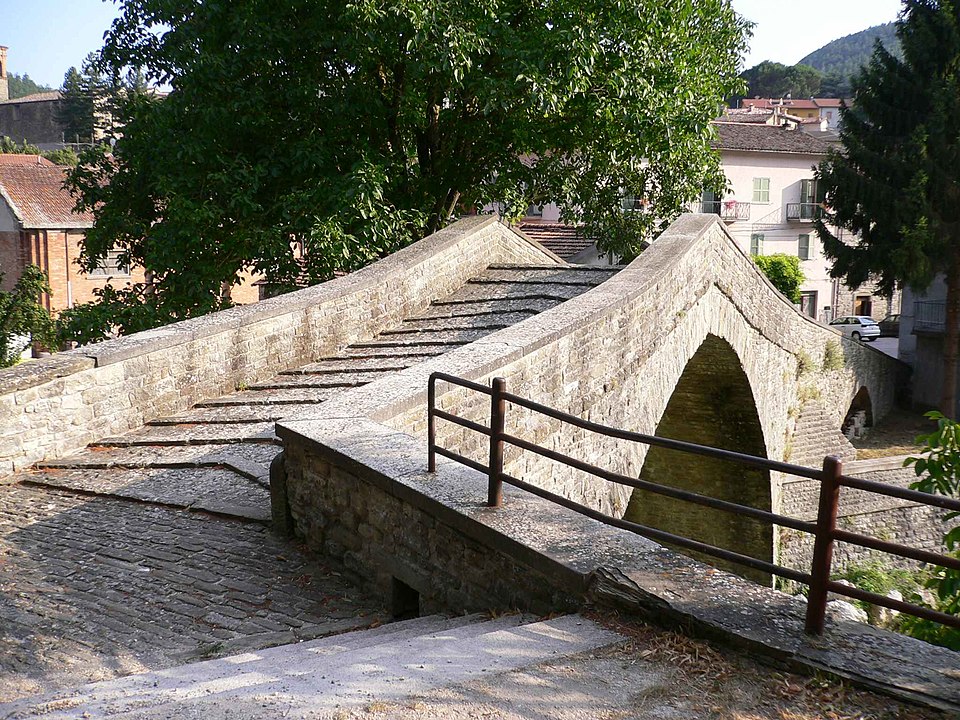
A stone bridge with rounded arches spans the Biscubio river at the village’s edge, likely dating to the fourteenth or fifteenth century. Its proportions are modest but exact, built with locally quarried sandstone that has weathered to a pale grey. The bridge connected Apecchio to trade routes running between the Adriatic coast and the Tuscan interior, and it remains one of the most photographed structures in the upper valley.
Rising above the roofline of the old centre, the bell tower — known locally as Il Campanone — serves as Apecchio’s most recognisable vertical landmark. Its square plan and solid masonry are characteristic of civic towers across the Montefeltro and northern Marche. The tower marked communal time and, during earlier centuries, functioned as a watchtower over the valley approaches.
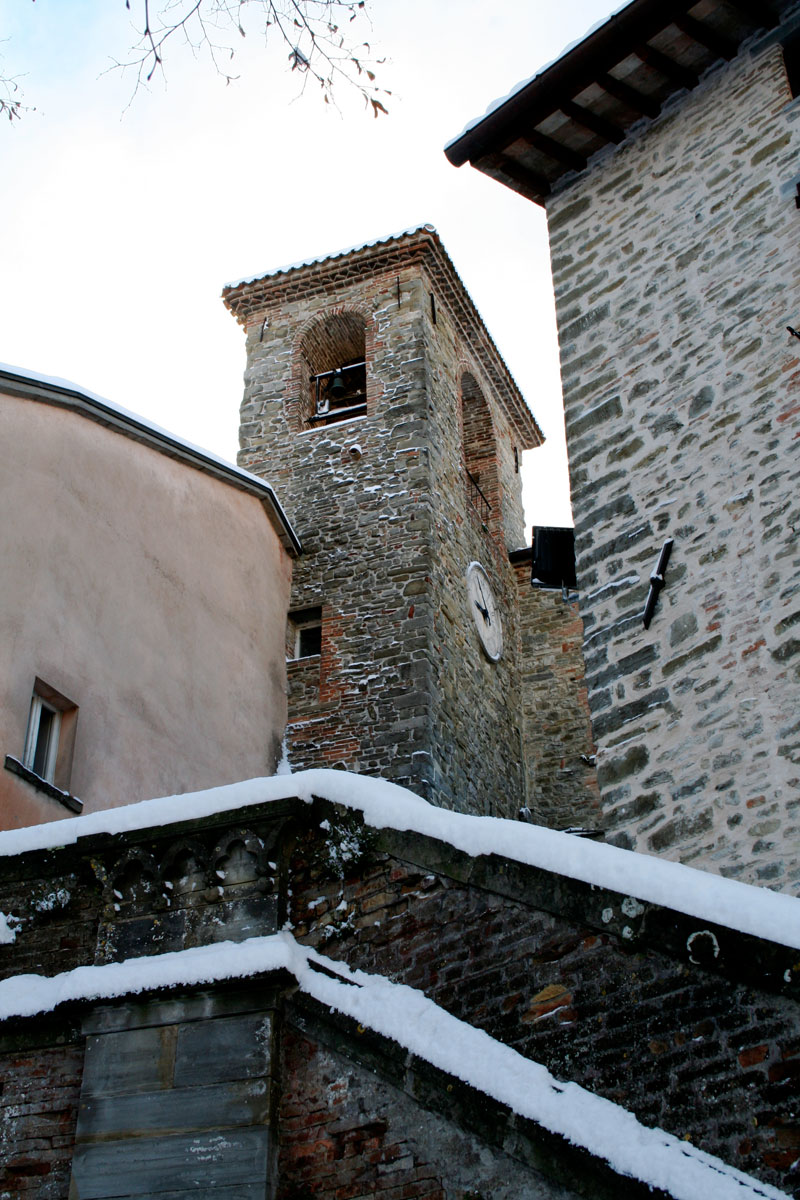
📷 By: Oigroig · CC BY 3.0 · All photo credits →
The Ubaldini palazzo stands in the centre of the village as the principal architectural testament to the family’s centuries-long rule. Its facade is restrained — thick walls, arched windows, a sense of fortified domesticity rather than courtly display. The building reflects the reality of governing a remote Apennine fief, where power was exercised through proximity and durability rather than ornamental excess.
Apecchio’s main parish church, dedicated to San Martino, contains elements from different construction phases spanning the medieval and early modern periods. The interior holds modest but locally significant artworks, including altar paintings and carved wooden furnishings. The church serves as the spiritual centre of the village and is typically open for visits during morning hours.
Walking trails extend from the village into beech and chestnut forests that cover the slopes above Apecchio, reaching into the Alpe della Luna range. These paths follow old mule tracks and forestry routes, offering close contact with a landscape that has changed little in form since the medieval period. The terrain is moderate — suitable for day hikes — with elevations rising above 1,000 metres within a few kilometres of town.
Apecchio’s culinary identity is built on the raw materials of its Apennine terrain: chestnuts, wild mushrooms, truffles, game, and the pork products that sustain every inland Marche table. The village is known within the region for its beer culture — an unusual distinction for a small Italian hill town — and hosts an annual beer festival that draws visitors from across the province. Local restaurants serve dishes rooted in cucina povera: hand-rolled pasta with ragù, grilled meats, polenta with porcini, and crescia — a flatbread cooked on stone that is common throughout the Pesaro e Urbino area.
The surrounding forests produce white and black truffles seasonally, and local truffle hunters supply both village kitchens and markets in nearby towns. Chestnut flour appears in autumn desserts and in a dense, slightly sweet polenta. For those looking to eat well, small trattorias in the historic centre offer fixed menus that shift with the season, priced modestly and served without ceremony. This is food that belongs to its geography — plain, direct, and rooted in a specific set of altitudes and soils.
Autumn is Apecchio’s most distinctive season. From late September through November, the chestnut and truffle harvests are underway, the beech forests above the village turn copper and amber, and the air carries a persistent scent of damp wood and mushroom. The annual beer festival, typically held in October, fills the village centre with a rare energy. Spring — April through June — brings wildflowers to the surrounding meadows and comfortable walking temperatures on the Apennine trails.
Summers are warm but not oppressive at 493 metres, with temperatures several degrees cooler than the Adriatic coast. Winters can be sharp, with frost and occasional snowfall transforming the valley into a quiet, monochrome landscape. Visitor numbers are low year-round, which means no queues, no reservation difficulties, and an unhurried relationship with the place. Pack layers regardless of season; the mountain weather shifts quickly.
Apecchio sits in the inland portion of the Marche region, roughly 60 kilometres southwest of Pesaro and the Adriatic coast. The nearest motorway access is the E78 (Fano–Grosseto), which connects to the A14 Adriatica motorway at Fano. From Fano, the drive inland follows the Metauro and then the Biscubio valley — approximately 50 kilometres on provincial roads that wind through progressively higher terrain.
The nearest railway station with regular service is Fano, on the Bologna–Ancona Adriatic line. From Fano, local bus services or a rental car are necessary to reach Apecchio. The closest airports are Rimini Federico Fellini Airport (approximately 90 km) and Ancona Falconara Airport (approximately 120 km). Bologna Guglielmo Marconi Airport offers the widest range of international connections, at roughly 200 km distance. A car is effectively essential for exploring Apecchio and the surrounding territory at your own pace.
The inland province of Pesaro e Urbino holds a constellation of small hill towns that share Apecchio’s character: medieval stonework, agricultural traditions, and a pace of life governed more by season than by clock. To the east, closer to the Metauro valley, the territory opens toward villages where Renaissance ducal influence shaped both architecture and civic culture, offering a counterpoint to Apecchio’s more austere Apennine identity.
Those continuing through the region should consider visiting Piobbico, a neighbouring village dominated by the Brancaleoni fortress and set in the dramatic gorge of the Candigliano river — just 15 kilometres from Apecchio. Further south, the fortified town of Cagli rewards visitors with Roman archaeological remains and a well-preserved historic centre at the crossroads of ancient consular roads. Together, these villages form a coherent itinerary through one of central Italy’s least explored and most quietly rewarding territories.
📝 Incorrect information or updates?
Help us keep the Apecchio page accurate and up to date.