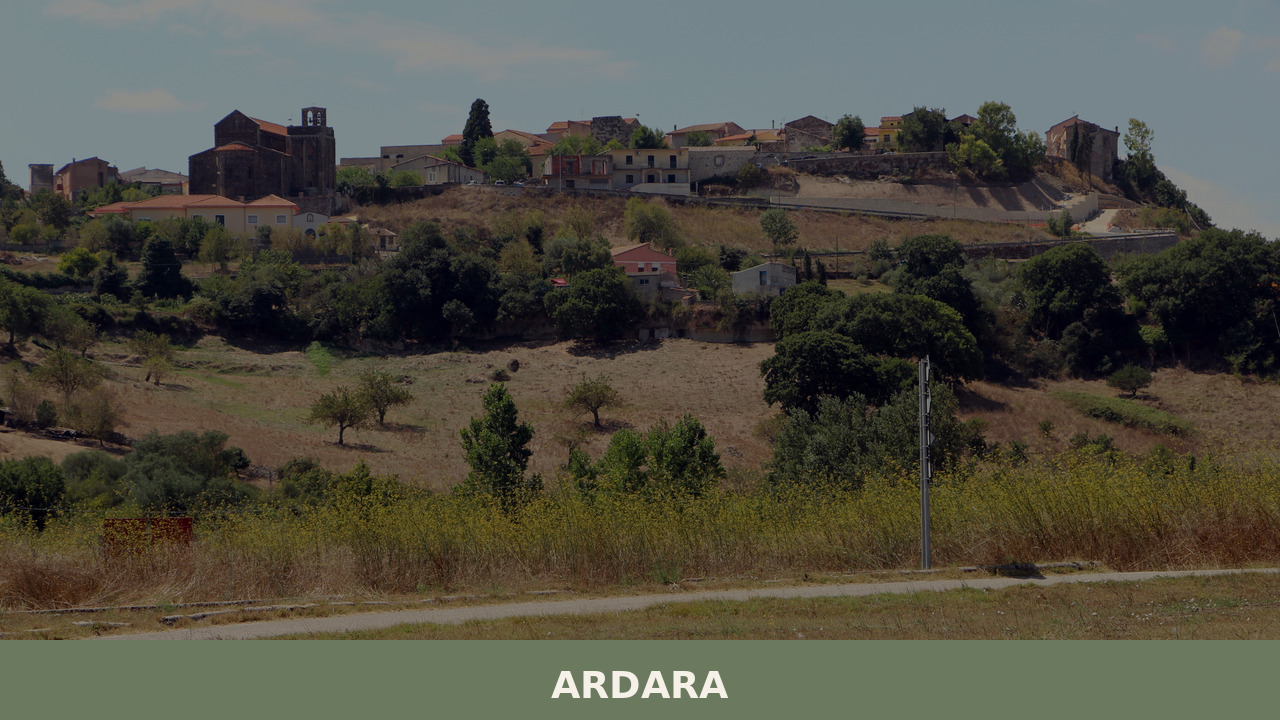
Morning light strikes the dark basalt walls of an old church, turning the stone the colour of wet coal. A rooster calls from somewhere behind the municipio. Ardara sits on a low rise at 296 metres above sea level in the province of Sassari, a village of 729 people that once served as the capital […]
Morning light strikes the dark basalt walls of an old church, turning the stone the colour of wet coal. A rooster calls from somewhere behind the municipio. Ardara sits on a low rise at 296 metres above sea level in the province of Sassari, a village of 729 people that once served as the capital of a medieval kingdom. For anyone asking what to see in Ardara, the answer begins with that black church — and unfolds into a layered history written in stone, fresco, and ruin.
Between the eleventh and thirteenth centuries, Ardara was the capital of the Giudicato di Torres, one of four independent kingdoms that governed Sardinia during the medieval period. The giudici — judge-kings — held court here, and the village carried political weight far beyond its modest size. It was in Ardara that Adelasia di Torres, the last giudicessa of Torres, married Enzo of Sardinia, the illegitimate son of Holy Roman Emperor Frederick II, in 1238. That union briefly tied this small Sardinian settlement to the vast ambitions of the Hohenstaufen dynasty.
The name “Ardara” likely derives from a pre-Roman root, though its precise etymology remains debated among scholars. What is certain is the village’s strategic position on the Logudoro plateau, a broad inland territory of northern Sardinia. The Giudicato di Torres controlled this region from Ardara for roughly two centuries before the kingdom fragmented in the mid-thirteenth century, its territories absorbed by Genoese and Aragonese interests. The castle where the giudici once held power still stands in ruin on the edge of the village, its broken walls a reminder of that lost sovereignty.
After the fall of the giudicato, Ardara entered a long decline. It passed through feudal hands, endured plagues and depopulation, and contracted into the quiet agricultural settlement visible today. Yet the monumental church and the castle ruins preserve an unmistakable echo of authority — evidence that this village of fewer than a thousand residents was once a seat of power.
Built between 1100 and 1107 in dark volcanic basalt, this Romanesque church served as the palatine chapel of the giudici di Torres. Inside, the retablo maggiore — a grand painted altarpiece dating to the early sixteenth century — fills the apse wall with gilded panels. The contrast between the austere black exterior and the polychrome interior is striking and immediate.
The remains of the judges’ castle stand on a slight elevation near the village centre. What survives are fragmented walls of basalt and limestone, enough to trace the footprint of what was once the administrative heart of the Giudicato di Torres. The ruins are unguarded and open, with views across the Logudoro plain — a place of quiet, unmediated contact with medieval Sardinian history.
Ardara’s old centre is compact and largely built of the same dark stone as the church. Narrow streets connect low houses with thick walls, many dating to the eighteenth and nineteenth centuries. The municipio, the town hall, anchors a small piazza. Walking here takes only minutes, but the coherence of the stone and the silence give the place a density beyond its size.
Set in the countryside outside the village, this small rural church is one of several campestri — country churches — that dot the Logudoro. It hosts a traditional festa each year, when villagers process from Ardara to the church. The building itself is modest, but its setting among fields and low scrub captures the pastoral character of this part of northern Sardinia.
The plateau surrounding Ardara is open, gently rolling terrain of volcanic soils, punctuated by cork oaks and cattle pasture. This is the Logudoro — historically the richest agricultural zone in the giudicato. Walking or driving the roads outside the village offers a sense of the spatial isolation that once made Ardara a defensible capital, and the fertility that sustained it.
Ardara sits in pastoral country, and its food reflects that. Sheep’s milk cheese — in particular pecorino sardo, which carries DOP status across the island — is a staple. Pane carasau, the paper-thin flatbread baked twice to a crisp, accompanies most meals. During festas, you may find zuppa gallurese (layered bread and cheese baked in broth) or culurgiones (stuffed pasta parcels), though these are shared traditions across much of inland Sardinia rather than Ardara-specific dishes. Local producers also keep small quantities of honey and olive oil.
The village does not have a wide restaurant scene — this is a settlement of 729 people. A trattoria or agriturismo in or near the village can provide a solid meal of roast pork or lamb, served with cannonau wine from the surrounding region. For a fuller range of dining options, the town of Ozieri, roughly fifteen kilometres to the east, offers more choice. The food in Ardara is honest, rooted in its pastoral economy, and best encountered at a table where someone’s grandmother had a hand in the recipe.
Spring — late April through June — is the best window. The Logudoro is green, the days are long but not yet oppressive, and wildflowers colonise the roadsides. Summer brings dry heat that can push past 35°C inland, and the landscape turns brown and hard. Autumn, particularly October, offers mild temperatures and a second greening after the first rains. Winter is cool and quiet, with temperatures occasionally dropping below 5°C at night, and few visitors.
The most significant event in Ardara’s calendar is the festa dedicated to the village’s patron saint, which centres on the church of Santa Maria del Regno. Local festas in the campestri churches also punctuate the warmer months, with processions, communal meals, and traditional music. These are small, community-scale events — not staged for tourists — which is precisely what gives them their value. Check with the Comune di Ardara website for current dates before planning a visit around a specific celebration.
The nearest airport is Alghero-Fertilia (Riviera del Corallo Airport), approximately 55 kilometres to the west, with seasonal and year-round connections to mainland Italy and several European cities. From Alghero, take the SS291 east toward Sassari, then follow the SS597 or SS131 south toward Ozieri; Ardara is signposted off the main road. The drive takes roughly fifty minutes.
There is no direct rail service to Ardara. The closest train station with regular service is in Ozieri-Chilivani, about 15 kilometres away on the Trenitalia network connecting Sassari, Olbia, and Cagliari. From there, a car or local bus is needed to reach the village. Public transport connections are limited; a rental car is the most practical option for exploring Ardara and the surrounding Logudoro.
The Logudoro and the broader province of Sassari contain some of the most historically rich villages on the island. North of Ardara, the granite landscape shifts dramatically as you approach the Gallura region. The village of Aggius, set among granite boulders in the Gallura hinterland, offers a different but complementary experience — a place defined by its stone, its textile traditions, and its choral music, well worth a detour for anyone building a circuit of Sardinia’s inland villages.
Sardinia’s interior rewards slow travel. Each village carries its own architectural dialect, its own festa calendar, its own inflection of Sardinian identity. From the black basalt of Ardara to the pale granite of Gallura, the island’s geology shapes its culture in visible, tangible ways. For deeper exploration of the region’s heritage, the Sardinia regional tourism board provides current information on routes, events, and local museums across the province and beyond.
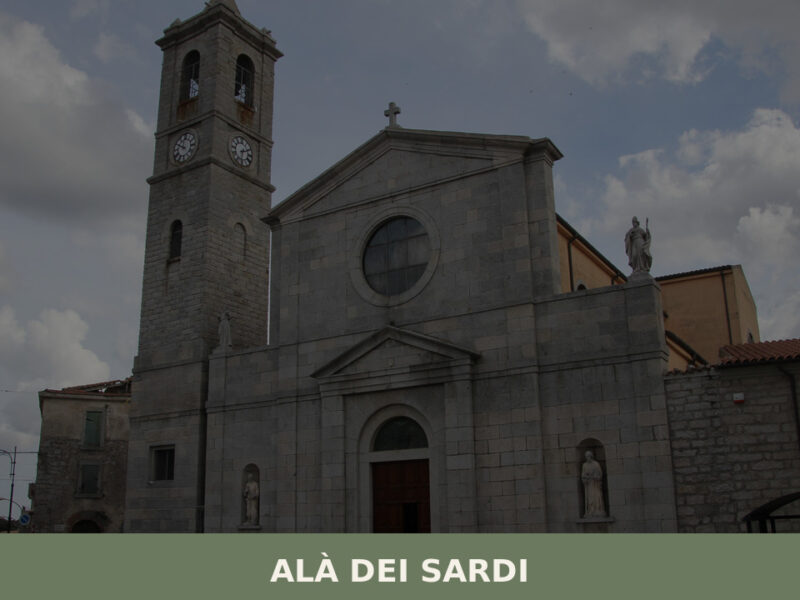
Morning mist rolls off the granite plateau and settles in the narrow streets, carrying the smell of woodsmoke and fresh bread from a communal oven that has not changed position in two centuries. At 663 metres above sea level, the air here is thinner, cooler, and quieter than on the coast below. Alà dei Sardi […]
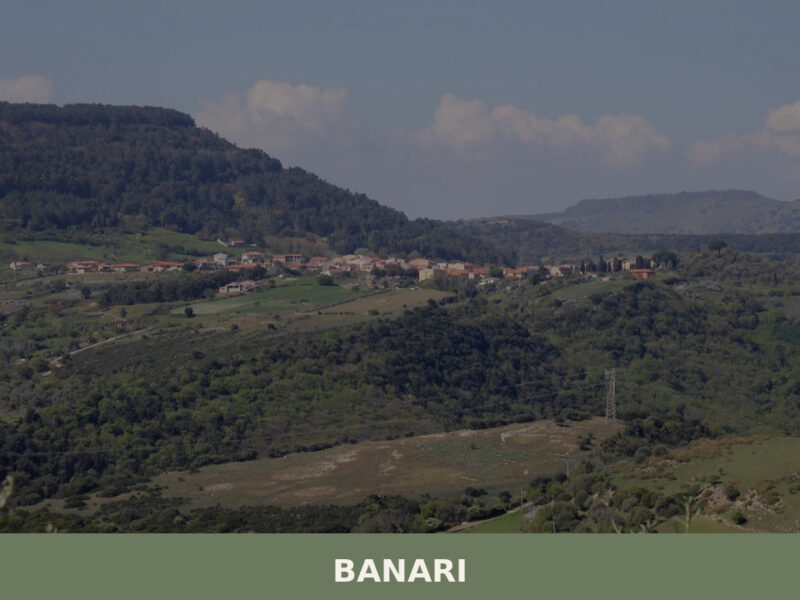
Morning light catches the limestone facades along Via Roma, turning them the colour of raw honey. A rooster calls from behind a courtyard wall. Somewhere below, the Meilogu plain stretches north toward Sassari, its patchwork of olive groves and grain fields still holding the night’s mist. Banari — population 516, perched at 419 metres above […]
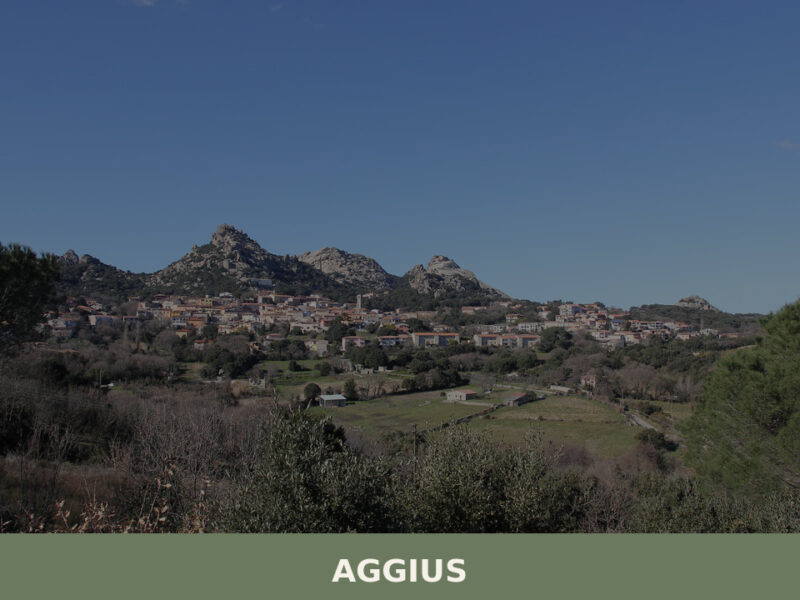
Granite boulders glow amber in the late afternoon, stacked like ancient sentinels across a valley floor that drops away toward the Gallura coast. Wind pushes through narrow lanes of grey stone houses, carrying the faint rhythm of a polyphonic chorus rehearsing behind closed shutters. At 514 metres above sea level, this village of just over […]
📝 Incorrect information or updates?
Help us keep the Ardara page accurate and up to date.


