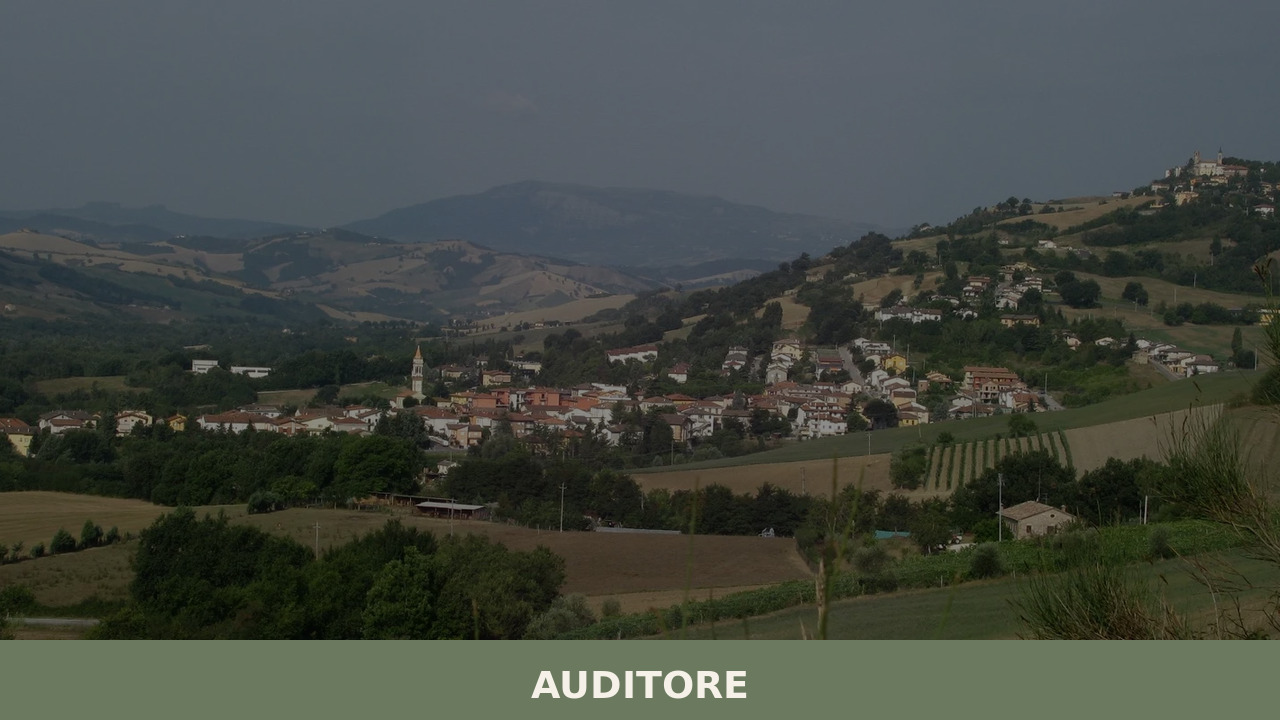
Morning light falls across a line of stone houses the colour of dry wheat, and somewhere below the rooftops a church bell marks the hour with a single, unhurried stroke. Auditore sits in the hill country of the province of Pesaro e Urbino, a settlement of 1,631 people where the Foglia river valley opens toward […]
Morning light falls across a line of stone houses the colour of dry wheat, and somewhere below the rooftops a church bell marks the hour with a single, unhurried stroke. Auditore sits in the hill country of the province of Pesaro e Urbino, a settlement of 1,631 people where the Foglia river valley opens toward the interior ridges of Marche. The place rewards patience more than haste, and knowing what to see in Auditore begins with understanding a landscape shaped by centuries of border-life between rival powers.
The name Auditore likely derives from the Latin auditores, a term linked to judicial or administrative figures who once held authority in this stretch of the upper Foglia valley. Documentary evidence places a fortified settlement here by the early medieval period, when the territory sat along the contested frontier between papal domains and the expanding influence of the Montefeltro counts. Control of the ridgeline meant control of passage between the Adriatic coast and the Apennine interior — a strategic reality that defined the village for centuries.
During the fourteenth and fifteenth centuries, Auditore fell within the orbit of the Duchy of Urbino, ruled by the Montefeltro and later the Della Rovere families. The fortifications visible today — fragments of walls, a watchtower base — date largely from this era, when even minor hilltop communities required defensive architecture. When the duchy was absorbed into the Papal States in 1631, Auditore entered a long, quieter period, its military importance fading as its agricultural identity deepened. The olive groves and wheat fields that still terrace the surrounding slopes are direct inheritors of that transformation.
The modern comune encompasses several frazioni — small hamlets scattered across the hills — each with its own chapel or country church, a pattern typical of rural Marche. The population has remained modest for generations, and the built fabric of the village centre reflects a community that grew slowly, stone by stone, without dramatic reinvention.
At the upper edge of the village, remnants of the original defensive tower and wall circuit mark Auditore’s strategic past. The stonework — rough-cut local sandstone, assembled without ornament — speaks to practical engineering rather than aristocratic display. From the base of the tower, the sightline extends down the Foglia valley, explaining precisely why this position mattered to medieval commanders.
The main parish church anchors the small central piazza. Its interior follows a restrained single-nave plan common across the Montefeltro area, with an altar arrangement and devotional paintings accumulated over several centuries. The bell that marks the hours across the rooftops belongs to this building — a sound that has structured village time for generations.
Paths leading from the village edge offer unobstructed views across the Foglia valley toward the ridgelines that divide Marche from Emilia-Romagna. In late afternoon, the light separates the hillside into bands of cultivated green and exposed clay — a geological palette characteristic of this transitional zone between coast and mountain.
The smaller hamlets surrounding Auditore each possess modest country chapels, some dating to the seventeenth or eighteenth century. These buildings, often unlocked, contain local votive art and simple frescoed decoration. Walking between them on unpaved tracks offers a more intimate encounter with the landscape than any single monument could provide.
Auditore’s compact centro storico is best explored on foot, following narrow lanes paved in worn river stone. Doorways bear carved dates — 1600s, 1700s — and the domestic architecture reveals a consistency of material and proportion that formal restoration programs elsewhere have struggled to replicate. Details reward attention: iron hinges, stone lintels, a fig tree pushing through a wall.
The cooking here belongs to the inland Marche tradition — robust, centred on grains, cured meats, and olive oil from trees that have occupied these hillsides for centuries. Passatelli in brodo, a dense pasta made from breadcrumbs, Parmigiano, eggs, and lemon zest, served in a clear meat broth, is a cold-weather staple. Grilled lamb, rabbit cooked with wild fennel, and crescia sfogliata — a layered flatbread enriched with lard — appear on tables across the Montefeltro area. The province of Pesaro e Urbino also falls within the production zone of Casciotta d’Urbino DOP, a soft mixed-milk cheese with a history reaching back to the Renaissance.
Olive oil production remains significant in the surrounding hills, with small-scale mills pressing fruit from the Leccino and Frantoio cultivars that thrive in the clay-and-limestone soils. Local restaurants and agriturismi — farmhouse accommodations offering meals — are the most reliable places to eat, serving dishes that follow seasonal availability rather than fixed menus. Truffles, both black and the prized white variety, appear in autumn preparations, connecting Auditore to the wider truffle economy of the Marche interior.
Late spring — May and early June — brings the most balanced conditions: warm days without the heavy heat of July and August, long evening light, and the surrounding fields in full growth. Autumn, particularly October, offers a second window when the truffle season begins, the grape harvest is underway, and the foliage across the Foglia valley turns through shades of copper and amber. Summers can be hot in the interior hills, with temperatures regularly exceeding 30°C, though evenings cool noticeably at altitude.
Village festivals and sagre (food fairs) typically cluster in the summer months and early autumn, providing the most animated encounters with local life. Check the Marche regional tourism board for updated event calendars. Winter is quiet — many agriturismi reduce hours or close — but the stripped-back landscape has its own austere clarity, and you are unlikely to share the lanes with anyone but residents.
Auditore lies in the interior of the province of Pesaro e Urbino, roughly 30 kilometres southwest of Pesaro and approximately 25 kilometres from Urbino. By car, the most practical route from the Adriatic coast follows the E78 (Strada di Fondovalle Foglia) inland from Pesaro, exiting toward Auditore via provincial roads. From the A14 motorway, take the Pesaro-Urbino exit and follow signs toward Urbino, then branch south.
The nearest railway station with regular service is Pesaro, on the Bologna–Ancona Adriatic line. From Pesaro, local bus connections operated by Adriabus serve the valley, though schedules are limited and a rental car is strongly advisable for exploring the area. Federico Fellini International Airport in Rimini, roughly 45 kilometres to the north, is the closest airport. Ancona-Falconara airport lies approximately 100 kilometres to the southeast along the coast.
The hill country around Auditore belongs to the wider Montefeltro district, a territory dense with small fortified settlements that once formed a network of watchtowers and feudal outposts. Exploring beyond Auditore reveals the cumulative texture of this landscape — each village slightly different in character, yet linked by shared geology, shared history, and shared cooking traditions.
To the south, Sassocorvaro is worth a detour for its unusual Rocca Ubaldinesca, a rounded fortress designed by the Renaissance military architect Francesco di Giorgio Martini, which famously sheltered thousands of artworks during the Second World War. Further into the Marche interior, the walled village of Frontino offers one of the best-preserved medieval centres in the province, set against the higher ridges where the landscape begins its climb toward the Apennine watershed. Together with Auditore, these settlements trace the contours of a region that remains one of Italy’s least-visited and most quietly rewarding.
📝 Incorrect information or updates?
Help us keep the Auditore page accurate and up to date.