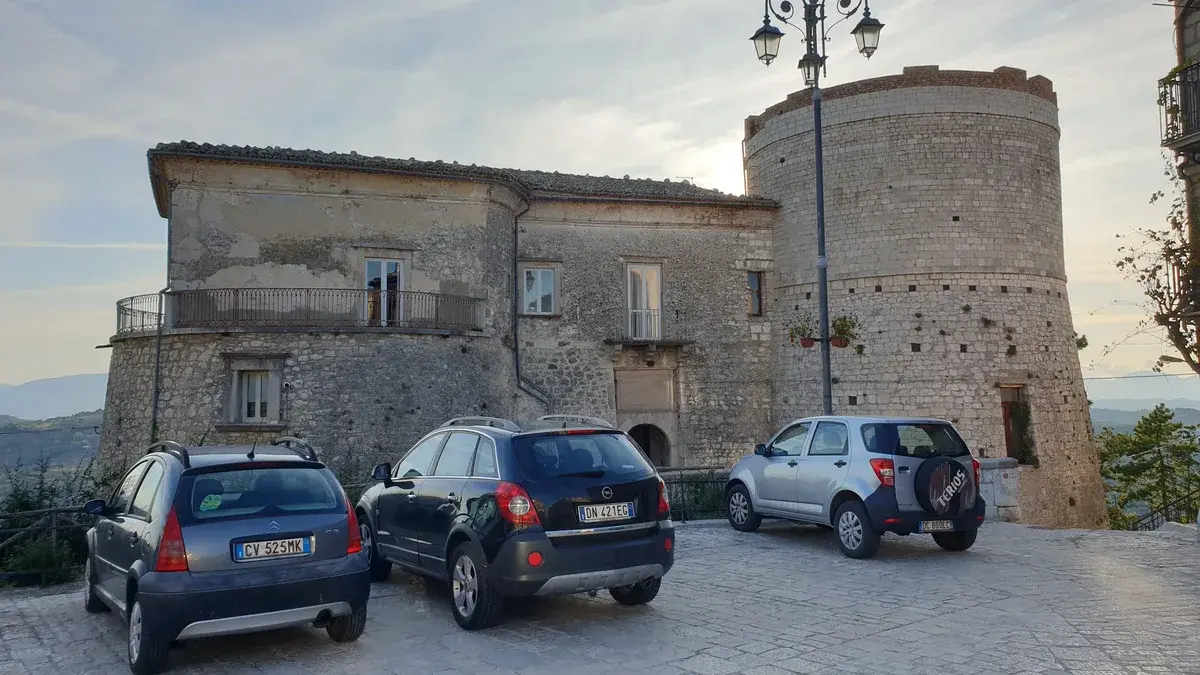
Morning light hits the limestone walls of Ferrazzano at an angle that turns every alley into a corridor of pale gold. At 872 metres above sea level, the air carries a sharpness that the lower towns of Molise never know — a clarity that makes the distant Adriatic coast visible on days when the haze […]
Morning light hits the limestone walls of Ferrazzano at an angle that turns every alley into a corridor of pale gold. At 872 metres above sea level, the air carries a sharpness that the lower towns of Molise never know — a clarity that makes the distant Adriatic coast visible on days when the haze lifts. With just over 3,200 inhabitants, this compact settlement rewards those who arrive on foot and pay attention. Understanding what to see in Ferrazzano begins not with a checklist, but with the slow work of looking: at worn stone, at ironwork balconies, at a skyline that hasn’t shifted in centuries.
Ferrazzano’s origins reach back to the early medieval period, when hilltop settlements across the central-southern Apennines served as defensive positions against successive waves of invasion. The village’s elevated site — commanding views over the Biferno river valley and the surrounding Molise highlands — made it a natural stronghold. Its name likely derives from a personal Latin name, possibly Ferrantius or a related form, a pattern common in southern Italian toponymy where settlements took the names of their founding landowners during the Lombard and Norman periods.
Under Norman rule in the eleventh and twelfth centuries, Ferrazzano was fortified with a castle that would be rebuilt and expanded by subsequent feudal lords. The Carafa family, one of the most powerful noble dynasties of the Kingdom of Naples, held the fief for a significant period, leaving their mark on the village’s architectural character. The castle and surrounding walls defined the shape of the settlement as it exists today — a tight cluster of stone buildings arranged along a ridge, with streets that follow the contour of the hill rather than any grid.
Like many small Molise communities, Ferrazzano experienced waves of emigration in the late nineteenth and twentieth centuries, particularly to North America. The village’s population has declined from its historical peaks, yet the built fabric remains remarkably intact — a consequence, in part, of the very depopulation that threatened it. What was not rebuilt was also not demolished.
The castle sits at the highest point of the village, its square tower visible from kilometres away. Originally Norman in construction, it was reshaped during the Carafa era into a baronial residence. The walls are thick enough to keep interiors cool even in August. From the terrace, the view extends across the Biferno valley to the Matese mountains — a panorama that explains the strategic logic of the site more plainly than any document.
The principal church of Ferrazzano occupies a position near the village’s centre, its facade modest but its interior holding several notable works of religious art. Stone columns and a layout that reflects successive periods of renovation — Romanesque bones beneath later Baroque additions — give the space a layered quality. Look for the carved stone details around the main portal, worn smooth by centuries of hands and weather.
A paved viewpoint at the edge of the old village offers an unobstructed sightline that, on clear days, reaches the Adriatic Sea some sixty kilometres to the northeast. There is no guardrail drama here — just a low wall, a bench, and a view that compresses an entire region into a single frame. Early morning and late afternoon provide the sharpest definition of the landscape below.
Ferrazzano’s old quarter is a tight mesh of narrow lanes, stone stairways, and arched passageways that connect one level of the hillside to the next. The buildings are predominantly local limestone, their doorways often framed by carved surrounds that hint at the relative prosperity of their original owners. Walking here is an exercise in vertical navigation — every path seems to lead either up or down.
The main piazza serves as the social centre of the village, anchored by a war memorial honouring Ferrazzano’s fallen from the two World Wars. The names inscribed are disproportionately numerous for a village of this size — a quiet record of the toll that conflict took on small southern communities. The square also functions as the starting point for any exploration of the old town.
The cooking of Ferrazzano belongs firmly to the mountain tradition of Molise — a cuisine built on legumes, cured pork, handmade pasta, and sheep’s milk cheese. Cavatelli, the region’s signature short pasta rolled by hand, appears at most tables, often dressed with a slow-cooked ragù of mixed meats or simply with broccoli rabe and anchovy. Lamb, raised on the surrounding uplands, is prepared roasted or in stews thickened with egg and cheese — a preparation known as agnello cacio e uova. The olive oil of Molise tends toward the robust, with a peppery finish that marks it as distinctly different from the gentler oils of neighbouring Puglia.
Local shops and the occasional trattoria in Ferrazzano offer products that rarely travel far from their point of origin: fresh scamorza cheese, still warm from the dairy; cured sausages seasoned with fennel seed or peperoncino; and taralli flavoured with black pepper. The wine culture here leans on the indigenous Tintilia del Molise grape, a red variety that produces bottles of notable depth and tannic structure. Eating in Ferrazzano is not a curated restaurant experience — it is domestic cooking elevated by the quality of raw materials grown in cold-winter, hot-summer conditions at altitude.
At 872 metres, Ferrazzano’s climate is distinctly cooler than the coastal towns of Molise. Winters bring frost and occasional snow, which lends the village a stark, photogenic quality but makes some lanes slippery and limits opening hours of local establishments. Spring — particularly late April through June — is the most rewarding season for a visit: wildflowers cover the surrounding meadows, the air is warm without the heaviness of summer, and the views from the belvedere are at their most expansive before summer haze sets in.
Summer brings the village’s festa patronale and other local events, which fill the piazza with temporary stalls, music, and processions. August, when emigrated families return, is the most socially animated month but also the hottest, with afternoon temperatures that push visitors into the shade of the narrowest streets. Autumn offers excellent light for photography and the beginning of the olive and grape harvests. For those interested in what to see in Ferrazzano without crowds, a weekday in May or October provides near-solitude and the full attention of any local willing to talk.
Ferrazzano lies approximately 5 kilometres south of Campobasso, the regional capital of Molise. By car, the village is reached via the SS645 or local roads branching from the Campobasso ring road. From Naples, the drive takes roughly two hours via the A1 motorway and then the SS17 or Fondovalle del Biferno. From the Adriatic coast — Termoli, the nearest seaside town — the journey covers about 75 kilometres and takes slightly over an hour.
The nearest railway station is Campobasso, served by Trenitalia regional services connecting to Naples, Isernia, and the Adriatic line via Termoli. Bus services link Campobasso to Ferrazzano, though schedules are infrequent and geared toward commuters rather than visitors — checking timetables in advance is essential. The nearest airports are Naples Capodichino (approximately 150 km) and Pescara (approximately 160 km). A rental car is the most practical option for reaching Ferrazzano and exploring the wider region.
Ferrazzano sits within a region that remains one of Italy’s least visited, which means that the villages surrounding it carry none of the over-tourism pressures found elsewhere. Molise’s small communities — many of them set on hilltops or tucked into valleys — share a common architectural language of stone and tile, but each holds its own particular history and character. For travellers willing to extend their route southward into neighbouring Puglia, the contrasts become vivid: the landscape flattens, the light intensifies, and the villages shift from mountain compactness to a broader, more open scale.
Two destinations worth considering as extensions of a Ferrazzano visit lie in northern Puglia. Torremaggiore, on the Tavoliere plain, preserves a castle linked to the Hohenstaufen emperor Frederick II and offers a very different architectural atmosphere — flat, sun-baked, and expansive where Ferrazzano is vertical and shaded. Further south along the Gargano promontory, Monte Sant’Angelo holds the Sanctuary of San Michele Arcangelo, a UNESCO World Heritage Site that has drawn pilgrims since the fifth century. Together, these villages frame a journey from the quiet interior of Molise to the dramatic coastline and sacred geography of Puglia — a route that remains, for now, largely the province of the curious rather than the crowd.
Morning mist spills across the rooftops at 930 metres, thinning as the sun reaches the bell towers. The air carries woodsmoke and the faint sound of a dog barking somewhere below the ridge. Cercemaggiore sits high in the Molise Apennines, a settlement of 3,601 people where stone houses line narrow streets that have changed course […]
A documentary guide to Baranello in Molise — its civic museum, medieval churches, castle, and the quiet rhythms of an overlooked Italian hill village.
A mountain village of 594 inhabitants at the foot of the Matese massif, Campochiaro holds a Lombard necropolis, Samnite sanctuary, and karst landscapes that reveal Molise's deepest layers.
📝 Incorrect information or updates?
Help us keep the Ferrazzano page accurate and up to date.


