


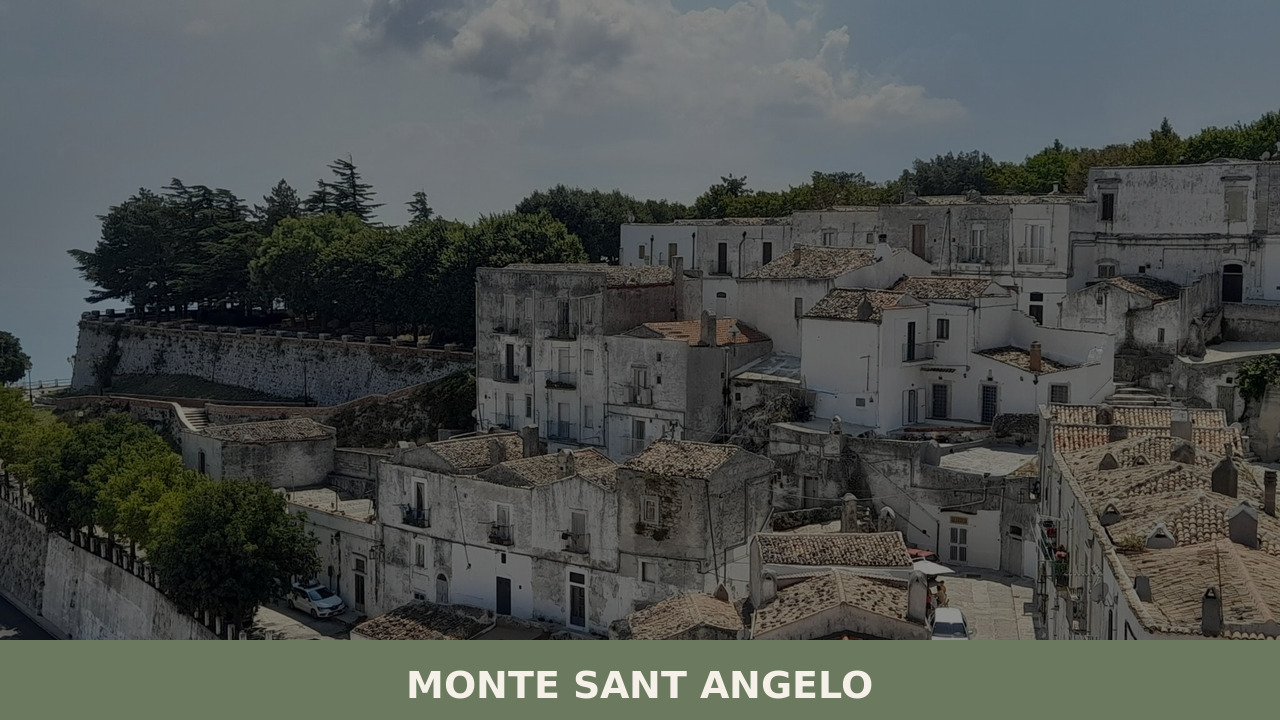
Monte Sant’Angelo
 Mountain
Discover what to see in Monte Sant’Angelo, Puglia: UNESCO sanctuary, Norman castle, Foresta Umbra and local food. Practical travel guide with tips.
Discover Monte Sant’Angelo
Since the sixth century, Christian pilgrims have been climbing the Gargano promontory to reach Monte Sant’Angelo, a comune of around 10,850 inhabitants in the province of Foggia, Puglia. The town sits at altitude on the limestone spur of the Gargano massif, and what draws most visitors — what to see in Monte Sant’Angelo — is not a single monument but a layering of sacred, natural and medieval heritage so concentrated that UNESCO recognised two of its sites in a single inscription.
History of Monte Sant’Angelo
The town takes its name directly from the apparitions of the Archangel Michael, which medieval sources record as occurring in a grotto on the Gargano between 490 and 493 AD, during the bishopric of Lorenzo Maiorano of Siponto. The site became one of the earliest Christian sanctuaries in Western Europe dedicated to an archangel, and by the early medieval period it had established itself on the principal pilgrimage routes of the Latin Church. Lombard dukes venerated it from the seventh century onward, and the Lombards’ attachment to Saint Michael as a warrior saint gave the sanctuary particular political and military resonance throughout the early medieval south.
Norman control of the Gargano in the eleventh century brought substantial investment in the sanctuary’s architecture. The Normans, who had themselves passed through Monte Sant’Angelo as pilgrims before their conquest of southern Italy, reinforced the site’s prestige and contributed to the construction of structures that still define the townscape. The campanile — an octagonal tower standing beside the sanctuary — dates in its lower sections to the Norman period, a physical record of that era of political consolidation under Roger I and later Roger II. The town subsequently passed through Swabian and then Angevin administration, following the broader dynastic shifts of the Kingdom of Sicily and later the Kingdom of Naples.
Monte Sant’Angelo’s inclusion in the UNESCO World Heritage List came in 2011 as part of the serial inscription “Longobardi in Italia: i luoghi del potere,” which recognised the Sanctuary of San Michele Arcangelo as one of seven Lombard-era sites of outstanding universal value across Italy. Separately, the Foresta Umbra within the Gargano National Park — whose territory overlaps with the Monte Sant’Angelo municipality — also holds UNESCO recognition as part of the ancient beech forests of the Apennines. These two designations, covering sacred architecture and primary forest within the same administrative boundary, are rare in Italian heritage geography and define Monte Sant’Angelo’s contemporary identity.
What to see in Monte Sant’Angelo: 5 must-visit attractions
Sanctuary of San Michele Arcangelo
The core of the sanctuary is a natural grotto in the limestone, entered through a set of eleventh-century bronze doors cast in Constantinople and donated by a Amalfitan merchant in 1076. The grotto itself functions as the basilica’s altar space — an underground chamber where the rock face is the wall, unmodified by human construction. Mass has been celebrated here continuously since at least the sixth century.
The Norman Campanile
Rising beside the sanctuary entrance, this octagonal tower was begun in the twelfth century under Norman patronage and completed in subsequent centuries. It stands approximately 30 metres tall and draws on the same Apulian Romanesque vocabulary seen across the Gargano and the Murge. The octagonal plan echoes the Castel del Monte and reflects a Norman-era interest in geometric symbolism in sacred architecture.
Castello dei Normanni (Norman Castle)
Standing at the highest point of the town, the castle was built by the Normans in the eleventh century and later modified under Swabian rule in the thirteenth. Two cylindrical towers survive from its medieval phase. The castle served as a control point over the Gargano plateau and the pilgrimage road below. Today it is accessible to visitors and contains lapidary finds from the medieval period.
Foresta Umbra
Within the Gargano National Park, the Foresta Umbra is a 10,000-hectare block of old-growth forest dominated by beech, yew, oak and hornbeam — one of the largest and least disturbed forest remnants in peninsular Italy. The name means “forest of shade,” a reference to the dense canopy that keeps the interior in near-constant shadow even in summer. Wildlife includes roe deer, wild boar and the rare white fallow deer.
The Judo Quarter (Giudecca) and the Old Town
Monte Sant’Angelo preserves a medieval Jewish quarter, documented from the early medieval period and evidenced by rock-cut tombs and inscriptions in Hebrew found in the area below the castle. The lanes of the old town, built in pale local limestone, retain their medieval street pattern. The municipality’s heritage office maintains information on documented Jewish-heritage sites within the historic centre.
Local food and typical products
The Gargano’s food culture is shaped by altitude, forest and coast in proximity. Monte Sant’Angelo sits above the sea but within reach of both fishing ports and upland pastures, and the local diet reflects that range. Lamb from the Gargano plateau is the dominant protein in traditional cooking, prepared slow-roasted or braised with wild herbs — particularly rosemary and fennel gathered from the maquis. Caciocavallo Podolico, produced from the milk of Podolica cattle that graze the Gargano uplands, is the local cheese of reference: aged, compact, with a sharp finish that intensifies over months of hanging. Extra virgin olive oil from the Gargano holds IGP status and is pressed from native cultivars, particularly the Ogliarola Garganica olive, which produces a medium-fruity oil with low acidity.
Pasta takes the form of cavatelli and troccoli, the latter a Foggian egg pasta cut with a ridged rolling pin. Lampascioni — the bulbs of wild grape hyacinth, bitter and requiring long cooking — appear in local antipasto preparations, typically preserved in oil or roasted whole. Restaurants concentrated around the sanctuary and in the old town serve these dishes without significant modification for outside tastes; this is a pilgrimage town that has fed travellers for fifteen centuries, and the kitchen remains functional rather than performative.
Best time to visit Monte Sant’Angelo
The sanctuary operates year-round, but the town’s rhythms are governed by two primary pilgrimage feasts: May 8, which marks the feast of the apparition of Saint Michael, and September 29, the Feast of the Archangel. Both dates draw large crowds from across the Gargano, Foggia province and the wider Italian south, and accommodation in the town fills weeks in advance. For visitors interested in the architecture and the Foresta Umbra, late April through early June offers the clearest combination of mild temperatures — typically 15–22°C at altitude — and full forest canopy. July and August bring heat and the highest visitor numbers, with the coast below the Gargano generating significant through-traffic. October is well-suited to the forest, when beech leaves turn and the crowds thin markedly after the September feast.
How to get to Monte Sant’Angelo
Monte Sant’Angelo sits on the Gargano promontory in Foggia province. The nearest motorway is the A14 Adriatica, with the Foggia exit being the most direct approach from the south and west, and the Poggio Imperiale or San Severo exits from the north. From the A14 Foggia exit, the drive to Monte Sant’Angelo via the SS89 and SP53 is approximately 55 kilometres and takes around one hour by car. There is no direct rail connection to the town. The nearest functioning rail hub is Foggia, served by Trenitalia on the main Bologna–Lecce line, with high-speed connections from Rome (approximately 3 hours) and regular services from Bari (around 1 hour). From Foggia, buses operated by regional carriers connect to Monte Sant’Angelo, with a journey time of roughly 1 hour 15 minutes depending on the service.
- Nearest airport: Bari Karol Wojtyła Airport (BRI), approximately 170 km by road
- From Foggia (rail hub): ~55 km by road, ~1 hr 15 min by regional bus
- From Bari: ~170 km by road, approximately 2 hours by car via A14
- From Foggia via A14: exit Foggia, then SS89 toward Manfredonia, then SP53 uphill to Monte Sant’Angelo
- Motorway exit: Foggia (A14 Adriatica)
A car is strongly recommended: the Gargano’s internal roads are narrow and infrequently served by public transport, particularly for access to the Foresta Umbra.
Where to stay in Monte Sant’Angelo
Accommodation in Monte Sant’Angelo is concentrated in the historic centre and along the road approaching the sanctuary. The town has a long tradition of hosting pilgrims, which means that small guesthouses, religious-run facilities and B&Bs are more common than large hotels. Agriturismi on the Gargano plateau offer an alternative for visitors who want proximity to the Foresta Umbra without staying in the town itself; several operate in the municipality’s rural territory. Holiday apartments in the old town are increasingly available through short-term rental platforms and suit those planning two or more nights to explore the historic centre properly.
Staying within the historic centre — within walking distance of the sanctuary — is the most practical choice, particularly for the May and September feast dates when road access becomes congested. Booking at least six to eight weeks ahead for those peak periods is advisable. The official Puglia tourism portal maintains a searchable accommodation registry with verified listings for the Monte Sant’Angelo area.
More villages to discover in Puglia
Puglia’s interior and coastline offer a range of settlements that contrast instructively with Monte Sant’Angelo’s upland, sacred character. Polignano a Mare, cut into the Adriatic cliffs south of Bari, presents a medieval centre built on white limestone directly above the sea — a wholly coastal counterpoint to the Gargano’s forest and pilgrimage culture. Further south, Conversano sits on a low hill in the Murge plateau, with a Norman castle and a Romanesque abbey that speak to the same Apulian-Norman building tradition that shaped Monte Sant’Angelo’s campanile.
For visitors moving through the Adriatic coast further north, Bisceglie offers a compact medieval centre with three Romanesque churches and a working fishing port — a useful stop between Bari and the Foggia province. And for those drawn to the quieter corners of the Ionian side of the region, Roccaforzata in the Taranto hinterland represents a very different Puglia: flat, agricultural and largely bypassed by the main heritage circuits, with its own distinct material culture.
—
Nearby Villages near Monte Sant’Angelo


In Apulia More villages to discover
San Severo
 Plains
A ridge-top village above the Tavoliere plain in Foggia province, San Paolo di Civitate holds Roman ruins, Norman battlefield history, and an unhurried agricultural life.
Locorotondo
 Hills
Hills
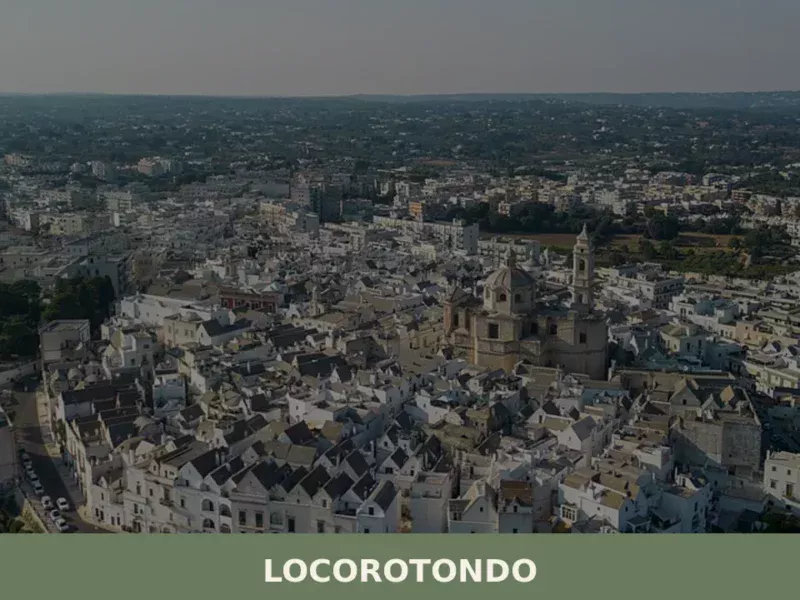
The toponym Locorotondo, documented as early as the 12th century as “Luogo Rotondo” (Round Place), derives from the concentric configuration of its historic center, an urban feature that still distinguishes it within the Itria Valley landscape. Located 410 meters above sea level, this municipality in the province of Bari has 14,258 inhabitants and presents a […]
Castellana Grotte
Hills
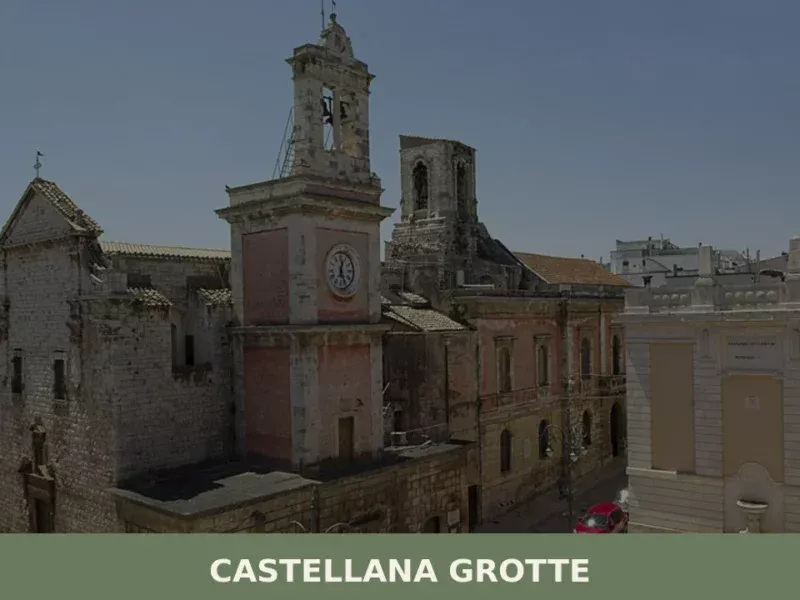
In 1938, speleologist Franco Anelli descended for the first time into a karst chasm a few kilometres from the town centre, revealing to the world an underground system stretching over three kilometres — one of the most extensive in Europe. That discovery permanently transformed the identity of an agricultural municipality on the south-eastern Murgia, placing […]
Altamura
Hills
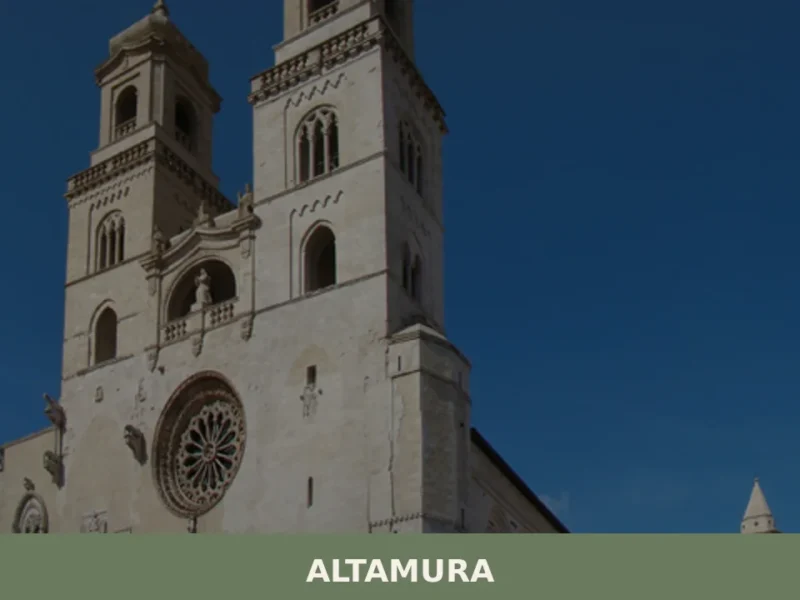
In 1993, inside the Lamalunga limestone quarry a few kilometres from the town centre, a skeleton of Homo neanderthalensis dating back approximately 150,000 years was brought to light — one of the most complete ever found in Europe. That discovery changed the perception of Altamura, transforming it from a bread-making town into a site of […]
Roseto Valfortore
Mountain
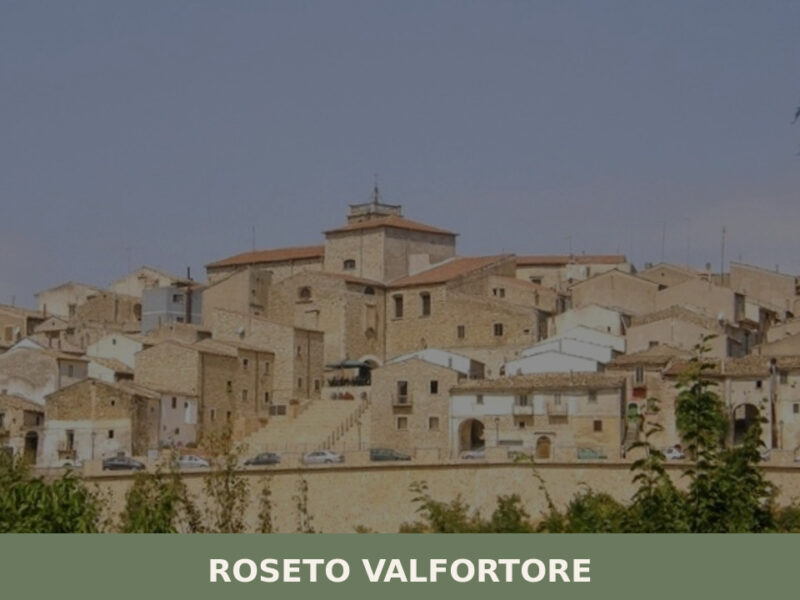
A stone village of 993 inhabitants at 658 metres in the Fortore valley. Roseto Valfortore preserves medieval architecture, mountain cooking traditions, and the quiet of inland Puglia.
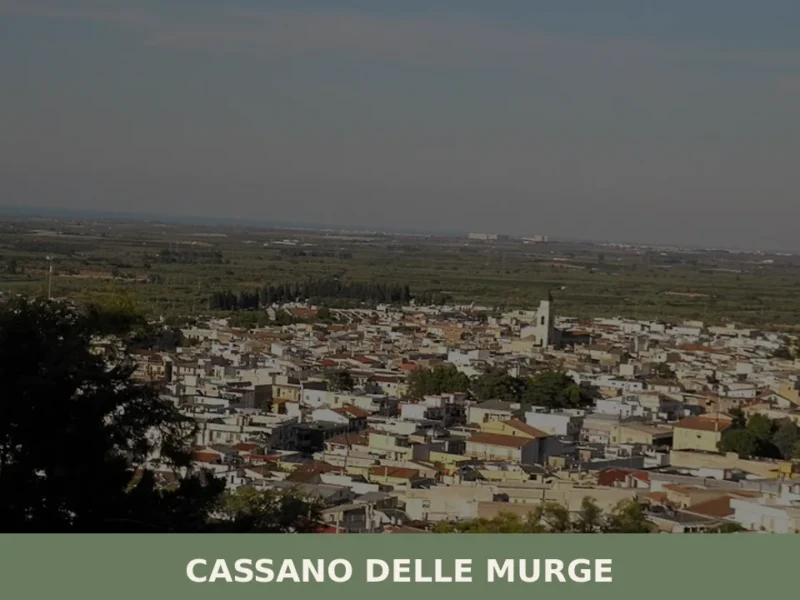
Cassano delle Murge
Hills
Cassano delle Murge, a municipality in Puglia located in the Metropolitan City of Bari, stands at 341 meters above sea level, positioned on the Murge plateau. Its territory, spanning approximately 89 km², includes a significant portion of the Bosco di Mercadante, a forest area important for the local ecosystem. With a population of 14,395 inhabitants, […]
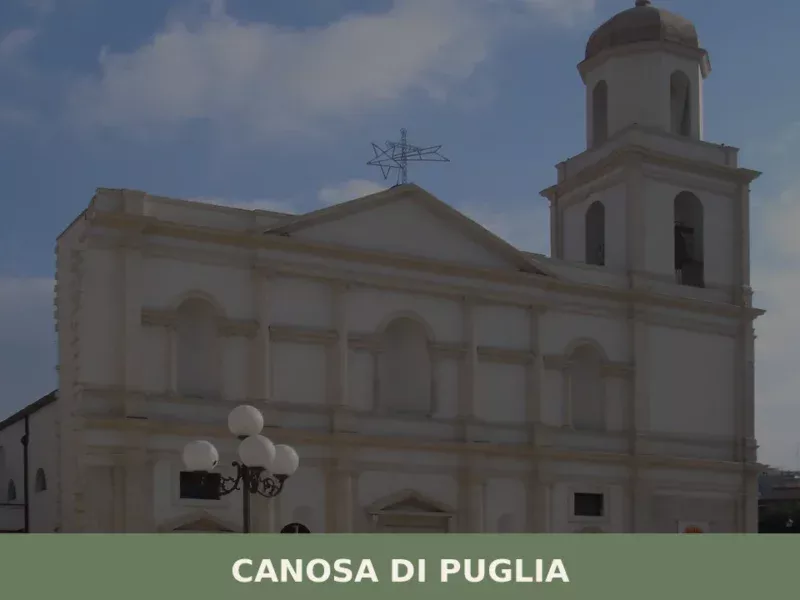
Canosa di Puglia
Hills
Discover what to see in Canosa di Puglia: Roman hypogea, Norman mausoleum, cathedral, archaeology museum and local food in northern Puglia.
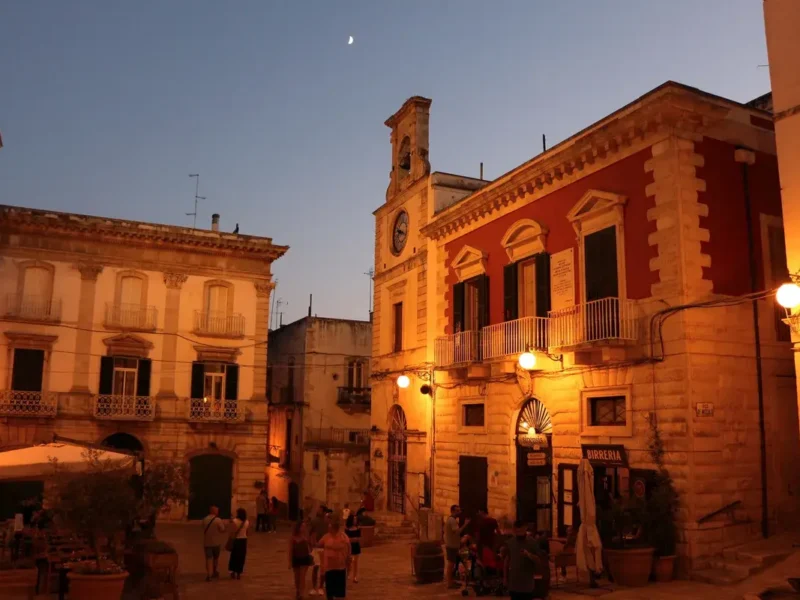
Putignano
Hills
What to see in Putignano: hilltop town at 372m in the Murgia Barese. Grotta del Trullo, 6-century-old Carnival, PAT cuisine. Plan your visit now.
Carapelle
Plains
what to see a Carapelle: 5 attractions, prodotti PAT e festivals patronali a 62 m s.l.m. in the province of Foggia. Scopri history, cuisine e how to get there.
Crispiano
Plains
Discover what to see in Crispiano, a 12,800-person comune near Taranto built around a prehistoric karst ravine, a medieval abbey, and a living farming economy.



🏡 Know Monte Sant’Angelo better than we do?
If you’re a local or have been there, your knowledge matters: add what’s missing or fix a detail on this page.