


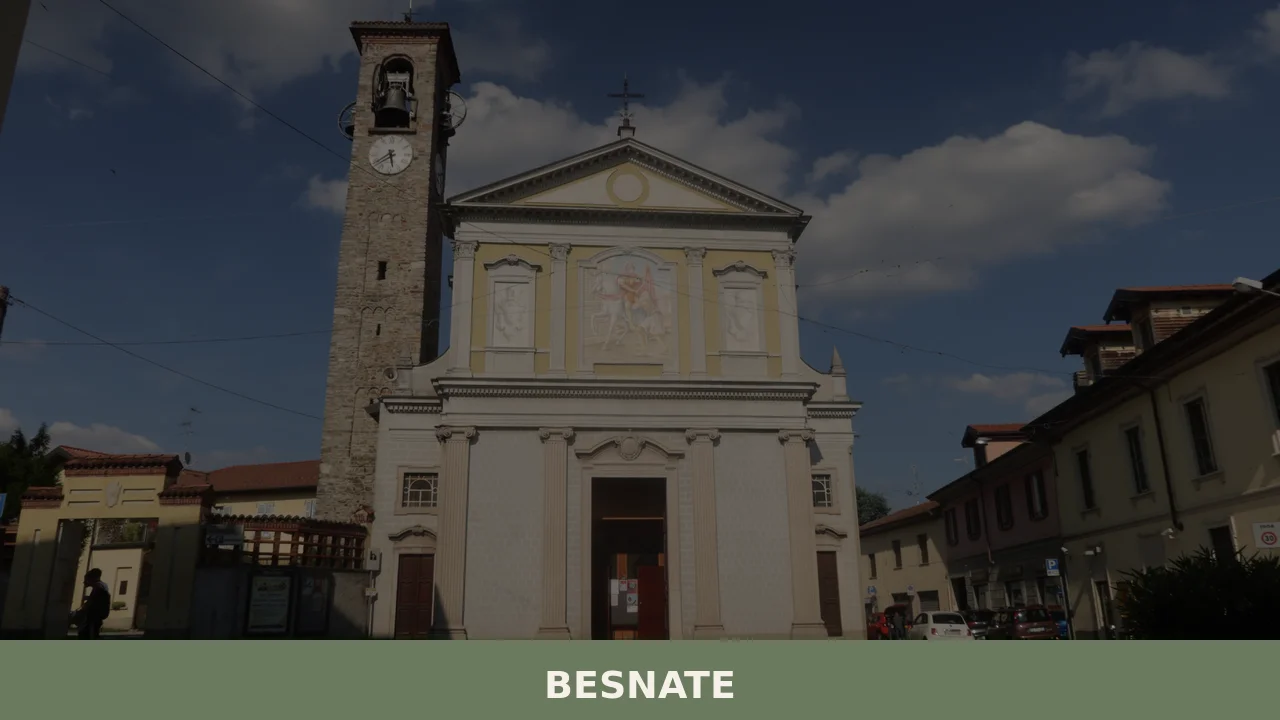
Besnate
With a population of 5,553 inhabitants and an altitude nearing 300 meters above sea level, Besnate is located in the Varese province, appearing as a settlement that retains traces of historical and territorial evolution. This hillside village, where daily life blends with an environment that has maintained rural characteristics, offers insights for those wishing to […]
Discover Besnate
With a population of 5,553 inhabitants and an altitude nearing 300 meters above sea level, Besnate is located in the Varese province, appearing as a settlement that retains traces of historical and territorial evolution. This hillside village, where daily life blends with an environment that has maintained rural characteristics, offers insights for those wishing to understand the dynamics of the Varese area. For those wondering what to see in Besnate, the itinerary reveals architectural elements and views that define the character of the place, away from the most frequented routes but with its own distinct identity. From its churches to its historic residences, Besnate offers an itinerary that invites careful observation and the discovery of its urban and rural fabric, as also documented on the official website of the Municipality of Besnate.
History and origins of Besnate
The toponym “Besnate” has its roots in hypotheses suggesting a Roman origin, perhaps linked to “Bis natos” – meaning “two born” – or deriving from “Bes,” a term that would indicate birch. Such etymologies, though not definitive, attest to the chronological depth of the settlement, whose first documented evidence dates back to the medieval era. The village was part of the Contado del Seprio, an important territorial entity of medieval northern Italy, and experienced the political and military events that characterized this border area.
Over the centuries, Besnate was influenced by great Milanese families, including the Visconti and the Della Torre, who determined its feudal control and ownership. Subsequently, the Besozzi family played a significant role in the management of the territory, contributing to shape the social and urban structure of the village. This succession of dominations left an imprint on the architecture and memory of the place, making Besnate a point of observation for understanding the feudal and lordly dynamics of historical Lombardy, as further explored on Wikipedia.
What to see in Besnate: 5 essential attractions
Parish Church of San Martino Vescovo
Dedicated to the patron saint, San Martino Vescovo (Saint Martin Bishop), this parish church is a reference point for the community. The current building is the result of nineteenth-century renovations, but it preserves earlier elements, including the eighteenth-century bell tower. The facade and interiors reflect the style of the era, featuring sacred artworks. It is an active place of worship and a witness to the spiritual events of Besnate.
Oratory of Sant’Anna
Built in the 17th century, the Oratory of Sant’Anna is an example of minor religious architecture in the Varese area. Its simple structure, often with a single nave and a small sail bell tower, fits into the urban context. These places of worship marked the life of rural communities, serving as a gathering point for prayer and local devotion.
Church of Santa Maria in Besnate
The Church of Santa Maria in Besnate, the oldest in the village, boasts origins in the 12th century. Its architecture displays clear Romanesque elements, visible in the masonry and configuration. Despite subsequent modifications, the church maintains the appearance of a historic building, offering a glimpse into the early phases of Christianization and settlement of the territory.
Villa Borghi
Home to the municipality, Villa Borghi is a nineteenth-century stately residence that overlooks the center. Surrounded by a park, the villa is an example of Lombard civil architecture between the 19th and 20th centuries. Its halls house the municipal offices, but the external structure and part of the interiors retain their original elegance, accessible to the public.
Il Portone
A historical architectural element, “Il Portone” (The Gate) bears witness to the village’s ancient configuration. It likely served as an access point or boundary, defining residential and community spaces. Its presence evokes a past in which such structures were central. It represents a detail that invites reflection on the urban stratifications of Besnate and its evolution.
Typical cuisine and local products
Besnate’s cuisine, deeply rooted in Lombard and particularly Varese tradition, reflects the availability of local raw ingredients. Among the most representative dishes are bruscitti, a main course made of shredded beef cooked slowly with wine and spices, often accompanied by polenta. Luganega di Monza, though not exclusive to Besnate, is a fresh sausage widely common and appreciated in local gastronomy, used in risottos or as a filling.
The gastronomic heritage is also enriched by typical cheeses from the province, such as Formaggella del Luinese DOP, a fresh or semi-aged goat cheese, and baked goods. Amor polenta, a cake made of corn flour and butter, is an example of traditional pastry that can be found in bakeries and pastry shops in the village and surrounding areas. Local festivals, often linked to the patron saint’s day or agricultural cycles, represent opportunities to taste these specialties.
When to visit Besnate: the best time
Besnate, being at an altitude of 300 meters, benefits from a mitigated continental climate, with warm but not sultry summers and cold winters. The best time to visit the village depends on individual preferences. Spring and autumn offer pleasant temperatures and nature that changes color, ideal for explorations on foot or by bicycle in the surrounding hilly areas.
The patron saint’s festival, dedicated to San Martino Vescovo, is celebrated on November 11th. This occasion can be an interesting time to observe local traditions and participate in community events, even if the late autumn climate can be cooler and more humid. Summer allows for full enjoyment of the long days and outdoor activities.
How to get to Besnate
Besnate is well connected to the Lombard road and rail network.
- By car: It is reachable via the A8 motorway (Milan-Varese), exiting at Gallarate or Busto Arsizio and continuing on provincial roads.
- By train: Besnate railway station is served by the S5 line (Varese-Milan Passante-Treviglio) of Milan’s suburban railway service, ensuring direct connections with Varese and the Lombard capital.
- By plane: The nearest airport is Milan Malpensa (MXP), about 15-20 minutes away by car, also connected via taxi or local bus services.
- Distances from major cities: Varese is about 20 km away, Milan about 50 km.
Other villages to discover in Lombardy
The Varese province and all of Lombardy offer a wealth of villages and localities that merit






📝 Incorrect information or updates?
Help us keep the Besnate page accurate and up to date.