


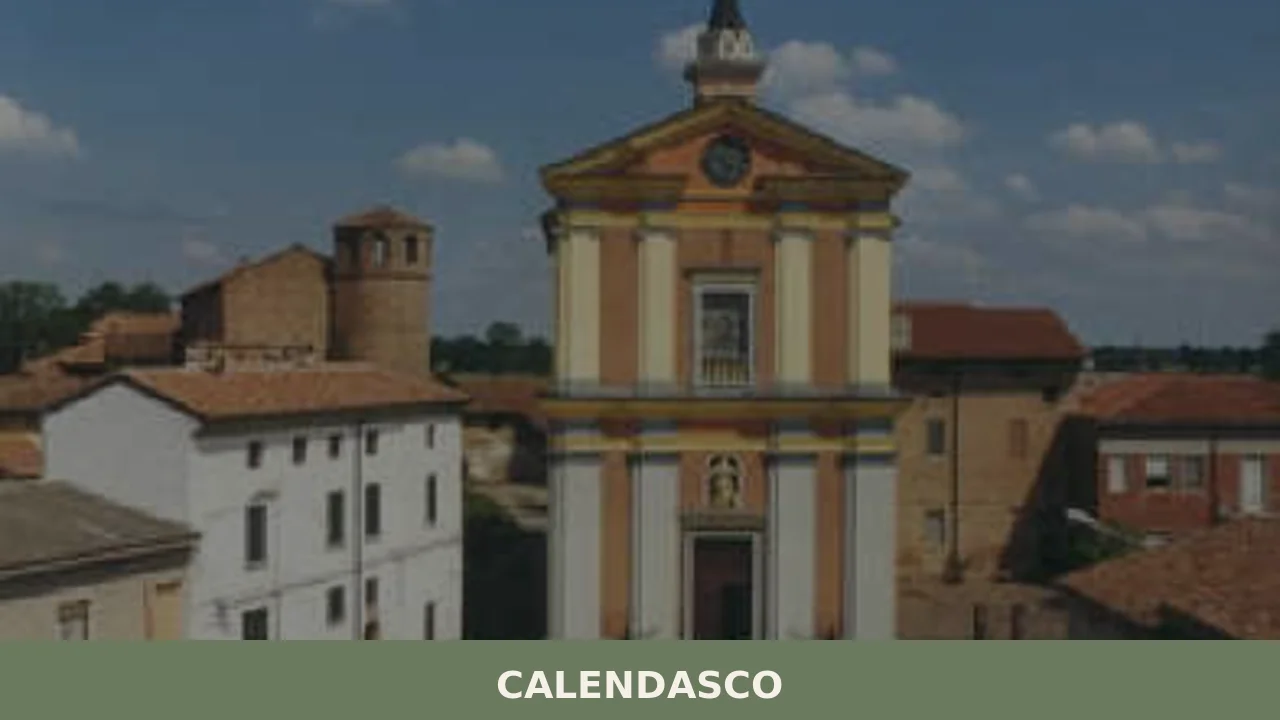
Calendasco
What to see in Calendasco, a village of 2,485 residents on the Po plain at 55 m elevation. Discover the medieval castle, the 19 February Saint Conrad festival and Piacenza cured meats.
Discover Calendasco
Calendasco sits 55 metres above sea level on the right bank of the Po, in the flatlands of the Piacenza plain, and has a current population of 2,485.
Those wondering what to see in Calendasco will find a village with a layered medieval history, shaped by the great dynastic houses of the Po Valley and by a strategic position between the river and the main routes into Piacenza.
The village does not feature heavily on mainstream tourism circuits, and for that reason it retains a genuine character worth exploring: historic buildings, a deep connection to Saint Conrad Confalonieri, and a plain landscape that reflects centuries of human settlement along the great river.
History and Origins of Calendasco
The earliest documentary records of Calendasco date to the medieval period, when the territory was already caught up in the feudal dynamics that defined the Piacenza section of the Po plain.
The village’s name, like many place names in the area, likely reflects the layered presence of Lombard and Carolingian populations that shaped the settlement patterns of this part of Emilia.
Its proximity to the Po made the site valuable both for river trade routes and for military control of the surrounding territory — factors that explain why permanent settlement here took hold relatively early.
Through the Middle Ages, Calendasco fell within the sphere of influence of the great houses competing for dominance over the Piacenza plain, including the Visconti and the noble families tied to the bishopric of Piacenza.
The Castello di Calendasco — the defensive structure that remains the village’s most recognisable architectural feature — has its foundations in precisely this period of feudal territorial organisation.
Later modifications, between the fifteenth and sixteenth centuries, altered the original appearance of the structure while leaving clearly legible traces of its original function: controlling and defending the surrounding land.
In the modern era, Calendasco followed the administrative fortunes of the province of Piacenza, passing under the control of the Farnese Duchy before being absorbed into the new Italian state following unification.
The community maintained a strong agricultural vocation over time, rooted in the fertility of the alluvial plain and in the Po as both a resource and a commercial axis.
The patron saint, Conrad Confalonieri, whose feast falls on 19 February, serves as a point of identity for the local community, linking Calendasco to the broader religious history of the Piacenza territory (as documented in local historical sources).
What to See in Calendasco: Main Attractions
Castello di Calendasco
The Castello di Calendasco is the village’s central architectural landmark and the natural starting point for anyone looking to explore what to see in Calendasco.
The structure, whose origins go back to the medieval period, presents itself as a fortified building that has undergone alterations over the centuries, yet retains the typological features of a Po plain castle.
Its position within the village’s urban fabric makes it possible to read the relationship between the defensive structure and the civilian settlement that grew up around it — offering a direct understanding of how the historic village was spatially organised.
Parish Church of Calendasco
The village parish church is a central point of reference in the community’s religious life and a place of interest for visitors.
The church preserves decorative and artistic elements connected to local devotion, including works relating to the cult of Saint Conrad Confalonieri, the community’s patron saint whose feast is celebrated every year on 19 February. The church forms a focal point within the village’s urban landscape, and a visit helps convey the community’s rootedness in its territory and the artistic expressions of Po Valley Catholicism from the medieval period through to the early modern age.
The Po Riverbank and River Landscape
The municipal territory of Calendasco borders directly on the Po — Italy’s longest river — which has historically determined both the shape of the landscape and the economic activities of the local community.
The floodplain and riverbank today offer natural views of interest, with the riparian vegetation typical of the great Po waterway.
Visitors drawn to Calendasco by an interest in natural landscapes will find the direct contact with the Po one of the most significant aspects of the place: the areas along the river are suited to walking and observing the river environment in a plain setting that still retains its original character.
Historic Centre and Urban Fabric
Calendasco’s historic centre preserves the layout typical of a Po plain village, with an urban structure that developed around the castle and the parish church.
Walking through the streets means observing the rural and civic architecture of the Piacenza plain, with brick buildings that reflect the traditional construction materials of the territory.
It is worth pausing to take in the architectural details of the oldest historic buildings, the rural courtyards still legible in the village’s spatial organisation, and the traces of accumulated construction over the centuries — all of which document the long history of community life in this corner of the Po plain.
Agricultural Landscape of the Piacenza Plain
The agricultural landscape surrounding Calendasco is an integral part of any visit to the village.
The Po alluvial plain displays its most characteristic features here: cereal fields, permanent meadows, tree-lined rows, and historic land reclamation works that have transformed the territory over the centuries.
Anyone exploring what to see in Calendasco should look beyond the built-up centre: the surrounding rural landscape, with its historic farmsteads and productive land organisation, tells the economic and social history of the community just as effectively as the village monuments.
The country roads radiating out from the village are well suited to cycling or walking through the plain.
Local Food and Products of Calendasco
The gastronomy of Calendasco sits within the culinary tradition of the Piacenza plain, one of Italy’s most highly regarded areas for the quality of its agri-food production. The province of Piacenza, of which Calendasco forms part, has historically been defined by a peasant cuisine that has drawn on local agricultural produce, pig and cattle farming, and cereal processing.
The influence of proximity to the Po also makes itself felt in the food tradition, with dishes that make use of freshwater fish and ingredients tied to the river environment.
Among the most representative dishes of Piacenza cuisine found in the Calendasco area, pisarei e fasò hold a place of prominence: these are small dumplings made from stale bread and flour, dressed with a sauce of borlotti beans, onion and lard — a frugal preparation that has become emblematic of the entire provincial food tradition.
Anolini in brodo are another key dish: pasta filled with beef stew and grana cheese, served in a rich broth, typically prepared for feast days.
Coppa piacentina, salame piacentino and pancetta piacentina are the three cured meats that define the territory’s butchery tradition, produced from pork processed according to long-established techniques and aged in environments that take advantage of the climatic conditions of both the hills and the plain around Piacenza.
As regards certified products, the available data does not record any DOP, IGP or PAT certifications specifically attributed to the municipality of Calendasco.
However, the village falls within the Piacenza production area where the DOP cured meats mentioned above are made, and where the cheesemaking tradition connected to Grana Padano DOP is particularly well established — the Piacenza plain being one of the historic production territories for this cheese.
Visitors to the area can find these products at the direct sales outlets of local farms and at markets in the surrounding territory.
Spring and autumn are the seasons when the Piacenza territory offers the richest calendar of food-related events.
The village fairs of nearby communities, often dedicated to cured meats, traditional pasta dishes or garden produce, provide concrete opportunities for those wanting to explore local cuisine during a visit to Calendasco and the surrounding area.
The weekly markets in Piacenza, just a few kilometres away, are the best place to buy fresh and processed products from across the province.
Festivals, Events and Traditions of Calendasco
The patron saint’s festival in Calendasco is dedicated to Saint Conrad Confalonieri and is celebrated on 19 February.
Saint Conrad Confalonieri is a significant figure in the religious history of the Piacenza territory: born in Calendasco around 1290 into a noble family, he initially led the life typical of the nobility until a dramatic episode brought about his conversion, after which he embraced a life of penance and spiritual withdrawal, eventually dying as a hermit in Noto, Sicily, in 1351.
Devotion to the saint runs deep in the local community, which marks his feast day by commemorating this most distinguished of the village’s native sons through traditional religious celebrations.
The 19th of February — the date on which the Catholic Church commemorates Saint Conrad Confalonieri — is the moment in the year when Calendasco most visibly expresses its bond with local religious history.
Celebrations take the form of solemn Mass and, in keeping with the tradition of Po plain villages, moments of communal gathering that draw in both residents and worshippers from neighbouring communities.
The fact that Saint Conrad was born in Calendasco itself gives the patron saint’s festival an identity-forming significance that goes beyond the liturgical calendar, making it an occasion for the community to collectively recognise its own historical roots.
When to Visit Calendasco and How to Get There
The best time to visit Calendasco is spring, between April and June, when the Piacenza plain landscape is at its most agriculturally vibrant and temperatures allow for outdoor excursions without difficulty. Autumn, between September and October, is another favourable season: the fog that settles over the Po plain in November and December has not yet become a consistent presence, and the territory’s food calendar reaches one of its richest points.
Those wishing to attend the patron saint’s festival should instead plan for 19 February, accepting the winter climate typical of the plain. For up-to-date information on local events and services, visit the Calendasco municipal website.
If you are travelling by car, the A1 Milan–Naples motorway provides the most direct connection: the Piacenza Sud exit is around 10 kilometres from Calendasco, making the village easy to reach in a few minutes.
The provincial road linking Piacenza to Calendasco presents no particular difficulties.
Those travelling by train will find Piacenza station the closest rail hub, served by regional and intercity services on the Milan–Bologna line. From Milan Malpensa Airport, approximately 90 kilometres away, Piacenza can be reached by car in under an hour via the A7 and A21 motorways.
Parma Airport, closer at around 50 kilometres, offers an alternative for international travellers arriving on specific routes.
Where to Stay in Calendasco
The municipality of Calendasco and its immediate surroundings have agriturismo accommodation that makes good use of the agricultural character of the Piacenza territory. The agriturismo model is the most widespread in the area, with working farms offering lodging and farm-to-table dining along the Po plain.
Those who prefer a broader range of services can choose to stay in Piacenza, around ten kilometres away, where the hotel offer is wide and varied, and use it as a base for day trips to Calendasco and the surrounding territory.
Other Villages to Discover in Emilia-Romagna
Emilia-Romagna offers a range of villages that, while varying in geographical setting and character, share with Calendasco a compact scale and a close relationship with the land.
Those wishing to extend their itinerary into the Piacenza Apennines can visit Zerba, a small village in the Val Trebbia that presents a mountain landscape entirely different from the Po plain, with a well-preserved rural identity.
Moving towards the Bologna Apennines, Castel di Casio is an example of a hill village with a castle that speaks to the region’s feudal dynamics, while Borgo Tossignano, in the Bologna area, displays a clearly medieval urban layout built on a rocky spur above the Santerno river.
For those keen to explore the variety of the Emilian-Romagnol plains and hills, Casalfiumanese, in the Faenza area, offers a landscape of clay hills with quality agricultural production and a historic centre whose original structure remains clearly legible. An itinerary combining Calendasco with these villages makes it possible to move through several distinct physical environments within the region — Po plain, Piacenza hills, Bologna Apennines, Romagna valleys — building a knowledge of the Emilian-Romagnol territory that cannot be reduced to any single perspective.
In Emilia-Romagna More villages to discover
Bettola
What to see in Bettola: a Val Nure village at 329 m with 2,983 residents. Discover the Sanctuary of the Madonna della Quercia, Piacenza DOP cured meats and how to get there.
Zerba
With just 71 registered inhabitants, Zerba is the least populated municipality in the entire province of Piacenza and one of the smallest in Italy. Situated at 906 metres above sea level in the upper Val Boreca, on the border between Emilia-Romagna and Liguria, this mountain settlement retains a sandstone building fabric that follows precise construction […]
Imola
In 1953, on the track of the Autodromo Enzo e Dino Ferrari, Formula One cars raced in the Italian Grand Prix, placing Imola firmly in international motorsport history. But this city of 69,121 inhabitants, spread out at 47 metres above sea level along the banks of the River Santerno, had already existed for two thousand […]



📝 Incorrect information or updates?
Help us keep the Calendasco page accurate and up to date.