Salt air sharpens every breath along the stone ramparts at dawn, and the Adriatic below shifts between grey-green and pale blue as fishing boats throttle out from the harbour, trailing diesel and the promise of the day’s catch. Termoli — a working coastal town of roughly 32,000 people in the province of Campobasso — sits […]
Salt air sharpens every breath along the stone ramparts at dawn, and the Adriatic below shifts between grey-green and pale blue as fishing boats throttle out from the harbour, trailing diesel and the promise of the day’s catch. Termoli — a working coastal town of roughly 32,000 people in the province of Campobasso — sits just 15 metres above sea level, its medieval core jutting into the sea on a narrow promontory. Understanding what to see in Termoli means stepping past the beachfront and into centuries of layered history that most travellers to southern Italy never encounter.
The origins of Termoli’s name remain debated. Some scholars trace it to the Latin Thermulae, suggesting the presence of ancient thermal springs; others link it to a pre-Roman Italic root. Archaeological evidence confirms settlement in the area since at least the Roman period, though the town’s strategic importance grew in the early Middle Ages, when its elevated promontory offered a natural defensive position against seaborne raids. By the 11th century, Termoli had become a fortified episcopal seat, its cathedral consecrated in a period of Norman consolidation across southern Italy.
Frederick II of Swabia left the most visible mark on the town. In the 13th century, he ordered the construction of the imposing Castello Svevo — the Swabian Castle — a compact, square-towered fortress designed to guard the harbour and the Adriatic coastline against incursions. Under Angevin and later Aragonese rule, Termoli endured sieges, earthquakes, and a devastating Ottoman raid in 1566 that left parts of the old town in ruins. Each occupation added another stratum to the town’s architecture and identity.
Through the 17th and 18th centuries, Termoli remained a modest fishing and trading settlement, overshadowed by larger ports along the Adriatic. Its modern growth came with the arrival of the railway in the late 19th century, which connected it to the national network and slowly transformed it into the primary coastal town of Molise, a region that remains one of Italy’s least visited and least densely populated.
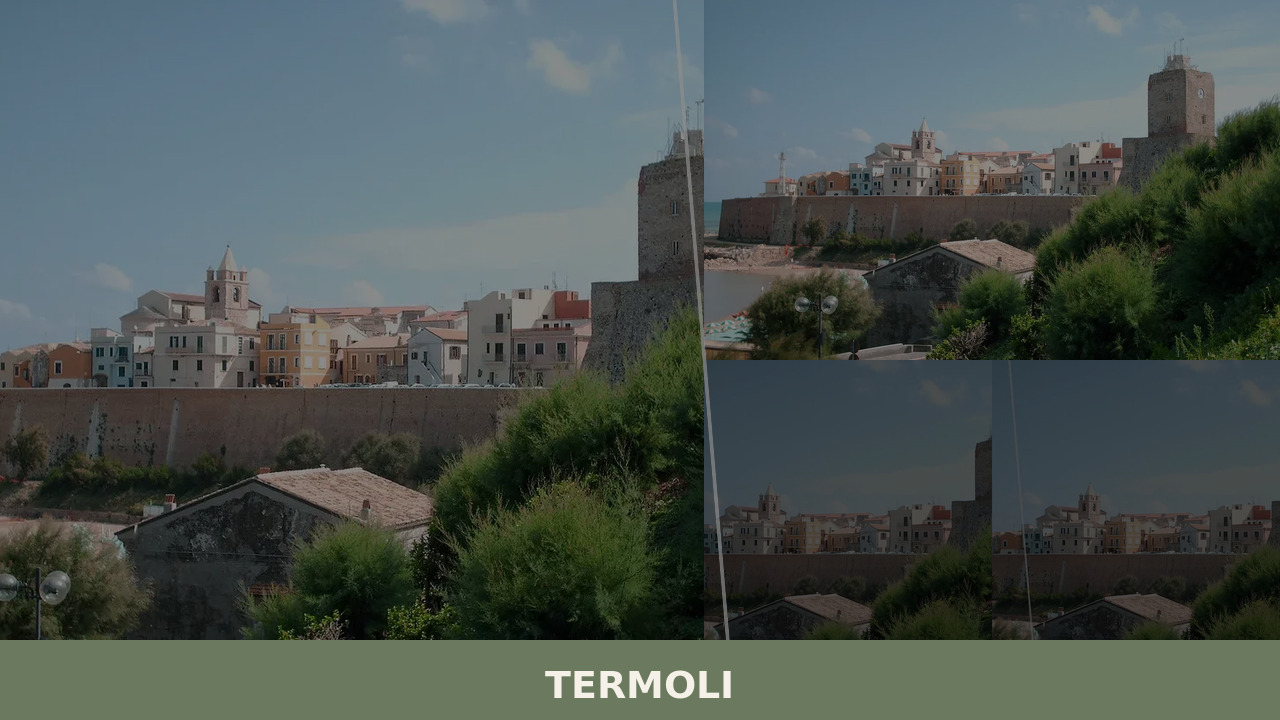
A compact labyrinth of narrow alleys and whitewashed houses perched on the promontory, the Borgo Antico is enclosed by remnants of medieval walls. Laundry hangs between balconies, cats patrol doorsteps, and the lanes open without warning onto sea views. The eastern tip narrows to a point where waves break against the rocks barely a metre below street level — a reminder that this quarter was built for defence, not aesthetics.
Termoli’s cathedral, dating to the 12th and 13th centuries, blends Romanesque and Puglian architectural influences. Its façade features blind arches and a rose window, while the interior holds the relics of Saint Timothy, reportedly brought here from Constantinople. The crypt, with its low vaulted ceiling and worn stone columns, predates the upper church and preserves an atmosphere of quiet austerity.
Frederick II’s castle dominates the skyline of the old town. Its single cylindrical tower rises above a square base, a design characteristic of Swabian military architecture. The walls are built from local sandstone, now weathered to a warm ochre. The castle is not a museum in the conventional sense — its interest lies in its mass, its position, and the panoramic views it commands over the harbour and open sea.
Along the rocky shoreline near the old town, wooden fishing platforms called trabucchi extend over the water on slender poles and cables. These ancient fishing machines — once common along the central Adriatic coast — operate by lowering large nets into the sea and hauling them up with a hand-cranked winch. A few remain in working condition, and their skeletal silhouettes against the water are among the most distinctive sights on this stretch of coast.
Termoli’s harbour is the main departure point for ferries and hydrofoils to the Tremiti Islands, an archipelago roughly 22 nautical miles offshore. Even without boarding a boat, the harbour area — with its fish market, moored trawlers, and the slow choreography of nets being mended — offers a working glimpse of the Adriatic fishing economy that still sustains much of the town.
Termoli’s cuisine is defined by the sea and by the pastoral traditions of the Molisan interior. The town’s signature dish is u’ bredette, a dense fish stew made with whatever the boats bring in — typically a mix of scorpionfish, cuttlefish, mussels, and small crustaceans, slow-cooked in tomato, garlic, and peperoncino. It is unrefined by design, a fisherman’s meal meant to use the unsellable catch. Along the harbour and in the old town, small restaurants serve it in terracotta bowls, often accompanied by slices of toasted bread rubbed with garlic.
Beyond seafood, the province of Campobasso contributes products less widely known but of genuine quality: caciocavallo cheese, handmade cavatelli pasta typically dressed with a slow pork ragù, and local extra-virgin olive oil pressed from the Gentile di Larino cultivar. Molisan wines, including the Tintilia del Molise DOC, a red grape variety grown almost exclusively in this region, are increasingly recognised for their character and have begun appearing on restaurant lists in town. A morning visit to the fish market near the port remains one of the most direct ways to understand what the local table depends on.
Summer — particularly July and August — brings Italian holidaymakers to Termoli’s sandy beaches north and south of the promontory. The town fills, prices rise, and the ferry service to the Tremiti Islands runs at its most frequent. For a clearer sense of the town’s rhythms, May, June, and September offer warm weather without the congestion: water temperatures are comfortable enough for swimming by mid-June, and the light along the old town walls in the early evening is at its most distinctive. The Feast of San Basso, Termoli’s patron saint, falls on 4 August and includes a maritime procession in which the saint’s statue is carried on a decorated fishing boat — a spectacle that draws crowds but remains rooted in genuine local devotion.
Winters are mild by northern European standards but can be raw, with cold winds off the Adriatic and occasional storms that send waves over the harbour walls. Many beachfront establishments close between November and March. However, the old town remains inhabited year-round, and the reduced visitor numbers allow for a more intimate encounter with the place — particularly useful for photography or for anyone interested in the working life of the port.
Termoli sits directly on the A14 Adriatic motorway, which connects Bologna to Taranto along the eastern coast of Italy. From the north, the drive from Pescara takes approximately one hour; from Bari to the south, roughly two and a half hours. The town has its own railway station on the main Adriatic line operated by Trenitalia, with direct services to Bologna, Ancona, Pescara, Foggia, and Bari. Regional trains also connect Termoli inland to Campobasso, the provincial capital, in around ninety minutes. The nearest airports are Pescara (Abruzzo Airport), about 120 km north, and Bari Karol Wojtyła Airport, approximately 200 km south. Naples Capodichino, roughly 230 km to the southwest, offers the widest range of international connections. From the harbour, seasonal ferries and year-round hydrofoils serve the Tremiti Islands, operated by several companies with crossings taking between 50 minutes and one hour.
Termoli functions as Molise’s window onto the Adriatic, but the region’s interior holds a different Italy entirely — one of hill towns, silent valleys, and stone architecture shaped by isolation rather than commerce. Travelling inland from the coast, the landscape climbs quickly into rolling terrain planted with wheat and olive groves, punctuated by compact settlements that have changed little in outline over the past several centuries. These are places where dialect persists and where the rhythms of agriculture still structure the year.
Among the most compelling is Larino, a town roughly 30 km southwest of Termoli with a Roman amphitheatre, a fine Gothic cathedral, and an annual ox-cart procession that dates to the Middle Ages. Further into the Molisan highlands, Guardialfiera overlooks the artificial lake of the same name, its stone houses stacked along a ridge above the water — a landscape that feels removed from the coast by more than mere distance. Together, these places form a mosaic that rewards slow, deliberate travel through one of Italy’s most overlooked regions.
📝 Incorrect information or updates?
Help us keep the Termoli page accurate and up to date.