


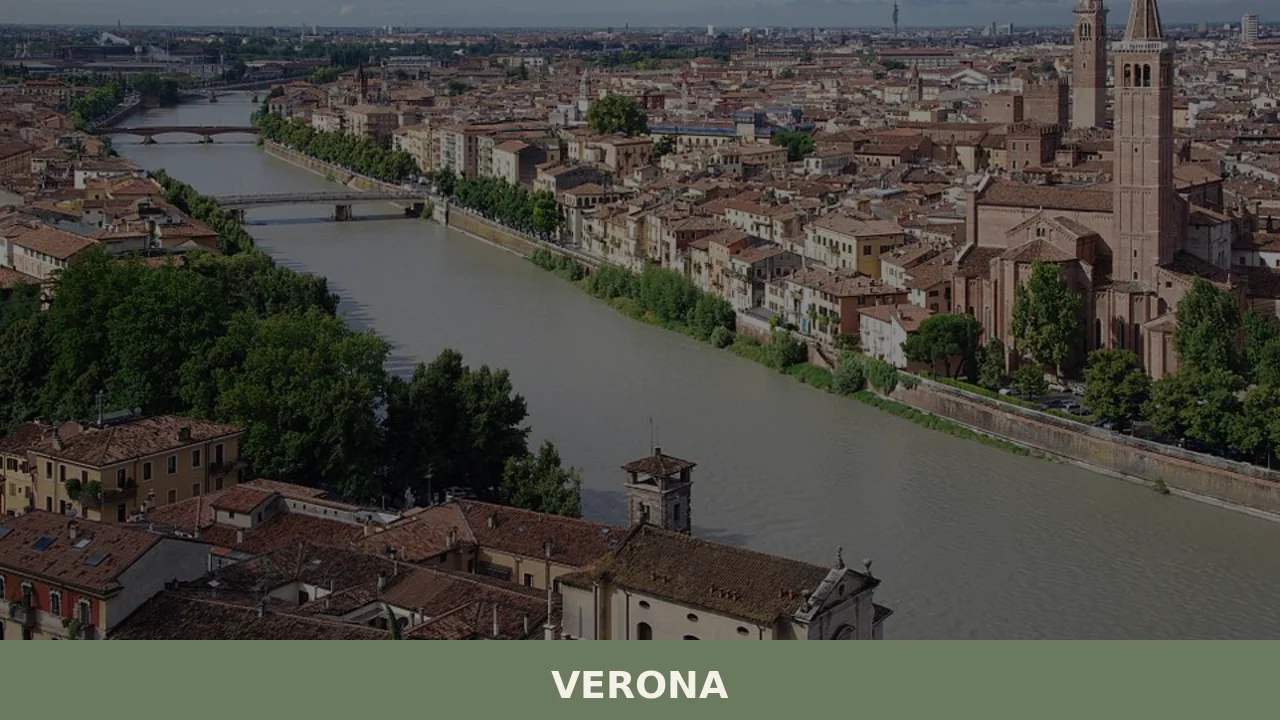
Verona
What to see in Verona, a UNESCO city of 255,000 people. Explore the Roman Arena, Juliet’s House, San Zeno Basilica and local dishes like bollito and pearà. Plan your visit now.
Discover Verona
Verona has a population of over 255,000 and sits at 59 metres above sea level, in the Veneto plain crossed by the Adige river. Anyone researching what to see in Verona will find a city that belongs in a different category from smaller towns: it is a major urban centre, designated a UNESCO World Heritage Site in 2000, with a historic core that preserves Roman, medieval and Renaissance structures with a degree of continuity that is rare in Italy.
The city’s patron saint is Bishop San Zeno, whose feast day falls every year on 21 May — a date that continues to shape both the civic and religious calendar of the city.
History and origins of Verona
Verona’s origins predate the Romans: the site was already inhabited by Raetic and Euganean peoples before Rome established a Latin colony there.
The year traditionally given for the founding of the Roman colony is 49 BC, when Verona was granted Roman citizenship under the Lex Roscia. The city’s name appears in Latin sources as Verona, though its etymology remains debated among scholars: some theories link it to Celtic or Venetic roots, but no explanation has been universally accepted.
During the imperial period, the city became one of the most important centres in Cisalpine Gaul, as evidenced by the construction of the Arena, the great amphitheatre that still defines the city’s urban layout today.
During the fourth and fifth centuries, Verona went through a period of considerable political significance. The emperor Gallienus resided there, and the city was the scene of decisive clashes between rival claimants to the imperial throne.
Following the fall of the Western Roman Empire, Verona came under the control of the Ostrogothic kings: Theodoric the Great, king of the Ostrogoths, made the city one of his preferred residences between the late fifth and early sixth centuries, and the tower associated with him — known as the Torre di re Pipino — still bears traces of this Gothic and Lombard presence in the urban fabric.
The city was subsequently contested between Lombards, Franks and the free communes, and became an important episcopal see from the early Middle Ages onward.
In the medieval period, Verona came under the rule of the Scaligeri family, who governed the city from 1262 to 1387. Under the lords of the Scala dynasty, and particularly under Cangrande I della Scala, Verona reached considerable political power and cultural vitality: the poet Dante Alighieri was welcomed at the Scaligeri court, as documented in historical sources.
After the fall of the Scaligeri, the city passed to the Visconti of Milan and then, in 1405, to the Republic of Venice, under whose rule it remained for nearly four centuries. In 1797, Napoleon Bonaparte brought Venetian dominance to an end; the popular uprising known as the Veronese Easter (Pasque Veronesi) broke out that same year. Verona was subsequently annexed to the Kingdom of Italy in 1866, following the Third War of Independence.
What to see in Verona: main attractions
Verona Arena
The Arena is a Roman amphitheatre built in the first century AD and is among the best-preserved in the world.
It stands on Piazza Bra, in the centre of the city, and can hold up to approximately 15,000 spectators. The elliptical structure, built in pink Valpolicella stone, measures 152 metres along its major axis and 123 metres along its minor axis. Since 1913 it has hosted the celebrated Arena di Verona Opera Festival, with open-air opera performances throughout the summer.
For anyone visiting Verona, the Arena is the essential reference point for understanding the continuity between the ancient city and the contemporary one.
Juliet’s House
Juliet’s House is located at Via Cappello 23 and owes its fame to the tradition identifying it as the residence of the Capulet family, the inspiration for Shakespeare’s drama.
The building is a fourteenth-century medieval palazzo, with the famous marble balcony added in the twentieth century to meet visitor expectations. The bronze statue of Juliet, created by sculptor Nereo Costantini, stands in the inner courtyard. The site is among the most visited in Italy, drawing tourists from around the world regardless of the literary — rather than historical — nature of Juliet as a figure.
Piazza delle Erbe
Piazza delle Erbe occupies the footprint of the old Roman forum and served as the commercial and civic hub of medieval and Renaissance Verona. The square is surrounded by buildings of considerable interest: the seventeenth-century Palazzo Maffei, topped by six statues of deities, the Torre del Gardello dating from 1370, the fourteenth-century Casa dei Mercanti, and the Palazzo del Comune. At its centre stands the Fontana di Madonna Verona, incorporating a Roman statue from the fourth century AD.
Anyone planning what to see in Verona in a single morning will inevitably pass through this square.
Basilica of San Zeno Maggiore
The Basilica of San Zeno Maggiore is widely regarded as one of the masterpieces of Lombard-Venetian Romanesque architecture.
Built between the eleventh and twelfth centuries on the site where Bishop Zeno — the city’s patron saint, whose feast day falls on 21 May — was buried, the church preserves a cycle of 48 bronze relief panels on its doors, dated between the eleventh and twelfth centuries, depicting scenes from the Bible and the life of the saint. Inside, the High Altar Altarpiece by Andrea Mantegna, completed in 1459, is considered one of the high points of Italian Renaissance painting.
Roman Theatre and Archaeological Museum
Verona’s Roman Theatre dates to the first century BC and stands on the right bank of the Adige, at the foot of the hill of San Pietro. The structure, partially restored during the nineteenth and twentieth centuries, now hosts the summer programme known as the Verona Summer Theatre Season (Estate Teatrale Veronese). Above the theatre sits the Archaeological Museum, housed in the former convent of San Girolamo, which holds Roman artefacts including mosaics, bronzes and stonework recovered from urban excavations.
The route ends with a view across the Adige and over the rooftops of the historic centre.
Local food and products of Verona
Veronese cuisine developed at the crossroads of the Po plain, the moraine hills of Lake Garda and the lower Alpine foothills of the Lessinia plateau.
This geographical position gave rise to a gastronomic tradition that draws on both the agricultural produce of the plain — cereals, pulses, beef and pork — and the ingredients of the hillside and lakeside zones. Venetian influences, accumulated over nearly four centuries of rule by the Serenissima, layer over more continental culinary traditions, giving Veronese cooking a dual character that runs through many dishes of the local repertoire.
Among the well-documented dishes of the Veronese tradition, bollito misto alla veronese holds a central place: it is prepared with multiple cuts of beef — including tongue, head meat and muscle — and served with pearà, a sauce made from stale bread, beef marrow, broth and generous amounts of black pepper, slow-cooked in a terracotta pot. Pastissada de caval is another dish deeply rooted in local history: it is a stew of horse meat marinated in red wine with spices, whose origin is traced by documented local tradition to the battle of 489 AD fought by Theodoric near Verona.
Risotto all’Amarone uses the red wine of the Valpolicella as its defining ingredient, giving the dish a dark colour and an intense flavour.
Regarding certified products, the available database does not record any DOP, IGP or PAT certifications specifically associated with the municipal territory of Verona.
On the basis of institutional sources, it can be noted that the province of Verona is home to some of Italy’s best-known wine appellations: Amarone della Valpolicella and Soave are DOCG and DOC wines produced in areas of the province, though not within the city municipality itself. Bardolino, a DOC wine produced on the eastern shores of Lake Garda, also falls within the provincial boundaries. These wines are available in the wine bars and restaurants of the historic centre and form a core part of the local food and drink offer.
The Piazza delle Erbe market runs every morning and is one of the most frequented places to buy fresh produce, cheese and local specialities. During the Christmas period, Verona’s Christmas market — among the most visited in northern Italy — transforms Piazza dei Signori and the surrounding squares into a commercial and festive hub drawing visitors from across the country between November and December.
Festivals, events and traditions of Verona
On 21 May, Verona celebrates the feast of Bishop San Zeno, the city’s patron saint.
San Zeno served as bishop of the city in the fourth century, and his figure is central to Verona’s religious identity: the basilica dedicated to him, built on the site of his burial, draws pilgrims and hosts solemn liturgical celebrations on the occasion of the feast.
The day includes a solemn Mass in the Romanesque basilica, attended by the city’s civil and religious authorities. Local tradition holds that on this day the people of Verona go to the basilica carrying flowering peach branches — a custom documented in local sources.
Among internationally significant cultural events, the Arena di Verona Opera Festival takes place every summer — generally from June to August — and draws audiences from around the world with opera performances under the open sky of the Roman amphitheatre.
The festival was inaugurated in 1913 with a performance of Verdi’s Aida to mark the centenary of the composer’s birth.
Alongside the opera festival, the Verona Summer Theatre Season uses the Roman Theatre as a venue for drama, dance and music performances between July and August. Vinitaly, the international wine trade fair held each April at the Verona Exhibition Centre, is one of the most important events in its sector worldwide, measured by the number of exhibitors and trade visitors.
When to visit Verona and how to get there
Spring and autumn are the most balanced seasons for visiting Verona: temperatures are mild, visitor numbers are less concentrated than in summer, and the historic centre is easier to move around. Those planning to attend the Arena Opera Festival need to arrange their stay between June and August, keeping in mind that this is when the city sees its highest visitor numbers and accommodation prices reach their peak.
The Christmas period, from late November to Epiphany, offers the opportunity to experience the city during the markets, with a distinctly different atmosphere from the rest of the year.
The Verona City Council website provides an up-to-date calendar of public events and information on municipal services.
If you are arriving by car via the A4 motorway (Milan–Venice), the Verona Sud or Verona Est exits allow you to reach the historic centre within minutes, with park-and-ride facilities connected to the centre by the tram line.
Verona Porta Nuova railway station is a major rail hub on the Milan–Venice line, with direct connections to Bologna, the Brenner Pass and Trento.
For those arriving by air, Verona-Villafranca Valerio Catullo Airport is approximately 12 kilometres from the city centre and is reachable by shuttle bus in around 20 minutes. Travellers from abroad researching what to see in Verona will find Catullo Airport the most direct point of entry to the city.
Where to stay in Verona
Verona has a broad and varied accommodation offer, spread across both the historic centre and the surrounding areas, including the hillside municipalities of the Lessinia plateau and the shores of Lake Garda. The historic centre is home to hotels across all categories, many of them housed in historic buildings from the medieval and Renaissance periods.
Agriturismo properties are found mainly in the Valpolicella hills to the north-west and in the Bardolino area along the Garda lakeshore, around 30 kilometres from the centre. B&Bs and short-term rental apartments are available in considerable numbers near the railway station and around Piazza Bra, as recorded on institutional tourism platforms.
Other villages to explore in the Veneto
The Veneto offers a variety of smaller centres that complement its major urban destinations such as Verona.
A few kilometres from the city, Bevilacqua is a village on the Veronese plain dominated by a fifteenth-century castle belonging to the Bevilacqua-Lazise family, which is well preserved and open to visitors: it makes an ideal addition to a city stay for those wishing to explore the wider provincial territory beyond the historic centre.
In the Lessinia, the small municipality of Erbezzo lies at around 1,000 metres above sea level and offers a plateau landscape entirely different from the plain, with nature trails and a quiet mountain setting. Those looking to extend their itinerary towards the mountains may also consider Velo Veronese, another Lessinia village with a documented cheese-making tradition and a landscape of pastures and woodland.
For those directing their travels towards the Dolomites, after exploring what to see in Verona and the surrounding province, Cortina d’Ampezzo is the Veneto’s primary mountain destination: host of the Alpine Ski World Championships in 2021 and set to co-host the Milan-Cortina 2026 Winter Olympics, the town combines Dolomite scenery with high-quality accommodation infrastructure. The route linking the Veronese plain to the Dolomites via the Lessinia and the Pre-Alps forms one of the most varied journeys that the Veneto offers to the curious traveller.
In Veneto More villages to discover
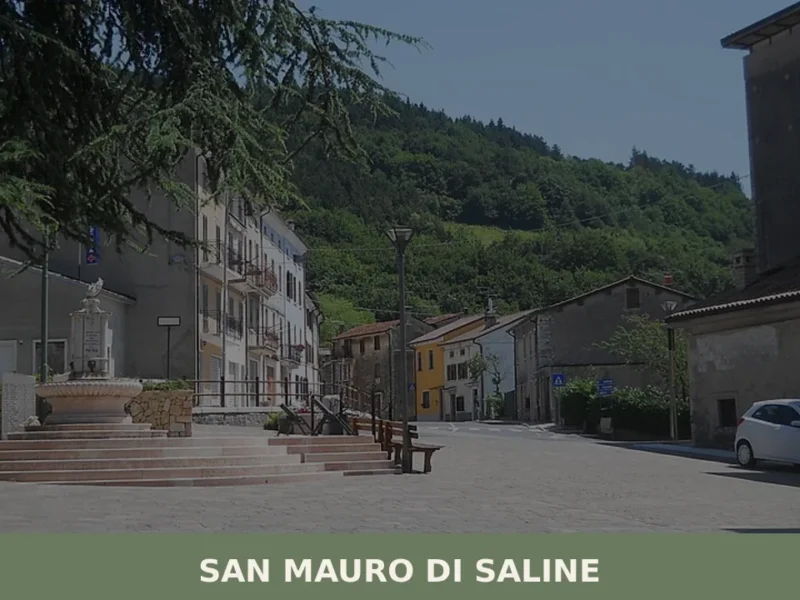
San Mauro di Saline
At 804 metres above sea level, on the eastern slope of the Veronese Lessini Mountains, San Mauro di Saline has a current population of 558 inhabitants spread between the municipal centre and the scattered hamlets along the pastures. The village’s name derives from the saline — the brackish water pools that historically surfaced in this […]
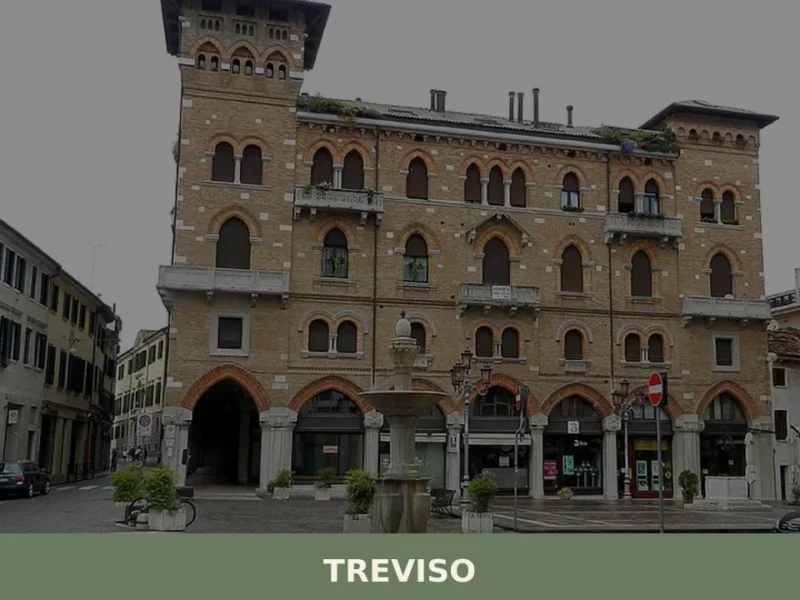
Treviso
What to see in Treviso: 84,000 inhabitants, Venetian walls from 1509, frescoed churches and Radicchio Rosso IGP. Plan your visit with our complete guide.
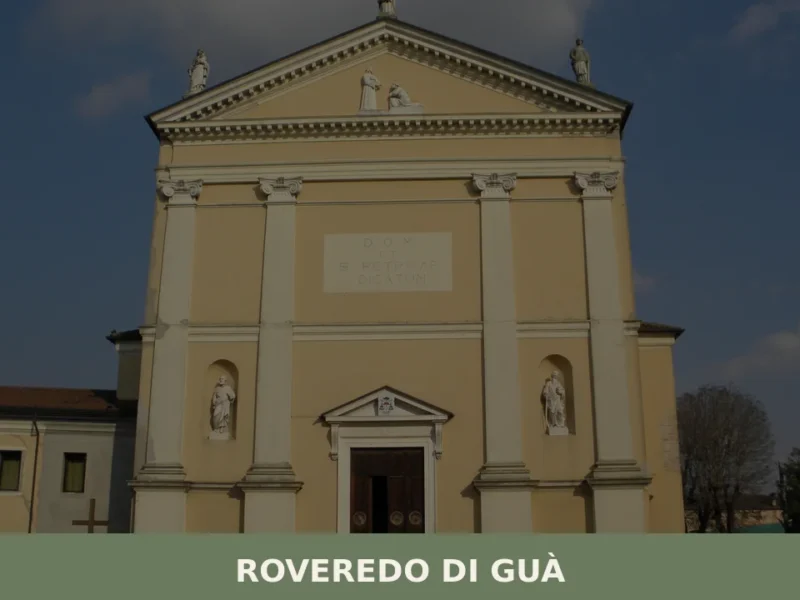
Roveredo di Guà
Roveredo di Guà has 1,542 inhabitants and covers an area of just 8 square kilometres on the lower Veronese plain, 16 metres above sea level, along the course of the Guà canal — a branch of the Adige river system that has determined the shape and economy of this territory. Understanding what to see in […]

📝 Incorrect information or updates?
Help us keep the Verona page accurate and up to date.