


Mantova
what to see in mantova. A UNESCO heritage village with 48,653 inhabitants. Explore Palazzo Ducale and taste the famous Pumpkin Tortelli.
Discover Mantova
With a population of 48,653 inhabitants and an altitude of only 19 m a.s.l., Mantova stands out in the Lombard landscape for its deep connection with water, being almost entirely surrounded by the three lakes formed by the Mincio river.
This peculiar geographical configuration has influenced its history, architecture, and cultural identity, making it a highly charming destination.
Those wondering what to see in Mantova will find an artistic and monumental heritage recognized by UNESCO, the result of centuries of history and an intense cultural flourishing, particularly under the Gonzaga dynasty.
History and Origins of Mantova
The origins of Mantova are rooted in the Bronze Age, with settlements that exploited the fertility of the territory and the natural protection offered by the lakes.
Subsequently, the area was inhabited by the Etruscans and then by the Cenomani Gauls, before being integrated into Roman rule, adopting the name Mantua. During the Roman period, the city maintained a certain strategic and commercial relevance, benefiting from its position along important communication routes. With the fall of the Western Roman Empire, Mantova went through a period of transitions, undergoing the dominations of Goths, Lombards, and Franks, who left traces in its social and urban structure.
The 12th century saw Mantova establish itself as a free commune, a period of growing autonomy and economic development, culminating in the construction of important civil and religious buildings.
The city became a center for trade and exchange, with vibrant artisanal activity.
The decisive turning point in Mantuan history came in 1328 with the ascent to power of the Gonzaga family, who established a seigniory destined to last for almost four centuries. Under the Gonzagas, Mantova experienced its period of greatest splendor, transforming into one of Europe’s most refined courts, a driving center for art, culture, and science, comparable to that of other Lombard towns like the village of Besnate.
The Gonzaga dynasty commissioned architectural and artistic works of inestimable value, attracting artists of the caliber of Andrea Mantegna, Leon Battista Alberti, and Giulio Romano to their court.
Mantova became a duchy in 1530 and continued to flourish until the early 18th century.
In 1707, following the War of the Spanish Succession, the city came under the rule of the Austrian Habsburgs, a period that saw the creation of new infrastructure and administrative reforms.
Subsequently, Mantova was involved in the Napoleonic events and, after the Congress of Vienna, returned under Austrian control as part of the Lombard-Venetian Kingdom, until its annexation to the Kingdom of Italy in 1866, at the end of the Third War of Independence.
What to see in Mantova: main attractions
Ducal Palace of Mantova
The Ducal Palace represents the heart of Gonzaga Mantova, a vast architectural complex that was the main residence of the lords of Mantova from the 14th to the 18th century. Spanning approximately 34,000 square meters, it includes numerous buildings, courtyards, gardens, and squares, with over 500 rooms.
Among its gems stands out the Castle of San Giorgio, a 14th-century fortress that houses the famous Camera degli Sposi (Bridal Chamber), a masterpiece by Andrea Mantegna, frescoed between 1465 and 1474, where the Gonzaga family is celebrated with extraordinary and innovative realism.
A visit to the Ducal Palace offers a journey through richly decorated halls, galleries, and apartments that bear witness to the magnificence of the court, allowing one to fully understand the history and art of this important Lombard center.
Palazzo Te
Commissioned by Federico II Gonzaga and built between 1525 and 1535 by the architect and painter Giulio Romano, Palazzo Te is an exceptional example of a suburban villa and Mannerist architecture.
Conceived as a place of leisure and representation, the palace is famous for its mythological frescoes and perspective illusions.
The main halls include the Hall of Giants, with its walls and ceiling entirely frescoed to create the illusion of being in the center of a mythological battle, and the Hall of Cupid and Psyche, which narrates the story of the two lovers.
The structure, with its large internal courtyard, is a masterpiece of harmony and artistic ingenuity, a visual experience that enchants visitors and fully answers the question of what to see in Mantova to immerse oneself in Renaissance art.
Basilica of Sant’Andrea
The Basilica of Sant’Andrea, one of Mantova’s architectural symbols, was designed by Leon Battista Alberti in the 15th century and completed many years after his death, with the dome built by Filippo Juvarra in the 18th century.
Its imposing facade, with a large triumphal arch reminiscent of ancient Roman architecture, dominates Piazza Mantegna. The interior, with a Latin cross plan, a single nave, and side chapels, houses the tomb of Andrea Mantegna and, above all, the precious relic of the Blood of Christ, an object of veneration and pilgrimages.
The majesty of its proportions and the richness of its decorations make it a fundamental stop for anyone wishing to explore the city’s religious and artistic heritage.
Mantova Cathedral (Cathedral of San Pietro)
The Cathedral of San Pietro, Mantova Cathedral, presents a complex architectural history that reflects its various construction and renovation eras.
The current facade, in Baroque style, was built between 1756 and 1761, while the interior, visually striking, was redesigned by Giulio Romano in the 16th century, incorporating Renaissance elements into a structure of Romanesque origin. The bell tower, also Romanesque, is the oldest and best-preserved element of the building. Inside, the naves are richly decorated and house works of art of considerable value.
A visit to the Cathedral offers an overview of the different artistic and historical phases that have shaped the building, from its foundation to its most recent transformations, making it an essential point of interest.
Rotonda of San Lorenzo
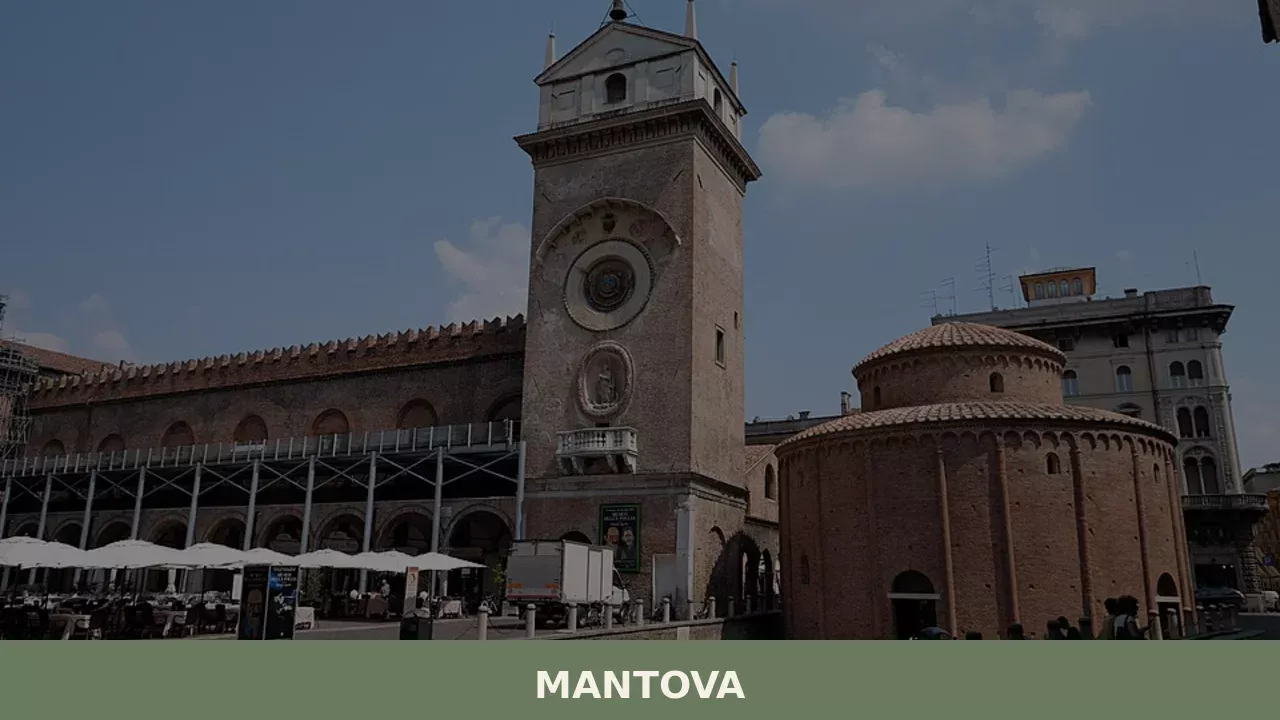
The Rotonda of San Lorenzo is Mantova’s oldest church, a Romanesque gem dating back to the 11th century, characterized by its circular plan and architecture that recalls Byzantine influences, similar to other ancient places of worship in Lombardy, such as those found near Arcisate.
Long incorporated into other buildings and then rediscovered and restored in the 20th century, the Rotonda is a place of great charm. Inside, remains of medieval frescoes are visible, adding to its historical charm. This small but significant architecture offers a unique perspective on medieval Mantova and its urban evolution, representing an interesting attraction for those seeking to discover the city’s deepest roots.
Typical Cuisine and Products of Mantova
The Mantuan gastronomic tradition is deeply rooted in the peasant culture of the Po Valley, characterized by an abundance of agricultural products and the influence of the Gonzaga court, which stimulated a rich and refined cuisine.
The basic ingredients reflect the territory: rice, pumpkin, pork, Parmigiano Reggiano, and mostarda are undisputed protagonists.
This cuisine stands out for its strong flavors and elaborate preparations, which often combine sweet and savory, creating harmonious contrasts and unique dishes that have been handed down from generation to generation.
Among the typical dishes, Pumpkin Tortelli are perhaps the most famous: fresh egg pasta filled with a mixture based on Mantuan pumpkin, amaretti, mostarda, Parmigiano Reggiano, and nutmeg, traditionally seasoned with melted butter and sage.
Another classic is Riso alla pilota, a loose risotto, cooked in a particular way and seasoned with “pistume,” a fresh ground and pan-fried pork salami. No less appreciated is Stracotto d’asino, a donkey meat stew slowly cooked in red wine and herbs, often served with polenta, a robust and flavorful dish that bears witness to the ancient tradition of using every available resource.
Although the database does not list DOP, IGP, or PAT certified products for this specific area, Mantuan gastronomy is rich in traditional specialties that deserve attention.
In addition to the main dishes, you’ll find Luccio in salsa (pike in sauce), a lake fish prepared with a sauce based on capers, anchovies, and parsley, and Bigoli con le sardelle, fresh pasta seasoned with a savory sardine sauce.
Among the desserts, the Torta Sbrisolona stands out, a crumbly cake made from corn flour, almonds, butter, and sugar, which is broken into pieces rather than cut, and the Torta Elvezia, layered with zabaione and butter cream.
For those wishing to purchase typical products, city markets are an excellent resource.
The weekly farmer’s market offers fresh seasonal produce, while the numerous shops in the historic center offer mostarde, artisanal cured meats such as Mantuan Salami, and traditional sweets. Food festivals, such as those dedicated to pumpkin or rice, are held mainly between September and October, offering the opportunity to taste local specialties in a festive atmosphere and to get in touch with the culinary culture of the area.
Festivals, Events, and Traditions of Mantova
Mantova’s cultural life is marked by events rooted in tradition and by international manifestations.
On March 18th, the city celebrates the feast day of its patron saint, Saint Anselm of Lucca.
This day is dedicated to religious celebrations that include solemn masses and processions, in which the local community participates. The streets of the historic center come alive with stalls and small fairs, offering artisanal products and gastronomic specialties, creating a festive atmosphere that involves residents and visitors.
In addition to the patron saint celebrations, Mantova is renowned for highly popular cultural events.
The Festivaletteratura (Literature Festival), held annually in September, transforms the city into a vibrant stage for author encounters, readings, performances, and workshops. This event attracts thousands of enthusiasts from all over Italy and abroad, solidifying Mantova’s reputation as a dynamic cultural center.
Other significant appointments include the Mantova Food & Science Festival, an opportunity to explore the relationship between food and science through conferences and tastings, and various art exhibitions that take place throughout the year, enhancing the city’s rich artistic heritage.
When to visit Mantova and how to get there
The best time to visit Mantova is spring (April-May) and autumn (September-October).
During these months, the climate is mild and pleasant, ideal for strolling through the historic center and visiting the numerous palaces and museums without the intense summer heat. Spring offers lush blooms in the gardens and along the lakes, while autumn coincides with important cultural events such as Festivaletteratura and food festivals dedicated to local products, allowing visitors to fully experience the city’s atmosphere.
Those seeking fewer crowds can consider the winter months, while keeping in mind colder temperatures and reduced opening hours for some attractions.
To reach Mantova, several transportation options can be considered.
By car, the city is well connected via the A22 motorway (Brennero-Modena), with dedicated exits for Mantova Nord and Mantova Sud. From Milan, the journey is approximately 150 km, while from Verona it covers about 45 km. For those who prefer the train, Mantova station is served by regional and interregional connections, with direct routes from Verona, Modena, and Milan.
It is advisable to consult the Trenitalia website for updated schedules and availability. The nearest airports are Valerio Catullo in Verona-Villafranca, approximately 30 km away, Guglielmo Marconi in Bologna, approximately 100 km away, and Milan Linate, approximately 150 km away, offering various arrival possibilities for national and international travelers.
| Starting Point | Distance | Estimated Time |
|---|---|---|
| Verona | 45 km | 40 minutes |
| Modena | 60 km | 1 hour |
| Milan | 150 km | 1 hour and 40 minutes |
Where to stay in Mantova
Mantova, being a city of significant tourist and cultural interest, offers a wide range of accommodation solutions, suitable for various needs and budgets.
In the historic center, visitors can find elegant hotels in period buildings, many of which have been restored to offer modern comforts while retaining their original charm.
There are also numerous bed & breakfasts and guesthouses, often privately run, which offer more intimate and personalized hospitality, allowing for a more authentic experience.
In the immediate vicinity of the center and in the surrounding rural areas, you can find agriturismi (farm stays) and holiday homes that offer a quieter stay in contact with nature, ideal for those seeking relaxation or wishing to explore the Mantuan landscape.
These establishments often feature restaurants that offer typical local cuisine, allowing guests to savor the region’s specialties.
It is advisable to visit the official website of the Municipality of Mantova or major tourist portals to consult accommodation options and book in advance, especially during high season or for important events like Festivaletteratura.
Those visiting Mantova can extend their itinerary to Besano, a village in Lombardy which, although geographically distant, shares with Mantova a rich historical-artistic heritage and the appreciation of its cultural roots, offering travelers an additional perspective on the region.
🧀 Italian traditional products

📝 Incorrect information or updates?
Help us keep the Mantova page accurate and up to date.