Trieste, the capital of the Friuli-Venezia Giulia region, is a city rich in history and culture, a meeting point between Central and Mediterranean Europe. Among the many attractions that make up the offer of what to see in Trieste, Piazza Unità d’Italia stands out as its beating heart and its showcase on the sea.
This monumental square represents a symbol of Trieste’s identity, embodying centuries of history and diverse influences.
Every visitor who arrives in the city cannot help but be fascinated by its grandeur and its unique position directly overlooking the Adriatic.
The Historical Origins of Piazza Unità d’Italia
The history of Piazza Unità d’Italia has its roots in the Middle Ages, when the area was a simple open space known as Piazza Grande, used primarily for commercial purposes and as an access point to the port. Initially, it did not have the majestic appearance we admire today, but was surrounded by less imposing buildings and served as a vital hub for the city’s maritime activities. Its transformation into a representative square began to take shape during the 18th century, when Trieste gained greater importance under the Habsburg Empire, becoming a strategic free port.
In 1870, the square was named after Franz Joseph I, Emperor of Austria, taking the name Piazza Francesco Giuseppe. It was during this period that many of the buildings that characterize it today were erected, reflecting the architectural style of the era and the desire to give the city an image of imperial grandeur. The redevelopment works were intense and involved the demolition of pre-existing structures to make way for the new palaces that would define the current perimeter.
The square thus became the political and social center of Trieste, hosting official events and representing the city’s connection with the Habsburg monarchy.
The current name, Piazza Unità d’Italia, was given to it in 1918, after the end of the First World War and the annexation of Trieste to the Kingdom of Italy.
This change of name was not just a formal act, but symbolized a profound change in the city’s identity and orientation, marking the end of one era and the beginning of another. The square has therefore experienced several historical phases, each of which has left an indelible mark on its architecture and its meaning, making it a symbol of Trieste’s history and its complex events.
The Architecture and Palaces of Piazza Unità d’Italia
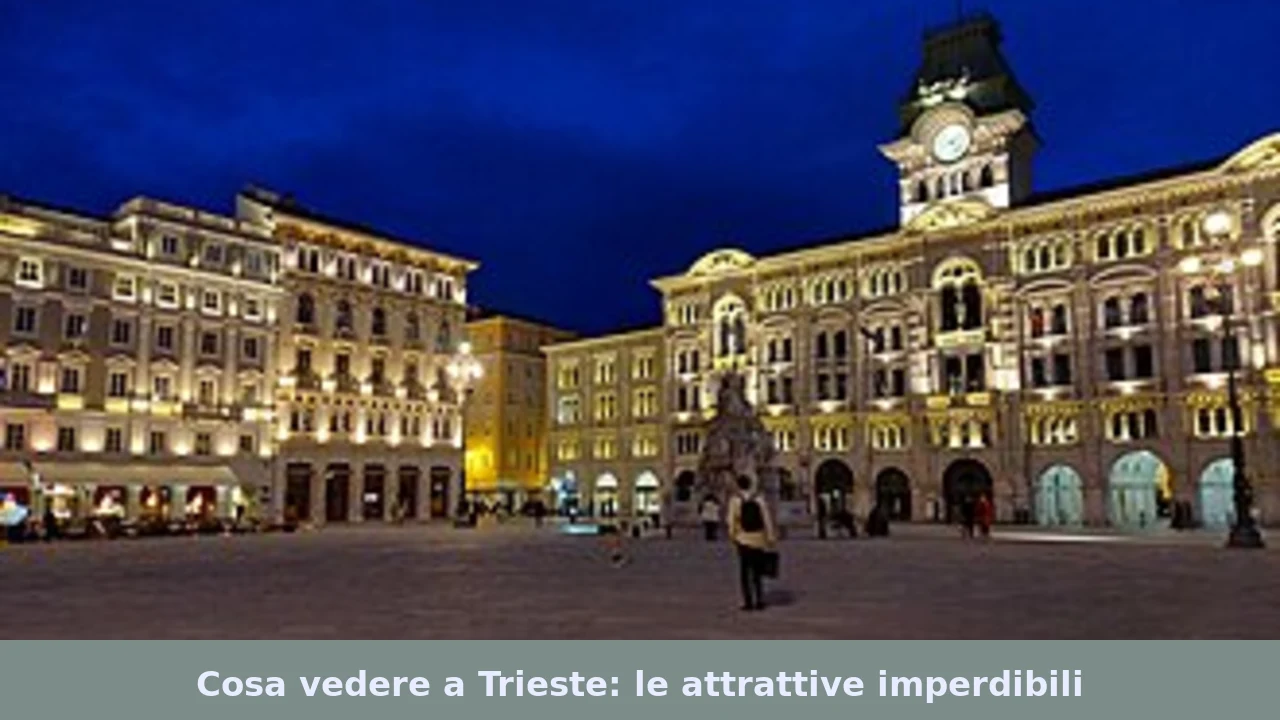
Piazza Unità d’Italia is famous for its extraordinary architecture, which makes it one of Europe’s most captivating squares. Every building surrounding it tells a part of Trieste’s history, with styles ranging from neoclassical to Art Nouveau, testifying to the different eras and cultural influences that have shaped the city. Its rectangular shape, open to the sea, is unique and offers a scenic perspective that immediately captures the visitor’s attention.
Among the most significant palaces, the Palazzo del Governo stands out, located on the northeast side of the square.
Built between 1901 and 1905 based on a design by architect Emilio Ambrosini, it features a majestic facade with eclectic style elements, enriched by mosaics and decorations that recall Byzantine art.
Today, it houses the Prefecture of Trieste. Opposite, on the other side, stands the Palazzo del Municipio, or Palazzo Che sarà, designed by Giuseppe Bruni and completed in 1875. Its clock tower, with the statues of “Michez and Jachez” marking the hours, is an iconic landmark for the square and the entire city. The palace houses the municipal offices and represents Trieste’s administrative center.
On the southeast side, overlooking the sea, is the Palazzo Lloyd Triestino, now home to the Friuli-Venezia Giulia Region. Built between 1880 and 1883 based on a design by Heinrich von Ferstel, the building is distinguished by its two side fountains symbolizing the Danube and Adige rivers, highlighting the connection between Trieste and its river hinterland.
Next to it, the Palazzo Stratti, built in 1839 for the Greek merchant Nicolò Stratti, houses the historic Caffè degli Specchi, a cultural and social meeting place that has seen numerous intellectuals and artists pass through its doors. Finally, the Palazzo Pitteri, the oldest in the square, dates back to 1780 and features an elegant neoclassical facade, testifying to the early stages of the area’s urban development.
In the center of the square is the Fountain of the Four Continents, created between 1751 and 1754 by Giovanni Battista Mazzoleni.
This Baroque fountain is an allegory of the four then-known continents (Europe, Asia, Africa, and America), with figures symbolizing rivers and exotic animals, and a statue of the city of Trieste at its center, depicted as a woman welcoming the world. Next to the fountain, the Column of Charles VI, erected in 1728, celebrates the emperor who proclaimed Trieste a free port, a crucial event for the city’s economic development.
The combination of these architectural and sculptural elements gives the square a grandeur and richness of detail that make it a true open-air museum.
Piazza Unità d’Italia: The Heart of Trieste’s Events and Life
Piazza Unità d’Italia is not just a historical and architectural monument; it is also the hub of Trieste’s social and cultural life. Its vast surface, strategic location, and the atmosphere created between the imposing palaces and the sea make it the ideal venue for hosting a multitude of events. Throughout the year, the square transforms into an open-air stage for concerts, sporting events, national celebrations, and fairs, attracting both residents and tourists.
This centrality makes it an essential reference point for anyone wishing to immerse themselves in daily life in Trieste.
One of the most anticipated and spectacular events taking place in Piazza Unità d’Italia is the Barcolana, the international sailing regatta held every October in the Gulf of Trieste. The square becomes a privileged vantage point to witness the arrival of the boats and hosts numerous stands and collateral initiatives that animate the city for days. During the Christmas season, the square lights up with festive installations and hosts traditional markets, creating an evocative and welcoming atmosphere.
New Year’s Eve celebrations also find their grandest setting here, with concerts and fireworks displays attracting thousands of people.
Beyond large-scale events, the square is a daily meeting point for the people of Trieste. It is the place for an evening stroll, enjoying a coffee in one of its historic establishments like Caffè degli Specchi, or simply sitting on the benches to admire the panorama and the sea breeze. Its openness to the sea offers a sense of freedom and space, making it a beloved spot for moments of relaxation and contemplation. The presence of boats moored just a few steps away reinforces the city’s indissoluble link with its port and its maritime vocation, offering a dynamic and ever-changing backdrop.
Planning your visit to Piazza Unità d’Italia
Visiting Piazza Unità d’Italia is an experience that deserves to be planned to fully appreciate every detail.
As the heart of Trieste, it is easily accessible and offers various opportunities to explore not only the square itself but also its surroundings. If you arrive by car, you can find paid parking nearby, such as Park San Giusto or the underground car parks of Molo IV, although the historic center is preferably explored on foot. Those arriving by public transport, such as city buses, will find numerous stops in the immediate vicinity of the square, making access extremely convenient.
The best time to visit the square depends on your preferences.
During the day, the sunlight enhances the architectural details of the palaces and the brilliance of the sea, ideal for those who wish to take photographs or study the art of the buildings. At sunset, the square is bathed in warm colors and offers a romantic spectacle, with the sky merging with the Adriatic. In the evening, the artistic illumination of the palaces gives the square a magical and sophisticated atmosphere, perfect for a relaxing stroll or an aperitif in one of the historic cafes. Consider dedicating at least an hour, or even more, to walk around, observe, and perhaps stop for a coffee, savoring the unique atmosphere.
Here are some practical tips for your visit:
- Duration of the visit: Allow at least 1-2 hours to calmly explore the square, admire the buildings, the fountain, and enjoy the sea view.
- Photography: The square offers countless picturesque spots for photos, especially at sunset or at night when it is illuminated.
- Historic Cafes: Don’t miss the opportunity to sit at Caffè degli Specchi for a coffee or an aperitif, experiencing a piece of Trieste’s history.
- Tourist Information: Trieste’s tourist office is located a few steps from the square, in Via dell’Orologio, and can provide maps and further details on the city’s attractions.
You can consult the official tourism website of Friuli-Venezia Giulia for updated information.
- Events: Check the local events calendar before your visit; you might have the opportunity to attend concerts, markets, or other events that liven up the square.
The square is fully accessible and suitable for visiting at any time of the year, although spring and autumn offer milder temperatures and less crowding compared to the high summer season. It is an ideal place to begin your discovery of Trieste, from which you can easily continue towards Molo Audace, Canal Grande, or Teatro Verdi, all within a short walking distance.
Curiosities and Symbolisms of Piazza Unità d’Italia
Piazza Unità d’Italia is a place rich in curiosities and symbolisms that enhance its charm and historical depth. One of its most distinctive features is its uniqueness: it is the only large European square that directly overlooks the sea, without road interruptions or significant barriers between the buildings and the water. This peculiarity gives it an openness and brightness that distinguish it from other city squares, creating a direct and visceral connection with the Adriatic, a fundamental element in Trieste’s identity.
An interesting anecdote concerns its night-time illumination.
Until a few years ago, the square was traditionally lit.
However, for special events or particular periods, the lighting is transformed with artistic projections onto the buildings and light displays that enhance the facades and sculptures. These luminous interventions, often themed, have the ability to reinvent the space and offer a completely new perspective of the square, making it a visual spectacle that attracts many visitors after sunset. The square’s ability to adapt and transform, while maintaining its historical grandeur, is a sign of its vitality.
The Fountain of the Four Continents, in the center of the square, is a true compendium of symbols. Besides representing the continents, the allegorical figures and exotic animals carved in stone tell the story of Trieste’s maritime trade and its openness to the world. The water, gushing from the fountain, symbolizes life and prosperity, crucial elements for a port city like Trieste. The statue of the woman representing Trieste, with open arms as a sign of welcome, is a clear message of the city’s cosmopolitan vocation.
The Column of Charles VI also recalls a fundamental moment for Trieste’s economy, emphasizing the importance of political decisions in shaping the destiny of a place.
Finally, the presence of Molo Audace, extending from the square into the gulf, is another curiosity.
This pier, originally part of a ship sunk in the port, has become an iconic spot for walks and for enjoying the view of the square from the sea. Its name comes from the destroyer Audace, the first Italian ship to enter the port of Trieste in 1918, marking the city’s annexation to Italy. Walking along the Molo Audace means retracing a piece of history and admiring the square from a unique perspective, with its majestic buildings silhouetted against the sky and the sea, in an image that remains imprinted in the memory of those who visit Trieste.
Frequently Asked Questions about Piazza Unità d’Italia
What is the origin of the name Piazza Unità d’Italia?
The square has had several names throughout history. Initially, it was known as Piazza Grande. In 1870, it was named after Franz Joseph I, Emperor of Austria, becoming Piazza Francesco Giuseppe. Its current name, Piazza Unità d’Italia, was assigned to it in 1918, after Trieste’s annexation to the Kingdom of Italy.
What are the most important buildings overlooking the square?
Several historic and architecturally significant buildings overlook the square.
Among these are the Palazzo del Governo (now the Prefecture), the Palazzo del Municipio (municipal seat), the Palazzo Lloyd Triestino (now the seat of the Friuli-Venezia Giulia Region), the Palazzo Stratti (with the historic Caffè degli Specchi), and the Palazzo Pitteri.
Is it possible to participate in events or manifestations in Piazza Unità d’Italia?
Absolutely.
Piazza Unità d’Italia is Trieste’s main stage for public events. It regularly hosts concerts, traditional markets, national celebrations, sporting events like the Barcolana, and shows during holidays, including New Year’s Eve festivities.
Piazza Unità d’Italia is undoubtedly a place that defines Trieste, an ideal starting point for exploring the city and its surroundings. We highly recommend dedicating time to this square, to let yourself be enveloped by its history and beauty. For more details on Trieste and to plan your trip, visit the complete village profile on our portal.