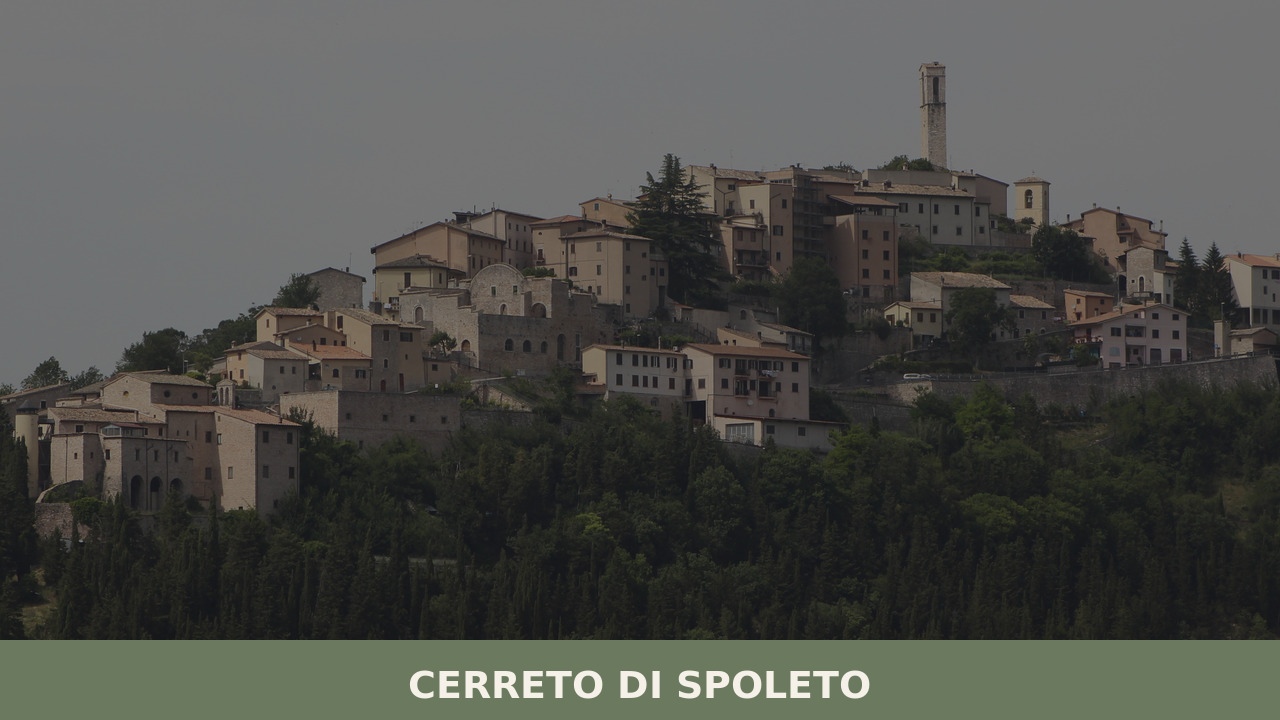
A ridge-top village of 975 inhabitants in the Valnerina, Cerreto di Spoleto holds medieval streets, scattered hamlets, and a centuries-old tradition of itinerant herbalists.
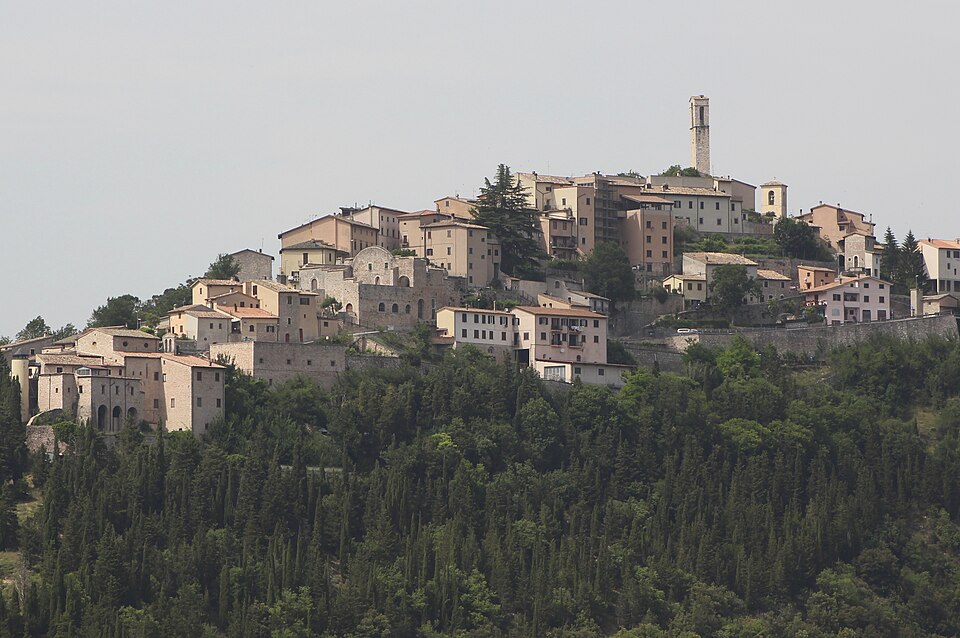
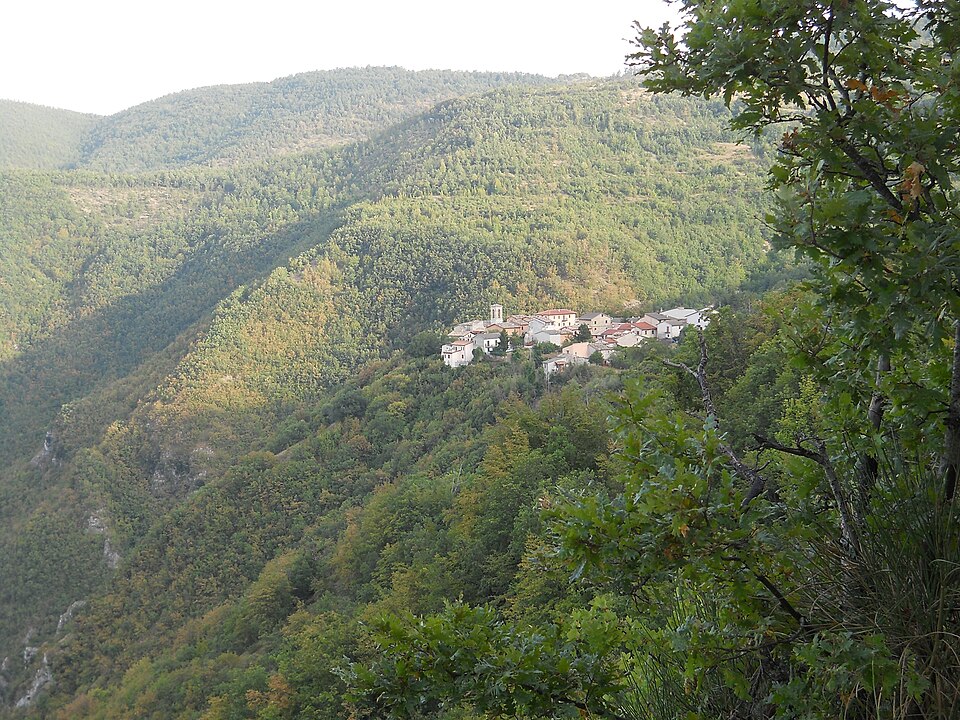
Morning fog lifts from the Nera valley in long, slow ribbons, revealing stone walls the colour of dry honey. A church bell marks seven o’clock — not for tourists, but for the few hundred residents who still keep time by it. At 557 metres above sea level, Cerreto di Spoleto stands on its ridge like a watchtower over eastern Umbria, a municipality of 975 people spread across a constellation of hamlets. If you are wondering what to see in Cerreto di Spoleto, the answer begins with this silence, this mineral light, and the layered medieval fabric that no restoration has managed to simplify.
The name likely derives from cerretum, the Latin word for a grove of Turkey oaks (Quercus cerris), a tree that still colonises the surrounding hillsides. The settlement’s strategic position — controlling the narrow Valnerina corridor between Spoleto and Norcia — made it a coveted stronghold throughout the Middle Ages. By the 13th century, Cerreto had established itself as a castello under the jurisdiction of Spoleto, its fortified walls encircling a tight cluster of houses, a parish church, and a communal palace that served as both administrative seat and symbol of civic identity.
The village’s most distinctive cultural legacy, however, is less monumental. Cerreto di Spoleto was historically linked to the ciarlatani — itinerant herbalists, tooth-pullers, and sellers of remedies who travelled across Italy and into France between the 16th and 19th centuries. The term “charlatan” in several European languages is etymologically connected to these figures, and Cerreto claims a particular place in that story. A documented tradition of itinerant commerce shaped the village’s economy and its reputation far beyond the Apennines.
Earthquakes — the recurring antagonist of Apennine communities — damaged Cerreto repeatedly, most severely in 1328, 1703, and again in the seismic events of 1997 and 2016. Each reconstruction altered the village’s profile slightly, yet the medieval street plan persists: narrow lanes climbing toward the upper church, small piazzas where three or four alleys converge, doorways with worn sandstone lintels bearing dates in Roman numerals.
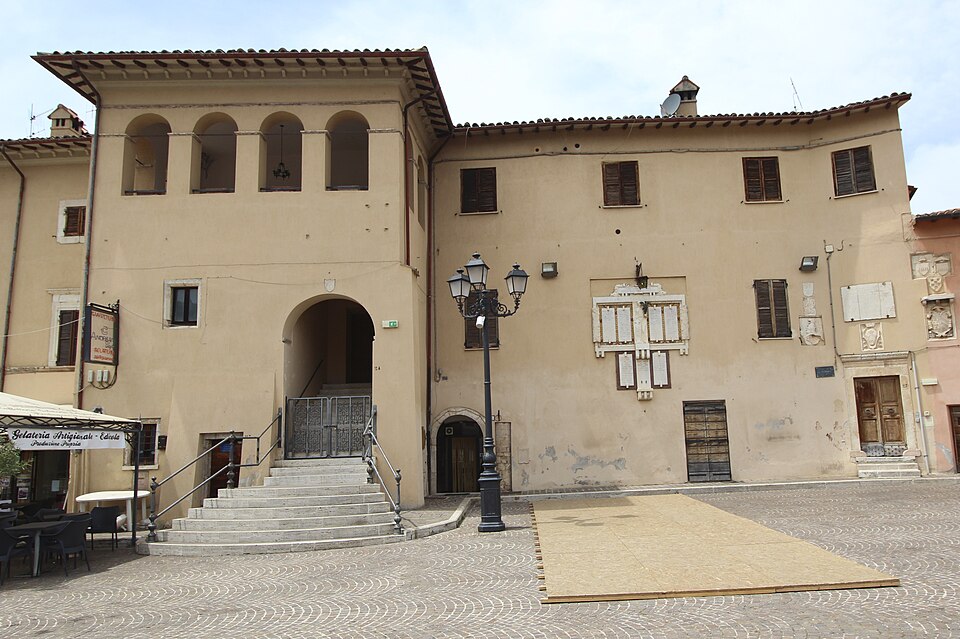
This compact civic building, visible from the main approach road, anchored the political life of the castello for centuries. Its façade — plain, load-bearing stone with a few arched openings — is a lesson in the austere functionalism of medieval Umbrian architecture. The structure has been rebuilt after successive earthquakes but retains its proportional relationship to the surrounding piazza, a space scaled for a community that governed itself within earshot.
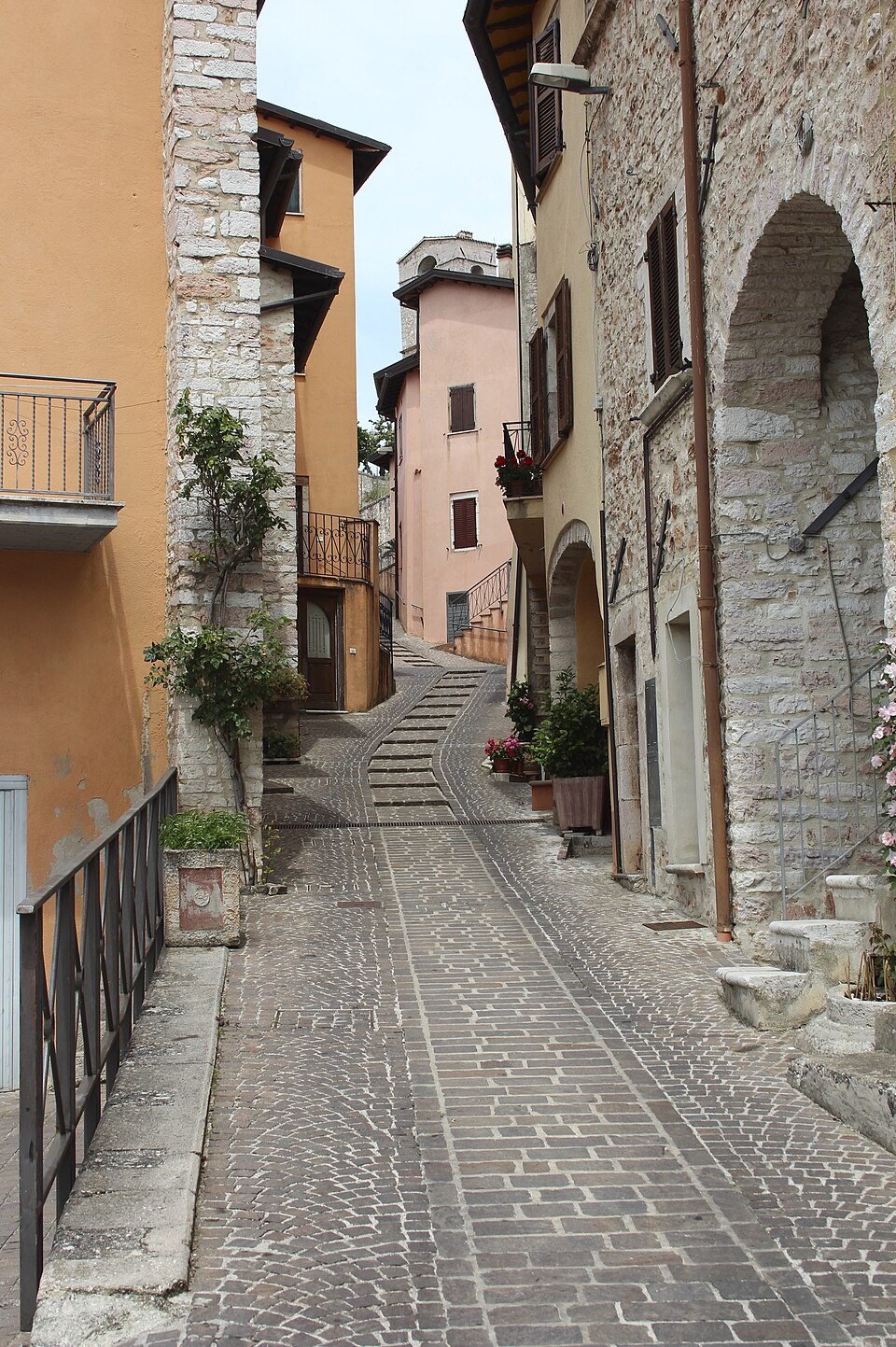
Cerreto’s internal streets are its truest monument. Built on steeply graded rock, they fold back on themselves in switchbacks barely wide enough for a loaded mule. External staircases climb to upper storeys. Stone arches bridge the gap between facing houses, providing structural reinforcement after seismic damage. Walking here is an act of reading — every patched wall records a different century’s response to gravity and tremor.
The hamlet of Borgo Cerreto, located at the valley floor where the Nera meets the Vigi stream, functions as the municipality’s commercial centre. The Church of San Lorenzo, a Romanesque foundation later modified, preserves fragments of frescoed decoration. Borgo Cerreto also sits at a crossroads that has been significant since Roman times — the point where routes to Norcia and Visso diverge.
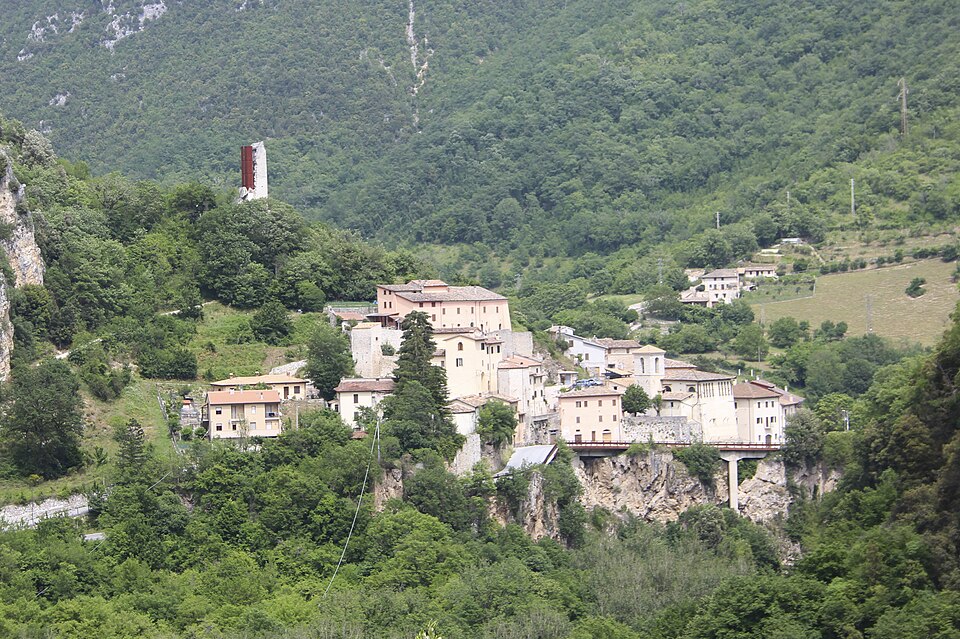
Perched above the confluence of the Nera and the Corno rivers, the hamlet of Triponzo was known for its sulphurous thermal waters, exploited since at least the 19th century. The 2016 earthquake severely damaged the settlement, and reconstruction continues. The approach road offers a view of the hamlet’s layered position — dwellings stacked against a cliff face, the river cutting its gorge below.
The tiny hamlet of Nortosce, reached by a road that contours along the mountainside above the valley, offers a perspective that explains the entire territorial logic of the municipality. From here, the dispersed pattern of settlement becomes legible: clusters of stone houses positioned at intervals along ridges and saddles, each commanding a visual relationship with the next, a chain of mutual surveillance inherited from centuries of insecurity.
The cooking of the Valnerina is mountain cooking — caloric, seasonal, and anchored to a handful of ingredients with little room for improvisation. Black truffles (tartufo nero), particularly the prized Tuber melanosporum harvested in winter, dominate local menus. They appear shaved over handmade strangozzi pasta or folded into an omelette (frittata al tartufo) that is deceptively simple and intensely aromatic. Lentils from nearby Castelluccio di Norcia, a product with IGP certification, are another staple — small, thin-skinned, cooked without soaking. Cured meats, especially wild boar salami and ciauscolo (a soft, spreadable pork sausage typical of the Apennine borderlands between Umbria and the Marche), round out the table.
Farro (emmer wheat) and roveja (a grey-green field pea cultivated at altitude) are older crops enjoying a revival among small producers. Local olive oil, pressed from groves on the lower, sun-facing slopes, tends toward the peppery and herbaceous end of the Umbrian spectrum. In Borgo Cerreto and the village centre, a small number of trattorie and agriturismi serve these products directly — expect short menus, handwritten, changing with the season and the mood of the kitchen.
Late spring — May and early June — brings the clearest light and the most comfortable temperatures for walking the steep streets and exploring surrounding hamlets on foot. The oak woods are fully leafed, wildflowers line the roadsides, and the high meadows above Nortosce are at their most vivid. Autumn, from late October through November, is truffle season, and the valley takes on a particular focus: the economy and the cuisine align around the harvest. Winter is cold and quiet, with temperatures regularly dropping below freezing at this altitude, but the absence of visitors gives the village its most authentic rhythm.
The municipality hosts events linked to the ciarlatano tradition and local food culture; details vary year to year and are best confirmed through the official municipality website. If you are planning around regional events, the Umbria Tourism board maintains a calendar covering the entire Valnerina. Regardless of timing, bring layers — the altitude and the valley’s orientation create abrupt temperature shifts between sun and shade, morning and evening.
Cerreto di Spoleto lies along the SS 209 Valnerina road, the old main route connecting Terni to Visso through the Nera river gorge. From Spoleto, the drive is approximately 30 kilometres northeast, taking around 35 minutes on winding but well-maintained roads. From Norcia, the distance is roughly 20 kilometres to the southeast.
Cerreto di Spoleto belongs to a network of small Valnerina communities whose histories, economies, and even family ties have been interwoven for centuries. To the south, the fortified village of Vallo di Nera clings to a conical hill above the Nera, its intact walls and frescoed churches making it one of the most visually concentrated medieval settlements in the valley. It is a natural complement to Cerreto — the two villages offer contrasting expressions of the same building culture.
Further along the valley, the village of Scheggino occupies a narrow strip of flat ground beside the river, its houses rising directly from the water’s edge. Known as a centre of the Umbrian truffle trade, Scheggino shares the culinary identity of the Valnerina while offering a different spatial experience — horizontal where Cerreto is vertical, river-bound where Cerreto is ridge-bound. Together, these communities map the full range of how people have adapted to this landscape over a thousand years.
📝 Incorrect information or updates?
Help us keep the Cerreto di Spoleto page accurate and up to date.