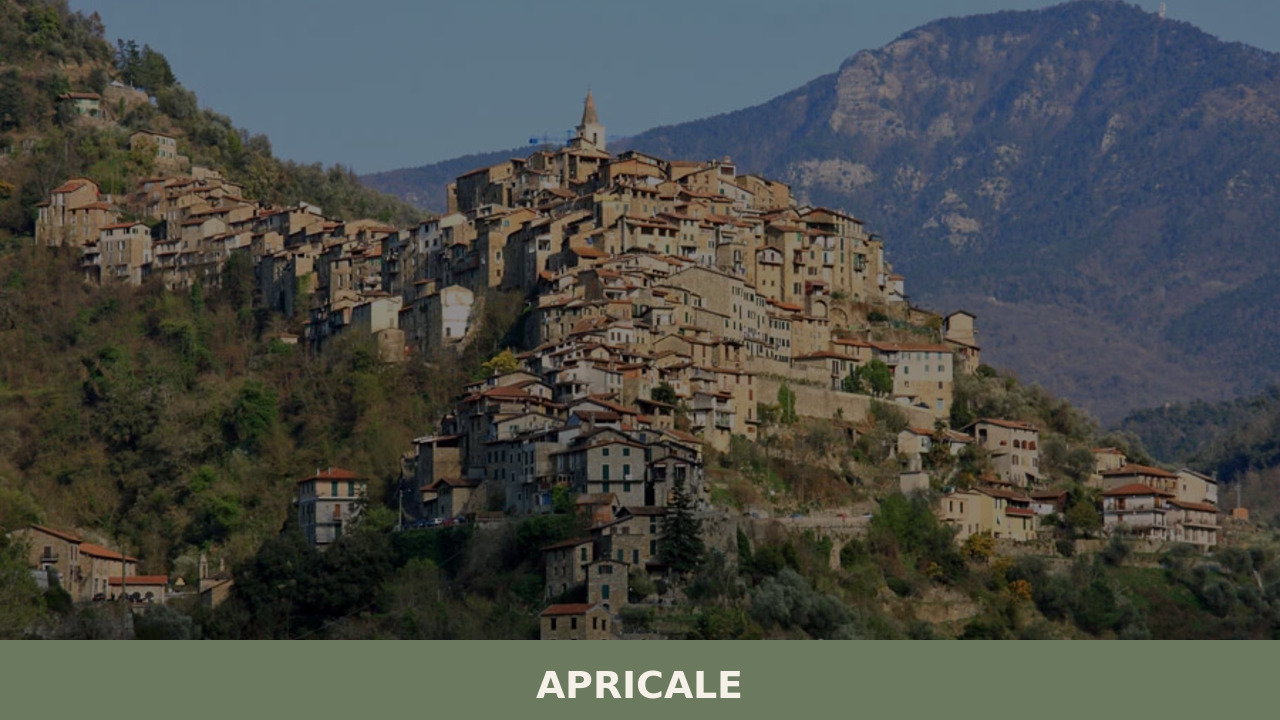
A sun-facing medieval village of 626 inhabitants in Liguria’s Val Nervia. Explore what to see in Apricale, from its castle to its open-air murals.
Morning light catches the stone facades one terrace at a time, climbing the hillside in slow increments until the entire village glows a warm ochre against the dark green of olive groves. Alleyways narrow to shoulder-width. Cats stretch across doorsteps warmed by early sun. Murals — dozens of them — appear on walls where you expect only plaster and age. With just 626 residents and a web of medieval passageways that resist any logic of grid planning, understanding what to see in Apricale requires slowing down, looking up, and letting the village reveal itself at its own pace.
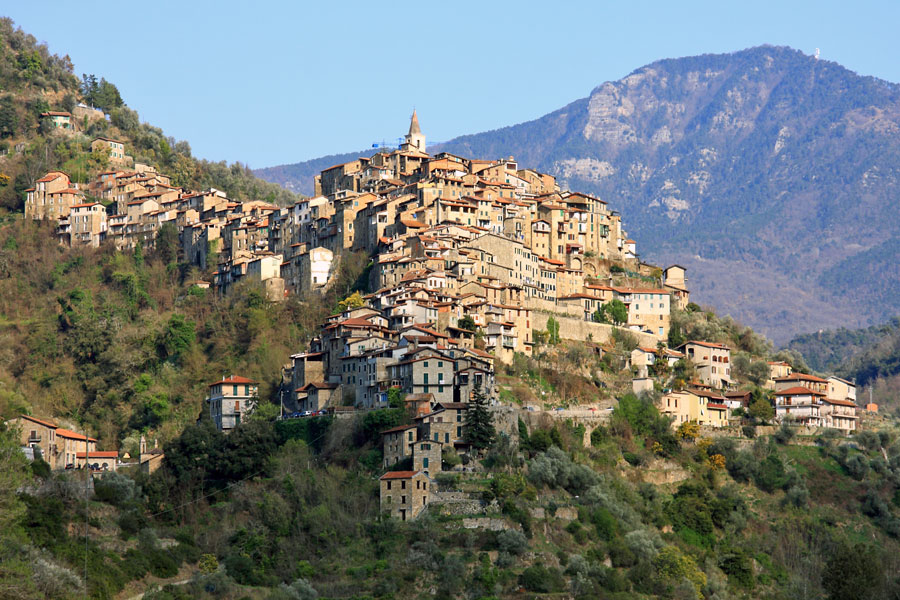
The name itself is a map reference to the sun. “Apricale” derives from the Latin apricus, meaning “exposed to the sun,” and the village earns the description honestly: built on a south-facing slope at 273 metres above sea level in the Province of Imperia, it absorbs light from dawn until the hills to the west finally block the last of it. The settlement dates to the late tenth century, when the Counts of Ventimiglia established a fortified outpost here to control the Merdanzo valley and the routes leading inland from the Ligurian coast.
By the thirteenth century, Apricale had come under the influence of the Republic of Genoa, which extended its administrative reach across the western Riviera and its hinterlands. The village’s compact, concentric layout — stone houses stacked in tight rows around the castle at the summit — is typical of defensive hilltop settlements of that era, designed to maximise protection while minimising the footprint of habitable land. Unlike many Ligurian villages that expanded during the Renaissance or Baroque periods, Apricale remained largely fixed in its medieval form, a consequence of its inland isolation and modest population.
In the twentieth century, rural depopulation reduced the village to a fraction of its earlier numbers, but a grassroots cultural revival beginning in the 1980s brought new attention. Artists were invited to paint murals on village walls, and the castle was restored as a cultural venue. Today, Apricale holds the distinction of being among Italy’s Borghi più belli d’Italia — a recognition that, in this case, reflects not tourism polish but a genuine architectural integrity maintained over a thousand years.
The “Castle of the Lizard” sits at the highest point of the village, its name a nod to the reptiles that sun themselves on its stone walls. Originally a tenth-century fortification built by the Counts of Ventimiglia, the structure was restored in the late twentieth century and now functions as a museum and venue for exhibitions and theatrical performances. Its terrace offers an unobstructed view down to the Mediterranean coast.
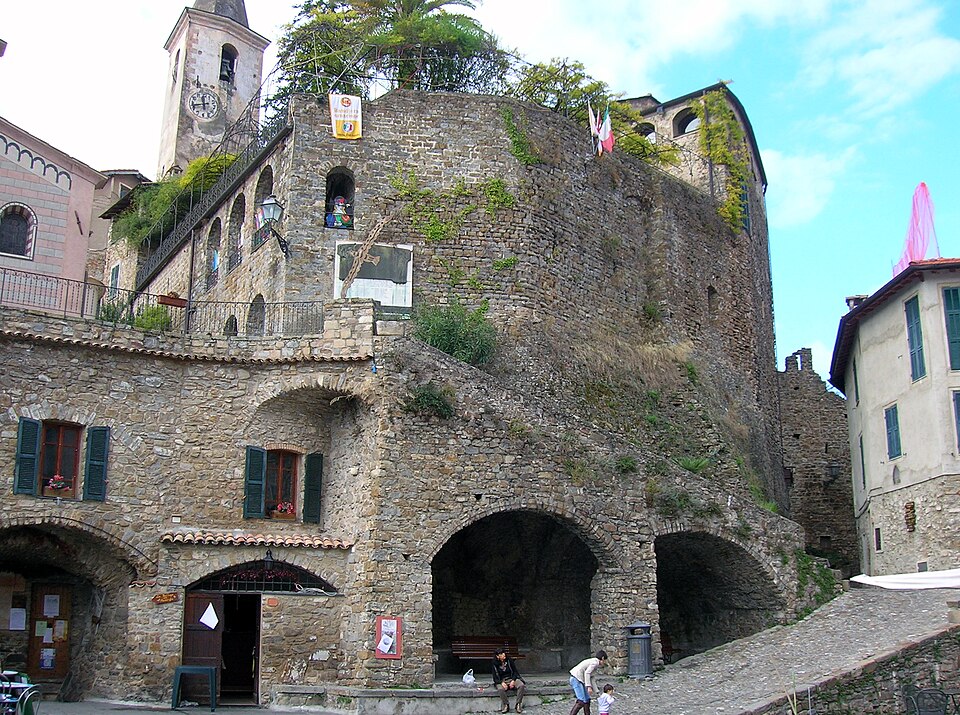
This parish church, positioned along one of the village’s main ascending paths, features a Baroque interior with painted vaults that contrast sharply with the rough stone of its medieval exterior. The bell tower serves as a vertical landmark visible from the valley floor, and the church remains the spiritual centre of Apricale’s small community, hosting services and feast-day celebrations throughout the year.
Beginning in the 1980s, artists from across Italy and beyond were invited to paint directly onto the walls of Apricale’s houses and passageways. The result is a scattered, unplanned gallery — figurative, abstract, surreal — integrated into the fabric of daily life. No two murals share a wall, and no catalogue fully maps them; finding each one becomes a form of directed wandering through the village’s vertical labyrinth.
Set slightly apart from the main cluster of houses, this small chapel dedicated to Saint Roch — the protector against plague — reflects a pattern common across Liguria, where such chapels were built at village edges as both spiritual defence and quarantine markers. Its modest proportions and unadorned facade make it easy to overlook, but its position offers a quiet vantage point across the olive-clad terraces below.
Another of Apricale’s rural chapels, the Cappella di San Martino stands on a path leading out of the village into the surrounding countryside. Its construction dates to the medieval period, and its simple stone architecture — devoid of ornamentation — is characteristic of the small devotional buildings scattered along mule tracks and pilgrimage routes throughout the Ligurian hinterland.
Apricale sits in the heart of western Liguria’s olive-growing territory, and the extra virgin olive oil produced from Taggiasca olives — small, dark, and intensely flavoured — defines the local kitchen. The village’s signature dish is pansarole, thin fried dough fritters traditionally served during festivals, sometimes dusted with sugar, sometimes paired with local cheeses. Rabbit cooked with Taggiasca olives and pine nuts (coniglio alla ligure) appears on menus with the regularity of a regional anthem. Pasta is dressed with pesto or with a walnut sauce, salsa di noci, that is more common in this inland area than on the coast.
The village has a small number of trattorias and agriturismi where these dishes are served without ceremony — terracotta plates, house wine from Rossese di Dolceacqua grapes, bread baked in wood-fired ovens. Rossese di Dolceacqua DOC, a light red wine with notes of dried herbs and cherry, is produced in the surrounding Val Nervia and pairs naturally with the olive-rich local cooking. During autumn, chestnuts from the surrounding forests are roasted and ground into flour for castagnaccio, a dense, barely sweetened cake.
Spring — late March through May — is ideal. Temperatures are mild at 273 metres of elevation, wisteria overtakes the stone walls, and the village is uncrowded. Summer brings warmth and occasional cultural events in the castle courtyard, including open-air theatre performances, though July and August see higher visitor numbers along the entire Riviera hinterland. Autumn offers the olive harvest, chestnut season, and the clean, low-angled light that documentary photographers favour for stone architecture.
Winter is quiet, sometimes markedly so. Some restaurants reduce their hours, and the village can feel genuinely empty on weekday mornings. But the air is sharp, the views toward the coast gain clarity, and the murals — freed from the flat glare of summer — take on a different character in the grey light. If solitude is the objective, January and February deliver it without reservation.
From the A10 motorway (Genova–Ventimiglia), exit at Bordighera and follow the SP63 road inland through the Val Nervia for approximately 13 kilometres. The drive from the coast takes around 20 minutes on a narrow, winding road that passes through Dolceacqua before climbing to Apricale. Parking is available outside the village gates — the interior streets are inaccessible to vehicles.
Local bus services connect Ventimiglia to the Val Nervia villages, but frequencies are limited, particularly on weekends. A car is the most practical option for reaching Apricale and exploring the surrounding hilltop settlements.
Apricale belongs to a wider constellation of Italian villages where small populations, geographic isolation, and centuries of architectural continuity have produced places that feel out of step with contemporary time. The phenomenon is not limited to Liguria. In the volcanic hills north of Rome, Calcata occupies a tufa cliff above a wooded gorge — a village that was nearly abandoned in the 1960s before a community of artists and outsiders reclaimed its empty houses. Its trajectory mirrors Apricale’s own revival, though the landscape and materials are entirely different: tufa rather than slate, gorge rather than terraced hillside.
Further south, in the Daunian sub-Apennines of Puglia, Volturino offers another variation on the hilltop village form — windswept, austere, with wide views across the Tavoliere plain. These are not interchangeable destinations. Each village is shaped by its specific geology, its specific light, its specific silence. What connects them is scale: communities small enough that a single afternoon of walking can reveal the entire built environment, and quiet enough that the absence of noise becomes, itself, something worth travelling for.
📝 Incorrect information or updates?
Help us keep the Apricale page accurate and up to date.


