


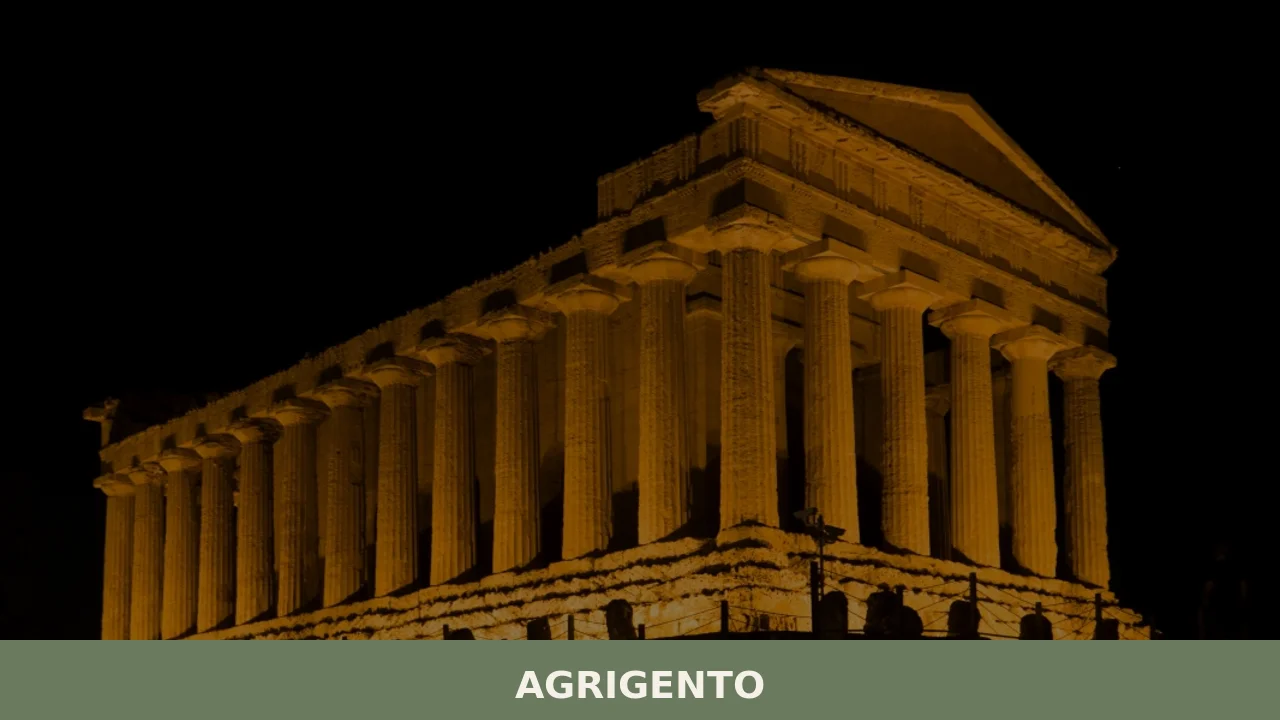
Agrigento
What to see in Agrigento, a city of 58,063 at 230m: UNESCO Valley of the Temples, Norman Cathedral, certified Cotognata. Plan your visit with our complete guide.
Discover Agrigento
At 230 metres above sea level, with a population of 58,063 and a strategic position in the heart of southern Sicily, Agrigento is one of the most significant cities on the entire island.
Anyone wondering what to see in Agrigento will find a monumental heritage spanning over two thousand years of continuous history, from Greek colonisation through the Norman period to modern urban development.
The provincial capital of the same-named province, the city rises across a series of hillside terraces facing the sea, with the celebrated Valley of the Temples stretching out at the foot of the hill on which the historic centre stands.
The Municipality of Agrigento administers a territory of considerable cultural and landscape complexity.
History and Origins of Agrigento
The origins of Agrigento date to 582–580 BC, when settlers from Gela founded the city under the name Akragas. The choice of site was deliberate: the elevated position provided natural defences, while the plain below offered fertile land and access to the sea. Within a short time, Akragas became one of the most powerful Greek city-states in the western Mediterranean.
The poet Pindar, in the fifth century BC, described it as “the most beautiful city of mortals” — a judgement borne out by the imposing temple construction that was already under way at the time.
Under the tyrant Theron, between 488 and 472 BC, the city reached its peak demographic and architectural development, with a population that some historical sources estimate at around 200,000.
Following the Carthaginian conquest of 406 BC, which caused the partial destruction of the city, Akragas passed back and forth between Punic and Greek control.
During the First Punic War, in 261 BC, it came under Roman rule and was renamed Agrigentum. Under the Romans the city retained a degree of commercial activity, though it never regained the political standing it had held in the Greek period. The arrival of the Arabs in the ninth century AD brought further changes: the city was called Kerkent and developed into an agricultural and commercial centre within the broader Mediterranean trading network.
The Normans, who arrived in the eleventh century, renamed it Girgenti — a name that remained in official use until 1927, when the Fascist regime reinstated the Latin form, Agrigento.
During the Middle Ages, Agrigento gained ecclesiastical importance with the establishment of the bishopric.
The city’s patron saint, Gerlando of Agrigento, was the first Norman bishop of the diocese, installed in 1088 by Roger I. His figure remains central to local devotion to this day. The historic centre, which developed around the Cathedral and the Bishop’s Palace, reflects successive layers of different rule: Arab, Norman, Swabian, Angevin and Aragonese. During the twentieth century, Agrigento underwent disorderly urban expansion, and in 1966 a landslide caused by unregulated construction damaged part of the hillside.
That dramatic event prompted a broader awareness of the need to protect the site, contributing to the gradual recognition of its universal value.
What to See in Agrigento: Main Attractions
Valley of the Temples
The Valley of the Temples is Agrigento’s most celebrated monument and one of the best-preserved Greek archaeological complexes in the world.
Designated a UNESCO World Heritage Site in 1997, it extends across approximately 1,300 hectares along the ridge south of the modern city.
The Temple of Concordia, dating from the fifth century BC, is the most complete: its structure of 34 Doric columns has remained standing largely because it was converted into a Christian church in the sixth century AD. The Temple of Hercules is the oldest in the complex. Anyone considering what to see in Agrigento should start here, walking the Avenue of the Temples in the early morning or at sunset, when the light brings out the golden colour of the limestone.
Pietro Griffo Regional Archaeological Museum
The Pietro Griffo Regional Archaeological Museum, located close to the Valley of the Temples, houses materials recovered from excavations carried out in the Akragas area from the nineteenth century onwards. The collection includes ceramics, coins, inscriptions and sculptures covering a chronological span from prehistoric times to the medieval period.
Among the most significant pieces is the telamon, a colossal male figure in stone from the Temple of Olympian Zeus — the largest Doric temple ever built in antiquity.
The museum is housed in a modern building adjacent to the church of San Nicola, itself constructed using reused materials from the Greek monuments.
Cathedral of San Gerlando
The Cathedral of San Gerlando dominates the hill of the upper city at the highest point of the medieval historic centre.
Founded between 1099 and 1101 at the behest of Count Roger I, it was dedicated to the first Norman bishop of the diocese. The current building is the result of extensive modifications carried out between the twelfth and seventeenth centuries: the unfinished façade reflects the construction difficulties posed by the unstable hillside terrain. The interior retains original Romanesque elements and a coffered wooden ceiling dateable to the sixteenth century.
The cathedral also houses the relics of Saint Gerlando, which are venerated during the patronal feast on 25 February.
Hellenistic-Roman Quarter
The Hellenistic-Roman Quarter of Agrigento is an urban excavation area that reveals the street plan of the ancient city from the third century BC to the third century AD.
The roads, laid out according to a regular Hippodamian grid, intersect at right angles and can still be walked today. Along the cardines and decumani stand the remains of private dwellings with mosaic floors, impluvium basins and partially preserved painted decoration. The site allows for a precise reconstruction of daily life in Roman Agrigentum, clearly distinguishing the Hellenistic layout from the Roman one superimposed upon it.
The area is incorporated into the archaeological park and can be reached on foot from the museum.
Via Atenea and the Historic Centre
The medieval historic centre of Agrigento is organised primarily along Via Atenea, the main street running through the hillside urban fabric between noble palaces, Baroque churches and small shops.
Along this route stands the church of Santa Maria dei Greci, built over a fifth-century BC Doric temple whose columns can still be seen incorporated into the foundations, alongside numerous aristocratic buildings constructed between the seventeenth and nineteenth centuries.
The street leads to Piazza Pirandello, named after the playwright Luigi Pirandello, who was born in Agrigento in 1867 — his Nobel Prize for Literature in 1934 remains one of the most significant moments in the city’s cultural history.
Local Cuisine and Products of Agrigento
The gastronomic tradition of Agrigento reflects the range of cultures that have succeeded one another across the territory. Arab influence is evident in the use of almonds, pistachios, citrus fruits and sweet spices in pastry-making; Greek and Roman influence appears in the importance given to olive oil, wheat and wine.
The coastal position, with the agricultural hinterland immediately behind it, has allowed a cuisine to develop that combines seafood and inland produce in preparations that remain faithful to long-established techniques.
Agrigento and its surrounding area form part of one of the most productive agricultural zones in southern Sicily, with significant cereal, wine and vegetable cultivation.
Among the dishes of the local tradition, pasta with sardines is one of the most representative of southern Sicilian cooking: it is prepared with wild fennel, fresh sardines, pine nuts, raisins and saffron, in a sweet-savoury combination of Arab derivation.
Equally widespread is caponata, made with fried aubergine, celery, olives, capers and vinegar, prepared in slightly different versions from one area to the next. Arancini, fried with a filling of meat ragù or butter and ham, are found in every local rosticceria. Local pastry-making includes cannoli with fresh sheep’s ricotta, and almond-based sweets such as pasta reale, made from almond flour and sugar shaped into geometric forms or the likeness of fruit.
Among the territory’s officially certified products, two stand out.
Cotognata (PAT) — produced in Agrigento, Palermo, Trapani, Caltanissetta, Enna, Catania, Ragusa, Siracusa and Messina — is a firm quince preserve made by cooking quinces with sugar, traditionally moulded in terracotta or wooden moulds and eaten as a sweet in its own right or as an accompaniment to cheese.
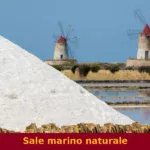
Natural sea salt (PAT) — produced in Agrigento, Trapani, Palermo, Marsala and Paceco — is harvested along the Sicilian coast through the evaporation of seawater in open-air basins, using methods that involve no chemical treatment and that preserve the natural mineral profile of the product.
The calendar of local festivals and markets provides concrete opportunities to buy local products directly from producers.
In spring, events are held to mark the almond blossom, the most well-known being the Almond Blossom Festival, which takes place in February in the Valley of the Temples and draws folk groups from numerous countries.
During the summer, weekly markets in the old town offer locally grown fruit and vegetables, cheeses, preserves and craft products.
Festivals, Events and Traditions of Agrigento
The patronal feast of Agrigento is dedicated to Saint Gerlando of Agrigento and is celebrated every year on 25 February. The Norman bishop, who died in 1100 and was canonised in 1126, is venerated with a solemn procession through the historic centre, during which the statue is carried from the cathedral through the main streets of the upper city.
The religious ceremony is accompanied by civic and musical events involving the city’s historic confraternities.
The feast has medieval roots and retains a strongly participatory character within the local community, drawing worshippers from villages across the province.
Alongside this celebration, the already-mentioned Almond Blossom Festival generally takes place in the first half of February and has over time acquired an international dimension.
The event was established in 1934 and each year attracts folk groups from dozens of different countries, who perform in the areas in front of the Valley of the Temples. The combination of the almond trees in bloom — particularly striking during the weeks of February — and the dance and music performances makes this one of the most anticipated events in southern Sicily.
In summer, the city hosts open-air theatre and cinema events, taking advantage of the monumental setting as a backdrop.
When to Visit Agrigento and How to Get There
The most suitable period for visiting Agrigento falls between late February and May, when temperatures are mild, the almond blossom enlivens the landscape and the Valley of the Temples has not yet been subjected to the intensive summer tourist influx. February coincides with the patronal feast and the Almond Blossom Festival, making it a particularly event-filled month. Autumn, from September to November, is a valid alternative: temperatures remain pleasant, the light is excellent for photography and the city is more manageable.
Those who prefer to avoid summer crowds and want a quieter pace will find these months ideal. Summer, though very busy, allows visitors to combine the archaeological sites with the beaches along the Agrigento coast, easily reachable within a few kilometres.
To reach Agrigento by car from the motorway, the most direct route is the SS640, which connects Caltanissetta to Agrigento through the island’s interior.
The distance from Palermo is approximately 130 km, and from Catania around 170 km.
Those travelling by train can use Agrigento Centrale station, connected to Palermo Centrale with a journey time of approximately two hours. The nearest airport is Palermo’s Falcone-Borsellino Airport, around 140 km away, with onward connections by bus or hire car.
Visitors to Agrigento can easily extend their itinerary to include Contessa Entellina, a village in inland Sicily that shares the same historical matrix of rural and aristocratic settlements across the south-central hills of the island. For information on municipal services and local road access, the official website of the Municipality of Agrigento is a useful resource.
Where to Stay in Agrigento
Agrigento offers a varied range of accommodation, from hotels in the historic centre to agriturismi in the surrounding countryside.
The Valley of the Temples area has several properties that allow guests to visit the archaeological site in the evening or at dawn, avoiding transfers from the upper city. Those who prefer to experience the rural landscape of southern Sicily can choose from numerous agriturismi spread across the farming districts to the east and west of the city. The medieval historic centre has B&Bs set within period buildings, often with views over the gulf or the inland hills.
For longer stays, holiday apartments are a cost-effective option, well distributed across the municipal area.
Those exploring central-western Sicily may also find it worthwhile to visit Cefalà Diana, known for one of the best-preserved Arab-Norman baths on the island, or Bompietro, a small centre in the Madonie mountains that offers a mountain landscape very different from the Agrigento coastline.
For those heading north-west, Aliminusa makes for an interesting stop in the hinterland between the provinces of Palermo and Agrigento, with the character of a hillside village typical of smaller centres in the Sicilian interior.
Understanding what to see in Agrigento also means building a broader itinerary that takes in these smaller centres, capturing the full complexity of a region that reveals itself far more clearly when explored in sequence rather than in isolation.
In Sicily More villages to discover
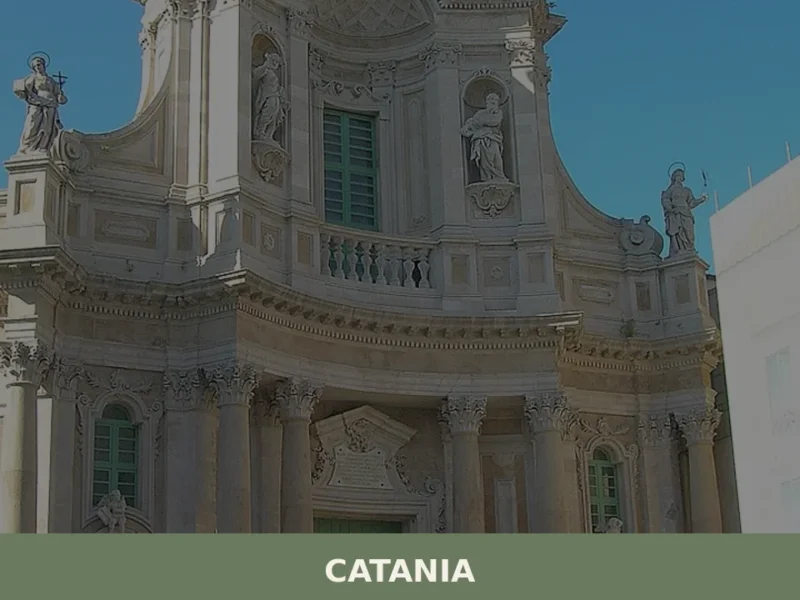
Catania
Discover Catania, a captivating village in Sicily, Italy. Explore its rich history, stunning architecture, local culture, and hidden gems waiting to be found.
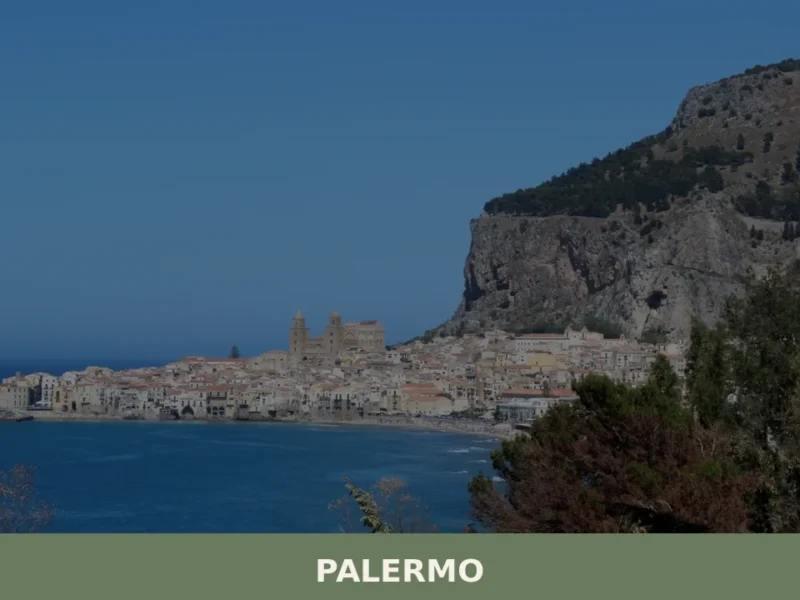
Palermo
What to see in Palermo: from the Palatine Chapel mosaics to Ballaru00f2 Market. Home to 654,987 people and 2 PAT-certified products. Plan your visit with this complete guide.
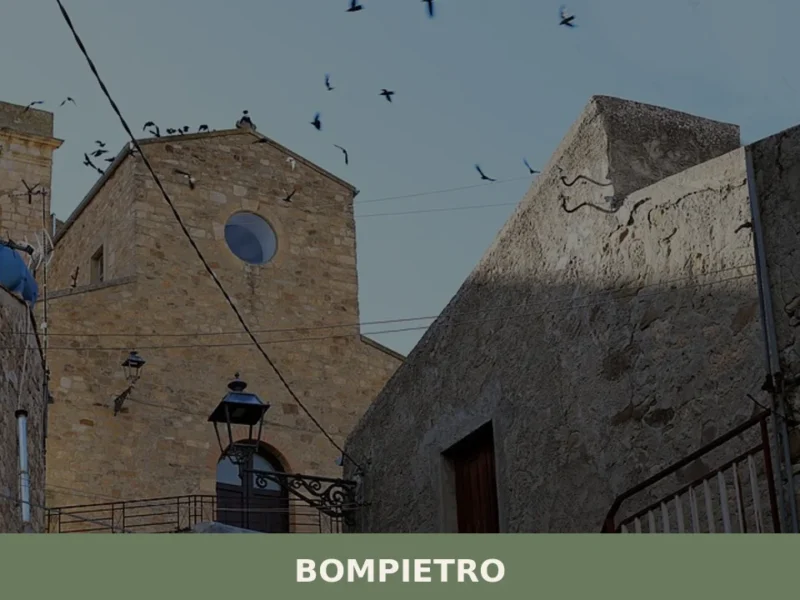
Bompietro
Morning light reaches Bompietro slowly, climbing over the Madonie range before it pours across the rooftops and into the narrow streets where older residents already occupy doorstep chairs. At 685 metres above sea level, the air carries a sharpness absent from the coast — part wild oregano, part cold stone. Fewer than 1,200 people live […]


📝 Incorrect information or updates?
Help us keep the Agrigento page accurate and up to date.