


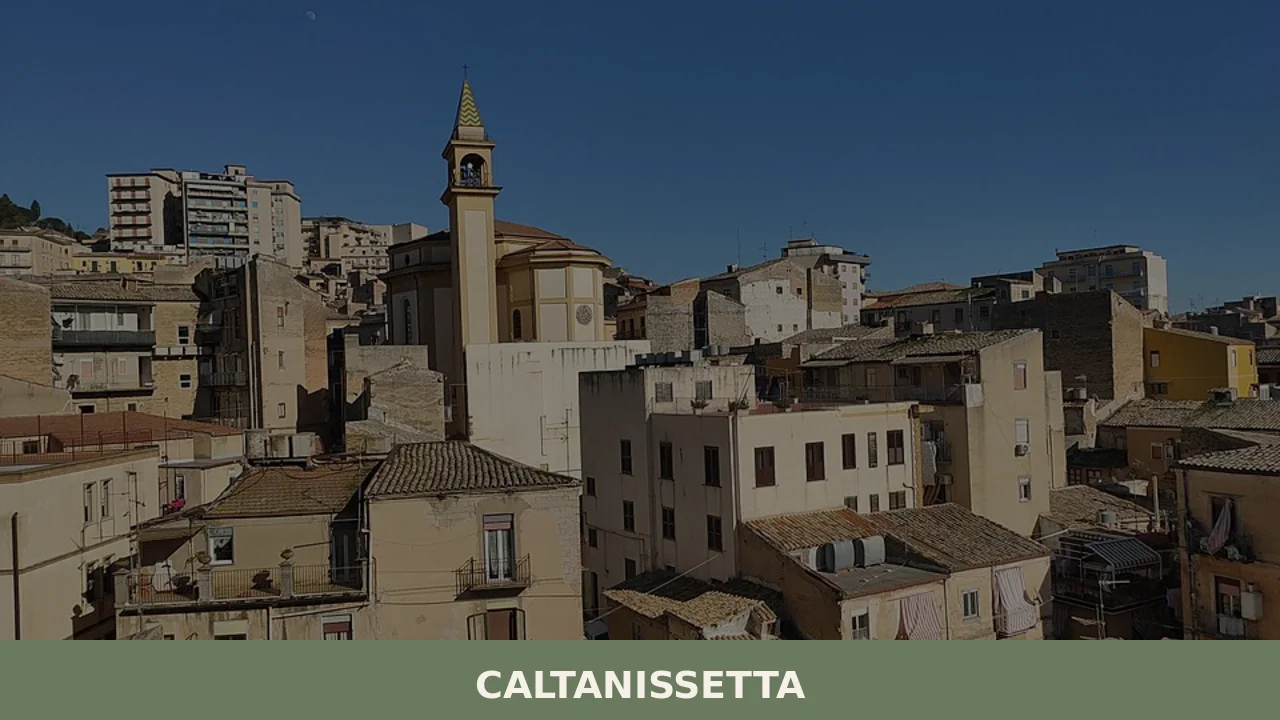
Caltanissetta
What to see in Caltanissetta: 61,000 residents at 568m, from Castello di Pietrarossa to Baroque churches and Holy Week. Plan your visit with this complete guide.
Discover Caltanissetta
At 568 metres above sea level, with a population of over 61,000, Caltanissetta is the most significant urban centre in inland Sicily and the capital of its namesake province.
Anyone asking what to see in Caltanissetta will find a city built up in layers: Arab rule left its name, the Normans left their castle, Sicilian Baroque shaped the facades of its churches, and Holy Week preserves rituals dating back to the sixteenth century.
Built on a plateau between valleys carved by the Salso and Gallo d’Oro rivers, the city does not reveal itself quickly — it demands time, attention to architectural detail, and curiosity about a history that runs through Arab, Norman, Swabian, and Bourbon rule.
History and Origins of Caltanissetta
The name Caltanissetta most likely derives from the Arabic Qal’at An-Nisâ’, conventionally translated as “castle of women”, though some alternative interpretations read the second element differently.
Arab presence in the territory dates back at least to the ninth century, when Sicily was under the control of the Aghlabid emirate and later the Fatimids. Historical sources confirm that the settlement predated the Norman conquest, functioning as a defensive outpost on a naturally sheltered plateau.
When the Normans completed their conquest of Sicily across the decades straddling the eleventh and twelfth centuries, Caltanissetta entered the feudal system of the Kingdom of Sicily and the castle on the Capodarso hill became a symbol of the new power.
During the medieval period the city was granted to various feudal families, among them the Moncada, who held control for a long time and contributed to urban development.
The Aragonese and later Spanish periods left a deep mark on the built environment: the churches, convents, and noble palaces that still define the historic centre date largely from the sixteenth and seventeenth centuries. The arrival of the Theatine fathers in the seventeenth century led to the construction of some of the most significant religious buildings in the city.
During the seventeenth and eighteenth centuries, Caltanissetta also experienced a period of sulphur production: the sulphur mines of the Nisseno territory became a fundamental economic resource, with profound effects on the social and demographic fabric of the area.
Visitors to Bompietro, in the heart of northern Sicily, will find a territory that shares with the Nisseno area this history of medieval settlements and feudal transformation in the Sicilian interior.
Between the nineteenth century and the early twentieth, the local economy was dominated by the sulphur industry, which made Caltanissetta one of the leading mining centres in the Mediterranean.
Working conditions in the mines were extremely harsh, and the city became the scene of significant social tensions.
With the decline of the sulphur industry — accelerated by international competition and definitively sealed in the post-war decades — the local economy had to reinvent itself.
The city retained its role as a provincial capital and strengthened the administrative, commercial, and university functions that continue to define it today.
What to See in Caltanissetta: Main Attractions
Castello di Pietrarossa
The Castello di Pietrarossa is the city’s defining monument, set high on a rocky spur that drops sharply into the valley of the Salso river.
Its origins go back to the Arab-Norman period, though the current structure is the result of successive medieval modifications. Today it presents itself as an evocative set of ruins dominated by two partially preserved towers in reddish limestone — the source of the castle’s name. It is worth climbing to the top for the views over the surrounding landscape and to appreciate the defensive logic that drove the choice of location.
Cathedral of Santa Maria la Nova
The Cathedral of Santa Maria la Nova, which faces onto the city’s main square, is one of the most articulate examples of religious architecture in Caltanissetta.
The current structure dates from the seventeenth and eighteenth centuries, with a two-order Baroque facade and a three-nave interior rich in painted and sculptural decoration. The interior holds notable paintings, including works attributed to Guglielmo Borremans, a Flemish painter active in Sicily during the eighteenth century.
For anyone exploring what to see in Caltanissetta from an art perspective, this is one of the primary points of reference.
Church of Sant’Agata al Collegio
The Church of Sant’Agata al Collegio, built by the Jesuits in the seventeenth century, is considered one of the most refined Baroque buildings in the city.
The facade in stucco and sandstone features pilasters, statue-filled niches, and a carefully worked portal. The interior makes an immediate impression with its gilded stucco work and the paintings distributed along the naves.
The entire adjoining convent complex is an important architectural document for understanding the Jesuit presence in early modern Sicily.
Regional Archaeological Museum of Caltanissetta
The Regional Archaeological Museum of Caltanissetta brings together materials from excavations carried out across the Nisseno area, with finds spanning a chronological range from the Neolithic to the Roman period. Among the most significant pieces are indigenous funerary goods and Greek and local ceramics recovered from the sites of Sabucina and Gibil Gabib — two prehistoric and protohistoric settlements documented within the provincial territory.
The museum offers a concrete perspective on the long human occupation of this part of the island.
Piazza Garibaldi and the Historic Centre
Piazza Garibaldi is the focal point of urban life in Caltanissetta and the most logical starting point for exploring the historic centre.
The square is framed by the Cathedral, the Municipal Palace, and the Church of San Sebastiano with its neoclassical facade. The surrounding streets are lined with eighteenth-century noble palaces, artisan workshops, and the traditional bars and cafes that fill up during the evening passeggiata.
Walking along Corso Umberto I brings you to the other main monuments within a few minutes on foot.
Traditional Food and Products of Caltanissetta
Nisseno cuisine has its roots in a peasant and pastoral tradition that shaped inland Sicilian life for centuries. The Arab influence — well documented in the city’s place names and history — shows up in the use of spices, almonds, and sugar in sweet preparations, as well as in the combination of sweet and sour flavours that runs through many local recipes. The historical culture of the sulphur mines also shaped a simple but substantial cuisine built around pulses, grains, and sheep’s meat.
Among the dishes most closely tied to the territory are maccarruna di casa, hand-rolled fresh pasta dressed with pork or lamb ragù, and frittedda, a sweet-and-sour preparation of broad beans, peas, and artichokes that follows the spring season.
Stigghiola — lamb intestines grilled over charcoal — is a street food rooted across Sicily and present in the Nisseno tradition as well.
On the sweet side, local production includes mustazzoli, spiced biscuits made with cooked grape must, almonds, and spices, prepared mainly for autumn and winter festivities.
Those wishing to explore the gastronomic traditions of the Sicilian interior further can extend their itinerary to Campofiorito, a small centre in the Palermo area where rural cooking preserves similar characteristics.
On the certified products front, the Nisseno territory is associated with two PAT recognitions (Traditional Agri-food Products) from the Ministry of Agriculture. Cotognata (PAT) — municipalities: Caltanissetta — is a solid preserve made by slow-cooking quince with sugar, then moulded into geometric shapes and left to dry until it reaches a compact consistency.
The product has ancient origins and is linked to domestic preserving traditions in the area.
Natural sea salt (PAT) — municipalities: Caltanissetta — is extracted using traditional methods and represents a key element of Sicilian agri-food heritage, with uses ranging from cooking to food preservation.
For buying local products, the neighbourhood markets in the historic centre and the food shops along Corso Umberto I are the most accessible points of reference.
In autumn, around the festivities connected with the grape harvest and olive picking, opportunities for direct purchase from producers across the provincial territory multiply.
Festivals, Events and Traditions of Caltanissetta
The festive calendar of Caltanissetta revolves around two events of different scale but both deeply embedded in local identity. The feast in honour of Saint Michael the Archangel, patron of the city alongside the Signore della Città, is celebrated on 29 September, the liturgical date traditionally dedicated to the archangel.
The celebrations include a solemn procession with the statue of the saint through the streets of the historic centre, the participation of confraternities, and evening fireworks.
The event draws the faithful and visitors from surrounding municipalities and is one of the most widely attended moments in Caltanissetta’s religious life.
The Holy Week of Caltanissetta is considered one of the most important in Sicily and one of the oldest on the island.
The rituals date back to the sixteenth century, when religious confraternities organised the first processions with the sculptural groups known as Vare — polychrome wooden statues depicting scenes from the Passion of Christ. The Vare process on Wednesday, Thursday, and Good Friday, accompanied by funeral music and popular participation that involves the entire city. The rite of the Signore della Città, the crucifix kept in the cathedral and the object of deep devotion, occupies a central place within this week.
The Municipality of Caltanissetta publishes the detailed programme of Easter celebrations each year on its official website.
When to Visit Caltanissetta and How to Get There
The most favourable time to visit the city is spring, between March and May, when temperatures are mild, the surrounding countryside is at its most verdant, and the calendar includes Holy Week.
Autumn, from September to November, is another recommended season: temperatures remain pleasant, the patron saint’s feast on 29 September brings the historic centre to life, and local markets offer the season’s produce. Summer, at 568 metres above sea level, is more manageable than on the coast, though July and August still bring considerable heat in the Sicilian interior.
Visitors arriving by car take the A19 Palermo–Catania motorway, exiting at the Caltanissetta junction, which is approximately 85 kilometres from Palermo and around 110 from Catania. Alternatively, the A19 connects with the SS626, which links the city to Gela and the southern coast.
Caltanissetta Centrale railway station has services to Palermo and Catania; for up-to-date timetables visit the Trenitalia website.
The nearest airport is Catania-Fontanarossa, around 110 kilometres away, followed by Palermo-Punta Raisi at approximately 130 kilometres.
Those planning a wider itinerary through inland Sicily may consider stopping at Cefalà Diana to the north-west in the Palermo area, or continuing on to Poggioreale in the Trapani area, which shares with Caltanissetta its position on the hills of the Sicilian interior.
In Sicily More villages to discover
Campofiorito
Campofiorito sits at 660 metres above sea level in the province of Palermo, a small agricultural commune of 1,321 inhabitants whose name translates literally as “field of flowers.” Founded as a feudal settlement in the early eighteenth century, the village occupies a limestone ridge in the upper Belìce valley, surrounded by wheat fields and grazing […]
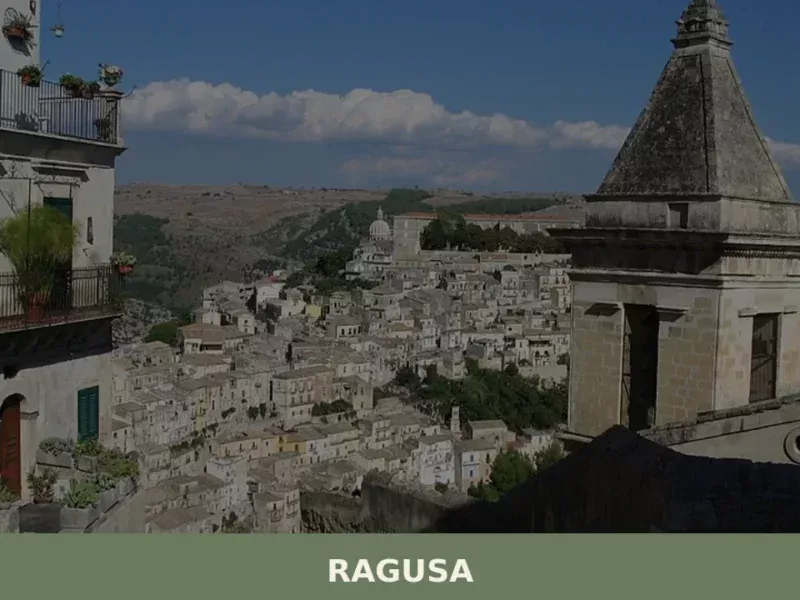
Ragusa
What to see in Ragusa, a UNESCO city at 520m with 70,000 residents: explore Ibla, San Giorgio, Giardino Ibleo and Cotognata PAT. Plan your visit now.
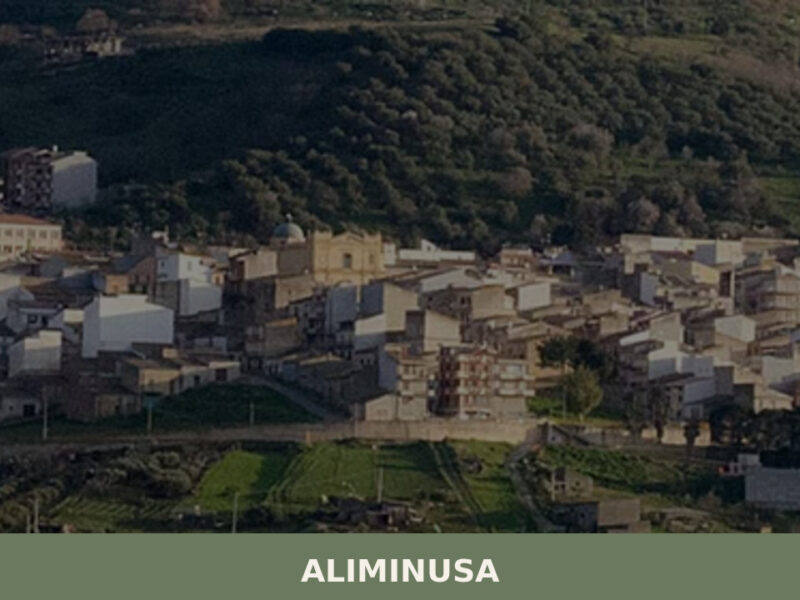
Aliminusa
Morning light hits the limestone facades along Corso Umberto at a low angle, turning the walls the colour of raw honey. A few voices carry across the piazza — unhurried, familiar. Aliminusa is a village of just over a thousand people, set at 450 metres above sea level in the hills of the Palermo province, […]
🧀 Italian traditional products
📝 Incorrect information or updates?
Help us keep the Caltanissetta page accurate and up to date.