


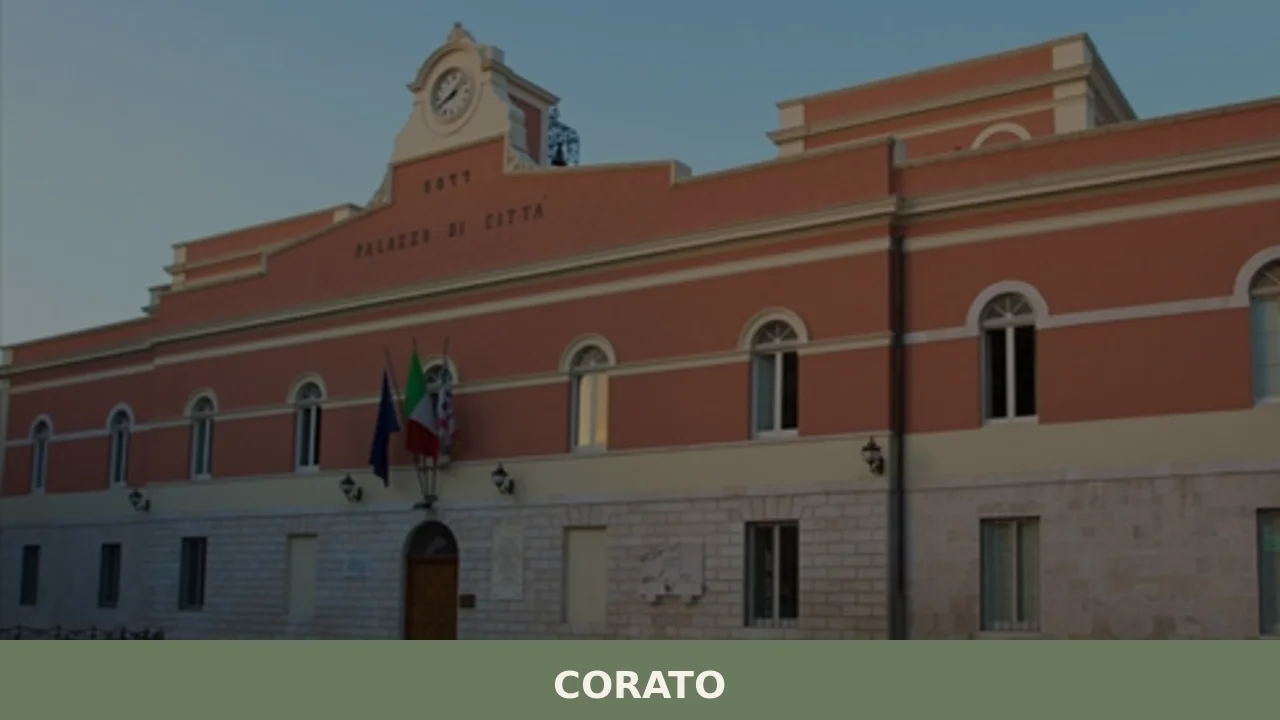
Corato
What to see in Corato, a city at 232 m in Puglia. 5 attractions, underground olive presses, Castel del Monte 18 km away, PAT dishes. Plan your visit now.
Discover Corato
In 1083, the Norman lord Ugo di Ridelsa received as a fief an agricultural settlement already active along the road connecting Bari to the Tavoliere plain. That fortified nucleus, which grew around a watchtower and a baptismal church, is today a city of 47,033 inhabitants situated at 232 metres above sea level, at the point where the Murgia of Bari gives way to the karst plateau. Anyone wondering what to see in Corato will find a layered urban reality: eighteenth-century noble palaces, underground olive presses carved into the limestone rock, Romanesque churches with sculpted portals. The historic centre retains a concentric layout, punctuated by narrow alleys and interior courtyards where almonds and olives are still processed today.
History and origins of Corato
The etymology of the name remains debated.
The most widely accepted hypothesis traces it back to the Latin Coratum, derived from cor (heart), referring to the town’s central position relative to the settlements of the north-western Murgia. Another interpretation, put forward by the local historian Ferrante della Marra in the seventeenth century, links it to the Greek term chorion, meaning rural village. The earliest written documents mentioning Corato date to the eleventh century, when the territory was under the Lombard rule of the Catepanate of Italy. With the Norman conquest, the settlement was incorporated into the County of Andria and equipped with defensive walls and a castle, whose surviving tower is still visible on the north-east corner of the old centre.
The Angevin period marked a decisive turning point. In 1268, after the Battle of Tagliacozzo, Charles I of Anjou confirmed the city’s feudal privileges. Over the following centuries Corato passed to the Del Balzo Orsini, then to the De Marinis family, and finally to the Carafa, who held control until the abolition of feudalism in 1806. During the Spanish domination, the city experienced significant urban expansion: grand aristocratic palaces were built along what is now Corso Mazzini and the major churches were enlarged. In 1799, Corato was the scene of an anti-French revolt suppressed in bloodshed, an episode that foreshadowed the Carbonari uprisings of the following decade.
Among the notable figures associated with the city are the jurist and patriot Giuseppe de Gemmis (1776–1830), active in the Neapolitan constitutional movement, and the nineteenth-century painter Michele de Napoli, whose canvases are preserved in several churches in the centre.
The nineteenth century brought sustained population growth — from around 14,000 inhabitants in 1861 to 35,000 by the early twentieth century — driven by the olive oil economy and viticulture. The railway, inaugurated in 1883 on the Bari–Barletta line, integrated Corato into regional trade networks and consolidated its role as a market centre for the entire Murgia district. To this day, the Municipality of Corato administers a predominantly agricultural territory of approximately 168 square kilometres.
What to see in Corato: 5 top attractions
1. Chiesa Matrice di Santa Maria Maggiore
Built between the twelfth and thirteenth centuries in the core of the historic centre, the Chiesa Matrice di Santa Maria Maggiore is Corato’s principal religious building. The Romanesque façade features a twelve-spoke rose window and a portal decorated with phytomorphic motifs and zoomorphic figures, typical of Apulian sculpture from the Swabian period. The interior, remodelled during the Baroque era, retains a sixteenth-century baptismal font and a cycle of eighteenth-century canvases attributed to the Neapolitan school. The bell tower, approximately 35 metres tall, is visible from several points across the city and serves as a constant topographic reference for anyone walking through the centre.
2. Church of San Domenico
Located along the main corso, the Church of San Domenico was built in the sixteenth century at the behest of the Order of Preachers, who maintained an adjacent convent until the Napoleonic suppressions of 1809. The late-Renaissance façade, sober and geometric, contrasts with the lavishly decorated interior: altars in polychrome marble, gilded stuccoes, and a coffered wooden ceiling painted with scenes from the life of Saint Dominic. In the right side chapel stands a seventeenth-century wooden Crucifix, an object of particular popular devotion during Holy Week, when it is carried in procession through the streets of the old quarter.
3. Palazzo di Città and Piazza Marconi
Piazza Marconi is Corato’s geometric and social centre, the meeting point between the old town and the nineteenth-century expansions. Overlooking it is the Palazzo di Città, a neoclassical building completed in the second half of the nineteenth century, with a portico of five arches on the ground floor and an upper loggia. The square hosts the Saturday weekly market, active without interruption since the Bourbon period, where Murgia fruit and vegetables and local cheeses are sold. From here the main thoroughfares radiate — Corso Mazzini heading north, Via Duomo towards the historic centre — and a tree-lined avenue leads to the public gardens.
4. Castel del Monte (18 km away)
Eighteen kilometres from Corato, on the summit of a hill at 540 metres above sea level, stands Castel del Monte, the octagonal fortress commissioned by Frederick II of Swabia around 1240 and inscribed on the UNESCO World Heritage List since 1996. The structure, lacking both a moat and conventional defensive features, remains an architectural enigma: eight octagonal towers, eight rooms on each of its two floors, an octagonal interior courtyard. From Corato it can be reached in under twenty minutes via the provincial road 234, which climbs towards the Murgia plateau through olive groves and dry-stone walls.
5. Underground olive presses of the historic centre
Beneath the street level of the old centre lies a network of underground olive presses (frantoi ipogei), spaces carved into the limestone bedrock where olive oil was produced for centuries using stone mills driven by draught animals. Some of these presses, dating from between the fifteenth and eighteenth centuries, still preserve their decanting basins, wooden screw presses, and drainage channels cut into the rock. The constant underground temperature — around 15 degrees — guaranteed ideal conditions for pressing olives.
Several of these presses can be visited upon request through local cultural associations, which organise guided tours beneath the city.
What to eat in Corato: local cuisine and traditional products
The cuisine of Corato reflects the city’s position between the Adriatic coast and the Murgia hinterland: a transitional table where fish appears rarely, while cereals, legumes, vegetables, and extra virgin olive oil dominate. The limestone terrain of the Murgia, poor in water but rich in minerals, has favoured the cultivation of almond trees, vines, and olive trees for centuries, and has steered the local gastronomy towards dry dishes, essential seasonings, and slow cooking methods. The peasant tradition was built on a principle of household economy: nothing goes to waste, and the humblest ingredients — stale bread, wild herbs, butchery offcuts — become the basis of elaborate preparations.
The most representative dish of the local tradition is Acquasale (PAT), a soup of stale bread softened in hot water, dressed with fresh tomatoes, raw onion, oregano, and a generous drizzle of extra virgin olive oil. It was traditionally eaten during the summer months as a quick meal for farmworkers labouring in the fields, and was prepared directly at the place of work with ingredients carried in a cloth saddlebag.
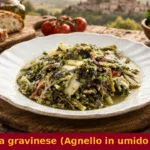
Alongside Acquasale, the Corato kitchen features Agnello al forno con patate alla leccese (PAT), known locally as Auniceddhru allu furnu, a meat dish slow-cooked in a wood-fired oven with potatoes, cherry tomatoes, grated pecorino, and parsley, reserved for patron saint festivities and Sunday lunches. A lesser-known but documented variant is Agnello alla gravinese (PAT), stewed lamb prepared with a soffritto of onion, celery, and carrot, deglazed with white wine and left to simmer until a dense, flavourful reduction is achieved.
Among the products certified as Traditional Agri-Food Products (PAT) of Puglia, the territory offers several specialities. Wild asparagus (PAT), gathered in March and April along dry-stone walls and at the edges of the Murgia’s oak woods, is eaten in omelettes or boiled with oil and lemon. The same asparagus is also preserved in oil (Asparagi sott’olio, PAT) in glass jars, maintaining the crunchiness and slightly bitter flavour characteristic of the wild plant.
Traditional sweets include Africani (PAT), small shortcrust pastries filled with chocolate cream and covered in a dark glaze, found in pastry shops across the Bari area but particularly rooted in Corato’s artisan production. Among the beverages, Amaro del Gargano (PAT) and Anisetta (PAT) are traditional Apulian liqueurs available in wine shops and local stores in the centre.
The patron saint festival of San Cataldo, celebrated on 10 May, is the main occasion to taste traditional preparations in a festive setting. During the days of the celebration, stalls and kiosks set up in the central squares offer Bari-style focaccia, white wine taralli, roasted almonds, and almond paste sweets. The Saturday weekly market in Piazza Marconi remains the most reliable place to buy local fruit and vegetables, loose extra virgin olive oil, and Murgia stretched-curd cheeses.
In recent years, several olive oil producers in the area have opened direct sales points along the road to Castel del Monte, where it is possible to taste and purchase single-varietal oil from the Coratina cultivar.
The Coratina cultivar, originating precisely from this territory, produces an extra virgin olive oil with an intensely fruity taste, pronounced bitter and peppery notes, and is considered among the richest in polyphenols in the Mediterranean. The area falls within the production zone of the DOP Terra di Bari olive oil, under the Castel del Monte sub-denomination. As for wines, the territory is included in the Castel del Monte DOC, which encompasses reds based on Nero di Troia and Bombino Nero, rosés, and whites from Pampanuto and Bombino Bianco grapes. Wineries situated along the provincial road towards Ruvo di Puglia offer tastings by appointment.
When to visit Corato: the best time of year
Spring, from mid-April to late June, is the most suitable period to visit Corato. Temperatures range between 15 and 25 degrees, the olive groves are in bloom, and the Murgia countryside is covered with wild herbs and flowers. On 10 May, the feast of San Cataldo brings three days of celebrations with a religious procession, illuminations in the historic centre, bandstand concerts in the square, and fireworks. Autumn, from October to November, coincides with the olive harvest and milling in the presses: some farms organise guided visits during which it is possible to watch the pressing and taste freshly produced oil.
Summer, from July to August, brings high temperatures that frequently exceed 35 degrees: visits to the historic centre are more comfortable in the early morning or late afternoon.
On the other hand, summer evenings offer a calendar of open-air cultural events — film screenings, concerts, theatre performances — organised in the courtyards of historic palaces. Winter is mild compared to northern Italy, with lows rarely dropping below 5 degrees, but the tourist flow decreases considerably. Those who prefer to visit the city without crowds will find February and March a quiet period, ideal for exploring the underground olive presses and churches without queues.
How to reach Corato
By car, Corato is reached from the A14 Bologna–Taranto motorway by exiting at the Trani junction (approximately 20 km) or at Andria-Barletta (18 km), then continuing along the provincial road 231. From Bari the route covers approximately 44 km, drivable in forty minutes via the state road 98. From Naples the distance is around 260 km (two hours and forty minutes via the A16 and A14). The city is served by the Bari Nord railway, operated by Ferrotramviaria, with frequent trains to and from Bari Centrale (journey time approximately fifty minutes) and connections towards Barletta and Andria.
The nearest airport is Karol Wojtyła Airport in Bari-Palese, approximately 40 km away and reachable in forty minutes by car.
From the airport it is possible to take a train to Bari Centrale and from there continue on the Ferrotramviaria line to Corato. Alternatively, SITA scheduled buses connect Corato to Bari and the main towns of the province. For those arriving from the south, the Bitonto motorway exit on the A14 (30 km) is a valid alternative, especially when coming from Taranto or Lecce.
Other villages to discover in Puglia
Visitors to Corato who wish to deepen their knowledge of the Apulian territory can head towards the Murgia interior or descend towards the Ionian coast. Approximately 30 km to the south, Cassano delle Murge offers a different landscape: the village sits at 340 metres above sea level, surrounded by woods of Fragno oak and downy oak covering the slopes of the south-eastern Murgia. The contrast with the olive-clad countryside of Corato is sharp, and the route between the two centres crosses a section of the Alta Murgia where karst formations, sinkholes, and natural caves emerge.
From Cassano it is possible to access the Alta Murgia National Park, with trails suitable for walking or cycling.
For those with more days available who want to explore southern Puglia, Roccaforzata, in the province of Taranto, represents a destination of an entirely different character: a small settlement on the northern Salento plain, with a reduced population and an urban rhythm radically different from that of Corato. The journey from Corato to Roccaforzata covers approximately 130 km and crosses the entire arc of central Puglia, passing through Altamura, Gioia del Colle, and the Itria Valley. A three- or four-day itinerary that includes Corato, Cassano delle Murge, and Roccaforzata allows travellers to traverse all the main landscape environments of the region: from the limestone Murgia to the wooded plateau, and on to the clay plains of the Taranto area.
In Apulia More villages to discover
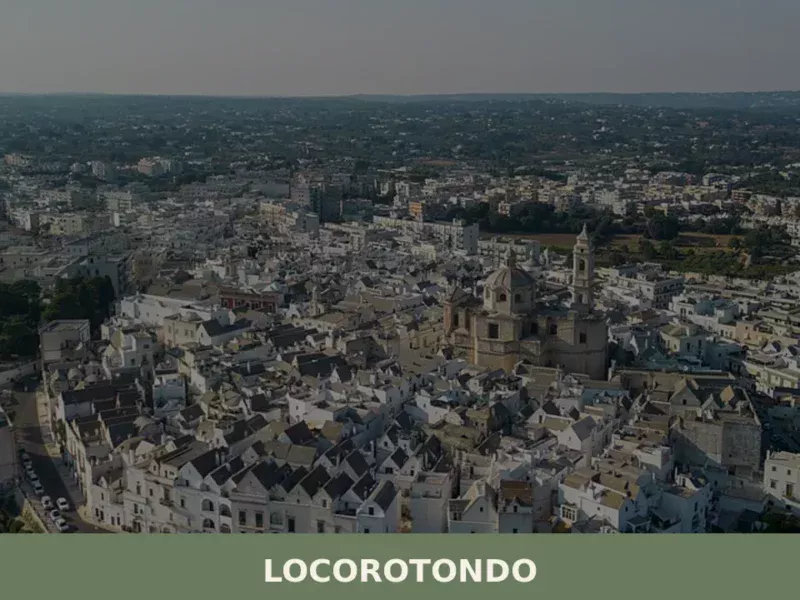
Locorotondo
The toponym Locorotondo, documented as early as the 12th century as “Luogo Rotondo” (Round Place), derives from the concentric configuration of its historic center, an urban feature that still distinguishes it within the Itria Valley landscape. Located 410 meters above sea level, this municipality in the province of Bari has 14,258 inhabitants and presents a […]
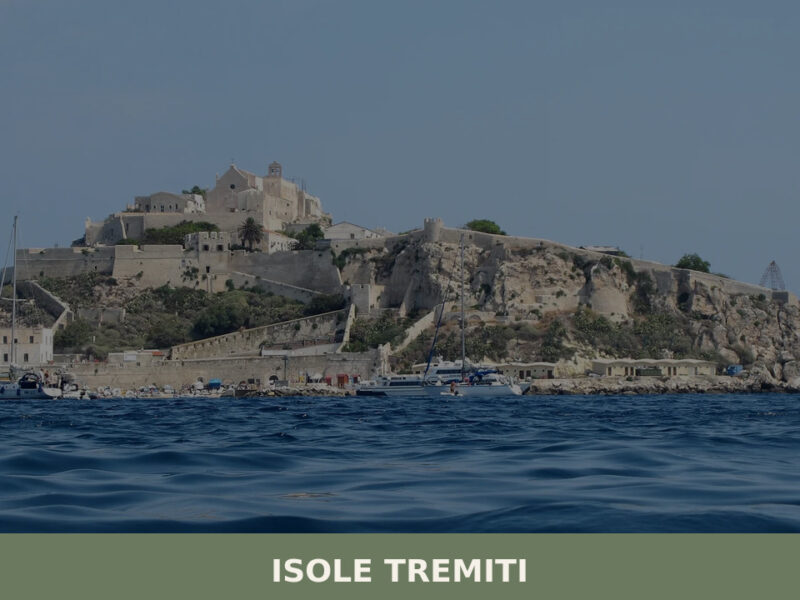
Isole Tremiti
A 481-resident archipelago off Puglia's Gargano coast, the Tremiti Islands compress monastic history, Adriatic wildlife, and sea caves into three inhabited islands.
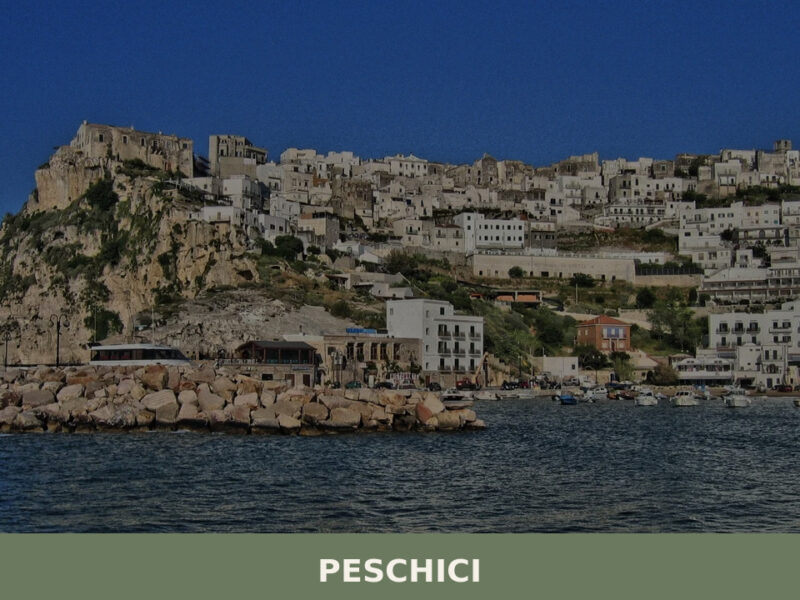
Peschici
Perched on a rocky promontory above the turquoise waters of the Adriatic Sea, Peschici is one of the most enchanting coastal villages in Puglia’s Gargano peninsula. With its whitewashed houses, narrow alleyways, and dramatic clifftop setting, this small town of 4,283 inhabitants offers a captivating blend of history, natural beauty, and Mediterranean charm. If you’re […]
📝 Incorrect information or updates?
Help us keep the Corato page accurate and up to date.