


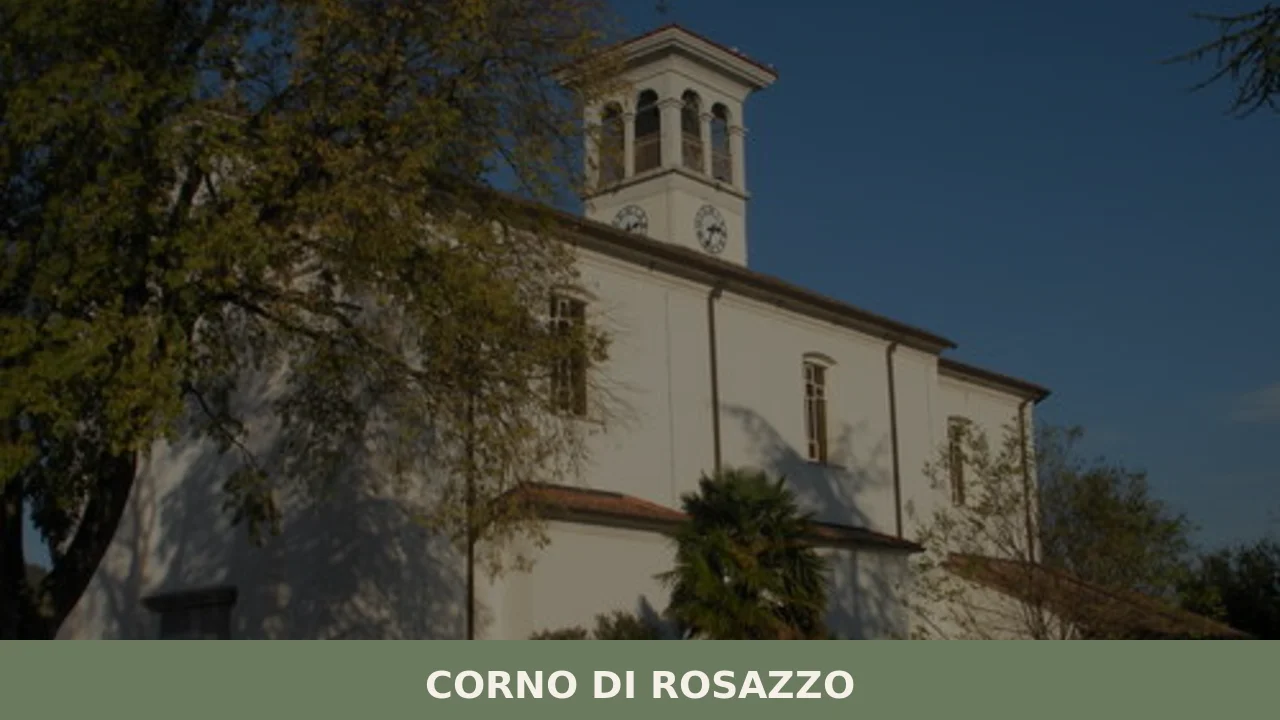
Corno di Rosazzo
In 1070, a deed of donation by the Patriarch of Aquileia mentioned the name Corno di Rosazzo for the first time, linking it to a parish church and a territory already organized around viticulture and cereal farming. Today that territory extends over just twenty square kilometres across the Colli Orientali del Friuli, at 88 metres […]
Discover Corno di Rosazzo
In 1070, a deed of donation by the Patriarch of Aquileia mentioned the name Corno di Rosazzo for the first time, linking it to a parish church and a territory already organized around viticulture and cereal farming. Today that territory extends over just twenty square kilometres across the Colli Orientali del Friuli, at 88 metres above sea level, with 3,261 inhabitants spread between the main town and the surrounding hillside hamlets. Understanding what to see in Corno di Rosazzo means walking through vineyards that climb moraine slopes, entering abbeys that have shaped the religious history of the region, and sitting down to eat where Friulano and Ribolla Gialla are everyday products, not labels in a wine bar.
History and origins of Corno di Rosazzo
The place name is made up of two distinct elements.
“Corno” probably derives from the Latin cornu, referring to a spur of land or a rise in the moraine terrain that characterizes this hilly belt between the Judrio river to the east and the Torre to the west. “Rosazzo” is directly linked to the Abbey of Rosazzo, founded in the 11th century and recorded in patriarchal documents as the spiritual and administrative centre of the area. The combination of the two names in the official toponym reflects the dual identity of the municipality: a civic nucleus and an ecclesiastical hub that functioned in symbiosis for centuries. The earliest traces of human settlement in the area date back to Roman times, as evidenced by artefacts found in the surrounding countryside and now held in the archaeological museums of the province of Udine.
The medieval period permanently defined the layout of the territory. In 1068, Patriarch Sigeard of Aquileia confirmed possession of the Benedictine Abbey of Rosazzo, which became one of the most influential monastic centres in eastern Friuli. During the 12th and 13th centuries, the abbey complex was repeatedly contested between local feudal families and the patriarchate, suffering damage and undergoing reconstruction. In 1420, with the fall of the Patriarchate of Aquileia, the territory came under the rule of the Republic of Venice, which maintained control until 1797. During the Venetian period, Corno di Rosazzo consolidated its agricultural vocation, with wine production already recognized in the commercial registers of the Serenissima.
The 20th century brought profound upheaval.
During the First World War, after the rout of Caporetto in October 1917, the territory was occupied by Austro-Hungarian troops until the end of the conflict, suffering requisitions and damage to civilian and religious buildings. Reconstruction was slow and marked by emigration to South America and Northern Europe. In the post-Second World War period, the 1976 Friuli earthquake also struck this area, though with less devastating damage than in the foothills zone. The rebuilding process encouraged a renewal of wineries and production facilities, laying the foundations for the winemaking revival of the Colli Orientali del Friuli, today one of the most respected appellations in Italian oenology. The population, which exceeded 4,000 residents at the start of the 20th century, has gradually stabilized at around 3,200 current inhabitants.
What to see in Corno di Rosazzo: 5 top attractions
1. Abbey of Rosazzo
Founded in the 11th century on a hill at approximately 170 metres altitude, the Abbey of Rosazzo is the most significant monument in the municipality and one of the most important monastic complexes in Friuli Venezia Giulia. The abbey church, dedicated to Saint Peter, retains Romanesque architectural elements in its load-bearing structure, although numerous interventions in the 15th and 18th centuries altered its interior appearance.
The cloister, partially rebuilt, and the historic rose garden — which gives its name to the entire locality — deserve a lengthy visit. Since 2008, the abbey has served as the seat of the Metropolitan Archbishop of Udine and hosts cultural events and tastings connected to local wine production. It is reached via a municipal road that passes through rows of vines arranged along the hillsides.
2. Parish Church of Santa Maria del Rosario
Located in the centre of the main town, the Parish Church of Santa Maria del Rosario is the principal place of worship for the community and the venue for celebrations marking the patron saint’s feast on 7 October. The current building dates from an 18th-century reconstruction, with a restrained façade reflecting the late-Baroque style common in rural Friulian churches. Inside, there is a polychrome marble high altar and several paintings from the Venetian school, including a depiction of the Madonna of the Rosary that gives the parish its name. Its central location makes it the natural starting point for a walk through the historic centre, where a number of stone buildings with arched doorways survive.
3. Vineyards of the Colli Orientali del Friuli
The viticultural landscape surrounding Corno di Rosazzo is not merely a backdrop: it is the economic and cultural engine of the territory. The vineyards extend across south- and southeast-facing moraine slopes, with marl and sandstone soils particularly suited to cultivating indigenous grape varieties such as Friulano, Ribolla Gialla and Picolit. The area falls within the Colli Orientali del Friuli DOC appellation and, since 2011, within the Rosazzo DOCG sub-zone, reserved for a white grape blend. Driving the farm tracks between the hamlets of Gramogliano, Noax and Visinale offers views of vine rows climbing the hills, with wineries open by appointment throughout the year.
4. Villa de Claricini Dornpacher
This 17th-century noble residence, located in the hamlet of Bottenicco a few kilometres from the centre of Corno di Rosazzo, is one of the finest examples of a Venetian villa on Friulian soil. Villa de Claricini Dornpacher is now owned by the University of Udine and is open to the public during events and guided tours. The interior houses a cycle of frescoes attributed to the school of Giambattista Tiepolo, with mythological scenes spread across the salons of the piano nobile. The surrounding park, with centuries-old trees and a formal Italian garden, adds further interest to the visit. The villa can be reached by car or bicycle along quiet secondary roads.
5. Hill trails and cycling-walking paths
The municipal territory offers a network of trails linking the hillside hamlets through vineyards, oak woods and small rural settlements.
The most popular route starts from the centre of Corno di Rosazzo and climbs towards the Abbey of Rosazzo, with a moderate elevation gain — around 80 metres — that makes it accessible even for families with children. Along the way, walkers encounter votive shrines, dry-stone walls and viewpoints from which, on clear days, the Friulian plain stretches as far as the Grado lagoon. The trail network connects to the routes of the Wine and Flavours Road of Friuli Venezia Giulia, which runs through several municipalities in the Colli Orientali.
What to eat in Corno di Rosazzo: traditional cuisine and local produce
The gastronomic tradition of Corno di Rosazzo is rooted in Friulian peasant culture, with influences that reflect its position on the border between the Latin and Slavic worlds. The proximity of Slovenia, just a few kilometres to the east along the Judrio valley, has introduced ingredients and cooking techniques into the local repertoire that are not found in western Friuli. The hilly climate, with warm summers and winters milder than on the plain, has always favoured the cultivation of vines and fruit trees, while the valley floors have sustained cereal production, especially maize and barley. The local cuisine is therefore a cuisine of the land, where pork, polenta and wild herbs form the basis of most dishes.
At the centre of the table you will often find polenta, prepared with stone-ground maize flour and served alongside aged cheeses, mushrooms or meat.
Frico is one of the most emblematic dishes of Friulian cooking: it is a preparation based on Montasio cheese — fresh or aged — pan-fried until it forms a crispy crust, sometimes enriched with potatoes. The dish has documented origins going back at least to the 15th century and is eaten both as a starter and as a main course. Another dish widespread in the hilly area is jota, a thick soup of beans, sauerkraut and potatoes, slow-cooked and flavoured with smoked lard. Jota reflects the connection with the Central European tradition and is served above all during the cold months.
The product that more than any other defines Corno di Rosazzo is wine. The Friuli Colli Orientali DOC appellation encompasses white and red wines produced from both indigenous and international grape varieties: Friulano (known as Tocai Friulano until 2007, when a European court ruling mandated the name change), Ribolla Gialla, Picolit, Verduzzo Friulano, Schioppettino and Refosco dal Peduncolo Rosso.
Since 2011, the Rosazzo DOCG sub-zone identifies a white blend produced exclusively within a restricted area that includes Corno di Rosazzo, with regulations requiring at least 50% Friulano, plus Sauvignon, Chardonnay, Pinot Bianco and Ribolla Gialla. Picolit, produced in limited quantities due to the natural shedding of vine flowers, is regarded as one of the most prized dessert wines in Italy, with a history reaching back to the 18th century, when Count Fabio Asquini promoted its distribution across European courts.
The local gastronomic calendar follows the rhythm of the agricultural seasons. In autumn, between September and November, wineries open for the harvest and organize tastings and guided tours. The patron saint’s feast of Santa Maria del Rosario, on 7 October, is accompanied by stalls selling local products and dishes prepared by community associations. During the spring, the “Cantine Aperte” event — organized at regional level by the Movimento Turismo del Vino — involves several wine estates in the municipality, offering the chance to buy directly from producers. On Saturday mornings, neighbouring towns hold markets where you can find cheeses, cured meats and honey from the surrounding hills.
As for dessert wines, Picolit DOCG deserves separate mention.
Made from the grape variety of the same name, the Picolit of Corno di Rosazzo stands out for an aromatic profile recalling acacia, ripe peach and chestnut honey. Production is naturally scarce — the yield per hectare is among the lowest in Italy — and this contributes to its high commercial value. It is traditionally paired with dry Friulian pastries such as gubana, a roll of leavened dough filled with walnuts, raisins, pine nuts and grappa, originating from the Valli del Natisone, just a few kilometres away. In some local trattorias it is also possible to taste Picolit with blue cheeses or foie gras, in pairings that reflect the evolution of local cuisine towards a contemporary register.
When to visit Corno di Rosazzo: the best time of year
Spring, from April to June, is the most suitable period for those who want to combine walks among the vineyards with cultural visits. Temperatures are mild, with daytime averages between 16 and 24 degrees, and vegetation is at its fullest growth: the vine rows are covered in deep green leaves and the meadows between the hills fill with wild flowers. In May, “Cantine Aperte” turns the territory into a widespread food-and-wine trail.
Autumn, particularly September and October, offers the spectacle of the grape harvest, and the patron saint’s feast of Santa Maria del Rosario falls on 7 October, with religious celebrations and civic events. The colours of the foliage in this season — from ochre yellow to deep red — make the Colli Orientali a first-rate subject for photography.
Summer is hot, with peaks that can exceed 30 degrees in July and August: those who choose this period will find the wineries operational but outdoor walks require precautions. Winter is the quietest period, ideal for those seeking silence and lower prices at local accommodation. Local trattorias serve winter dishes such as jota and frico with hot polenta, and on the clearest days the snow-covered profile of the Julian Alps is visible from the hills.
For those travelling with children, spring and early autumn offer the best balance between climate, trail accessibility and availability of organized activities.
How to reach Corno di Rosazzo
By car, the main reference point is the A4 Venice–Trieste motorway: the recommended exit is Palmanova, from which Corno di Rosazzo is approximately 15 kilometres to the northeast, reachable in 20 minutes along regional road 356. From Udine, the provincial capital, the distance is 18 kilometres to the southeast along the SP 54. From Trieste, the journey is approximately 75 kilometres and takes about one hour. From Venice, the distance is around 140 kilometres, covered in approximately one hour and forty minutes.
The nearest railway station is Manzano-San Giovanni al Natisone, on the Udine–Trieste line, about 5 kilometres from the centre. Regional rail connections are frequent, with services every 30–60 minutes during daytime hours. The nearest airport is Trieste Airport (Ronchi dei Legionari), 35 kilometres away and reachable in 30 minutes by car. Venice Marco Polo Airport is approximately 130 kilometres distant.
Local public transport is operated by TPL FVG, with buses connecting the municipality to Udine and nearby centres, although frequencies are limited on public holidays and weekends.
Other villages to discover in Friuli Venezia Giulia
Approximately 30 kilometres south of Corno di Rosazzo, reachable in half an hour by car across the Friulian plain, lies Aquileia, a UNESCO site and one of the most important archaeological complexes in northern Italy. The patriarchal basilica with its 4th-century early Christian mosaics, the Roman forum and the river port provide a complementary experience to the hilly, wine-producing landscape of Corno di Rosazzo. Those with a full day available can combine a morning visit to the vineyards of the Colli Orientali with an afternoon exploring the Roman remains of Aquileia, building an itinerary that spans two thousand years of regional history.
Closer still, less than 15 kilometres to the southwest, Bagnaria Arsa offers an example of a lowland village tied to land reclamation and cereal farming. The contrast with Corno di Rosazzo is stark: where here hills and vineyards dominate, in Bagnaria Arsa the landscape is flat, marked by canals and open fields.
This difference makes the two villages complementary within an itinerary that aims to convey the variety of Friuli Venezia Giulia, a region where within a few kilometres you can pass from mountain to plain, from hillside to lagoon. The cycling route between the two municipalities, along flat secondary roads, takes around 40 minutes and crosses farmland of striking visual consistency.
In Friuli Venezia Giulia More villages to discover
Colloredo di Monte Albano
The earthquake of 6 May 1976 split the history of Colloredo di Monte Albano in two: before and after. The castle of the Counts of Colloredo, one of the most imposing noble residences in Friuli, largely collapsed that evening, and with it shattered an architectural heritage built over seven centuries. Today, after decades of restoration, […]
Aquileia
What to see in Aquileia: early Christian basilica, UNESCO mosaics, Roman forum, archaeological museum. Guide with history, cuisine and how to get there.
Arta Terme
In 1687, the physician and naturalist Giovanni Battista De Candido published the first treatise on the healing properties of the sulphurous waters flowing from the Fonte Pudia spring in the territory of Arta. That document marked the beginning of a thermal spa tradition that would define the economic identity of this Carnic centre for the […]
📝 Incorrect information or updates?
Help us keep the Corno di Rosazzo page accurate and up to date.