


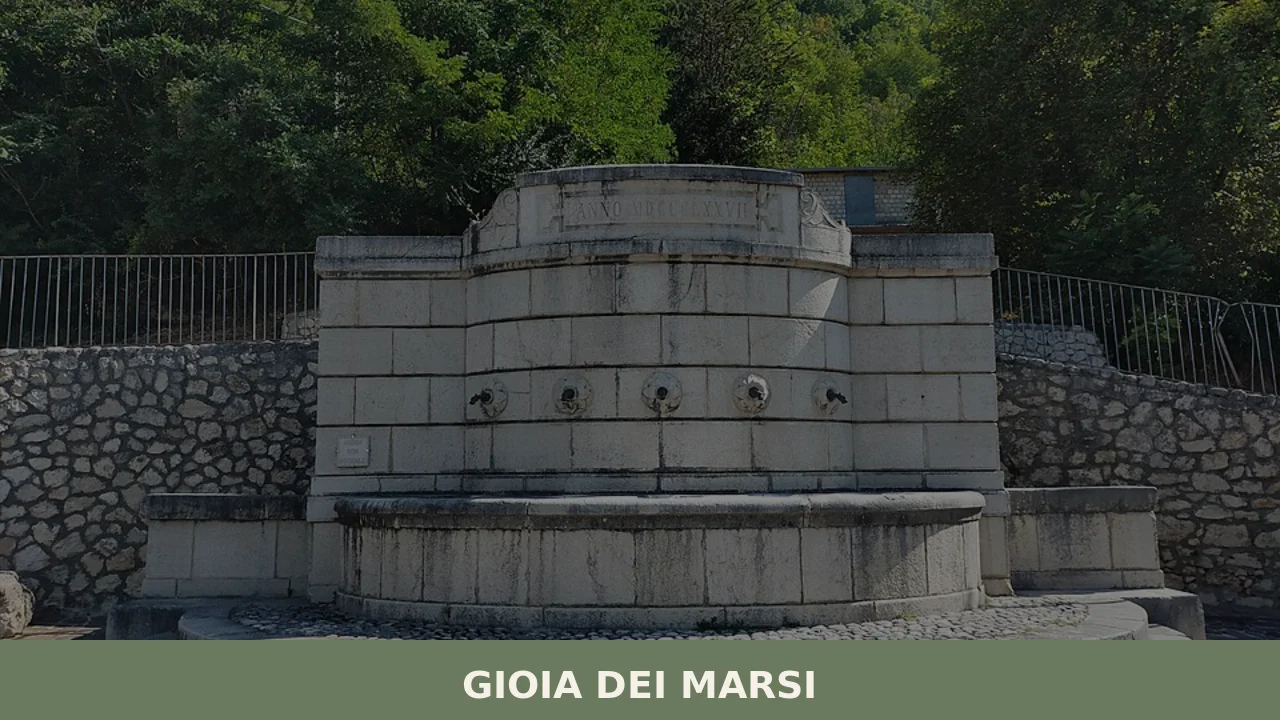
Gioia dei Marsi
Gioia dei Marsi has a population of 2,091 and sits at 725 metres above sea level on the eastern edge of the Fucino, the plain that until 1875 was the largest lake in peninsular Italy. The draining of the lake radically transformed the economy and landscape of this Marsican settlement, shifting its centre of gravity […]
Discover Gioia dei Marsi
Gioia dei Marsi has a population of 2,091 and sits at 725 metres above sea level on the eastern edge of the Fucino, the plain that until 1875 was the largest lake in peninsular Italy. The draining of the lake radically transformed the economy and landscape of this Marsican settlement, shifting its centre of gravity from water to land. Asking what to see in Gioia dei Marsi means engaging with a dual identity: that of a mountain village and that of a community shaped by the most ambitious land-reclamation project in pre- and post-unification Italy.
History and origins of Gioia dei Marsi
The name “Gioia” first appears in medieval documents from the 11th century, when the area fell under the jurisdiction of the County of the Marsi, a Lombard and later Norman political entity that administered the land around the Fucino basin. The suffix “dei Marsi” refers to the Marsi, an Italic people who occupied the Fucino region as early as the 4th century BC and whom Rome definitively subjugated after the Social War (91–88 BC). The historical profile of the village is marked by a succession of feudal powers: from the Counts of the Marsi to the Colonna family, passing through various baronial houses that controlled its fate until the abolition of feudalism in 1806.
On 13 January 1915, the Marsica earthquake — magnitude 6.99, with its epicentre at Avezzano — destroyed much of the settlement. Gioia dei Marsi suffered severe damage: buildings collapsed, lives were lost, and the pre-existing urban fabric was devastated. Reconstruction redesigned the centre along principles quite different from the medieval layout, which is why the village’s current appearance does not reflect its original form but rather the urban-planning choices of the early 20th century. This fact is essential for understanding the architecture one encounters today while walking through the village streets.
The other defining event for Gioia dei Marsi was the completion of the draining of Lake Fucino, begun by Prince Alessandro Torlonia in 1854 and finished in 1875. The fertile plain that resulted turned the villages around the former lake into agricultural centres, and Gioia was no exception. To this day, horticulture on the Fucino plain — particularly the cultivation of potatoes and carrots — remains a mainstay of the local economy.
What to see in Gioia dei Marsi: five places to know
1. Church of San Vincenzo
Dedicated to the patron saint Vincent of Saragossa, the parish church was rebuilt after the 1915 earthquake. The current building has a single-nave layout with features typical of early 20th-century Abruzzese ecclesiastical architecture. It hosts the patron saint’s feast day on 22 January, an occasion when the community gathers for celebrations that remain firmly rooted in the local civic and religious calendar.
2. Remains of the old village and traces predating 1915
In the hamlets and outlying areas of the settlement, sections of masonry predating the earthquake survive. These fragments — door jambs, lintels in local stone, stretches of dry-stone walling — document Marsican building techniques from before the disaster. There is no signposted trail; rather, reading the territory requires close attention to architectural details scattered among later constructions.
3. The Fucino plain and the reclamation landscape
From the eastern edge of Gioia, one can observe the geometry of the plain: straight canals, agricultural plots divided by drainage ditches, perpendicular farm roads. It is an artificial landscape, designed by the engineers of the Torlonia reclamation, and it represents one of the largest territorial transformation projects in 19th-century Europe. The view from 725 metres conveys its scale with clarity.
4. Gateway to the Abruzzo, Lazio and Molise National Park
Gioia dei Marsi lies on the north-western slope of the Abruzzo, Lazio and Molise National Park, established in 1922. From here, trails lead towards the Val di Sangro and the beech forests that form the habitat of the Marsican brown bear, an endemic subspecies with an estimated population of around 50–60 individuals. The municipal territory includes transitional areas between the agricultural plain and the forested mountains above 1,000 metres.
5. The spur and hamlets: Casali d’Aschi and Lecce dei Marsi
The municipal territory encompasses separate hamlets, each with its own distinct identity. Casali d’Aschi, at higher altitude, retains a settlement pattern that illustrates the Marsican mountain-village model. Lecce dei Marsi, closer to the plain, has a different layout, linked to its agricultural vocation. Visiting them means observing how the same municipality spans different altitudes, economies and building types within just a few kilometres.
Cuisine and local products of Gioia dei Marsi
The cuisine of Gioia dei Marsi reflects its dual position between mountain and agricultural plain. Dishes from the pastoral tradition — sagne e fagioli (pasta and beans), polenta resca with sausages, legume soups — sit alongside preparations tied to the Fucino’s fruit and vegetable production. The Patata del Fucino IGP (Fucino Potato, with Protected Geographical Indication) and the Carota del Fucino (Fucino Carrot), grown on the former lake bed just a few kilometres from the centre, are central ingredients in the local diet. Fucino potato gnocchi, dressed with a lamb ragù, are a concrete expression of this territory’s cooking.
Among local products one also finds locally made pecorino cheeses, mountain honey and dried pulses — lentils and grass peas — grown in the higher-altitude areas of the municipality. Dining options in the village are limited to a handful of establishments; for a wider choice, one needs to head towards Avezzano or the towns within the National Park. The municipal website publishes up-to-date information on seasonal food festivals and gastronomic events.
When to visit Gioia dei Marsi: the best time
Gioia dei Marsi has an Apennine continental climate, with harsh winters — night-time temperatures between December and February frequently drop below zero — and moderate summers, rarely exceeding 30°C. Spring, from April to June, is the period when the Fucino plain is covered with crops in their growing phase and the Park’s beech forests are in full understorey bloom. Autumn offers the advantage of foliage colour in the National Park valleys and the agricultural harvest on the plain.
The feast of San Vincenzo, on 22 January, falls in the depths of the Marsican winter and provides an opportunity to observe local ritual life. In summer, between July and August, the hamlets organise neighbourhood festivals with open-air cooking. Those planning to hike the National Park trails should consider the May–October window, checking path conditions at the Park Authority’s visitor centres.
How to reach Gioia dei Marsi
By car, Gioia dei Marsi is reached from the A25 Roma–Pescara motorway by taking the Pescina exit; from there, it is approximately 10 km southward on local roads. From Rome, the distance is about 120 km, with a travel time of around one hour and thirty minutes. From Pescara, it is roughly 110 km via the A25.
The nearest railway station is Pescina, on the Rome–Avezzano–Sulmona–Pescara line, served by regional trains. The closest airport is Rome Fiumicino, approximately 160 km away; Abruzzo Airport in Pescara is about 120 km distant. Local public transport connections between Pescina and Gioia are limited: having your own vehicle is advisable, especially for reaching the hamlets and the access points to the Park.
What to see in Gioia dei Marsi and in the villages of the Marsica
The Marsica area and the Abruzzo side of the central Apennines are home to other settlements that share historical and geographical traits with Gioia, though each has distinct characteristics. Alfedena, to the south-east in the Sangro valley, preserves a Samnite necropolis and has a direct relationship with the National Park’s protected area. Its historical profile, linked to the Italic Samnite people, offers a point of comparison with Gioia’s Marsian identity.
In a different direction, towards the Navelli plain on the Aquilan plateau, Navelli is the centre of Abruzzo’s DOP saffron cultivation, with a medieval village whose pre-earthquake urban layout remains legible. Together, these three settlements — Gioia, Alfedena, Navelli — trace an itinerary that crosses three different landscapes of inland Abruzzo: the reclaimed plain, the Apennine river valley and the high plateau. Three altitudes, three economies, three parallel histories within the same region.
In Abruzzo More villages to discover
Cermignano
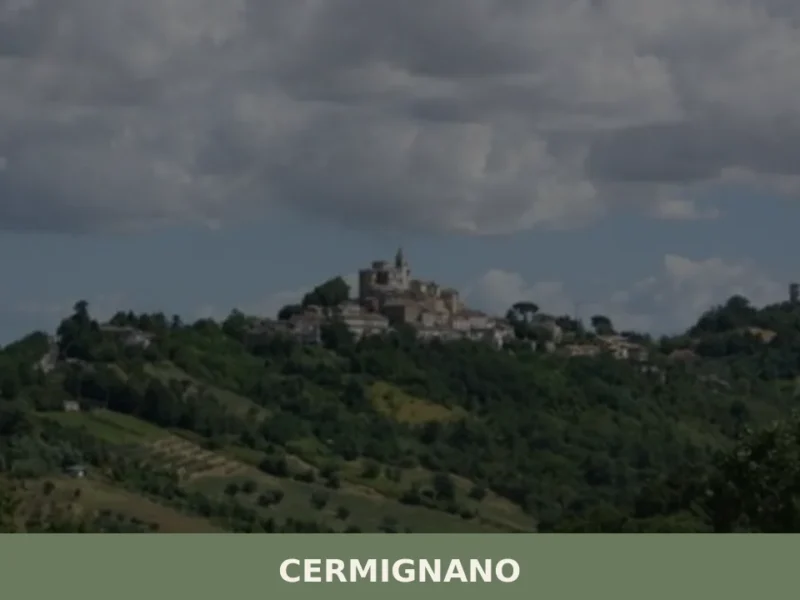
With its 1,440 inhabitants, Cermignano stands at 563 meters above sea level, offering a view of the Vomano valley and the foothills of Gran Sasso. This town in the province of Teramo, whose patron saint is Saint Sylvester, appears as a hillside settlement that retains traces of its historical development. For those wondering what to […]
Castilenti
At 272 metres above sea level, along the valley of the Fino torrent, Castilenti has a current population of 1,346 and occupies a stretch of hilly terrain in the province of Teramo where olive cultivation marks the landscape with orderly rows of trees and still-active oil mills. Anyone wondering what to see in Castilenti will […]
Furci
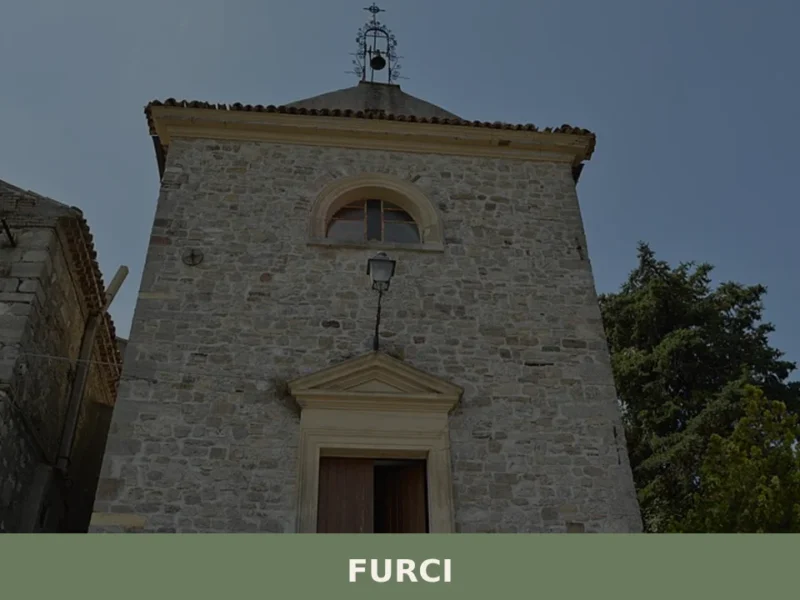
Furci has 806 inhabitants and sits at 550 metres above sea level, along the hill ridge that separates the Sinello valley from the Treste stream valley, in the southern part of the province of Chieti. Anyone looking into what to see in Furci will find a compact urban centre, organised around the main church and […]

📝 Incorrect information or updates?
Help us keep the Gioia dei Marsi page accurate and up to date.