


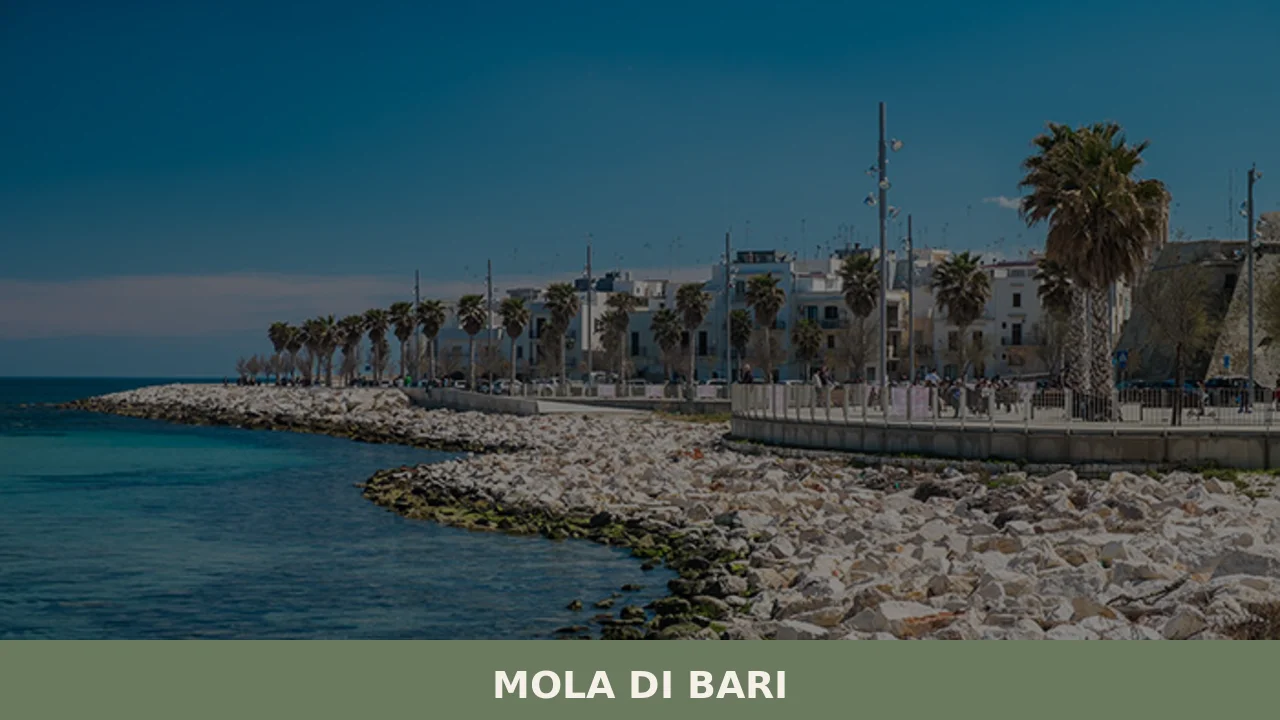
Mola di Bari
In 1278, Charles I of Anjou ordered the construction of a castle on the Adriatic coast south of Bari, at a spot where fishermen had been hauling their boats ashore for generations. That castle still stands, and it marks the exact centre of Mola di Bari, a town of 24,416 inhabitants spread out at just […]
Discover Mola di Bari
In 1278, Charles I of Anjou ordered the construction of a castle on the Adriatic coast south of Bari, at a spot where fishermen had been hauling their boats ashore for generations. That castle still stands, and it marks the exact centre of Mola di Bari, a town of 24,416 inhabitants spread out at just 15 metres above sea level. Anyone wondering what to see in Mola di Bari will find the answer by walking along the old harbour: on one side the walls of the Angevin fortress, on the other the nets laid out to dry on the quays and the moored lampara boats that head out every evening into the darkness of the Adriatic. This is a town that still lives off its sea, and from that sea has drawn its identity, its economy and its table.
History and origins of Mola di Bari
The name “Mola” has generated a long debate among historians.
The most widely accepted hypothesis links it to the Latin moles, a term indicating a massive structure or a harbour breakwater — a direct reference to the docking structures that characterised this stretch of coast as far back as Roman times. Other, less supported readings have proposed a derivation from the term mola, the grain millstone, linked to the presence of mills in the hinterland. Early medieval documents attest to the form “Mola” as early as the 10th century, when the territory fell within the orbit of the Byzantine Catepanate of Italy. Its coastal position — halfway between Bari and the lands of the south-eastern Barese area — made the site strategic for controlling Adriatic trade routes.
The decisive period for the urban layout of Mola coincides with Angevin rule. It was Charles I of Anjou, in 1278, who commissioned the construction of the castle that still dominates the seafront today, transforming a fishing settlement into a fortified centre. Over the course of the 14th and 15th centuries the town passed through several feudal lordships: the Del Balzo, the Orsini, the Toraldo families. In 1525, during the Italian Wars, Mola suffered a violent sacking by French troops led by Marshal Lautrec, an event that left deep marks on the collective memory and on the built fabric of the old town.
The reconstruction that followed redesigned part of the urban layout according to more regular criteria.
Between the 18th and 19th centuries, Mola di Bari experienced a phase of expansion driven by fishing and agriculture — particularly olive cultivation. The population grew steadily: from roughly 8,000 inhabitants at the start of the 19th century it rose to 15,000 after the First World War, reaching today’s 24,416. The harbour, enlarged several times during the 20th century, maintained its role as the economic engine. Among notable Molesi, Niccolò van Westerhout (1857–1898) stands out — a composer of operas who earned recognition in Italian and European theatres. The municipal theatre is named after him, one of the most important in the province of Bari, active since 1888 and still home to musical and theatrical seasons.
What to see in Mola di Bari: 5 top attractions
1. Angevin Castle
Built on the orders of Charles I of Anjou from 1278 onwards, the castle rises directly from the sea at the eastern end of the old harbour. The plan is an irregular polygon with four cylindrical towers at the corners, added in later periods during the Aragonese renovations of the 15th century. The entrance portal, facing the town centre, retains the Angevin coat of arms carved in local limestone. Inside, barrel-vaulted rooms periodically host exhibitions and cultural events. The sentry walkway offers a full view over the harbour, the fishing boats and the coastline stretching south-east as far as Polignano a Mare.
2. Mother Church of San Nicola
The mother church, dedicated to San Nicola, stands in the heart of the old town, just a few dozen metres from the castle. The current building dates largely to the 16th century, rebuilt after the damage sustained during the sacking of 1525. The sober, linear façade is constructed in local stone with a central rose window. The three-nave interior houses Baroque altars in polychrome marble and a fine 18th-century wooden choir. Of particular interest is the crypt below, which preserves traces of older masonry — probably remains of the original 12th-century church — and some fragments of Byzantine-school frescoes.
3. Lungomare Dalmazia and the Old Harbour
Mola di Bari’s seafront promenade extends for over a kilometre along the coast, from the old harbour to the area near the railway station. The old harbour is the most genuine nucleus: here the lampare — the traditional night-fishing boats fitted with onboard lamps — are moored in the shelter of the castle walls. In the late afternoon, fishermen unload their catch directly onto the quaysides, where it is sold fresh. The outer breakwater, built from blocks of limestone, is the best spot from which to observe the coast to the north and, on clear days, make out the urban outline of Bari roughly twenty kilometres away.
4. Church of the Addolorata
Dedicated to Maria SS. Addolorata, patron of Mola di Bari together with San Michele Arcangelo, this 18th-century church is located in the upper part of the old town. The façade, decorated with a triangular pediment and late-Baroque pilasters, leads into a single-nave interior with stucco ornamentation and 17th-century canvases. The wooden statue of the Addolorata, kept inside, is the focal point of the procession held on the second Sunday of September, when it is carried on shoulders through the streets of the old town down to the harbour. It is one of the most frequented religious buildings among the Molese community, a devotional reference point for the entire town.
5. Teatro Niccolò van Westerhout
Inaugurated in 1888 and named after the Molese composer Niccolò van Westerhout, the theatre is one of the few 19th-century theatres in the province of Bari still in operation. The auditorium, laid out in the traditional Italian style with stalls, boxes and gallery, can seat around 280 spectators. The interior retains original painted decorations on the proscenium walls and on the ceiling. Following a restoration completed in the early 2000s, the theatre hosts an annual season comprising drama, concerts and opera performances. It is located on Via De Gasperi, in the centre of the modern town, and can be reached on foot from the castle area in under ten minutes.
What to eat in Mola di Bari: local cuisine and traditional products
The cuisine of Mola di Bari is built on two pillars: Adriatic fish and the products of the Apulian hinterland.
The coastal position has shaped a gastronomic tradition in which raw seafood — sea urchins, octopus, prawns — sits alongside land-based dishes tied to the farming culture of the south-eastern Barese area. Extra virgin olive oil, produced from the Cima di Mola and Ogliarola cultivars, is the dominant cooking fat and condiment in every preparation. The simplicity of the ingredients and the speed of execution — many dishes were born out of the fishermen’s need to eat between one trip to sea and the next — define a repertoire that is essential and direct.
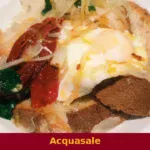
Among the dishes that define the Molese table, Acquasale (PAT) holds a central place. It is a peasant soup made with stale bread soaked in warm water, dressed with fresh tomatoes, raw onion, olives, oregano and a generous pour of extra virgin olive oil. In some versions, capers or peppers are added. It is a summer dish, originally eaten as breakfast by farm labourers before dawn, and still served today in the local trattorias during the warm months. The simplicity of its preparation — no cooking, only assembly — makes it a gastronomic document of the most stripped-back Apulian food culture.
Among the products recognised as PAT (Traditional Agri-Food Products) of Puglia and present in local tradition are Africani, soft pastries made with almonds and cocoa, covered in dark icing, widespread across the province of Bari and sold in Mola’s pastry shops especially during festive periods.
Agnello al forno con patate (PAT), a classic preparation for Sundays and Easter celebrations, involves slow oven-cooking with roughly cut potatoes, cherry tomatoes, lampascioni (wild hyacinth bulbs) and grated pecorino. Also worth mentioning are Asparagi selvatici (PAT), wild asparagus gathered in the surrounding countryside between March and April, eaten in frittata or sautéed with garlic and oil, and Asparagi sott’olio (PAT), a traditional preserve that extends their consumption into autumn.
On the second Sunday of September, during the patron saint’s festival, the streets of the centre fill with food stalls offering stuffed focaccia, fried fish and local sweets. During summer, the old harbour hosts gastronomic events dedicated to fish — particularly octopus, prepared in salad, grilled or stewed with tomato. Mola’s fish market, open every morning on the harbour quayside, is the most direct place to buy fresh Adriatic fish: small cuttlefish, red mullet, cod, pink prawns.
For agricultural produce, the neighbourhood markets on Wednesdays and Saturdays offer local oil, seasonal vegetables and artisanal preserves.
The coastal area south of Bari falls within the production zone of Primitivo di Gioia del Colle DOC and Castel del Monte DOC, full-bodied red wines that pair well with meat dishes. For fish, local tradition favours fresh whites such as Fiano pugliese or Minutolo, an indigenous grape variety rediscovered over the last twenty years. Anisetta (PAT), an anise-based liqueur widespread throughout Puglia, traditionally closes the meal on convivial occasions — served cold in summer or at room temperature during the winter months. Amaro del Gargano (PAT), made from herbs and citrus, is another digestif found in local pantries.
When to visit Mola di Bari: the best time
The coastal position gives Mola di Bari mild winters — average January temperatures hover around 8–9 °C — and warm summers tempered by the Adriatic breeze. The period from May to October is the most suitable for those who want to combine a visit to the old town with time by the sea: the beaches and small coves south of the harbour, towards Cozze and San Vito, are accessible and uncrowded until mid-June and again after the first week of September. The second Sunday of September coincides with the patron saint’s festival in honour of Maria SS.
Addolorata and San Michele Arcangelo: three days of processions, luminarie, brass band concerts and fireworks over the sea that draw visitors from across the province.
Those who prefer to avoid the summer crowds will find ideal conditions in April and May: temperatures between 15 and 22 °C, long days and countryside in full bloom — this is the season for wild asparagus picking. October also offers a good compromise, with the sea still warm and the start of the olive-pressing season bringing life to the surrounding countryside. The winter months, from December to February, suit those seeking quiet and wanting to focus on visiting the old town, the castle and the Teatro van Westerhout without the pressure of tourist flows. The Christmas period brings markets and nativity scenes set up in the old town centre.
How to reach Mola di Bari
Mola di Bari can be reached by car from the A14 Bologna–Taranto motorway, taking the Bari Sud exit and continuing along the SS 16 Adriatica heading south for approximately 20 kilometres. From central Bari the distance is 25 km, covered in about 30 minutes. From Taranto the journey is around 80 km via the SS 100 and then the SS 16, taking just over an hour. The town has its own railway station on the Ferrovie del Sud-Est (FSE) line, which connects Bari to Lecce along the coast. Regional trains from Bari Centrale take approximately 25–30 minutes, running roughly once an hour during peak times.
Bari-Karol Wojtyła Airport is 35 kilometres from Mola and can be reached in around 40 minutes by car via the Bari ring road.
From the airport, you can take the Amtab shuttle to Bari’s central station and from there an FSE train to Mola. Alternatively, SITA regional bus services connect Mola with Bari and neighbouring coastal towns. For those arriving by sea, the tourist harbour can accommodate small and medium-sized pleasure craft, although it does not yet offer a scheduled passenger service.
Other villages to discover in Puglia
Twenty kilometres to the north, Bari is the provincial capital and the natural complement to a visit to Mola. The old city — with the Basilica of San Nicola, the Norman-Swabian castle and the maze of alleyways where local women shape orecchiette on small tables in the street — requires at least half a day to explore. The direct train link makes it possible to combine the two destinations without a car. From Mola, Bari also provides access to long-distance transport services — high-speed trains, the airport, ferries to Greece — useful for anyone planning a wider itinerary across Puglia.
In the opposite direction, towards the Tavoliere delle Puglie, Orta Nova represents another side of the region: an agricultural town in the province of Foggia, about 150 km from Mola, set in the largest cereal-growing plain in southern Italy.
Visiting it after Mola di Bari means crossing Puglia from coast to interior, moving from the maritime and olive-growing landscape of the Barese area to the flat, grain-producing terrain of Capitanata. For a deeper look at the geography and history of Mola di Bari, the dedicated Wikipedia page offers a detailed overview of documentary sources. Those planning a longer trip can also consult the listings from the Touring Club Italiano for information on accommodation and routes in the province.
In Apulia More villages to discover
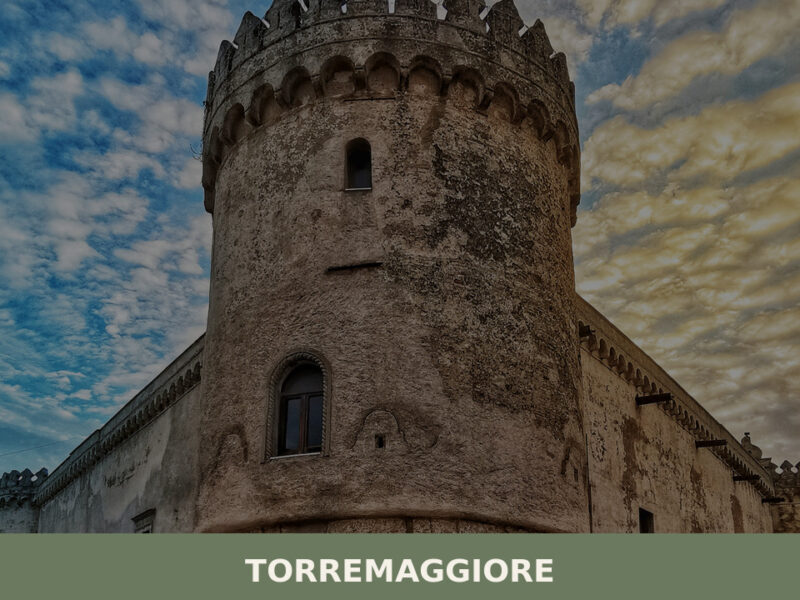
Torremaggiore
A complete guide to Torremaggiore in northern Puglia — its medieval castle, the ruins of Fiorentino, local food traditions, and practical travel information.
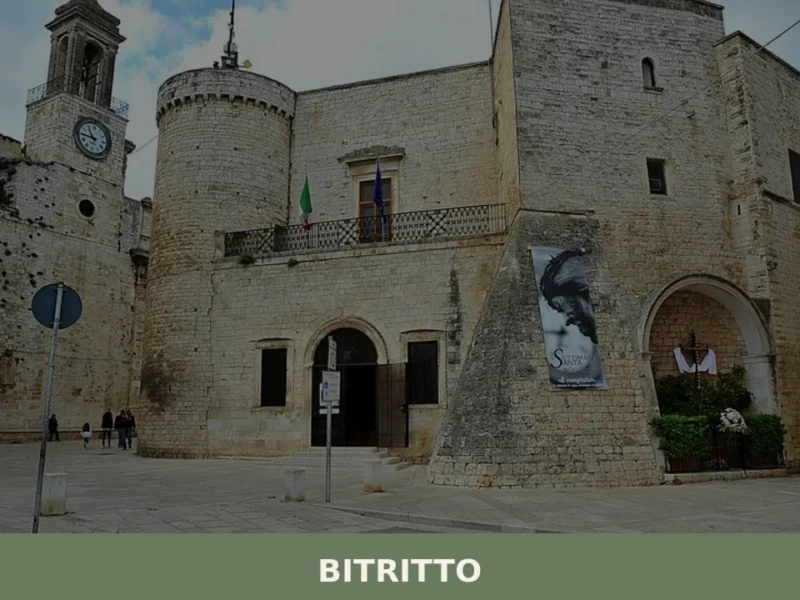
Bitritto
Approximately 11 kilometers southwest of Bari, in the basin opening towards the hinterland, lies Bitritto, a municipality with 11,046 inhabitants, situated 102 meters above sea level. Its territory, marked by olive groves and almond orchards, is an integral part of the Apulian agricultural landscape and reflects the region’s farming heritage. For those wondering what to […]
Stornarella
A working agricultural village on the Tavoliere plain near Foggia, Stornarella offers wheat-field panoramas, rural chapels, and the elemental cuisine of northern Puglia.
📝 Incorrect information or updates?
Help us keep the Mola di Bari page accurate and up to date.