


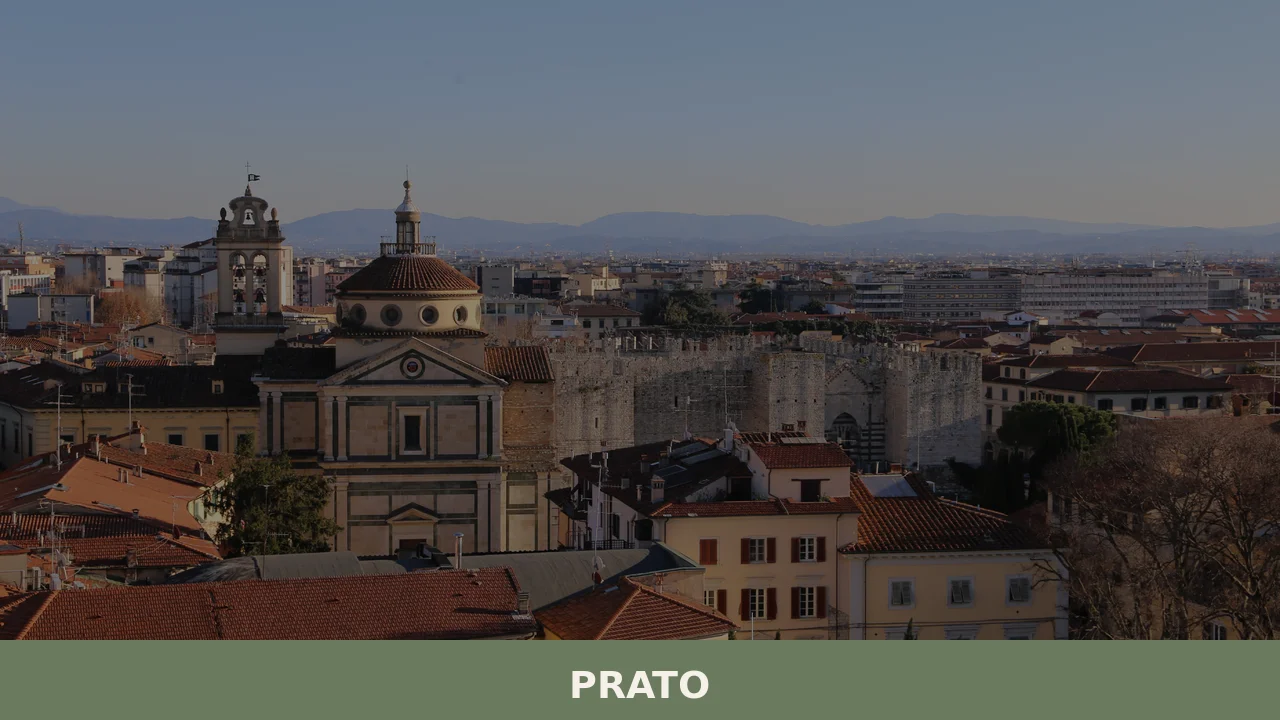
Prato
With nearly 187,000 inhabitants, Prato is the second most populous city in Tuscany and one of the largest urban centres in central Italy. Located on the plain between the Bisenzio river and the first foothills of the Apennines, the city has built a distinct identity over the centuries, defined by its textile industry, medieval art, […]
Discover Prato
With nearly 187,000 inhabitants, Prato is the second most populous city in Tuscany and one of the largest urban centres in central Italy.
Located on the plain between the Bisenzio river and the first foothills of the Apennines, the city has built a distinct identity over the centuries, defined by its textile industry, medieval art, and a lively cultural scene.
Anyone exploring what to see in Prato will find a substantial catalogue: castles, museums, Romanesque churches, and monumental complexes that document seven centuries of productive and civic history without significant interruption.
History and Origins of Prato
The name Prato most likely derives from the Latin pratum, meaning simply a meadow — flat, open ground.
The area was frequented as far back as the Etruscan period, but the urban settlement took shape in the Middle Ages, around the 10th and 11th centuries, when a community of merchants and craftsmen became established there. Its geographical position — on the plain crossed by the Bisenzio river, not far from Florence — fostered a commercial vocation from early on, expressed above all in textile craftsmanship, a sector that would go on to become the economic engine of the city for centuries.
In 1350, Prato was incorporated into the Florentine domain following a prolonged process of political and military acquisition, gradually losing the municipal autonomy that had defined the preceding period.
Before this annexation, the city was governed by a Commune that had produced notable figures, among them the celebrated merchant Francesco di Marco Datini, born around 1335 and died in 1410, whose life is one of the most thoroughly documented of the late medieval period in Europe.
Datini built a commercial enterprise with branches across the whole of Europe and left behind, at his death, a private archive of over 150,000 documents, now held at the State Archive of Prato — an irreplaceable primary source for scholars of medieval economic history.
Between the 14th and 15th centuries, Prato was the site of a dramatic episode that has remained lodged in collective memory: in 1512, Spanish troops in the service of the Medici systematically sacked the city, causing thousands of civilian deaths.
The event, known as the Sack of Prato, left a deep mark on local history and accelerated Florence’s surrender to the Medici family.
In the centuries that followed, the city gradually recovered and grew, leading to the major industrial expansion of the 19th and 20th centuries, when the Prato textile district became one of the most important in Europe, drawing internal migration and later international immigration that substantially transformed the city’s demographic profile.
What to See in Prato: Main Attractions
Castello dell’Imperatore
The Castello dell’Imperatore is the only Swabian castle built in central-northern Italy, commissioned by Frederick II of Swabia around 1237. The square-plan structure, with its limestone corner towers, dominates the historic centre and retains much of its original fabric. Over the centuries the building was also used as a prison and military depot, but it is now open to visitors and hosts temporary exhibitions.
The battlements and wall walk offer a view across the entire urban area that alone makes the visit worthwhile.
Cathedral of Santo Stefano
The Cathedral of Santo Stefano, built from the 11th century and extended between the 12th and 14th, is the city’s principal religious building.
The façade features a two-tone cladding in white marble and green Prato marble, characteristic of the Tuscan Romanesque-Gothic style.
Inside, the main chapel contains frescoes by Fra Filippo Lippi, painted between 1452 and 1466 and regarded as one of the most significant fresco cycles of the Italian Renaissance. The external pulpit of the Sacred Girdle, designed by Donatello and Michelozzo in 1428, is an architecturally exceptional element.
Museo di Palazzo Pretorio
The Museo di Palazzo Pretorio occupies the former civic palace overlooking the main square and holds works of art ranging from the 12th to the 20th century. The permanent collection includes panel paintings and altarpieces by Filippino Lippi, Giovanni da Milano, and other masters active in the Tuscan region.
The palace itself, with its crenellated façade and tower, stands as an architectural record of medieval civic government.
The museum reopened after an extensive restoration and now features a modern layout that supports a chronological reading of the works on display.
Museo del Tessuto
The Museo del Tessuto is one of Europe’s most significant specialist museums in its field, holding a collection of over 6,000 historic textile samples spanning from the 4th to the 20th century.
Housed in the former Cimatoria Campolmi, a 19th-century industrial building that has been restored and converted, the museum documents the history of Prato’s productive district through original artefacts, machinery, and archives. For those exploring what to see in Prato beyond its medieval monuments, the museum offers a first-rate industrial and manufacturing perspective.
Centro per l’Arte Contemporanea Luigi Pecci
The Centro per l’Arte Contemporanea Luigi Pecci, inaugurated in 1988 and expanded in 2016 to a design by architect Maurice Nio, is one of Italy’s leading contemporary art museums.
The venue holds a permanent collection of works from the 1980s to the present, alongside temporary exhibitions by international artists. The building itself — with its circular form and the metal structure rising above the original pavilion — represents a significant architectural intervention in the European museum landscape.
The centre also runs performance events, film screenings, and educational programmes throughout the year.
Traditional Food and Products of Prato
Prato’s cuisine sits within the broader Tuscan gastronomic tradition, with peasant and artisan roots stretching back to the Middle Ages.
The city’s geographical position — on the Bisenzio plain with easy access to both the Apennines and the Tyrrhenian coast — allowed for a varied range of available ingredients over the centuries: beef and pork from the plain, dairy products from the hill areas, and vegetables from the Prato farmland.
The city’s industrial character also left its mark on local food culture, producing a practical, substantial cuisine tied to the rhythms of work in the textile factories that defined daily life for decades.
The best-known sweet product of Prato is the biscotto di Prato, also known as cantucci — a dry biscuit made from flour, eggs, sugar, and whole almonds, baked twice to achieve a hard, crumbly texture.
The recipe is well documented across the centuries, and the biscuit is traditionally served with vin santo, into which it is dipped before eating.
Another product associated with the city is mortadella di Prato, a local cured meat that differs from the Bologna version through the addition of alchermes, a red liqueur that gives the product a distinctive colour and aroma.
Farro soup also features among the traditional local dishes, present in both the plain and mountain variants of Tuscan cuisine.
As regards food certifications, the available database does not record any DOP, IGP, or PAT products specifically attributed to the municipality of Prato. Mortadella di Prato and cantucci are products with documented traditional roots but, based on currently available information, have not been formally awarded European certification.
Visitors to the city will find these products in artisan shops in the historic centre and in a number of traditional workshops that continue to follow original recipes without significant industrial modification.
The Mercato Centrale di Prato, located in the heart of the city, offers a daily selection — on weekday mornings — of local fruit and vegetables, cheeses, cured meats, and baked goods from the Tuscan tradition.
The autumn months, particularly October and November, bring the richest seasonal produce from the area: mushrooms from the Prato Apennines, chestnuts, and new-season olive oil from the surrounding hills. The Friday and Saturday neighbourhood markets are also worth exploring, where local producers sell directly without intermediaries.
Festivals, Events and Traditions of Prato
The most important event in Prato’s civic and religious calendar is the Ostensione del Sacro Cingolo, celebrated five times a year: on 1 January, 25 March (Annunciation), 1 May, 15 August (Assumption), and 8 September (Nativity of the Virgin).
During the ceremony, the Sacred Girdle — the relic that tradition holds to be the belt given by the Virgin Mary to the apostle Thomas at the moment of her Assumption — is displayed to the public from the external pulpit of the Cathedral of Santo Stefano.
The procession accompanying the ceremony involves participants in medieval costumes, representatives of civil and religious institutions, and large crowds of the faithful and visitors.
In September, the city hosts Settembre Pratese, a programme of cultural events, performances, and community initiatives spread across the municipality over several weeks.
Prato also hosts the Festival delle Colline, dedicated to contemporary performing arts, with theatre and dance productions taking place across various city venues. Open-air cinema screenings in the central squares and initiatives linked to the textile district — including special openings of historic workshops — complete a calendar that keeps the city active throughout the year.
When to Visit Prato and How to Get There
The recommended period for those who want to discover what to see in Prato while combining comfortable weather with a full events calendar is spring, from April to June, and autumn, from September to November.
During these seasons temperatures are moderate, the historic centre is easy to explore, and the cultural programme is particularly full.
The summer months — July and August — bring high temperatures to the Prato plain but have the advantage of less crowded museums compared to the major art cities nearby.
1 May and 8 September coincide with Ostensioni of the Sacred Girdle, drawing visitors from across the region.
Prato is accessible by car via the A11 Florence–Sea motorway, with the exits Prato Ovest or Prato Est depending on the direction of travel, and via the A1 with the exit at Calenzano–Sesto Fiorentino for those arriving from the north. The distance from Florence is approximately 17 kilometres.
By train, Prato is served by the Trenitalia rail network at Prato Centrale station, with direct and frequent connections to Florence taking around 20–25 minutes.
The nearest airport is Florence Peretola (officially Amerigo Vespucci), approximately 20 kilometres away, reachable from Prato by car in under half an hour or by bus and train in around 40 minutes.
Visitors to Prato can extend their itinerary to include villages of northern Tuscany that share with the Prato area historical roots in medieval rule and Apennine culture.
Fosdinovo, in the Lunigiana, preserves a medieval castle of exceptional structural integrity, in a hilly landscape very different from the Prato plain but connected to the same historical period of defensive construction.
Travelling north-west, the itinerary can also take in Mulazzo, a small Lunigiana centre with documented medieval origins and a territory crossed by ancient road routes. Further north, along the Via Francigena, Filattiera is a notable stop with its Romanesque parish church and Malaspina castle, while Podenzana offers a more compact profile and a panoramic position over the surrounding valleys.
In Tuscany More villages to discover
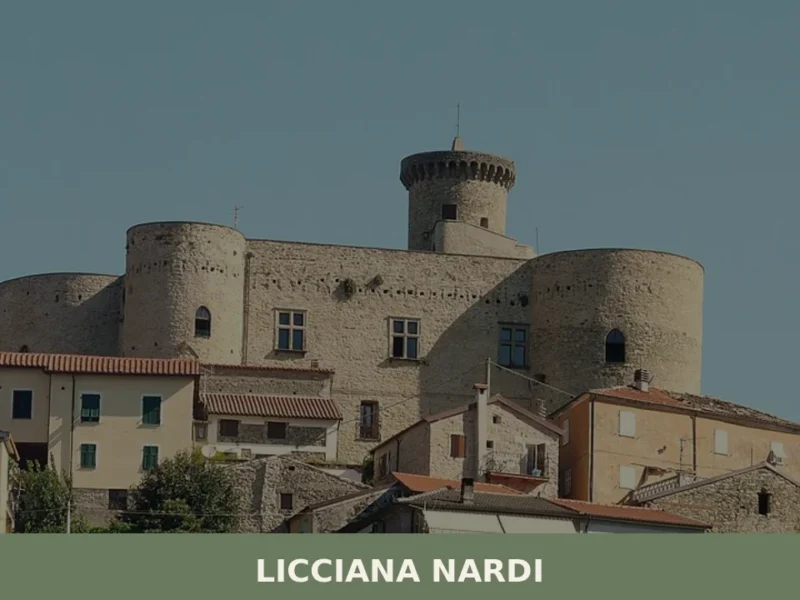
Licciana Nardi
The territory of Licciana Nardi includes six castles spread between the valley floor and the Apennine slopes, a concentration of defensive structures that documents the strategic role of this stretch of Lunigiana in controlling the routes between the Po Plain and the Tyrrhenian coast. With its 4,894 inhabitants distributed across 55 square kilometres at an […]
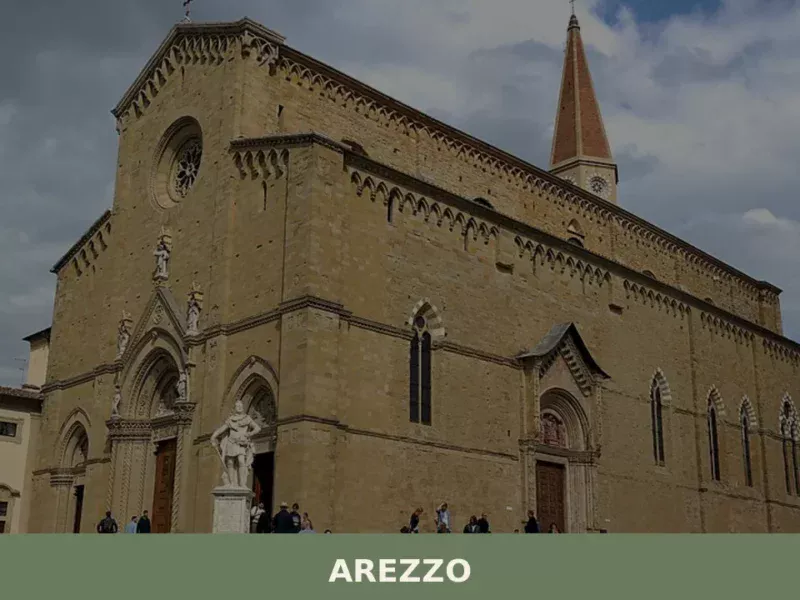
Arezzo
Discover Arezzo, a charming village in Tuscany, Italy. Explore its rich history, stunning architecture, and vibrant culture nestled in the heart of Toscana.
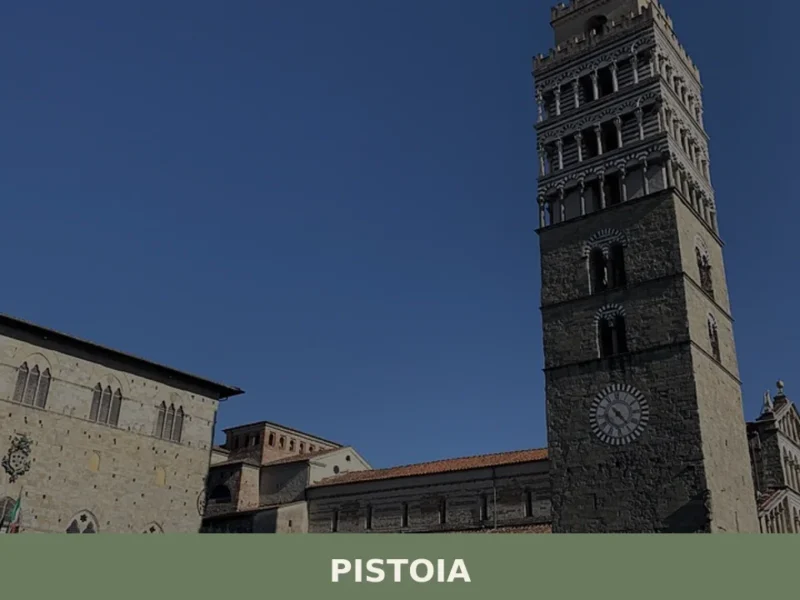
Pistoia
Discover Pistoia, a charming village in Tuscany, Italy. Explore its rich history, stunning architecture, and authentic Italian culture off the beaten path.
📝 Incorrect information or updates?
Help us keep the Prato page accurate and up to date.