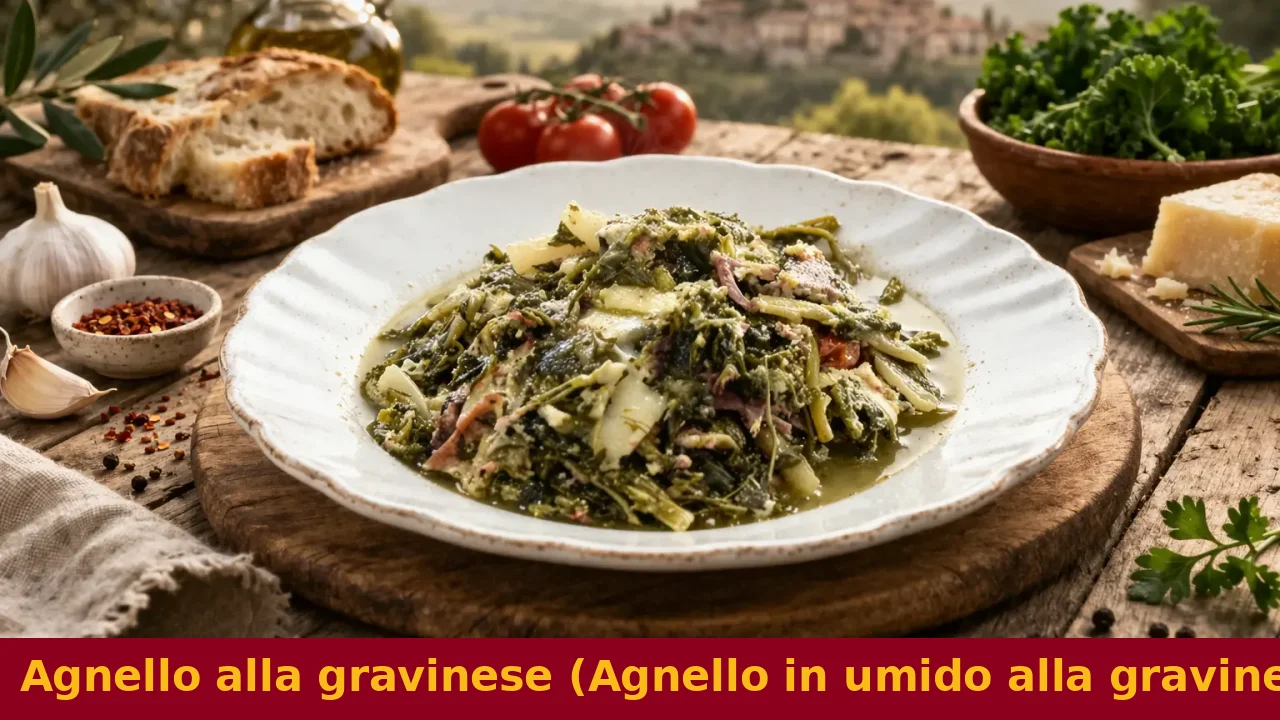
In the heart of the Murgia barese, where the land shares tales of shepherds and ancient culinary practices, a soul-warming dish emerges: agnello alla gravinese (agnello in umido alla gravinese). This robust stew, a symbol of Gravina in Puglia’s gastronomy, embodies the essence of Apulian cooking, crafted from simple yet excellent quality ingredients, transformed by…
Also known as: (Agnello in umido alla gravinese)
In the heart of the Murgia barese, where the land shares tales of shepherds and ancient culinary practices, a soul-warming dish emerges: agnello alla gravinese (agnello in umido alla gravinese). This robust stew, a symbol of Gravina in Puglia’s gastronomy, embodies the essence of Apulian cooking, crafted from simple yet excellent quality ingredients, transformed by knowledge passed down through generations. It is an invitation to discover not only a true taste but also the territory it comes from, an area rich in history and landscapes that have shaped the local food culture.
agnello alla gravinese, also known as agnello in umido alla gravinese, is a traditional dish of Apulian cuisine, specifically from the Gravina in Puglia area. It is a lamb meat stew, slow-cooked in a rich and flavorful sauce, enriched with fresh vegetables and typical Mediterranean aromas. Recognized as a Traditional Agri-food Product (PAT), this dish stands out for the tenderness of the meat, which easily falls apart, and for its intense and enveloping flavor. The preparation involves using specific cuts of lamb, such as shoulder or leg, which, thanks to the long cooking process, absorb the flavors of the other ingredients, creating a deep and satisfying taste balance.
The origins of agnello alla gravinese are rooted in the pastoral and rural traditions of Puglia. Sheep farming has always played a fundamental role in the economy and food culture of many Italian regions, including Puglia. Although sources primarily cite Sardinia, Abruzzo, Molise, Lazio, Sicily, Tuscany, Campania, Basilicata, Marche, and Calabria as areas of greater importance for raising sheep destined for milk, meat, and wool, the presence of sheep in Puglia has also been historically significant for the sustenance of local communities. Lamb meat, in particular, was a valuable food, often consumed on special occasions or during festivities. The need to make the best use of every part of the animal and to tenderize even less noble cuts led to the development of slow-cooking techniques, such as stews. agnello alla gravinese is the expression of this knowledge, a dish that, despite its simplicity, tells the story of a people connected to the land and its bounty. The recipe has solidified over time, passed down from family to family, becoming a symbol of the gastronomic identity of Gravina in Puglia and the traditional products from PUGLIA.
agnello alla gravinese is closely tied to the territory of Gravina in Puglia, a municipality located in the province of Bari, bordering Basilicata. This area is part of the Murgia, a karst plateau characterized by wide expanses of pastures, gravine (natural canyons), and Mediterranean scrub. The Murgian landscape, with its rock formations and wild vegetation, offers an ideal environment for sheep farming. Lambs grazing on these lands feed on aromatic herbs and natural forages, which impart a distinctive flavor and prized texture to their meat. The quality of local lamb is a determining factor for the success of the dish. The tradition of farming in these areas, although not always cited among the most extensive nationally, has allowed for the preservation of practices that ensure a niche product. Exploring the surrounding territory, perhaps with a visit to centers like Foggia or Lucera, helps to better understand the agricultural and pastoral context that sustains these culinary traditions.
The preparation of agnello alla gravinese is a process that demands patience and care, essential elements to achieve its distinctive flavor. The process begins with the selection of the lamb, preferably young and locally sourced, cut into medium-sized pieces. The meat is usually browned in extra virgin olive oil, typical of the region, until it turns golden on all sides. Subsequently, chopped vegetables are added, which may include onions, carrots, celery, and tomatoes (fresh or peeled, depending on the season), along with aromatic herbs such as rosemary, bay leaf, and parsley. After allowing the sauté to develop flavor, it is deglazed with local dry white wine, which helps to cut through the richness of the meat and enrich the dish’s aromatic profile. Cooking continues over low heat, covered, for several hours, adding vegetable broth or hot water as needed, to ensure the meat remains tender and juicy and that the sauce slowly thickens. Some variations may include adding potato pieces towards the end of cooking, which absorb the sauce and become incredibly flavorful. The result is agnello in umido alla gravinese with extremely tender meat and a dense, aromatic sauce.
agnello alla gravinese presents itself as a dish with a rustic and inviting appearance. The meat’s color is reddish-brown, immersed in a thick sauce that ranges from intense red to dark orange, depending on the quantity and type of tomato used. The tender, well-blended vegetable pieces enhance the texture. To the nose, the aroma is complex and enveloping: one perceives the intense notes of slow-cooked meat, the herbaceous nuances of rosemary and bay leaf, the sweetness of onion, and the slight acidity of tomato, all softened by the aroma of fine olive oil. On the palate, the experience is rich and satisfying. The lamb meat is extraordinarily tender, almost melting in the mouth, and its decisive flavor is balanced by the sweetness of the vegetables and the acidity of the tomato and wine. The sauce, dense and flavorful, envelops every bite, leaving a persistent and aromatic aftertaste. It is a dish that offers a sense of warmth and comfort, with a complexity of flavors revealed with each bite. Its robustness makes it an ideal dish for colder months.
agnello alla gravinese is traditionally served as a main course, a true centerpiece of the Apulian table. Given its rich texture and ample sauce, it ideally pairs with Apulian homemade bread, crispy outside and soft inside, perfect for “scarpetta” (mopping up the sauce with bread) and for gathering every drop of the delicious sauce. It is often offered during Sunday lunches or on festive occasions, when the family gathers. It can be accompanied by a simple side dish, such as baked potatoes (if not already present in the stew), boiled wild greens, or a fresh green salad, to balance the richness of the dish. Regarding wine pairing, a robust Apulian red is the perfect choice. Wines like a Primitivo di Gioia del Colle or a Nero di Troia, with their structure and soft tannins, pair splendidly with the decisive flavor of agnello in umido alla gravinese, enhancing its aromatic notes without overpowering them.
agnello alla gravinese stands out for its distinctiveness due to a combination of factors that make it much more than a simple stew. Firstly, its strong connection to the territory of Gravina in Puglia and the Murgia barese, which provides superior quality lamb, fed with local wild herbs. This specificity of the base ingredient is fundamental. Secondly, the recipe itself, passed down through generations, represents an example of traditional gastronomy that has evolved while maintaining its identity firmly. It is not just a matter of ingredients, but of a slow and patient cooking method that allows flavors to blend and intensify, a process that few dishes can replicate with the same depth. Finally, its status as a Traditional Agri-food Product (PAT) underscores its cultural and historical value, recognizing it as an integral part of Apulian culinary heritage. This makes it a genuine and unrepeatable gastronomic experience, a true symbol of Italian traditional food products. Its culinary longevity is a testament to its excellence.
agnello alla gravinese (agnello in umido alla gravinese) is recognized as a Traditional Agri-food Product (PAT). This certification, established by the Ministry of Agricultural, Food, and Forestry Policies, identifies products that are “obtained with processing, conservation, and aging methods consolidated over time, homogeneous throughout the interested territory, according to traditional rules and prolonged for a period of no less than twenty-five years.” The PAT recognition is not a binding geographical origin certification like PDO or PGI, but it attests to the typicality and historical nature of a product, enhancing its connection to the territory and local traditions. For agnello alla gravinese, this means that its recipe, its main ingredients, and its preparation method reflect a consolidated and genuine practice, deeply rooted in the gastronomic culture of Gravina in Puglia.
To savor the true agnello alla gravinese, the best place is undoubtedly Gravina in Puglia and its surroundings. In local trattorias and agriturismos, you can find this dish prepared according to the traditional recipe, often with lamb sourced directly from Murgia’s farms. Many restaurants in Gravina include it on their menu, especially during cooler months and on festive occasions. While exploring Puglia, you may find variations or similar dishes in other locations, but the original agnello alla gravinese remains an experience to be had in its place of origin. For those wishing to replicate the dish at home, quality lamb meat can be purchased in local markets or from trusted butchers, paying attention to the provenance and freshness of the product. Visiting the area also offers the opportunity to discover other gastronomic and cultural excellences. Traveling the roads connecting Gravina to centers like Foggia or Lucera, one can appreciate the richness of Apulian cuisine and the hospitality of the local people. Many local events and festivals, especially in autumn and winter, are the perfect occasion to taste agnello alla gravinese and other traditional products from PUGLIA, fully immersing oneself in the local culture.
📷 Photo: Villages Italy · Villages Italy License · All credits →
Piozzano, a village in Emilia-Romagna with 645 inhabitants, is situated at an elevation of 222 meters above sea level within the province of Piacenza. This location places it amidst the agricultural landscape of the Piacentine hills, where the transition from the Po Valley to the Apennine foothills is evident. For those considering what to see […]

What to see in Carpaneto Piacentino: 7,598 residents, 114 m altitude, Saints Fermo & Rustico festival on 9 Aug, DOP cured meats. Plan your visit now.

The Val Roveto divides southern Abruzzo from Lazio along a fault line that has determined earthquakes, migrations and feudal borders for over seven centuries. Balsorano occupies the valley floor and the hillside at 340 metres above sea level, with its 3,617 inhabitants spread between the upper historic centre — Balsorano Vecchio — and the modern […]
📝 Incorrect information or updates?
Help us keep the Agnello alla gravinese (Agnello in umido alla gravinese) page accurate and up to date.