

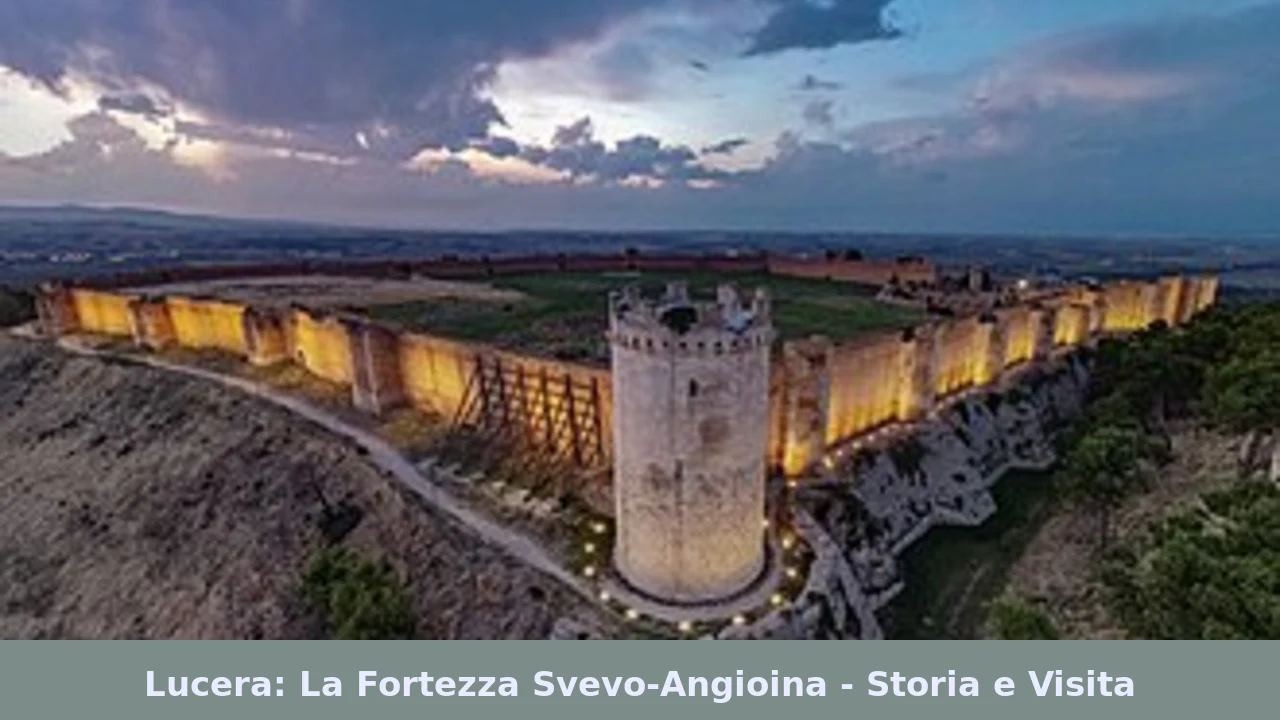
Imagine a colossal stone crown, perched atop a hill, its jagged teeth silhouetted against the vast Apulian sky. This is not merely a ruin; it is a testament to empires, a silent storyteller of fierce battles, imperial visions, and a unique cultural melting pot. We are speaking, of course, of Lucera, and specifically, the magnificent and historically charged structure known as 1. la fortezza svevo-angioina, a monumental landmark that dominates the landscape and defines the very identity of this enchanting medieval village.
Unveiling the Majesty: Lucera’s Swabian-Angevin Fortress and its Imperial Legacy
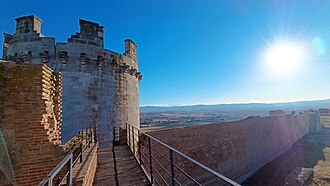
To truly grasp the essence of Lucera, one must first understand the monumental significance of its fortress. It is far more than just a castle; it is a palimpsest of power, etched by the hands of emperors and kings. Its origins stretch back to the Roman era, where the strategic hill, known as Monte Albano, already hosted an acropolis for the ancient city of Luceria. However, it was in the High Middle Ages that this site was transformed into one of the most remarkable and controversial strongholds in Southern Italy, a project spearheaded by one of history’s most fascinating rulers: Frederick II of Hohenstaufen.
Frederick II, often called Stupor Mundi (the Wonder of the World), was an emperor of unparalleled intellect and ambition. He envisioned a centralized, efficient, and culturally rich kingdom in Sicily and Southern Italy, and Lucera was to be a cornerstone of this vision. By the early 13th century, Frederick faced internal strife in Sicily, particularly from rebellious Saracen communities. His solution was audacious and pragmatic: he forcibly relocated thousands of these Sicilian Saracens to Lucera, creating a unique Muslim colony within a Christian realm.
This decision was not arbitrary. Frederick admired the Saracens’ military prowess, their loyalty (as they had no ties to local Christian feudal lords), and their advanced knowledge in various fields. In Lucera, they found a home, a place to practice their religion and traditions, and in return, they became the emperor’s most trusted soldiers and guards. It was for this loyal garrison and as a personal imperial residence that Frederick began the construction of a grand palace and the initial fortifications, laying the groundwork for what would become Lucera‘s iconic Swabian-Angevin fortress.
Frederick II’s Saracen colony in Lucera was unique in medieval Europe. It allowed Muslims to live according to their customs, build mosques, and even mint their own coins, all under the direct protection of the Emperor, making Lucera a vibrant, albeit controversial, hub of cultural exchange.
The Emperor’s Jewel: Frederick II’s Palatial Vision within Lucera’s Swabian-Angevin Fortress
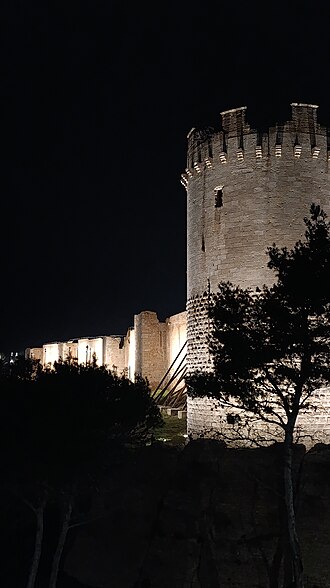
Frederick II’s architectural projects were always imbued with symbolic meaning and practical ingenuity. His palace within the burgeoning fortress complex was no exception. Built between 1233 and 1239, the Palatium Regium was a magnificent structure, designed not just for defense but for comfort, administration, and imperial grandeur. It served as a primary residence for Frederick, a treasury for his immense wealth, and a strategic military base.
The palace itself was a sprawling complex, featuring a residential quarter, administrative buildings, a chapel, and extensive stables. While today only foundations and fragments remain, archaeological excavations have revealed its sophisticated layout. It boasted a central courtyard, large halls for audiences, and private chambers for the emperor and his court. The materials used were of the highest quality, often repurposed from ancient Roman structures, a common practice for Frederick, who saw himself as an heir to Roman imperial glory.
The Saracen presence was integral to the palace’s function and defense. They formed the elite imperial guard, ensuring the emperor’s safety and the security of his treasures. Lucera, with its fiercely loyal Saracen garrison and its impregnable fortress, became a virtually autonomous state within the Kingdom of Sicily, a place where Frederick could retreat, govern, and indulge his intellectual pursuits away from the political machinations of other European courts.
The strategic location of Lucera also allowed Frederick to oversee his vast domains in Puglia, a region he particularly cherished. From the ramparts of his fortress, he could survey the Tavoliere delle Puglie, a fertile plain that provided immense agricultural wealth to his kingdom. The fortress was a symbol of his absolute power, a tangible manifestation of his vision for a modern, centralized state.
From Swabian Glory to Angevin Dominion: The Evolution of Lucera’s Strategic Fortress
The death of Frederick II in 1250 marked a turning point for the Holy Roman Empire and, eventually, for Lucera. His son, Manfred, inherited the crown of Sicily and continued his father’s policies, maintaining Lucera as a loyal stronghold and a significant administrative center. Under Manfred, the fortress remained a symbol of Hohenstaufen power, a place where he could gather his forces and secure his treasury against his enemies, particularly the papacy.
However, Manfred’s reign was tragically cut short. In 1266, he was defeated and killed at the Battle of Benevento by Charles I of Anjou, who had been invited by the Pope to conquer the Kingdom of Sicily. This victory marked the end of Swabian rule in Southern Italy and the beginning of the Angevin era. Lucera, still fiercely loyal to the Hohenstaufen cause and its Saracen inhabitants, became the last bastion of resistance.
Charles I of Anjou, a formidable and ruthless warrior, could not tolerate such a powerful and rebellious enclave in the heart of his new kingdom. In 1269, he laid siege to Lucera. The siege was long and brutal, lasting several months. The Saracen defenders, renowned for their archery and military skills, put up a valiant fight, but ultimately, they were overwhelmed by the Angevin forces. The fall of Lucera in August 1269 was a pivotal moment in Southern Italian history.
The consequences for the Saracen colony were dire. Many were massacred, and the survivors were forcibly converted to Christianity. Their mosques were demolished, and churches were built in their place. The unique cultural and religious tapestry woven by Frederick II was brutally unraveled. The Angevin conquest transformed the very character of Lucera, both demographically and architecturally. The existing Swabian structures were adapted, and extensive new fortifications were added, giving 1. la fortezza svevo-angioina the impressive form we largely see today.
The fortress is open to visitors year-round, though hours vary by season. It’s advisable to check the official website of the Municipality of Lucera or the local tourism office for the most up-to-date information on opening times and potential entry fees. Allow at least 2-3 hours to explore the extensive grounds and enjoy the panoramic views. Wear comfortable shoes!
The Angevin Transformation: Expanding the Walls of Lucera’s Swabian-Angevin Fortress
Under Angevin rule, the fortress of Lucera underwent significant expansion and modification, designed to solidify Charles I’s control and enhance its defensive capabilities. The most striking addition was the massive perimeter wall, stretching over 900 meters, which enclosed the entire hilltop. This wall, punctuated by numerous towers, including the impressive Torre del Leone (Lion’s Tower) and the polygonal Torre della Regina (Queen’s Tower), is a testament to Angevin military engineering.
The Angevin additions effectively incorporated Frederick II’s earlier palace and fortifications within a much larger, more formidable defensive complex. While the Swabian palace gradually fell into disuse and ruin, the Angevin walls and towers continued to serve as a crucial military outpost for centuries. The fortress became a royal castle, a place for Angevin monarchs to reside when in Puglia, and a strategic point for controlling the surrounding territory. It also served as a prison for high-ranking captives, adding another layer to its rich, often dark, history.
The sheer scale of the Angevin walls is breathtaking. Walking along the ramparts, one can appreciate the strategic genius behind its placement and construction. From these heights, the entire Tavoliere plain unfolds, offering commanding views that stretch as far as the Gargano Promontory on clear days. This vantage point was critical for anticipating approaching armies and for maintaining control over the fertile lands below.
The fortress remained an active military installation through various subsequent periods, though its strategic importance waned over time with changes in warfare and political boundaries. Earthquakes and neglect also took their toll, and by the early modern era, parts of the fortress were dismantled, with its stones repurposed for new constructions within the town of Lucera. Yet, its imposing silhouette continued to define the town, a constant reminder of its imperial past.
Beyond the Walls: Exploring Lucera and Nearby Treasures
While the fortress is undoubtedly the star attraction, Lucera itself is a charming medieval town well worth exploring. Its historic center, with narrow cobbled streets, elegant palaces, and the impressive Cathedral of Santa Maria Assunta (built on the site of the former Saracen mosque), offers a delightful journey back in time. The Civic Museum houses artifacts from the Roman and medieval periods, providing further context to the town’s rich history.
After immersing yourself in the history of Lucera’s fortress, consider venturing into the surrounding areas of Puglia and Campania. The region is dotted with other fascinating medieval villages, each with its own unique story and charm. For instance, the picturesque village of Deliceto, with its imposing Norman castle, offers another glimpse into the region’s feudal past and stunning landscapes. Its quiet streets and panoramic views provide a serene contrast to the grand scale of Lucera’s fortress.
Further afield, one might explore Pietramontecorvino, often referred to as one of Italy’s most beautiful villages, with its well-preserved medieval architecture and a charming historic center. Or, for those interested in the broader historical context of the region, a visit to San Paolo di Civitate, with its ancient origins and remnants of a Roman settlement, provides a deeper understanding of the layers of history that define this part of Italy.
These nearby villages are not just beautiful destinations; they are integral parts of the historical tapestry that Lucera’s fortress once commanded. They offer a chance to experience the authentic rural beauty of Puglia and the enduring legacy of its medieval past.
The Enduring Legacy: Why Lucera’s Swabian-Angevin Fortress Still Captivates
Today, the fortress of Lucera stands as a magnificent ruin, a powerful reminder of a turbulent yet incredibly rich period in Italian history. It is a site of immense archaeological interest, with ongoing excavations continually revealing new insights into its construction, its inhabitants, and its daily life. The efforts to preserve and study this monumental complex are crucial for understanding the interplay of cultures and powers that shaped Southern Italy.
For visitors, the fortress offers more than just a history lesson; it provides an immersive experience. Standing on its ancient walls, feeling the wind that has swept over these stones for centuries, one can almost hear the echoes of Frederick II’s court, the prayers of the Saracen soldiers, and the clang of Angevin armor. It’s a place where history feels tangible, where every stone has a story to tell.
The panoramic views from the fortress are simply breathtaking, especially at sunset when the light bathes the ancient walls in a warm glow, and the vast plain below stretches out towards the horizon. It’s a moment of reflection, connecting the present with a past that was both glorious and tragic.
Visiting Lucera and its fortress is an essential journey for anyone interested in medieval history, imperial power, and the complex cultural interactions that shaped the Mediterranean world. It is a place that challenges preconceptions and rewards curiosity, leaving a lasting impression on all who wander its ancient grounds.
For more detailed historical information and visitor guidelines, you can consult the official website of the Municipality of Lucera: Comune di Lucera.
Frequently Asked Questions
What is the best time to visit Lucera’s fortress?
The best time to visit is during the spring (April-June) or autumn (September-October) when the weather is mild and pleasant for exploring the outdoor ruins. Summer can be very hot, though early mornings or late afternoons are still enjoyable.
Are there guided tours available for the fortress?
Yes, guided tours are often available, especially during peak tourist season. It’s recommended to inquire at the local tourist information office in Lucera or check the official municipality website for tour schedules and booking options.
What facilities are available at the fortress site?
The fortress is primarily an archaeological site. While there are usually restrooms and information panels, extensive visitor facilities like cafes or gift shops are typically located closer to the town center. Plan to bring water and any personal necessities.
Can children enjoy visiting the fortress?
Absolutely! The vast open spaces, the imposing walls, and the historical anecdotes make it a fascinating place for children to explore and engage with history. The panoramic views also offer great photo opportunities for families.
As you depart from Lucera, the image of 1. la fortezza svevo-angioina will undoubtedly remain etched in your memory—a powerful symbol of human ambition, cultural confluence, and enduring history. It’s a place that doesn’t just tell a story; it makes you feel a part of it, inspiring a deep appreciation for the layers of time that shape Italy’s enchanting medieval villages. Plan your visit to this extraordinary Apulian gem and step into a world where emperors and warriors once walked.