


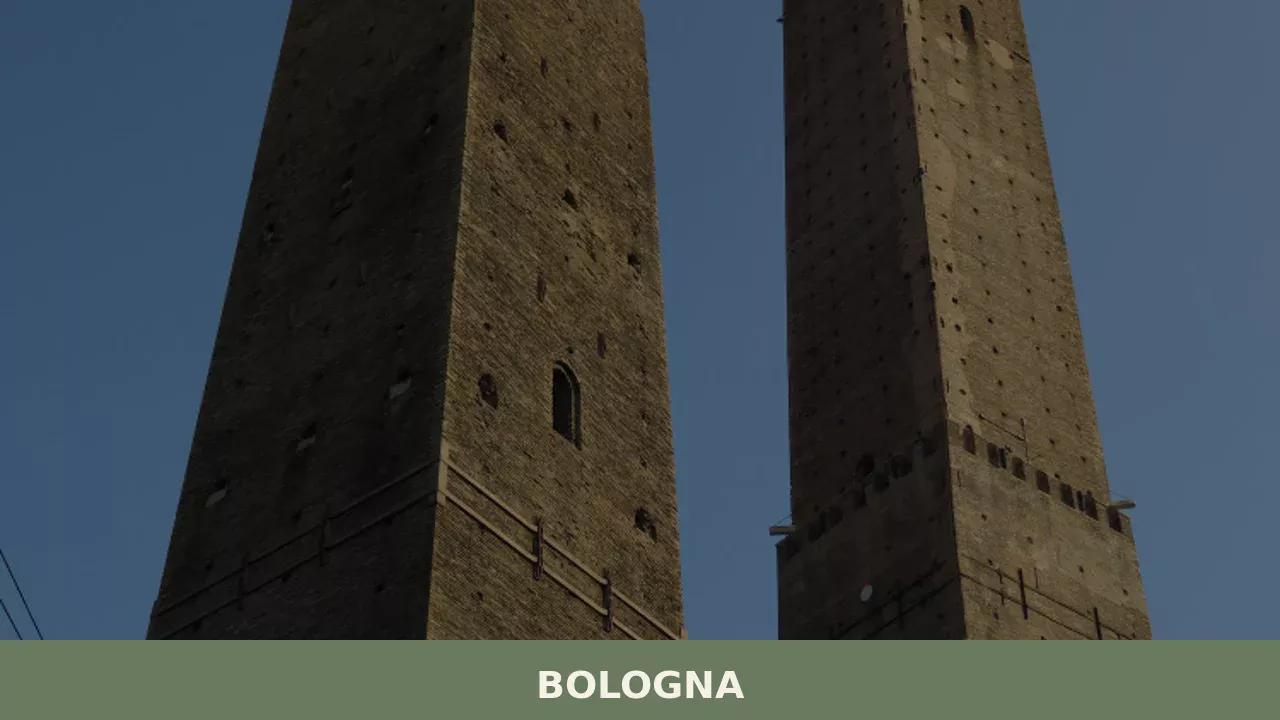
Bologna
What to see in Bologna: 388,000 inhabitants, UNESCO porticoes and the Two Towers. Plan your visit with our guide to tortellini, Mortadella IGP and top museums.
Discover Bologna
The dough is rolled out by hand on a wooden board — a gesture that Bologna’s sfogline have repeated for centuries, using a rolling pin nearly a metre long, until the sheet becomes translucent and even.
From that pasta come tagliatelle al ragù, the dish that more than any other defines Bologna in the world, and meat-filled tortellini, folded into their navel shape according to a form officially codified in 1974 by the Chamber of Commerce.
Understanding what to see in Bologna means starting right here — with cooking as cultural practice, with food craftsmanship as historical record. A city sitting 54 metres above sea level, with nearly 388,000 inhabitants, that has built a lasting identity through its university, its porticoes, and a culinary tradition that makes no concessions.
History and Origins of Bologna
The name Bologna most likely derives from the Celtic root Bona, meaning a settlement or foundation. Before Romanisation, the site was inhabited by the Etruscans, who founded the city of Felsina here around the 6th century BC, developing it into one of the leading centres of the Po Valley. When the Boii Gauls arrived in the 4th century BC, the city was renamed Bonomia, and it was definitively conquered by the Romans in 189 BC, becoming a Latin colony and a strategic node on the Via Emilia — the consular road linking Rimini to Piacenza that still structures the regional territory today.
In the Middle Ages, Bologna entered a period of extraordinary intellectual vitality.
In 1088, the University of Bologna was founded — the oldest in the Western world in continuous operation — and the city became a centre of attraction for students and legal scholars from across Europe.
The Comune established itself as an autonomous power in the 12th and 13th centuries, when the famous noble towers were erected: of the approximately two hundred that once rose above the medieval city, twenty-one remain today, among them the two most celebrated, the Torre degli Asinelli and the Garisenda. The patron saint Petronius, a 5th-century bishop, was chosen as a civic symbol during those years of communal expansion, and his feast is celebrated every year on 4 October.
Between the 14th and 16th centuries, Bologna was contested among the great ruling families — the Visconti, the Bentivoglio, the papacy — before passing definitively into the Papal States in 1506, a condition it maintained, with Napoleonic interruptions, until Italian Unification in 1860.
In the modern era, the city distinguished itself in the partisan Resistance during the Second World War, earning the Gold Medal for Military Valour.
The bombing of the train station on 2 August 1980, which killed 85 people, remains the deepest wound in Bologna’s contemporary history, commemorated each year with a public ceremony. Today Bologna is a metropolitan capital with nearly 388,000 inhabitants, a university city with over 85,000 enrolled students, and the main cultural reference point for the entire Emilia-Romagna region.
What to See in Bologna: 5 Key Attractions
1. The Two Towers — Torre degli Asinelli and Torre Garisenda
Built in the 12th century by aristocratic families as symbols of power and wealth, the Two Towers are Bologna’s defining landmark. The Torre degli Asinelli reaches 97.2 metres and is still open to the public: its 498 internal steps lead to a terrace from which the entire Po Valley can be seen. The Garisenda, shorter and with a lean visible to the naked eye — approximately 3.22 metres — was cited by Dante Alighieri in the Inferno (Canto XXXI).
Both towers stand in Piazza di Porta Ravegnana, in the centre of the historic district.
2. Basilica di San Petronio in Piazza Maggiore
Dedicated to the city’s patron saint, the Basilica di San Petronio is one of the largest Gothic churches in the world: 132 metres long and 66 metres wide, it was begun in 1390 to a design by Antonio di Vincenzo. The façade was never completed — only the lower third is clad in white and red marble — but the interior contains 22 lateral chapels with works by Giovanni da Modena and other masters. Particularly notable is the geodetic sundial traced on the floor in 1655 by astronomer Giovanni Domenico Cassini, the longest ever built inside a building.
3. Bologna’s Portico System
With over 38 kilometres of continuous porticoes in the historic centre alone, Bologna holds an architectural distinction recognised by UNESCO in 2021 as a World Heritage Site. Their origins go back to the Middle Ages, when citizens were permitted to extend the upper floors of buildings out over the public street, creating covered walkways below.
The porticoes of Via dell’Indipendenza, those of Strada Maggiore, and the long portico of San Luca — 3.8 uninterrupted kilometres with 666 arches — are three of the most significant expressions of this urban system.
4. The Sanctuary of San Luca and Its Portico
The Sanctuary of the Madonna of San Luca stands on the Colle della Guardia at 289 metres above sea level, reachable on foot via the world’s longest portico: 3,796 metres with 666 arches, built between 1674 and 1793 to shelter pilgrims from rain during the ascent. The church, designed by Carlo Francesco Dotti and consecrated in 1774, houses an icon of the Madonna attributed by tradition to Saint Luke the Evangelist. From the forecourt, the entire Po Valley is visible, and on clear days the view extends as far as the Alps.
5. Palazzo Poggi National Museum and the Archiginnasio Complex
The Palazzo dell’Archiginnasio, built in 1563 on the commission of Cardinal Carlo Borromeo, was the university’s first unified home and preserves the celebrated Anatomical Theatre, rebuilt after the 1944 bombings: a masterpiece of woodcarving with tiered benches and a central dissection table. The walls and ceilings are covered by over six thousand coats of arms belonging to students and professors.
Adjacent to it, the Palazzo Poggi Museum houses the scientific instruments and natural history collections of the Institute of Sciences founded by Luigi Ferdinando Marsili in 1712.
What to Eat in Bologna: Traditional Cuisine and Local Products
Bolognese cuisine is rooted in the availability of excellent raw ingredients: the alluvial plain provides soft wheat for fresh pasta, the surrounding hills support pig farming, and the dairy tradition has been firmly established for centuries.
It is no coincidence that Bologna has been called La Grassa — the Fat One — since the Middle Ages. The nickname did not simply refer to abundance for its own sake, but to a structured food culture, tied to the land and the seasons, and practised with the same seriousness given to the university or the arts.
Tortellini in brodo remain the dish of great occasions: a filling of pork loin, prosciutto crudo, mortadella, Parmigiano Reggiano, egg and nutmeg, enclosed in a thin sheet of fresh pasta folded around the little finger. The official recipe was registered with the Bologna Chamber of Commerce in 1974 by the Accademia Italiana della Cucina.
Tagliatelle al ragù — a slow-cooked ragù of beef and pork, white wine, milk and tomato purée, simmered for at least three hours — also follow a registered recipe, with the width of the cooked tagliatella set at 8 millimetres, equal to the 12,270th part of the height of the Torre degli Asinelli.
Among the territory’s European-recognised products, Mortadella Bologna IGP stands out as the city’s most representative cured meat: a cooked sausage made from finely ground pork, with cubes of throat fat and spices, produced in the Emilian area according to EU specifications.
Parmigiano Reggiano DOP, produced in the provinces of Parma, Reggio Emilia, Modena and the part of the Bologna province to the left of the Reno river, is aged for a minimum of 12 months, though often 24 or 36. Prosciutto di Parma DOP, though it comes from the neighbouring province, appears on every Bolognese table and is an integral part of the shared regional gastronomy.
For quality local products, the Mercato di Mezzo on Via Clavature — refurbished in 2014 within a medieval building — offers stalls of cured meats, cheeses and fresh pasta.
The Mercato delle Erbe on Via Ugo Bassi is the city’s historic covered market, with over seventy traders and continuous opening hours. The Festa di San Petronio on 4 October is an opportunity to find seasonal products at stalls throughout the centre, while November brings the Sana Festival, a national fair for organic and natural food with tastings and local producers.
Emilia-Romagna is among Italy’s most productive wine regions.
The Bologna area produces Colli Bolognesi DOC, which includes white wines — predominantly Pignoletto, an indigenous variety — and reds such as Cabernet Sauvignon and Merlot. The Pignoletto dei Colli Bolognesi, produced in the hills west of the city, is a dry or lightly sparkling white with its own denomination and a mineral character that pairs well with local fresh pasta.
When to Visit Bologna: The Best Time of Year
Spring — April through June — and autumn — September and October — offer the most favourable conditions for visiting Bologna, with temperatures between 15 and 22 degrees and consistently bright days.
The most significant cultural events also fall in these periods: the BilBOlbul Festival for comics in March, the Bologna Children’s Book Fair in March and April (one of the most important in the world for illustrated children’s publishing), and the Sana Festival in September and October.
The feast of patron saint Petronius on 4 October includes processions, special openings of monuments and events in Piazza Maggiore.
Summer brings humid heat — July and August regularly exceed 35 degrees — and a drop in the university population, which makes the city quieter but also less lively. Winter, between November and February, suits those who want to visit without queues at museums and enjoy the city at a cooler pace under the porticoes: Christmas markets in Piazza Maggiore bring December to life, while February is the month of Carnival with processions through the historic centre.
For a first-time visitor to Bologna seeking a complete experience — gastronomy, architecture, university life — October is the most well-rounded month of the year.
How to Get to Bologna
Bologna is one of Italy’s most important transport hubs. By car, the A1 motorway (Milan–Naples) passes through the city with exits at Bologna Casalecchio, Bologna Borgo Panigale and Bologna San Lazzaro; the A13 links Bologna to Padua and Venice, while the A14 heads towards Rimini and the Adriatic. The distance from Milan is approximately 210 km (2 hours), from Florence around 100 km (1 hour), and from Rome about 380 km (3.5 hours).
The historic centre is largely a limited-traffic zone: park-and-ride facilities with shuttle services are the recommended option for those arriving by car.
Bologna Centrale station is a first-rate rail hub: Frecciarossa high-speed trains connect Bologna to Milan in 65 minutes, to Florence in 37 minutes, and to Rome in just over 2 hours.
Guglielmo Marconi International Airport is just 6 km from the centre, served by the Aerobus (line BLQ) in 20 minutes and by the light metro People Mover, opened in 2020, which connects the airport to the railway station in 7 minutes. Within the city, the ATC bus network and an extensive cycle lane system — Bologna ranks among Italian cities with the highest per-capita bicycle use — complete the urban transport offer.
Other Villages to Explore in Emilia-Romagna
Those exploring the Bologna metropolitan area will find, within a few dozen kilometres of the city, places of a very different scale but considerable interest.
Camugnano, in the Bolognese Apennines, is a mountain municipality spread across hamlets among chestnut woods and the shores of Lake Suviana — a 1930s hydroelectric landscape that coexists with rural settlements of medieval origin.
Casalfiumanese, in the Santerno valley, is an example of a hill settlement that retains its traditional structure, with a castle and parish church dominating the residential fabric below. Both can be reached from Bologna in under an hour by car and work well as half-day excursions combined with a visit to the city.
Further afield but worth a dedicated itinerary, Zerba — on the border between the Emilian and Ligurian Apennines — is one of the most isolated and intact settlements in the region, with a minimal population density and a landscape that has remained essentially agricultural and wooded.
For those who prefer the plain, Castel Guelfo di Bologna offers a different side of Emilian territory: a low-lying municipality with deep agricultural traditions and one of northern Italy’s most visited commercial outlets, illustrating how the Bologna area overlays historical layers and contemporary functions without contradiction.
An itinerary linking the city to these four villages covers a geographical radius of around 60 kilometres and gives a thorough reading of the variety within the Bolognese landscape.
For more on Bologna’s history and attractions, the official website of the Municipality of Bologna, the Wikipedia page dedicated to the city and the resources of the Touring Club Italiano are all recommended — the latter publishes regularly updated guides with opening hours and practical information on the main monuments.
—
In Emilia-Romagna More villages to discover
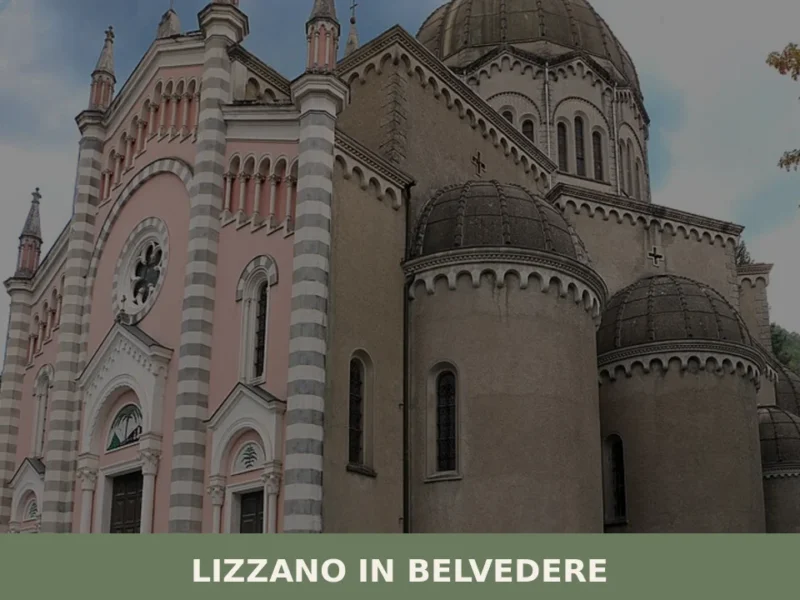
Lizzano in Belvedere
Every year, on 17 August, the procession in honour of Saint Mamante winds its way up the streets of Lizzano in Belvedere to the parish church, following a ritual that has been repeated since at least the 15th century. This municipality of 2,314 inhabitants, situated at 640 metres above sea level on the Bolognese Apennines, […]
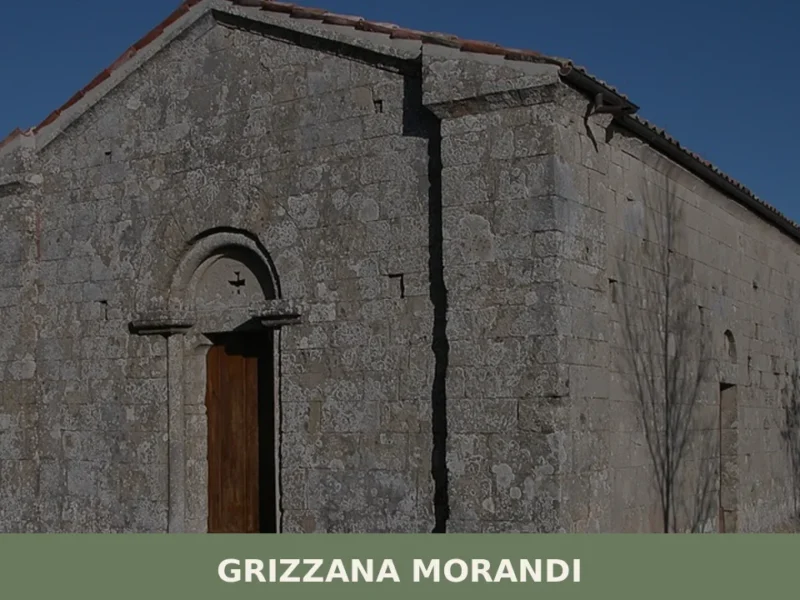
Grizzana Morandi
In 1929, the Bolognese painter Giorgio Morandi travelled to Grizzana for the first time — a scattered municipality in the Emilian Apennines that he would return to every summer for over thirty years. From the barns and tower-houses of this valley, he painted hundreds of landscapes, transforming the clay badlands and mountain ridgelines into universal […]
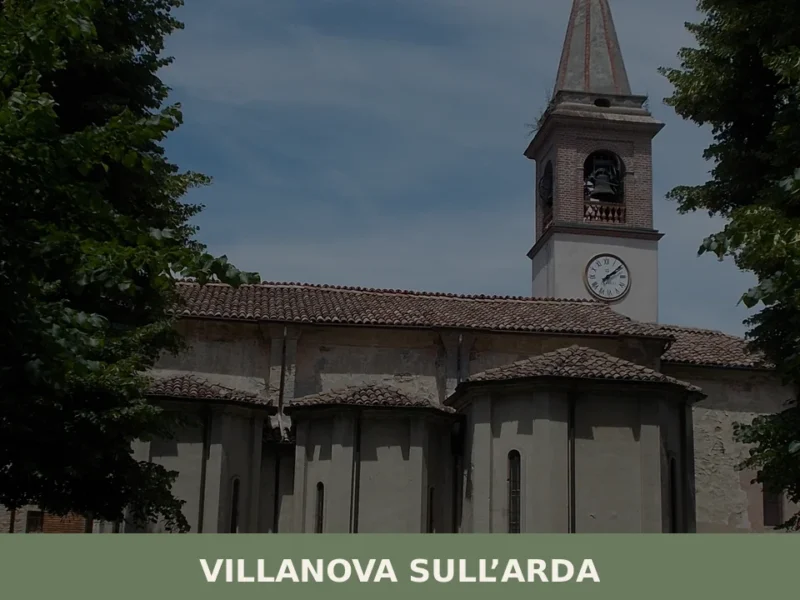
Villanova sull’Arda
In 1813, in the hamlet of Sant’Agata, Giuseppe Verdi was born — the composer who would rewrite the history of European melodrama. Villanova sull’Arda, home to 1,894 inhabitants in the Bassa Piacentina lowlands, still bears the marks of that bond: the villa where Verdi lived for over half a century with soprano Giuseppina Strepponi stands […]
🧀 Italian traditional products
📝 Incorrect information or updates?
Help us keep the Bologna page accurate and up to date.