


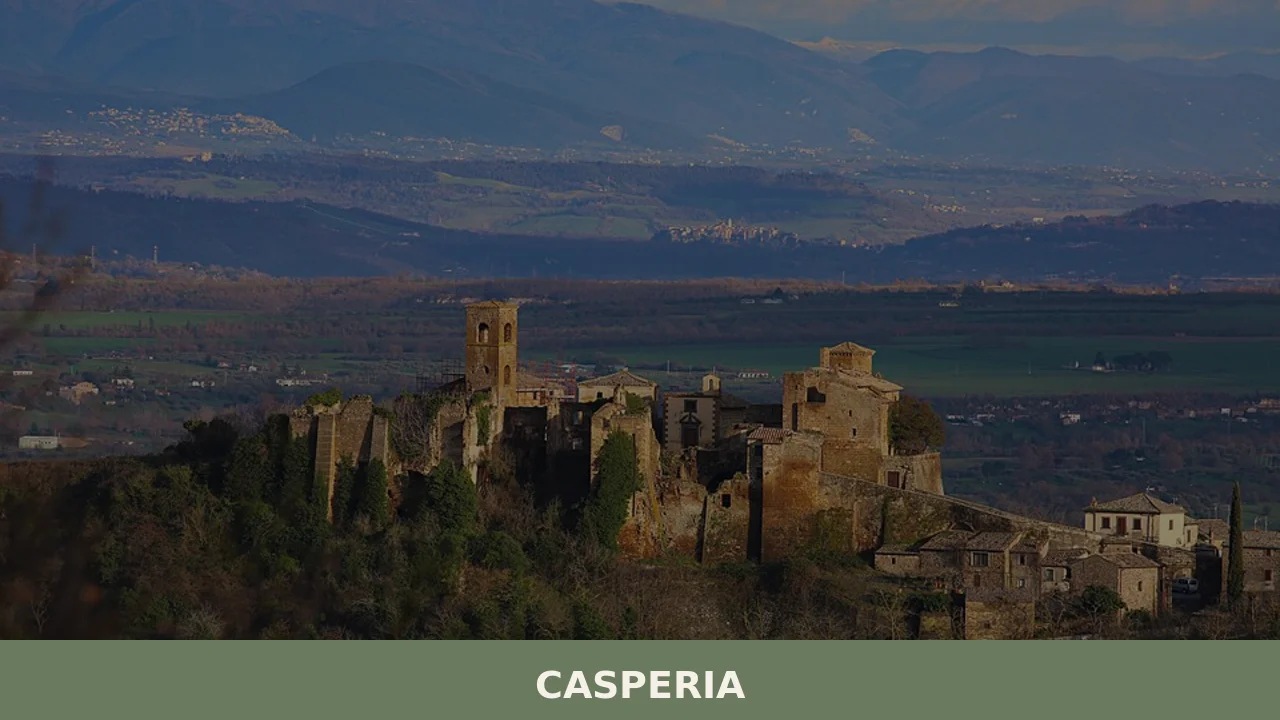
Casperia
What to see in Casperia, a hilltop village at 397 m in Rieti province: medieval centre, 3 PAT-certified products including guanciale. Plan your visit and where to stay.
Discover Casperia
Casperia sits at 397 metres above sea level in the Sabina hills, in the province of Rieti, and is one of the best-preserved historic villages in north-central Lazio. With 1,231 inhabitants spread between the historic core and the surrounding hamlets, the town retains a substantially intact medieval street plan: stone houses built side by side along narrow, winding lanes.
Those looking into what to see in Casperia will find a coherent range of attractions — religious architecture, defensive towers, rolling hill scenery, and a food tradition built around certified local products such as guanciale and cacio fiore cheese.
All of this lies within easy reach of Rome and the road network that runs through historic Sabina.
History and Origins of Casperia
The territory where Casperia now stands was already inhabited in pre-Roman times.
The Sabina, the historic region occupying the hill belt between the Tiber and the Apennines, was home to Sabine tribes before being progressively absorbed into Rome’s sphere of influence between the 4th and 3rd centuries BC. The medieval village grew up around a castle built in a commanding position overlooking the surrounding valleys — a defensive function common to many settlements in the Lazio Sabina during the early Middle Ages.
The name of the municipality has ancient roots, though its current form became fixed in medieval documents, with variants that most likely point to a Latin or Lombard origin.
During the Middle Ages, the village came under the influence of the major ecclesiastical powers that controlled the Sabina, most notably the Abbey of Farfa — one of the most powerful monastic complexes in medieval central Italy. Founded in the early Middle Ages a few kilometres east of Casperia, the abbey exercised political, economic and cultural authority over the entire Sabina region for centuries. The villages of the area, including Casperia, fell within its direct or indirect sphere of influence.
This relationship with Farfa left a deep mark on the social and land-ownership structure of the territory, the effects of which can still be read in the organisation of the agricultural landscape today.
In the early modern period, the village retained its role as a local administrative centre within the feudal system of the Papal States, of which the Sabina formed part until Italian Unification.
After 1870, when Lazio was annexed to the Kingdom of Italy, Casperia followed the same path as most small Italian rural municipalities: a gradual economic transformation, significant emigration throughout the twentieth century, and a growing orientation towards local tourism in recent decades.
The historic core has preserved its medieval structures through restoration work that respected the original form of the village.
What to See in Casperia: Main Attractions
Church of San Giovanni Battista
The church dedicated to San Giovanni Battista (Saint John the Baptist), the village’s patron saint, is Casperia’s principal place of worship and one of the most significant religious monuments in the entire historic centre.
The building, which preserves elements of medieval religious architecture alongside later additions from the early modern period, serves as the spiritual and symbolic focal point of the community.
The patron saint’s feast is celebrated on 24 June, the date of the Nativity of Saint John the Baptist in the Catholic liturgical calendar.
It is worth pausing in the open space in front of the church to observe how the sacred building relates to the surrounding urban fabric — this relationship conveys the medieval structure of the village more clearly than any written description.
Medieval Tower and Defensive System
Casperia retains elements of its ancient medieval defensive system, including a tower that defines the village’s skyline and remains visible from various points in the valley below. Structures of this kind were an integral part of the military organisation of Sabine villages during the Middle Ages, when control of passes and communication routes was vital to the survival of settlements.
As in many hilltop villages in Lazio, the tower has merged with the surrounding houses to become part of the continuous built fabric of the historic centre.
Walking through the internal streets of the village, visitors can appreciate its solid masonry mass and its strategic position in relation to the surrounding landscape.
Historic Centre and Medieval Architecture
The historic centre of Casperia is arguably the most substantial draw for visitors: a system of local stone houses arranged across multiple levels, connected by staircases, arches and covered passageways that create a dense and layered spatial continuity.
The medieval street plan has remained largely legible over the centuries, allowing visitors to follow the original settlement logic on foot along short but varied routes. Understanding what to see in Casperia means, in large part, understanding this historic centre — not as a collection of isolated monuments, but as a coherent whole in which every constructional detail carries its own history.
Views over the Tiber Valley and the Sabina
From the elevated position of the village, at 397 metres above sea level, the views over the Tiber Valley and the surrounding Sabina hills are one of the principal reasons to make the climb to Casperia.
The terraces and more exposed points of the historic centre offer broad outlooks over the agricultural landscape of the Sabina — olive groves, oak woods and cultivated valley floors.
This type of landscape is protected and promoted at regional level precisely for the quality of its visual composition. Visitors who arrive in the afternoon will find the light particularly well-suited to appreciating the depth of the territory to the west.
Sabina Countryside and Nature Trails
The municipal territory of Casperia extends across the hilly landscape of historic Sabina, offering opportunities for walks along trails that pass through woodland and farmland.
The nature paths around the village connect the inhabited centre to scattered farmsteads and viewpoints on the surrounding hills, making Casperia a useful base for those who enjoy trekking or cycling on minor roads.
The typical vegetation includes olive groves of the Sabina variety — linked to quality extra-virgin olive oil production — and mixed woodland characteristic of this altitude band in the Lazio Apennines.
It is worth checking which trails are available before visiting, as accessibility varies with the seasons.
Local Food and Products of Casperia
The cuisine of the Sabina, the broader region to which Casperia belongs, is rooted in a peasant food tradition that has refined a small number of core ingredients over the centuries, working them with simple but effective techniques.
Geography plays a decisive role: the position between hills that produce extra-virgin olive oil, pastoral areas that supply cheeses and meats, and woods that yield black truffles and mushrooms has produced a cuisine where the quality of the raw ingredient takes precedence over the complexity of the preparation.
This culinary logic is evident in Casperia, where local restaurants and trattorias offer menus grounded in local produce.
Among the dishes that best express this tradition is pasta with guanciale sauce, in which cured pork cheek is fried in a pan until crisp and used as the base for condiments of great simplicity and aromatic intensity.
Equally well-established are legume soups, particularly those made with local lentils and beans, slow-cooked with wild aromatic herbs. Pecorino cheeses and cacio fiore — made from sheep’s milk curdled with vegetable rennet — appear both as starters and as key elements in fresh egg pasta sauces.
These preparations feature in various combinations on local menus, with seasonal variations depending on the availability of fresh ingredients.
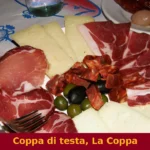
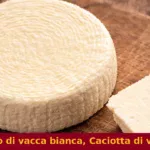
In terms of certified products, Casperia is associated with three PAT (Traditional Agri-food Products) designations from the Italian Ministry of Agriculture. Cacio fiore (PAT) — municipalities: Casperia, Rome, Viterbo — is a soft cheese made from whole sheep’s milk, traditionally curdled with vegetable rennet extracted from artichoke or wild thistle flowers, a technique that sets it clearly apart from animal-rennet cheeses.
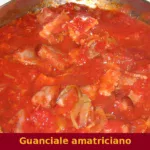
Guanciale (PAT) — municipalities: Casperia, Rieti, Amatrice, Accumoli — is produced from the pork cheek through salting and curing with natural aromatics, and is one of the most representative cured meats of the Lazio and Abruzzo area.
Guanciale amatriciano (PAT) — municipalities: Casperia, Amatrice, Accumoli, Rieti — is the specific variant tied to the Amatrice tradition, distinguished by a seasoning of black pepper and chilli that sets it apart from the more neutral version.
To purchase these products directly, the most effective approach is to visit small local producers and the shops in the historic centre, where extra-virgin olive oil from the Sabina and honey from the surrounding hills can also be found.
Some farms in the area open for direct sales, particularly in autumn, when the olive harvest coincides with the production of the new oil.
Festivals, Events and Traditions of Casperia
The most important event in Casperia’s civic and religious calendar is the feast in honour of the patron saint San Giovanni Battista, celebrated on 24 June.
This date, which corresponds in the liturgical calendar to the Nativity of the Baptist, has been one of the most significant occasions for the local community for centuries.
Celebrations traditionally include religious services in the main church dedicated to the saint, processions through the historic centre, and communal festivities in which the community gathers around its patron.
The 24th of June also coincides with the summer solstice in the traditional calendar, a fact that has historically lent this date particular significance in many Italian communities.
Beyond the patron saint’s feast, the Sabina territory surrounding Casperia hosts a number of events throughout the year tied to local agricultural production. Autumn is the richest season in this respect: the olive harvest, the production of grape must and the preparation of seasonal cured meats generate markets and tasting events that involve villages across the area. The local food tradition also expresses itself through product fairs which, in the Sabina, frequently revolve around guanciale, cacio fiore and extra-virgin olive oil. For specific dates and up-to-date programmes, it is advisable to consult the municipality’s events calendar before visiting.
When to Visit Casperia and How to Get There
Spring and autumn are the best seasons to visit Casperia.
In spring, between April and June, hill temperatures are mild, vegetation is at its fullest and the long days allow visitors to explore both the historic centre and the surrounding trails without summer heat.
Autumn, from September to November, offers the Sabina landscape during the agricultural harvest period, with the chance to witness traditional food processing and to find fresh seasonal products at local markets.
Those seeking quieter conditions may also consider the winter months, when the village is largely free of visitors and the hill landscape takes on stronger, more defined colours. Summer draws visitors but never becomes overcrowded, given the contained size of the village. For up-to-date information on events and local services, the official reference is the Casperia Municipality website.
By car, the most direct route from Rome follows the A1 motorway with the exit at Fiano Romano, or alternatively the Via Salaria state road, which runs through the Sabina towards Rieti.
The journey from Rome covers approximately 60 kilometres.
The nearest railway station is Poggio Mirteto, served by the regional Rome–Rieti line, from which Casperia is about ten kilometres away, reachable by taxi or local transport.
For those travelling from outside the region, the relevant airport is Rome Fiumicino International Airport, approximately 80 kilometres from Casperia, connected to the capital by trains and buses from which travellers can continue towards the Sabina by private or hire vehicle.
Where to Stay in Casperia
The village and its surrounding territory offer small-scale accommodation, mainly agriturismos and bed and breakfasts set within the Sabina hill landscape. These types of lodging fit naturally with the rural character of the territory and allow visitors to stay on working farms, often with the opportunity to taste produce from the property.
Some properties are located directly in or immediately adjacent to the historic centre, while others occupy isolated farmhouses in the countryside around the village.
The total number of beds available is limited, so advance booking is advisable, particularly during the peak periods of spring and autumn.
Other Villages to Explore in Lazio
Those planning an itinerary through the Sabina and northern Lazio can combine a visit to Casperia with other villages in the region that share similar qualities of historic preservation and landscape.
Lubriano, in the Viterbo area, is a hilltop village that looks out dramatically over the Valle dei Calanchi, with a compact urban structure and visually striking surroundings — well-suited to those who want to combine a historic visit with a nature walk.
Also in the province of Viterbo, Latera has a medieval historic centre positioned near the Latera Lake Nature Reserve, with a volcanic landscape that distinguishes it markedly from the Sabina scenery.
For those wishing to extend the itinerary further into the Tuscia, Villa San Giovanni in Tuscia is a small municipality in the province of Viterbo with a well-preserved historic fabric and a location that makes it easy to reach other centres of historic Tuscia.
Finally, Capodimonte, on the shores of Lake Bolsena, presents a character entirely different from Casperia but complementary to it: facing water rather than hills, it offers a contrasting perspective on rural and historic Lazio. Combining these villages in a three- or four-day circuit allows travellers to move through varied landscapes and distinct local traditions within a relatively compact and well-connected geographical area.
In Lazio More villages to discover
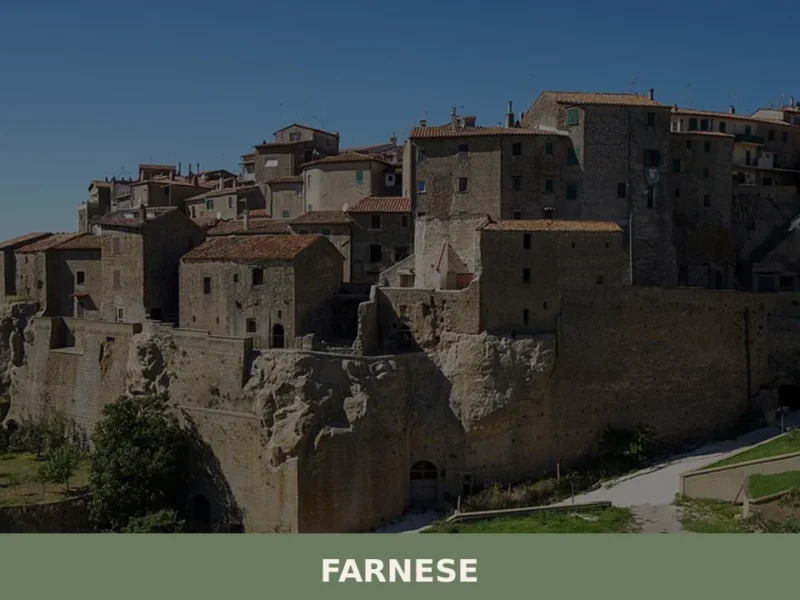
Farnese
The morning light, a pale gold filtering through the narrow aperture of a medieval archway, illuminates the rough-hewn basalt paving stones of Farnese. A faint scent of woodsmoke and damp earth hangs in the cool air, carried on a breeze that rustles the leaves of an ancient oak on the village’s periphery. Here, at 341 […]
Castelnuovo di Farfa
What to see in Castelnuovo di Farfa: 1,032 inhabitants at 358 m in the Sabina. Explore the medieval castle, San Nicola church and PDO cacio fiore. Plan your visit now.
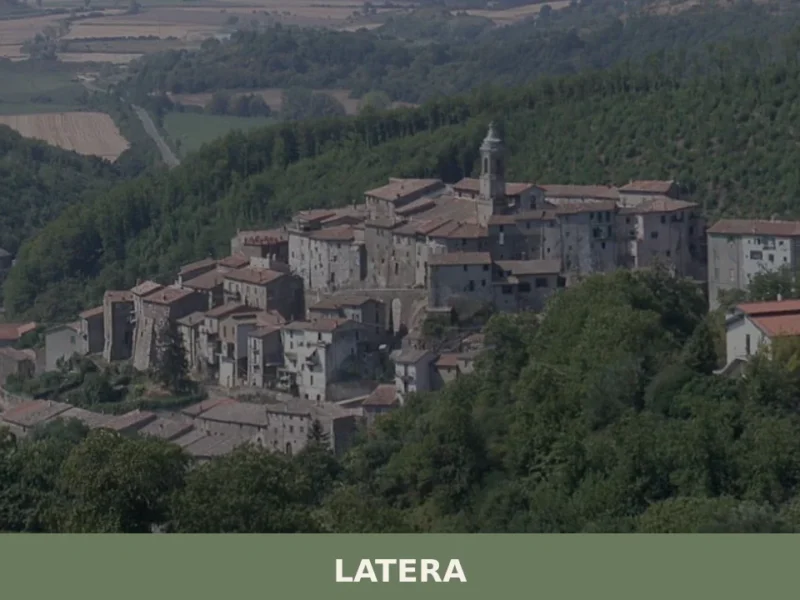
Latera
Latera has 766 inhabitants and sits on a tuff plateau at 508 metres above sea level, on the far northern edge of the province of Viterbo, close to the borders with Umbria and Tuscany. For centuries a fiefdom of the Farnese family, this small centre retains a compact Renaissance urban layout, with straight streets converging […]
📝 Incorrect information or updates?
Help us keep the Casperia page accurate and up to date.