


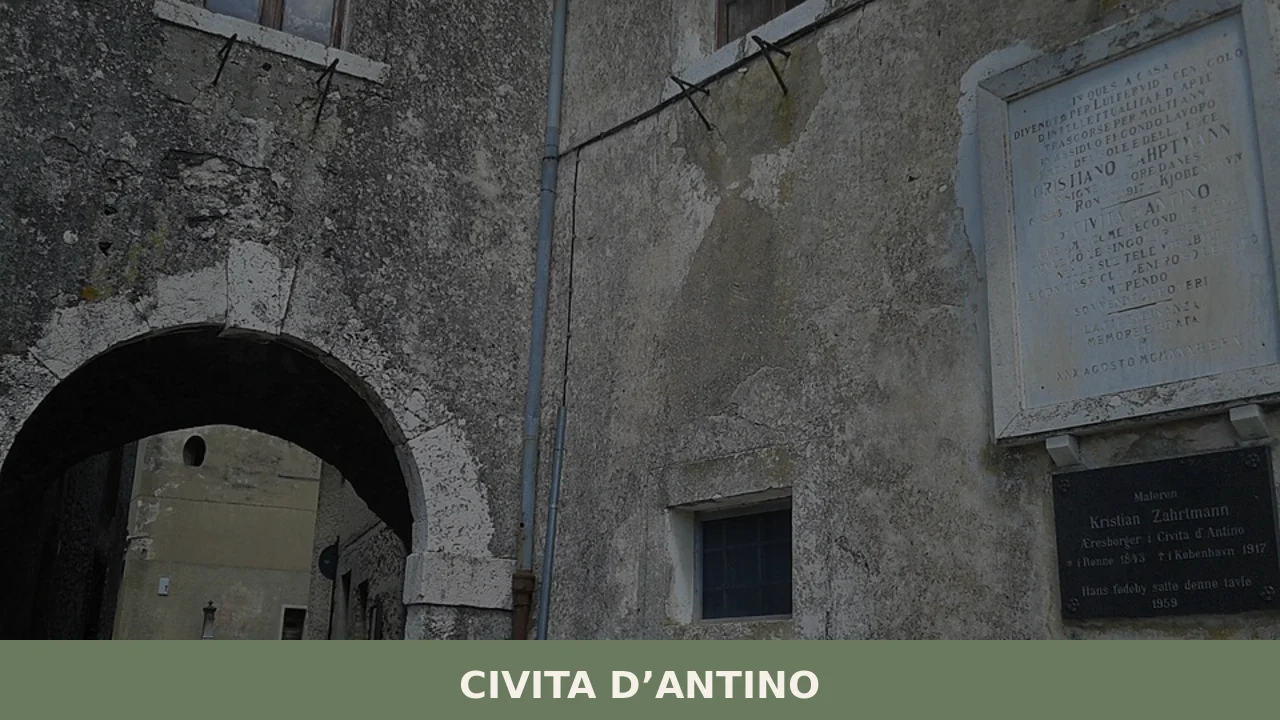
Civita d’Antino
In 1878, the Danish painter Kristian Zahrtmann reached Civita d’Antino for the first time and decided to return every summer until 1911, turning this small town in the Valle Roveto into an artistic colony frequented by dozens of Scandinavian painters. Even today, anyone wondering what to see in Civita d’Antino will find traces of that […]
Discover Civita d’Antino
In 1878, the Danish painter Kristian Zahrtmann reached Civita d’Antino for the first time and decided to return every summer until 1911, turning this small town in the Valle Roveto into an artistic colony frequented by dozens of Scandinavian painters. Even today, anyone wondering what to see in Civita d’Antino will find traces of that era in the village streets: façades reproduced on canvases held in Copenhagen museums, recognisable corners in oil-on-panel works exhibited in Stockholm. At 904 metres above sea level, with 913 inhabitants and a position commanding the Liri valley, Civita d’Antino retains a dual identity — Abruzzese and Northern European — layered over more than a century of cultural exchange.
History and origins of Civita d’Antino
The name derives from the ancient Antinum, a Marsic city documented by Pliny the Elder in his Naturalis Historia and by Livy in his account of the wars between Rome and the Italic peoples. Antinum was a Roman municipium enrolled in the Tribus Sergia, and remains of polygonal walls in opus incertum are still visible on the eastern slope of the settlement. After the fall of the Empire, the centre contracted toward the upper part of the hill, gradually taking on the name “Civita” — a Lombard term denoting a fortified settlement built over a pre-existing urban core.
In the Middle Ages, Civita d’Antino came under the orbit of the County of the Marsi and subsequently the Kingdom of Naples. The fief passed through several noble families, including the Colonna, who maintained control until the abolition of feudalism in 1806. The Marsica earthquake of 13 January 1915 — magnitude 6.7, over 30,000 victims in the area — devastated much of the built fabric. Reconstruction was slow and partial, altering the appearance of many buildings, but the village plan preserves the footprint of its medieval layout, with narrow, parallel streets following the contour lines of the hill.
The Scandinavian chapter remains the most singular episode in the history of Civita d’Antino. Zahrtmann brought students and colleagues — among them Peder Severin Krøyer and Joakim Skovgaard — forging a link between the mountains of Abruzzo and the Danish art world of the late nineteenth century that has no equivalent in any other Italian village. The Municipality and the Fondazione Zahrtmann keep this memory alive through periodic exhibitions and cultural exchanges with Danish institutions.
What to see in Civita d’Antino: 5 main attractions
1. Polygonal walls of Antinum
Blocks of local limestone, dry-laid and arranged in third-style polygonal masonry, emerge along the eastern slope of the village. They date to the 4th–3rd century BC and constitute the material evidence of the Marsic settlement. Some sections reach two metres in height and are accessible via a path that starts from the provincial road.
2. Church of Santo Stefano Protomartire
Dedicated to the patron saint of the village — celebrated on 19 August — the parish church was rebuilt after the 1915 earthquake while retaining elements of the earlier structure. Inside, a local stone altar and sacred furnishings recovered from the rubble document the liturgical continuity of a community that refused to abandon the site even after the catastrophe.
3. Casa Cerroni and the Zahrtmann trail
The Cerroni family hosted Kristian Zahrtmann during his summer stays. The building, recognisable in the views painted by the Danish artist, is the starting point of an itinerary that takes in the locations depicted in his works: the fountain, the stairway, the lookout over the Valle Roveto. Bilingual Italian-Danish information panels accompany the visitor.
4. Palazzo Ferrante
A noble residence dating to the 17th century, Palazzo Ferrante features a stone portal with a family coat of arms and an inner courtyard with a loggia. Damaged in 1915 and restored over the course of the 20th century, the building retains its original massing and represents the civic architecture of the Valle Roveto during the feudal period.
5. Trail to Monte Viglio and the beech forest
From Civita d’Antino, a network of trails climbs toward the Apennine ridge and the beech forests above 1,200 metres. The route to Monte Viglio (2,156 m), on the border with Lazio, passes through beech and Turkey oak woods and summit grasslands. The total elevation gain from Civita exceeds 1,200 metres, with a walking time of around five hours for fit hikers.
Food and local produce
The table at Civita d’Antino reflects the mountain cooking of the Valle Roveto, with a repertoire that favours fresh pasta, pulses and sheep meat. Maccheroni alla chitarra — cut using a frame strung with steel wires — are served with lamb ragù or with a tomato and sweet chilli sauce, the so-called Abruzzese diavolicchio. Pecora alla cottora, slow-cooked in a copper cauldron with tomato, peppers and potatoes, is the dish of communal feasts. Arrosticini, skewers of sheep meat cut into small cubes and grilled over an elongated brazier (furnacella), are ubiquitous even at this altitude. Among first courses you will find sagne e fagioli, irregular hand-torn pasta served with local beans in a thick broth, and scrippelle ‘mbusse — thin crêpes immersed in hen broth — common across the L’Aquila area. Zafferano dell’Aquila DOP (L’Aquila saffron), cultivated on the Navelli plateau about 60 kilometres from Civita, finds its way into risottos and sweet preparations throughout the province.
Among the cheeses, Pecorino d’Abruzzo at various stages of ageing is paired with local apple preserves or mountain honey. Lentils grown in the Marsican mountain areas — small and hardy, similar in habitat to those of Santo Stefano di Sessanio — appear in winter soups. Sweets follow the liturgical calendar: ferratelle (anise-flavoured wafers pressed in iron moulds) are prepared year-round, while celli pieni — shortcrust pastry parcels filled with grape jam and almonds — belong to the Christmas tradition. As for wines, the area falls within the DOC Montepulciano d’Abruzzo zone, and extra-virgin olive oil from the lower Valle Roveto, at lower elevations, reaches local markets. The Municipality’s website lists summer food festivals dedicated to local produce, concentrated in July and August.
When to visit Civita d’Antino: the best time
The feast of Santo Stefano Protomartire, on 19 August, is when the village sees its highest concentration of events: procession, brass bands, fireworks. Summer — from June to September — offers the best conditions for hiking to the higher elevations. At 904 metres, summer temperatures remain moderate: highs around 25–28 °C, with cool nights that make air conditioning unnecessary. Events linked to the memory of Zahrtmann are often held during the summer months, with exhibitions organised in collaboration with Danish institutions.
Winter brings frequent snowfall above 1,000 metres and minimum temperatures that drop below zero. The village is accessible year-round, but between December and March it is advisable to check road conditions. Spring, from April to May, is the season of wildflower blooms in the mountain meadows and the reopening of trails after the thaw: a good time for those who prefer to walk without the summer heat and with fewer people around.
How to reach Civita d’Antino
By car, from the A25 Roma–Pescara motorway, take the Avezzano exit and follow the SR 690 toward Sora, continuing along the Valle Roveto for about 30 kilometres to Civita d’Antino. From Rome the distance is approximately 120 kilometres, reachable in around one hour and forty minutes. From L’Aquila the drive takes about 90 minutes via Avezzano.
The nearest railway station is Avezzano, served by the Roma–Pescara line and the Avezzano–Sora line. From Avezzano, the connection to Civita d’Antino is by bus operated by TUA (Trasporto Unico Abruzzese), with limited services especially on public holidays: it is advisable to check timetables in advance. The nearest airport is Leonardo da Vinci in Rome-Fiumicino, approximately 150 kilometres away.
Other villages to discover in Abruzzo
Visitors to Civita d’Antino who want to continue exploring inland Abruzzo can head toward the eastern side of the region, where Arsita, a small settlement at the foot of the Gran Sasso in the Teramo province, offers a different setting: here we are in the hill belt, among oak woods and durum wheat fields, with a historic core that preserves traces of medieval town planning and direct access to the Gran Sasso and Monti della Laga National Park.
For those interested in thermal springs and nature, Caramanico Terme, in the Orfento Valley in the province of Pescara, combines sulphur springs with one of the deepest gorges in the central Apennines. The distance from Civita d’Antino is around 100 kilometres, crossing the core of the Majella massif — a drive that alone justifies the trip, reaching elevations above 1,400 metres along the SS 487.
Nearby Villages near Civita d’Antino
In Abruzzo More villages to discover
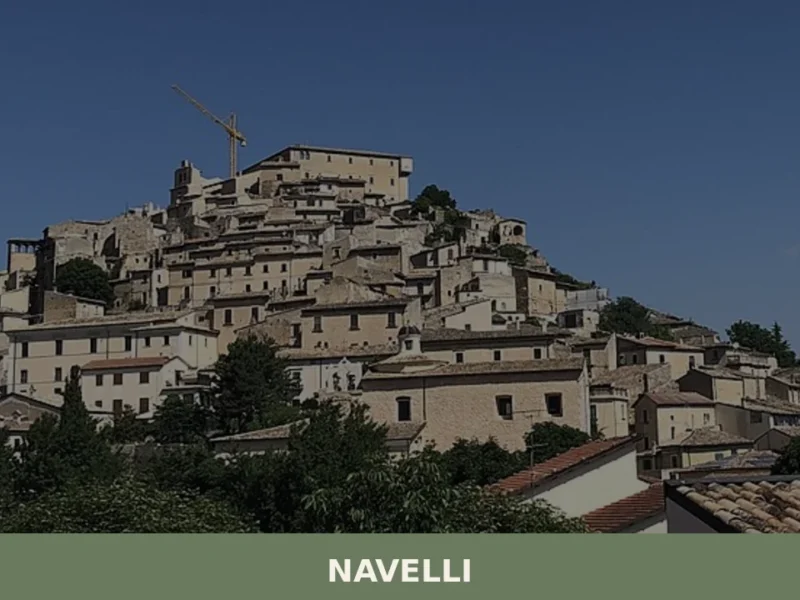
Navelli
Navelli has a current population of 537 and occupies a plateau at 760 metres above sea level on the homonymous highland, in the province of L’Aquila. Saffron cultivation in this area has been documented since at least the 13th century, when the spice became a trade commodity destined for the markets of Milan, Venice and […]
Carpineto Sinello
At 381 metres above sea level, on the ridge line separating the Sinello valley from the Appello stream valley, Carpineto Sinello has just 480 inhabitants today — less than a fifth of the nearly two thousand recorded in early twentieth-century censuses. The demographic data tells the story of a hilltop centre in the Chieti area […]
Fossa
The Vestine necropolis of Fossa, unearthed in 1992 along the state road 17, revealed over six hundred tombs dating from the 9th to the 1st century BC — a discovery that rewrote our understanding of pre-Roman central Italy. Anyone wondering what to see in Fossa will find a solid starting point here: a village of […]






📝 Incorrect information or updates?
Help us keep the Civita d’Antino page accurate and up to date.