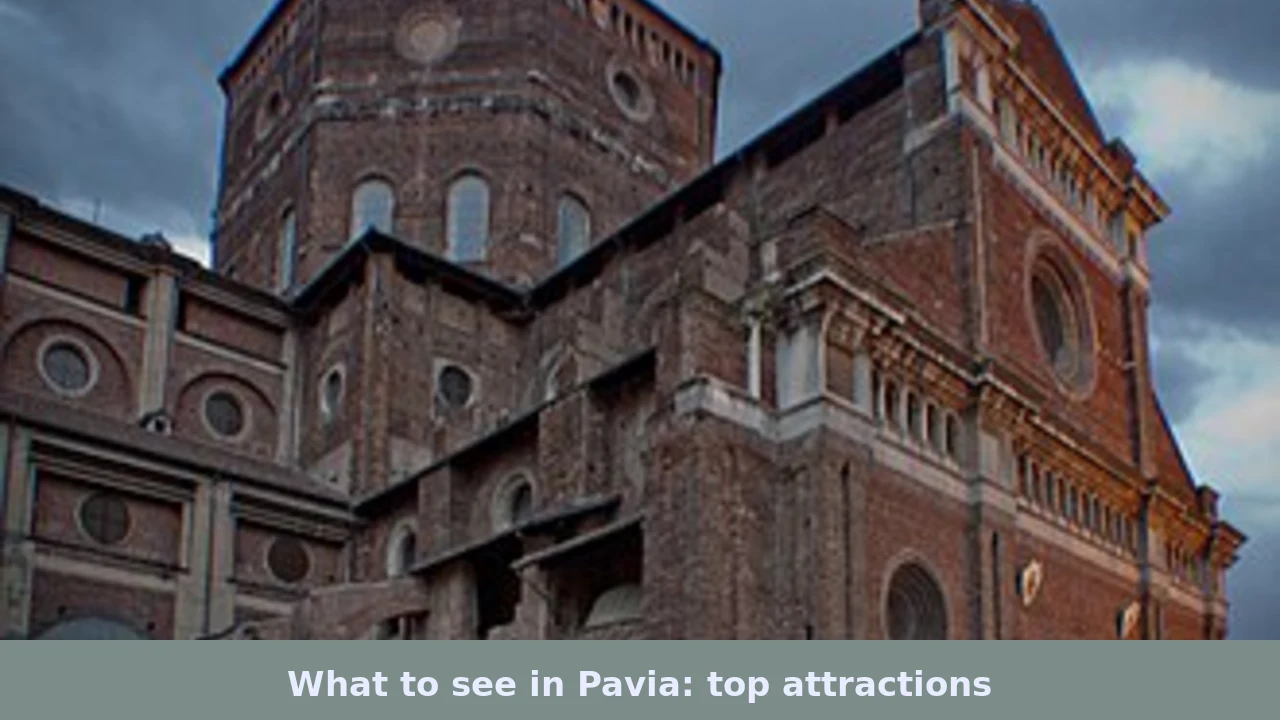
In the heart of Pavia stands the majestic Cathedral, whose construction began in 1488 under the Duchy of Gian Galeazzo Sforza. For anyone wondering what to see in Pavia, this imposing cathedral represents a fundamental stop, a masterpiece of Lombard Renaissance that fascinates with its history and dimensions. The project saw the participation of exceptional minds such as Donato Bramante and, indirectly, Leonardo da Vinci, contributing to define its grandeur. Its long and complex realization spanned almost four centuries, making it a true symbol of artistic and architectural perseverance and a focal point for those exploring the entire city of Pavia.
Pavia Cathedral
The History of Pavia Cathedral
The history of Pavia Cathedral is rooted in an ambitious project, conceived at the end of the 15th century to replace the two ancient Romanesque cathedrals, Santo Stefano and Santa Maria del Popolo, which were no longer suitable for the city’s needs. The construction, inaugurated in 1488, saw the collaboration of prominent figures of the Italian Renaissance. Donato Bramante provided the initial central-plan design, while Leonardo da Vinci was involved in studies and consultations for the tiburium, influencing the work albeit indirectly.
The construction was entrusted to local craftsmen and architects such as Giovanni Antonio Amadeo and Cristoforo Rocchi, who continued the work in subsequent centuries. The construction phases were long and complex, extending for almost four hundred years, with the dome completed only in 1885 and the facade in 1898, as can be further explored in the entry Pavia Cathedral. This long gestation has given the building a stratification of styles and interventions that tell its rich evolution.
Architectural Features of Pavia Cathedral
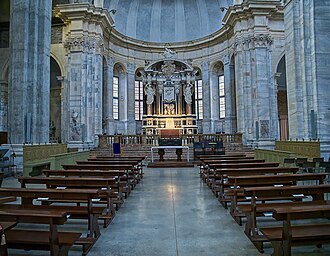
Pavia Cathedral stands out for its imposing central-plan structure, a typical Renaissance model that finds one of its greatest expressions here. The magnificent dome, completed in the nineteenth century, is the third largest in Italy for a central-plan church, reaching a height of 97 meters and a diameter of 34 meters, a true engineering marvel for its time. The interior is characterized by three wide and bright naves, marked by massive pillars supporting the cross vaults, creating a sense of majesty and spatial harmony.
The side chapels enrich the journey, offering spaces for devotion and artistic contemplation. The facade, in Candoglia marble, presents an elegant neoclassical composition, although Bramante’s original design was intended to be very different, testifying to the various stylistic phases that have characterized its construction. The solemn grandeur of the exterior merges with the brightness and spaciousness of the interiors, making it a significant example of Italian sacred architecture.
What to Admire Inside Pavia Cathedral
A visit inside Pavia Cathedral reveals several works of art and places of great historical-religious interest. In the crypt of San Siro, located beneath the presbytery, rest the remains of Pavia’s first bishop, a place of deep spirituality and history that invites reflection. One can admire decorated altars, frescoes, and sculptures that have been added over the centuries, reflecting the different eras and artistic styles that have contributed to its overall richness.
Particular attention should be paid to the sarcophagus of Saint Epiphanius, Bishop of Pavia in the 5th century, whose relics are preserved in a side altar, a testament to the city’s long religious tradition. Take the time to observe the architectural details and structural solutions that make this cathedral a unique example of transition between the late Renaissance and subsequent styles, a true art history book carved in stone.
Why Pavia Cathedral is Worth a Visit
Visiting Pavia Cathedral means immersing oneself in a significant chapter of Italian architecture and art, a place where Renaissance ideas took shape in a Lombard context. Its importance stems not only from its size or constructive complexity, but also from its connection with figures like Bramante and Leonardo, who left an indelible mark on the history of art and thought. It is a building that tells centuries of urban history, faith, and masterful craftsmanship, through its walls and its works.
Its imposing presence in Pavia’s historic center makes it a visual and cultural landmark, a symbol of the city and its historical heritage. Anyone who appreciates the grandeur of Renaissance architecture and the historical stratification of sacred buildings will find in Pavia Cathedral an experience of great value and inspiration.
Curiosities and Anecdotes about Pavia Cathedral
Among the curiosities related to Pavia Cathedral stands out the legend that Bramante’s initial project envisioned an even larger dome, an ambition that would have surpassed even Brunelleschi’s in Florence, an idea that testifies to the grandeur of Renaissance visions. Although the final work has remarkable dimensions, the evolution of the project and construction difficulties led to modifications compared to the original idea, making the building a compromise between aspirations and concrete possibilities.
Another interesting aspect is the extraordinary duration of its construction, almost four centuries, which saw generations of architects and artisans succeed one another, each leaving their mark and contributing to its current form. This continuity over time makes the Cathedral a true architectural palimpsest, where styles and techniques overlap and merge, narrating a story of incessant transformation and adaptation through the ages.
Practical Information for Visiting Pavia Cathedral
For those wishing to visit Pavia Cathedral, the cathedral is generally open to the public every day, with hours that may vary depending on liturgical celebrations or special events. We recommend consulting the official website of the Diocese of Pavia for the most up-to-date hours and any notices, to best plan your visit. Admission is free, but it is always appropriate to maintain respectful attire for the place of worship, out of respect for the sacredness of the environment.
If you arrive by car, you can find paid parking near the historic center, while the train station is about a fifteen-minute walk away, making the Cathedral easily accessible. The central location of the Cathedral allows you to visit it comfortably as part of an exploratory itinerary of the city, easily reachable on foot from other main attractions of Pavia. For more details on hours and accessibility, you can consult the dedicated section on the website of the Diocese of Pavia.
After exploring the magnificence of the Cathedral, you might want to delve deeper into Pavia and its surroundings. We invite you to visit the complete city profile on our portal, where you will find further ideas for your trip. And if your desire is to continue discovering the beauties of Lombardy, we suggest you explore villages such as Arsago Seprio, Casalzuigno, and Brunello, which offer equally rich experiences of history and culture.