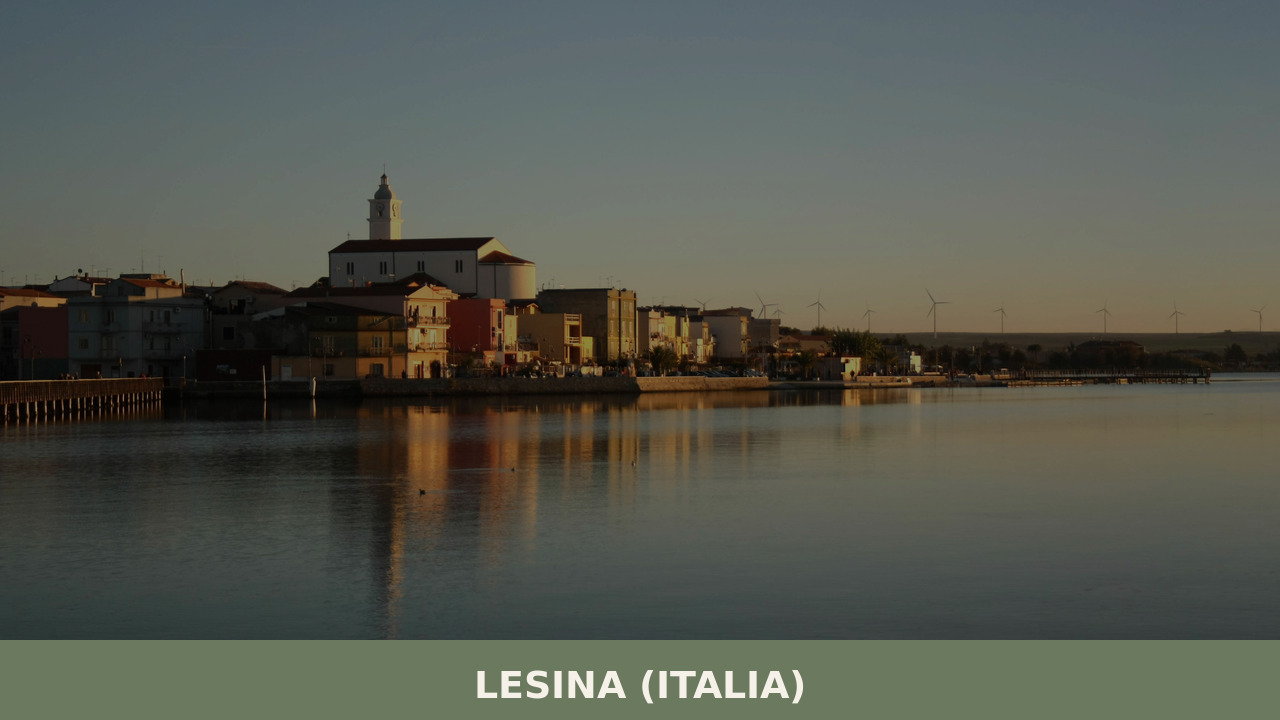
Lesina sits between Italy’s second-largest coastal lagoon and the Adriatic Sea. A guide to its lagoon ecology, eel fishing traditions, and quiet historic centre.
Dawn arrives on the lagoon before it reaches the village. A pale, silver light spreads across the water, and the first sounds are not engines or voices but the low murmur of reeds bending under wind that has crossed the Adriatic. Fishermen are already out, checking eel traps in a lake that has defined this place for millennia. At just 5 metres above sea level, Lesina sits on a narrow strip of land between its vast coastal lagoon and the Adriatic Sea — a geography that makes asking what to see in Lesina (Italia) an exercise in looking as much at water as at stone. This is a settlement of 6,204 people in the province of Foggia, and it has never stopped being shaped by the element that surrounds it.
The origins of Lesina reach deep into antiquity. The settlement is generally identified with the ancient Roman town of Alexina or Lesina, a waypoint along routes connecting the Adriatic coast to the interior of the Daunia region. The name itself likely derives from a Slavic or pre-Latin root — scholars have debated whether it traces to the Dalmatian island of the same name (today Hvar) or to an older Italic word related to the lagoon landscape. What is certain is that the site’s position on the coastal lake made it strategically valuable for fishing, salt production, and as a point of defense against seaborne incursions.
During the medieval period, Lesina passed through the hands of Norman, Swabian, and Angevin rulers who administered the broader Capitanata territory. Frederick II’s consolidation of southern Italian lands in the thirteenth century brought administrative order to the region, though Lesina remained a modest fishing community rather than a feudal centre of power. The Cathedral of the Annunziata, rebuilt several times after earthquakes and the passage of centuries, served as the spiritual anchor of the settlement. Successive tremors — the Gargano is a seismically active area — periodically reshaped the built fabric, meaning much of what stands today reflects reconstruction over older foundations.
By the early modern period, Lesina’s economy was almost entirely bound to its lagoon. The harvesting of eels and the management of the lake’s delicate hydrology became matters of civic importance. Even in the twentieth century, the lagoon remained the defining feature, with land reclamation and drainage projects transforming surrounding marshlands into agricultural territory while the lake itself endured, protected by its ecological significance.
Stretching roughly 22 kilometres in length and separated from the Adriatic by a thin sandy bar, the Lesina Lagoon is the second-largest coastal lake in Italy. Its shallow, brackish waters support a complex ecosystem — eel, mullet, and a shifting population of migratory birds, including herons and cormorants. The lagoon is best observed from the southern shore, where the scale of the water becomes apparent against the flat horizon.
The principal church of Lesina occupies the historic centre and has been rebuilt multiple times following earthquake damage. Its current form preserves a Romanesque sensibility in its restrained facade, while the interior houses altarpieces and liturgical furnishings accumulated over centuries. The building functions as a quiet record of the community’s persistence through seismic upheaval and changing political rule.
Operated as part of the Gargano National Park, this interpretive centre documents the lagoon’s ecology, the life cycles of its resident eel population, and the traditional fishing techniques still practised by local fishermen. Small exhibits explain the hydrology that sustains the lake — the interplay of freshwater springs and tidal exchange through narrow channels.
A small island within the lagoon, San Clemente once held a Benedictine monastery that served both spiritual and agricultural purposes. Today the ruins are fragmentary, but the island remains accessible by boat and offers a vantage point from which the lagoon’s immensity and silence can be experienced without the interference of the shoreline road. It is a place where the medieval imprint on this landscape becomes tangible.
Lesina’s old quarter is a compact grid of low, whitewashed and stone-faced buildings oriented toward the lake. The former Bishop’s Palace, the Palazzo Vescovile, reflects the town’s historical status as an episcopal seat. Walking through the narrow lanes, one notices doorways scaled for a different century and occasional carved lintels that hint at modest prosperity drawn entirely from the water.
The eel of Lesina is the defining ingredient of the local table. Harvested from the lagoon using traditional fixed traps, eels are prepared in numerous ways — roasted over open coals, marinated in vinegar, or slowly braised. The annual eel harvest remains a cultural event as much as an economic one. Alongside the eel, the lagoon yields grey mullet, whose roe is dried and pressed into a version of bottarga — amber-coloured, intensely savoury, and grated over pasta or eaten in thin slices with olive oil. The surrounding agricultural land produces Pugliese staples: hard durum wheat, olives for oil, and wild herbs foraged from the Gargano slopes.
Dining in Lesina is a straightforward affair. Small trattorias in the historic centre serve lagoon fish prepared without ostentation — grilled, simply dressed, and accompanied by local bread. During summer months, temporary food stalls along the lakeside offer quick plates of fried fish and roasted eel. For those seeking the full scope of Pugliese cooking, the province of Foggia provides a broader repertoire of orecchiette, lampascioni (wild hyacinth bulbs), and cardoncello mushrooms, but in Lesina itself, the lagoon dictates the menu.
The lagoon shifts character with the seasons, and so does the experience of the village. Spring — from April through early June — brings migratory birds to the wetlands, turning the shores into a birdwatcher’s corridor. The light in this period is soft and the temperatures comfortable for walking the lakeside paths. Summer is warm and dry, with temperatures frequently above 30°C; the sandy barrier beach, known as the Bosco Isola, provides access to the Adriatic for swimming, though the area draws seasonal crowds. The annual Festa del Pesce, typically held in August, centres the community around its lagoon harvest and is the most lively public event of the year.
Autumn and early winter are quieter but rewarding. The eel harvest intensifies between October and December, and the lagoon takes on a subdued, grey palette that documentary photographers find irresistible. Winter temperatures are mild by northern European standards but can be raw when the tramontana wind blows across the water. Practical considerations: accommodation options in Lesina are limited, so booking ahead during August is essential. For the rest of the year, the village sees few international visitors, which is itself part of its appeal.
Lesina is positioned along the northern coast of the Gargano, connected to the national road network via the SS16 Adriatica, which runs along the coast. The A14 motorway (Bologna–Taranto) provides the most efficient access from longer distances; exit at Poggio Imperiale and follow local roads southeast for approximately 15 kilometres. From Foggia, the provincial capital, Lesina is roughly 80 kilometres to the northeast — a drive of about one hour.
By rail, Lesina has a station on the Trenitalia line connecting Bologna to Lecce via the Adriatic coast. Regional trains stop here, though frequency is modest; checking timetables in advance is advisable. The nearest airport is Gino Lisa Airport in Foggia, though its commercial service is limited. Bari Karol Wojtyła Airport, approximately 200 kilometres to the south, is the most practical option for international arrivals, with car rental desks available. From Bari, the drive north to Lesina takes roughly two hours via the A14.
The province of Foggia holds a constellation of small communities that reflect the diversity of the Capitanata landscape — from coastal wetlands to the high tableland of the Tavoliere. Inland and to the south, Cerignola sits at the heart of the Tavoliere plain, one of the largest agricultural expanses in southern Italy. Its character is shaped by olive groves, vineyards, and a history tied to grain production and agrarian reform — a useful counterpoint to Lesina’s aquatic identity.
Closer to Lesina and also along the northern margin of Puglia, Chieuti preserves the cultural memory of its Arbëreshë (Albanian) heritage, with traditions, dialect, and customs that distinguish it from its Italian neighbours. Together, these villages compose a picture of Puglia that goes well beyond the well-photographed trulli of the Itria Valley — a region where wetlands, plains, and minority cultures coexist within a few dozen kilometres of one another.
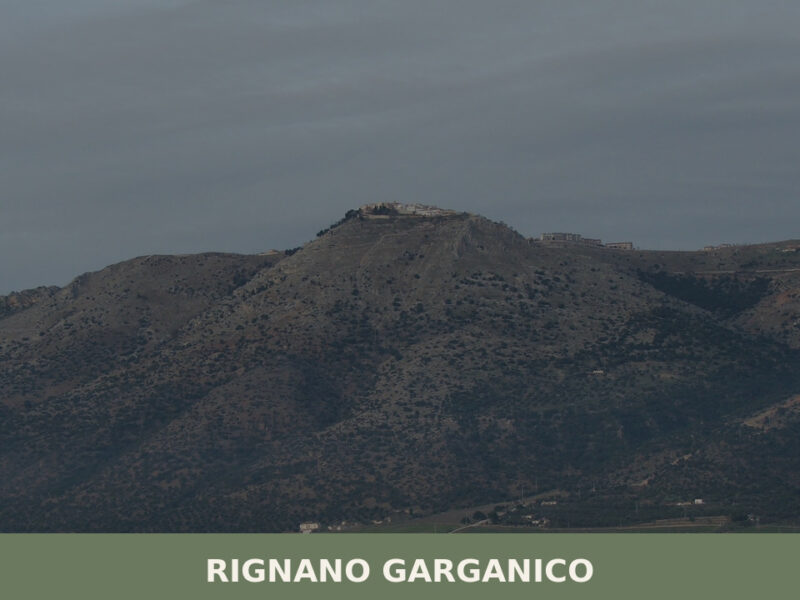
A quiet hilltop village at 590 metres on the Gargano promontory, Rignano Garganico rewards visitors with medieval lanes, wide Tavoliere views, and the honest food traditions of inland Puglia.
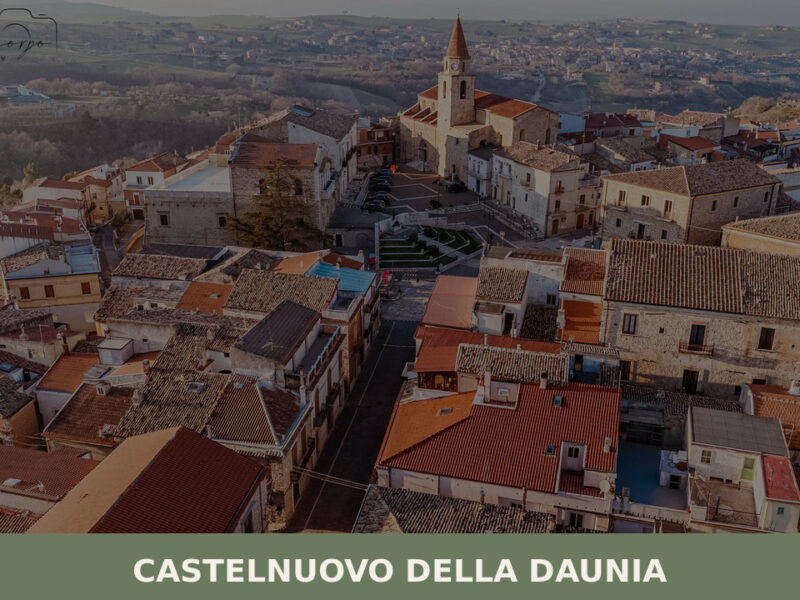
A compact hill village at 543 metres in Puglia's Subappennino Dauno, Castelnuovo della Daunia offers medieval lanes, panoramic views over the Tavoliere, and the quiet rhythms of inland southern Italy.
A 651-inhabitant hilltop village in Puglia's Daunia hills, Motta Montecorvino rewards slow visitors with medieval lanes, long views over the Tavoliere plain, and robust mountain cooking.
📝 Incorrect information or updates?
Help us keep the Lesina (Italia) page accurate and up to date.