


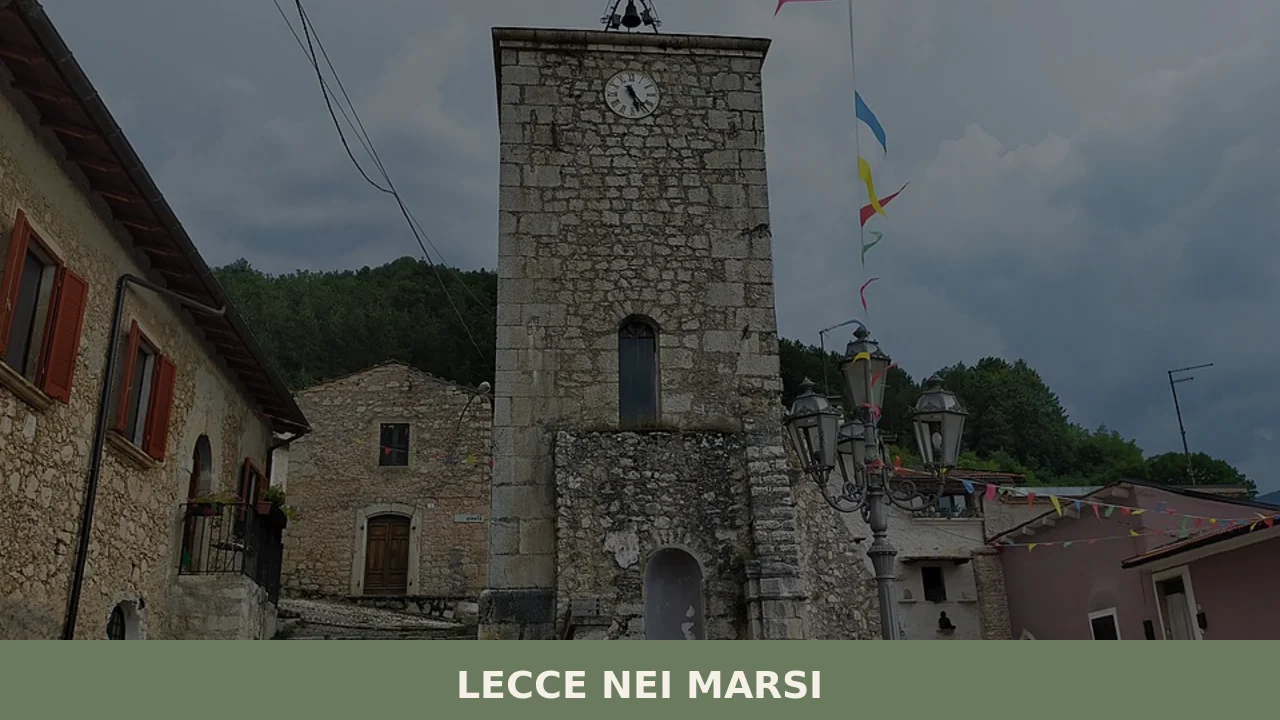
Lecce nei Marsi
Lecce nei Marsi has 1,534 inhabitants spread between the main centre and outlying hamlets along the eastern slope of the Marsica area, at 740 metres above sea level. The municipal territory borders the Abruzzo, Lazio and Molise National Park and falls within the province of L’Aquila. Anyone looking into what to see in Lecce nei […]
Discover Lecce nei Marsi
Lecce nei Marsi has 1,534 inhabitants spread between the main centre and outlying hamlets along the eastern slope of the Marsica area, at 740 metres above sea level. The municipal territory borders the Abruzzo, Lazio and Molise National Park and falls within the province of L’Aquila. Anyone looking into what to see in Lecce nei Marsi will find a settlement whose urban layout owes its current form to the reconstruction that followed the 1915 earthquake, when the Marsica was devastated by a magnitude 7.0 shock that wiped out much of the historic building stock. What survives of the original layout coexists with twentieth-century structures: two layers of history that can be read with the naked eye along the same streets.
History and origins of Lecce nei Marsi
The village’s name most likely derives from the Latin Litium or Licium, a place name recorded in medieval documents linking the settlement to the Marsi, an Italic people who inhabited the Fucino area from the pre-Roman period. The qualifier “nei Marsi” was officially added in 1863 to distinguish the municipality from the city of the same name in Puglia. The area was already inhabited in Roman times, as confirmed by the remains of structures and inscriptions found in the surrounding plain, connected to the ancient drainage of Lake Fucino attempted by Emperor Claudius in 52 AD.
During the Middle Ages the village fell within the orbit of the County of the Marsi and later passed under the control of various feudal families of the Kingdom of Naples. The parish church, dedicated to Saint Blaise of Sebaste, patron saint of the town, served as the focal point of community life for centuries. The Marsica earthquake of 13 January 1915 — an estimated 30,000 victims across the entire area — razed most of the settlement to the ground, forcing a reconstruction that profoundly altered the appearance of the original historic centre.
In the post-war period, depopulation struck Lecce nei Marsi as it did many municipalities in the Apennine interior. The population, which exceeded three thousand residents in early twentieth-century censuses, halved over the following decades and stabilised around its current figures. The local economy, once based almost exclusively on sheep farming and mountain agriculture, has partly shifted towards tourism linked to the proximity of the National Park.
What to see in Lecce nei Marsi: 5 main attractions
1. Church of San Biagio
The current building is the result of reconstruction after the 1915 earthquake. The church maintains the cult of patron saint Blaise of Sebaste, celebrated on 3 February with a procession through the town centre. Inside there are liturgical furnishings recovered after the earthquake and devotional statues of late nineteenth-century craftsmanship. The facade, sober and linear, reflects the style of twentieth-century Marsican reconstruction.
2. Remains of the medieval settlement
Some wall sections predating 1915 survive in the oldest part of the village, recognisable by their construction technique using exposed local stone, different from the regular blocks employed in the reconstruction. Fragments of doorways, carved jambs and stretches of perimeter walls allow visitors to read the building stratification of the village. These elements are concentrated in the upper part of the settlement, where the original village once stood.
3. Trails to the Abruzzo, Lazio and Molise National Park
Hiking routes departing from the municipal territory reach the boundaries of the Abruzzo, Lazio and Molise National Park. The beech forests covering the higher elevations are home to documented wildlife — red deer, roe deer, Apennine wolves. The trails follow the routes of historic mule tracks used by shepherds during transhumance to summer pastures.
4. Fucino Plain
Below the settlement stretches the Fucino Plain, the largest drained basin in Italy: 150 square kilometres of agricultural land where a lake existed until 1875. From the road descending from Lecce nei Marsi, one can observe the regular geometry of the drainage channels designed by Prince Alessandro Torlonia. Today the plain produces carrots, potatoes and sugar beets on an industrial scale, and it is a farming landscape without parallel in the peninsula.
5. Historical fountains and wash-houses
Several public stone fountains, some dating from the reconstruction period and others of earlier origin, are dotted around the centre and the hamlets. These hydraulic structures functioned as water supply points and spaces for social gathering. The wash-house basins, still visible in some of the municipality’s hamlets, retain their original structure with sloped limestone surfaces used for laundering clothes.
Traditional cuisine and local products
The table in Lecce nei Marsi reflects the agro-pastoral tradition of the mountainous Marsica. Sheep features as the central ingredient: arrosticini, skewers of hand-cut mutton, are cooked over narrow, elongated braziers called fornacelle. Sagne e fagioli — irregular fresh pasta cooked with borlotti beans, garlic and chilli pepper — is the most common first course in the area. Local pecorino cheese, aged in natural cellars, accompanies homemade bread baked in wood-fired ovens that some families still use.
The proximity of the Fucino Plain brings vegetables grown just a few kilometres away to the table: the Carota dell’Altopiano del Fucino IGP, recognised by the European quality mark, is the best-known product of the territory. Marsica potatoes, cultivated in soils enriched by the sediments of the ancient lake, are used to prepare gnocchi and thick soups. In autumn, the gathering of porcini mushrooms and truffles in the municipal woodlands fuels a seasonal micro-economy involving several residents.
What to see in Lecce nei Marsi and when to visit: the best time
Winter at 740 metres brings temperatures that regularly drop below zero and frequent snowfalls between December and February: conditions suited to those seeking snowshoe hikes in the surrounding woods, but not very practical for casual visits. The feast of San Biagio, on 3 February, brings the village to life in the depths of winter with a procession and the blessing of the throat, a rite linked to the tradition of the saint as protector against throat ailments.
Late spring — from mid-April onwards — and summer offer the best conditions for walking the trails towards the National Park and watching the mountain pastures come into bloom. In summer, daytime temperatures rarely exceed 28 degrees, a marked contrast with the coastal plains. Autumn, with mushroom foraging and the foliage of the beech forests, draws hikers and foragers between September and November. For up-to-date information on events and services, the official municipal website publishes notices and calendars of local events.
How to reach Lecce nei Marsi
By car, the most direct route from Rome follows the A25 Torano–Pescara motorway, exiting at the Celano or Aielli-Cerchio toll station; from there, the provincial road leads to the village in about 20 minutes. The distance from Rome is approximately 130 kilometres, covered in about an hour and a half. From Pescara the journey takes around two hours along the A25 in the opposite direction.
The nearest railway station is Avezzano, served by the Rome–Pescara line, about 15 kilometres from the centre of Lecce nei Marsi. From Avezzano it is necessary to continue by car or local bus. The reference airport is Rome Fiumicino Leonardo da Vinci, about 170 kilometres away. For those arriving from the Adriatic side, Pescara’s Abruzzo Airport is approximately 150 kilometres away.
Other villages to discover in Abruzzo
The Abruzzo interior has a high density of small mountain settlements that share with Lecce nei Marsi the status of municipalities with fewer than two thousand inhabitants, yet each has a distinct character. Navelli, on the plain of the same name north-east of L’Aquila, is the centre of Abruzzo DOP saffron cultivation, a crop documented since the thirteenth century. The village retains a compact medieval layout with noble buildings in white stone, and the saffron harvest — strictly by hand, flower by flower — takes place every October in a ritual that involves the entire community.
Moving towards the border with the Marche, Ancarano occupies a frontier position in the Val Vibrata, in the province of Teramo. The setting is completely different from the Marsican context: here we are in the hills, just a few kilometres from the Adriatic, in an agricultural landscape dominated by vineyards and olive groves. The geographical and climatic distance between Lecce nei Marsi and Ancarano — inland mountain versus coastal hill — illustrates the morphological variety of a region that, in fewer than a hundred kilometres, passes from the 2,900 metres of the Gran Sasso down to sea level.
In Abruzzo More villages to discover
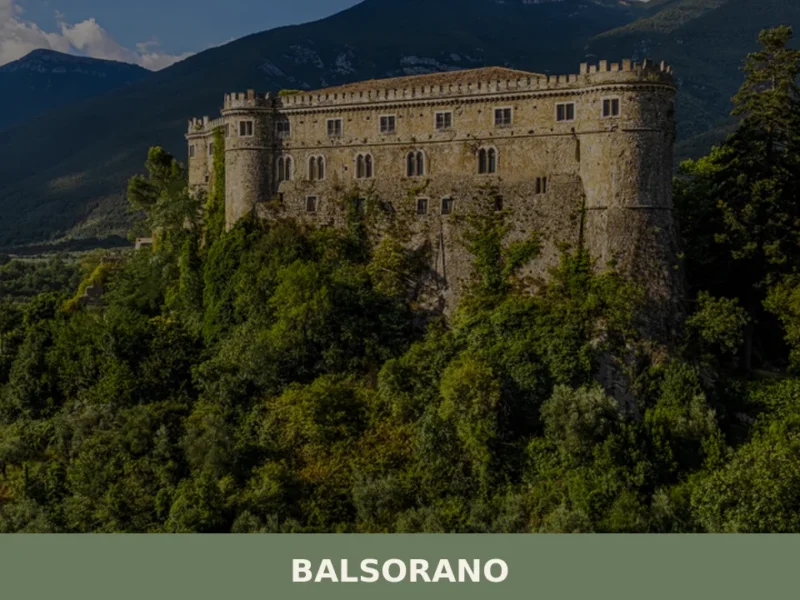
Balsorano
The Val Roveto divides southern Abruzzo from Lazio along a fault line that has determined earthquakes, migrations and feudal borders for over seven centuries. Balsorano occupies the valley floor and the hillside at 340 metres above sea level, with its 3,617 inhabitants spread between the upper historic centre — Balsorano Vecchio — and the modern […]
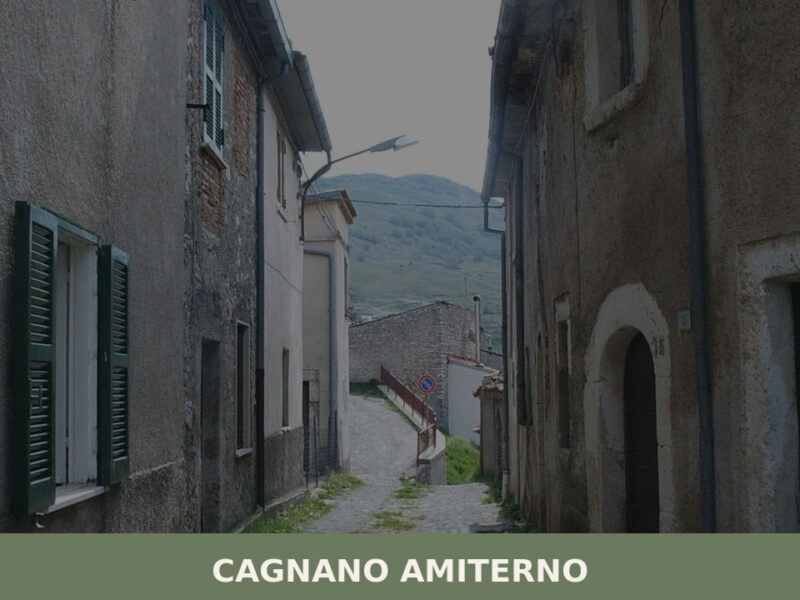
Cagnano Amiterno
Morning light falls flat across the high plateau west of L’Aquila, catching the stone walls of a settlement that has survived earthquakes, depopulation, and the slow erosion of memory. The air carries woodsmoke and the cold mineral scent of mountain water. Cagnano Amiterno, home to just over 1,400 residents, sits in a landscape shaped by […]
Castelguidone
Castelguidone has 294 inhabitants and occupies a ridge at 775 metres above sea level in the upper Trigno valley, on the border between Abruzzo and Molise. The place name, documented in Angevin records from the 13th century, points to a fortified settlement linked to a feudal lord named Guidone. Anyone looking for what to see […]


📝 Incorrect information or updates?
Help us keep the Lecce nei Marsi page accurate and up to date.