


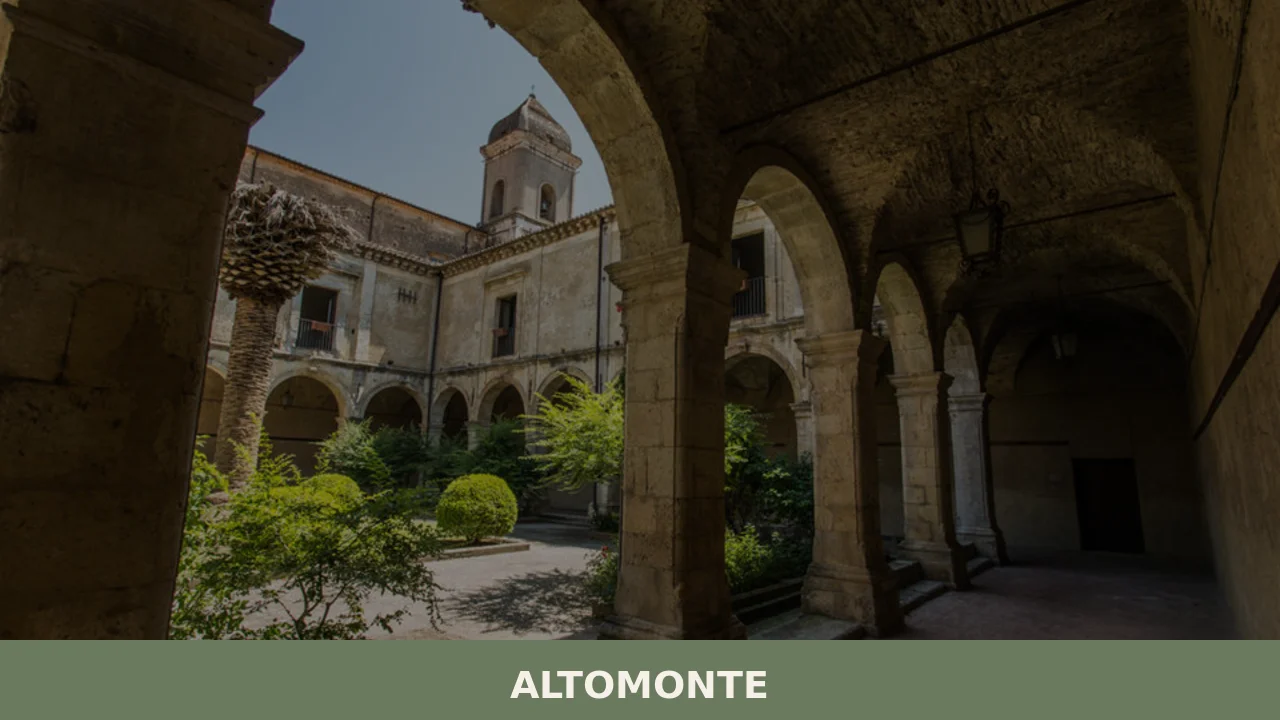
Altomonte
What to see in Altomonte: a hill village at 455m in Calabria with a 14th-century Gothic church, Civic Museum and medieval castle. Plan your visit today.
Discover Altomonte
Altomonte sits at 455 metres above sea level, in the heart of the province of Cosenza, on a hillside that overlooks the Coscile valley.
For anyone wanting to know what to see in Altomonte, the starting point is inevitably the medieval historic centre, where the Church of Santa Maria della Consolazione and its attached Franciscan convent form an architectural profile visible from a distance.
With just under 4,800 inhabitants, the village has maintained its own civic and religious identity over the centuries, tied in particular to the figure of Saint Francis of Paola, patron of the town, whose feast day falls on 2 April each year.
The hillside position, the artistic heritage and the proximity to other villages in northern Calabria make it a solid destination for cultural tourism.
History and Origins of Altomonte
The origins of the settlement date back to the medieval period, when the territory was known by the name of Franca Villa.
The transformation of the village and its new name are directly linked to Filippo I Sangineto, one of the most powerful feudal lords of the Angevin south in the fourteenth century.
Filippo Sangineto obtained the fief in 1343 and promoted a radical urban reorganisation of the centre, providing it with new walls, a castle and representative religious buildings.
It was during this period that the village took the name Altomonte, most likely to emphasise the elevated position and the new political status of the site. The Sangineto intervention was not purely military: the family promoted the construction of a conventual church that would become one of the most significant monuments in all of medieval Calabria.
During the fourteenth and fifteenth centuries, Altomonte was drawn into the feudal dynamics typical of the Angevin and later Aragonese south. The fief passed through several noble hands, caught up in the political tensions running through the Kingdom of Naples.
Despite the changes in lordship, the village preserved its urban structure and its religious heritage, which continued to serve as the centre of community life in the centuries that followed.
The events of the Spanish period left their mark on the local economy, which depended on agriculture and livestock farming — activities that defined life in the village well into the modern era.
In the modern period, Altomonte followed the trajectory of the post-unification south, with waves of emigration gradually reducing the population from its historic highs.
The village is now classified among the hill villages of Calabria, a type of settlement widespread in the province of Cosenza, where the shape of the land has historically determined how communities were distributed across the territory.
The Coscile valley area shares with nearby villages such as Acquaformosa, a short distance to the north, a history of medieval settlements and feudal transformations spanning the same centuries.
What to See in Altomonte: Main Attractions
Church of Santa Maria della Consolazione
The Church of Santa Maria della Consolazione is the most important monument in Altomonte and one of the most significant examples of Gothic architecture in Calabria.
Built at the behest of Filippo Sangineto around the middle of the fourteenth century, it features a façade with a large central rose window and a portal decorated with sculptural elements typical of southern Gothic style. The single-nave interior preserves works of art of considerable value, including the tomb of Filippo Sangineto himself, attributed to sculptors of the Neapolitan school.
The church is attached to the convent of the Dominican Fathers, who have ensured its upkeep over the centuries.
Anyone working out what to see in Altomonte cannot overlook this visit.
Altomonte Civic Museum
Within the Dominican conventual complex sits the Altomonte Civic Museum, which brings together works of art from the church and the surrounding territory. The collections include panel paintings, medieval and Renaissance sculptures, liturgical artefacts and material evidence of local history. The museum is an important reference point for those studying artistic production in northern Calabria during the Angevin and Aragonese periods.
The layout allows visitors to examine at close range pieces that would otherwise be difficult to access, offering a route that connects directly to the history of the village and its noble patronage.
Sangineto Castle
The remains of the medieval castle stand at the highest point of the village, in a dominant position above the valley below.
The structure was built during the Angevin period and extended by the Sangineto family in the fourteenth century, as part of the broader urban reorganisation of the centre. From the original layout, sections of walls and several towers survive, allowing visitors to reconstruct the plan of the defensive complex. It is worth climbing to the level of the castle not only to examine the architectural remains, but also for the open view across the Coscile valley and the surrounding heights of the province of Cosenza.
Historic Centre and Medieval Urban Layout
Altomonte’s historic centre retains the typical structure of a Calabrian medieval hill settlement, with narrow streets that follow the contour lines and houses built in local stone.
Walking through the urban fabric allows visitors to read the different construction phases of the village, from its medieval foundations through to layers added in the modern era. Several noble palaces with decorated doorways indicate that families of rank once lived permanently in the village.
The Municipality of Altomonte oversees the promotion of this heritage as part of its local tourism development policies.
Convent of the Dominican Fathers
The convent attached to the Church of Santa Maria della Consolazione was founded at the same time as the church itself in the fourteenth century and is one of the best-preserved conventual complexes in northern Calabria.
The cloisters and interior spaces allow visitors to appreciate Gothic conventual architecture adapted to local conditions. The Dominican community maintained a continuous presence in the convent for centuries, ensuring the transmission of its artistic and documentary heritage. The church-and-convent ensemble forms a cultural focal point that, when considering what to see in Altomonte, deserves at least an hour and a half to explore properly.
Local Food and Products of Altomonte
The cuisine of Altomonte belongs to the gastronomic tradition of northern Calabria, a geographical area where the agricultural economy and livestock farming have historically shaped eating habits.
The hillside position of the village, at 455 metres of altitude, has favoured the cultivation of cereals, pulses and vegetables, while sheep and pig farming has supplied the raw materials for a cuisine rooted in rural tradition.
The influence of Angevin and Aragonese rule, which brought techniques and ingredients from across the Mediterranean basin into the south of Italy, can still be detected in certain local preparations that combine bold flavours with the use of spices and aromatic herbs.
Among the most deeply rooted dishes in local tradition are pulse soups, particularly preparations based on beans and grass peas, cooked with lard and wild herbs.
Homemade pasta, in the forms typical of Calabria such as fileja — a format made by wrapping the dough around a thin rod — is served with pork ragù or tomato sauces enriched with Calabrian chilli. Goat and lamb feature in festive preparations, often baked in the oven with potatoes and rosemary, a technique common throughout the hill areas of the province of Cosenza.
Local cured meats, made from pigs raised in the area, include soppressata and capocollo, prepared according to methods passed down within families.
As regards certified products, the available data records no DOP, IGP, PAT or DOC certifications specifically assigned to the territory of Altomonte.
The local cuisine should therefore be appreciated for its artisanal and family-based character, without attributing formal recognitions that sources do not confirm.
Visitors travelling through the area can find similar produce in nearby villages: Bianchi, in the Cosenza hinterland, shares with Altomonte a tradition of cured meat production and a rural cuisine built around the same basic ingredients.
The best opportunities to sample local products are the patron saint’s feast and the summer food festivals, when local producers display cured meats, pecorino cheeses and preserved tomatoes. The village’s weekly markets and the small shops in the historic centre offer the chance to buy artisanal products directly from producers.
The summer months, between July and August, concentrate most of the local food and wine events, with evenings dedicated to traditional Calabrian cooking.
Festivals, Events and Traditions of Altomonte
The patron saint of Altomonte is Saint Francis of Paola, the Calabrian friar who founded the Order of Minims, born in Paola in 1416 and canonised in 1519.
His feast falls on 2 April and is celebrated with a solemn procession through the streets of the historic centre.
Popular devotion to Saint Francis of Paola runs deep throughout Calabria: the saint is venerated as the protector of sailors and the most vulnerable, and his figure combines religious meaning with a strong sense of Calabrian identity. In Altomonte, the 2 April celebration includes a solemn mass in the main church, a procession carrying the statue of the saint and moments of communal gathering in the village centre.
Beyond the patron saint’s feast, the events calendar in Altomonte includes summer initiatives tied to the promotion of the territory and its local products.
The period between June and August is traditionally the busiest for events, with cultural evenings organised in the spaces of the historic centre and the Dominican conventual complex.
Local religious traditions also include celebrations tied to the Catholic liturgical calendar, with particular attention to Easter festivities and Good Friday processions — practices widespread across hill communities in Calabria, with forms that vary from village to village.
When to Visit Altomonte and How to Get There
The most suitable period to visit Altomonte is spring, between April and June, when temperatures at this altitude are mild and the surrounding landscape is green.
Early April coincides with the patron saint’s feast on the 2nd, which offers the chance to experience the village on one of its most lively days.
September and October are also good months, with a temperate climate and fewer visitors than in summer.
Those looking for a quieter visit can opt for the autumn months, when the village is frequented mainly by local visitors and daily life in the historic centre is more in evidence.
To reach Altomonte by car, the most direct route from the A2 Autostrada del Mediterraneo involves taking the Altomonte-Castrovillari exit, from which the village is just a few kilometres to the west. The nearest railway station is at Castrovillari-Morano, connected to the Calabrian regional rail network via Trenitalia services.
For those travelling from outside the region, the main reference airport is Lamezia Terme, approximately 130 kilometres away, or alternatively Naples Capodichino for those coming from the north. Visitors planning an itinerary through northern Calabria can include in the same day a visit to Acquappesa, another village in the province of Cosenza reachable in just over an hour by car.
Where to Stay in Altomonte
Altomonte has a number of accommodation options that make use of the historic building stock in the centre and the surrounding area.
The Dominican conventual complex has over the years hosted initiatives connected to religious and cultural tourism.
In and around the village, agriturismi and small guesthouses offer bed and breakfast stays, often combined with the local food products of the area. Those looking for a longer stay in the area can also explore accommodation in nearby villages, such as Belsito, in the Cosenza hinterland, which shares with Altomonte the same type of rural hill accommodation offer.
In Calabria More villages to discover
Aprigliano
Explore Aprigliano Calabria, a picturesque village nestled in the heart of Italy. Uncover its rich history, stunning landscapes, and authentic Calabrian charm. Plan your visit today!
Amantea
Explore the picturesque village of Amantea Calabria. Discover its historic center, beautiful beaches, and authentic Italian charm. Plan your perfect trip to this hidden gem on the Tyrrhenian coast.
Amendolara
Explore Amendolara village, a charming Italian gem nestled in Calabria. Discover its rich history, stunning landscapes, and authentic local culture. Plan your visit today!



📝 Incorrect information or updates?
Help us keep the Altomonte page accurate and up to date.