


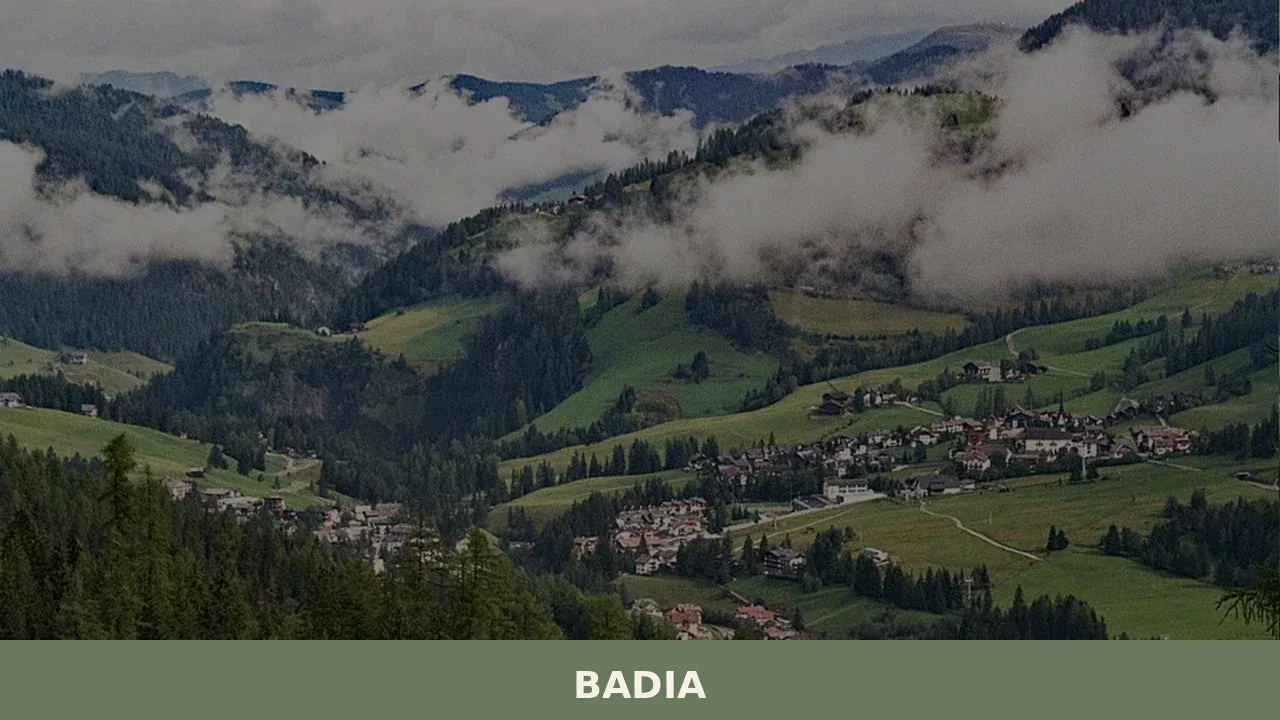
Badia
Badia has 3,396 inhabitants spread across six hamlets — San Leonardo, Pedraces, La Villa, San Cassiano, La Val and Antermoia — and occupies a stretch of the Val Badia where Ladin is the mother tongue for over ninety per cent of the population. Understanding what to see in Badia means entering a Dolomite valley where […]
Discover Badia
Badia has 3,396 inhabitants spread across six hamlets — San Leonardo, Pedraces, La Villa, San Cassiano, La Val and Antermoia — and occupies a stretch of the Val Badia where Ladin is the mother tongue for over ninety per cent of the population. Understanding what to see in Badia means entering a Dolomite valley where the Ladin linguistic identity has shaped architecture, place names and land organisation more deeply than in any other municipality in the Province of Bolzano.
History and origins of Badia
The name “Badia” derives from the Latin term abbatia and refers to the documented presence, from at least the 12th century, of an Augustinian convent at Castel Badia (Abtei in German), a structure that served as the administrative and religious centre of the valley. The ecclesiastical jurisdiction the monastery exercised over the entire area was consolidated under the Prince-Bishopric of Bressanone, to which the Val Badia remained tied until Napoleonic secularisation in 1803. The oldest documents mentioning settlements in the area date to around 1030, when the hamlets appear in the land registers of the bishopric.
The Ladin community of the Val Badia maintained relative cultural autonomy even after the annexation of South Tyrol to Italy in 1919. During the Fascist period, the policy of Italianisation attempted to erase Ladin from public life, but the language survived through family transmission and religious services. After the Second World War, the Autonomy Statute of 1972 granted the Ladin people specific linguistic rights, guaranteeing trilingual education — Ladin, German and Italian — in the valley’s schools. To this day, the municipality of Badia is classified as a Ladin-majority linguistic territory, with trilingual road signs and a balanced school system.
In architectural terms, the valley preserves the Viles, rural clusters of farmsteads grouped according to a settlement pattern predating the 16th century. These groupings of wood-and-stone buildings, with stables, barns and dwellings arranged around a shared space, document a communal organisation of agricultural labour typical of the Ladin Dolomite area.
What to see in Badia: 5 top attractions
1. Sanctuary of the Holy Cross (Santa Crusc)
At an altitude of 2,045 metres, on a plateau at the foot of the Sasso di Santa Croce, the sanctuary dates to 1484 and houses a late-Gothic wooden altar. The walk up from San Leonardo takes roughly one hour and forty minutes along a trail with 700 metres of elevation gain. The original chapel, already documented in the 13th century, was enlarged several times until it reached its current form.
2. Museum Ladin Ursus ladinicus (San Cassiano)
In the hamlet of San Cassiano, this museum displays the remains of an Ursus ladinicus, a species of cave bear discovered in 1987 in the Conturines cave at 2,800 metres. The skeleton, dated to around 40,000 years ago, is among the best preserved in the Alps. The exhibition halls also illustrate Dolomite geology and the formation of the Triassic coral reefs that make up the valley’s rock walls.
3. Castel Badia (Schloss Sonnenburg)
Founded in 1039 as a Benedictine convent for women and later transferred to Augustinian canonesses, Castel Badia overlooks the confluence of the Val Badia and the Val Pusteria. The building was damaged by fire in 1785 and subsequently remodelled. Today it houses a hospitality facility, but the convent church and some portions of the Romanesque structure remain visible and can be visited on request.
4. The Viles of San Leonardo and La Val
The traditional Ladin rural clusters, known as Viles, can be observed particularly well in the hamlets of San Leonardo and La Val. Groups of three to eight farmsteads with wooden-shingle roofs, dolomite-stone walls and continuous larch-wood balconies document Alpine building techniques dating from the 15th to the 18th century. The themed trail “Saus dla Crusc” in La Val links several of them with information panels.
5. Piz La Ila and the Gardenaccia
From La Villa, the cable car leads to Piz La Ila (2,077 m), the access point to the Gardenaccia plateau, a vast limestone tableland above 2,000 metres with fossiliferous strata visible to the naked eye. The Dolomites Geological Trail, marked with panels by the Touring Club Italiano, crosses this area, which has been classified as a UNESCO World Heritage Site since 2009.
What to see in Badia: typical cuisine and local products
Val Badia cuisine is Ladin, not generically South Tyrolean, and this distinction is evident in both the names and the preparations. Cajincí (half-moon pasta parcels filled with spinach, ricotta and potatoes, dressed with melted butter and chives) are the most representative dish of the valley, distinct from Tyrolean Schlutzkrapfen for their thinner dough and leaner filling. Crafuncins, a variant stuffed with fermented sauerkraut, appear on winter menus. Turtres, rye-dough fritters filled with spinach or sauerkraut and fried in lard, were the meal eaten on market days. Speck Alto Adige IGP, also produced in the valley, follows product specifications requiring a minimum ageing of twenty-two weeks with beechwood smoking. Graukäse (grey cheese) from the Val Pusteria, lean and grainy, is eaten marinated with oil, vinegar and onion — a dish known as Graukäse mit Essig und Zwiebel. Rye bread (Schüttelbrot), thin and crispy, flavoured with caraway seeds and fenugreek, accompanies every meal.
Among the desserts, Furtaies (spiral-shaped fritters made from a very thin batter, sugared at the moment of serving) are prepared during the patron-saint festivals of the various hamlets, especially the feast of San Leonardo in late October. Apple strudel, here made with Val di Non DOP apples when available, and Strauben (a spiral fritter of liquid batter) round out the dessert repertoire. As for cheeses, in addition to Graukäse, Bergkäse (semi-hard alpine cheese) is produced during the summer months at the active mountain dairies above 1,800 metres. Every year in late September, the municipality of Badia hosts “Ciamorces y Ciarces”, a market of Ladin dairy and artisan products held across the hamlets.
When to visit Badia: the best time of year
The Val Badia has two clearly defined seasons. Winter, from December to March, is dominated by the Alta Badia ski area, with 130 kilometres of slopes connected to the Dolomiti Superski circuit. La Villa and San Cassiano are the main access points. In December, the Gran Risa slope in La Villa hosts an annual giant slalom race counting towards the men’s Alpine Ski World Cup, drawing crowds of up to 20,000 spectators. Summer, from mid-June to mid-September, opens up the hiking network and the via ferrata routes — daytime temperatures range between 15 and 25 degrees in the valley floor (around 1,300 m).
The least crowded period falls in the weeks between mid-May and mid-June, when the snow has retreated but the summer lifts are not yet running. For those looking to experience the valley at a normal pace, the second half of September offers settled weather and the larches begin to turn yellow — a useful condition for landscape photography. If you are seeking quiet, avoid the two central weeks of August and the Feast of the Immaculate Conception long weekend.
How to reach Badia
By car, from the Brenner motorway A22, the most convenient exit is Bressanone. From there, take the SS49 national road towards the Val Pusteria as far as Longega, where you turn onto the SS244, which climbs up into the Val Badia. From Bressanone to San Leonardo di Badia the distance is approximately 36 kilometres, covered in about 40 minutes. From Bolzano it is around 70 kilometres (one hour and ten minutes); from Innsbruck 130 kilometres; from Venice roughly 210 kilometres via the A27 and A22.
The nearest railway station is Brunico (Bruneck), on the Val Pusteria line, from where SAD buses depart hourly towards the hamlets of Badia. The closest airport is Bolzano (70 km), with limited connections; better served are Innsbruck (130 km), Verona Villafranca (220 km) and Venice Marco Polo (210 km). In winter, snow chains or winter tyres are compulsory on the SS244, which reaches an altitude of 1,350 metres. The Municipality of Badia website publishes updates on road conditions.
Other villages to discover in Trentino-Alto Adige
Those who travel through Trentino-Alto Adige following the thread of its smaller communities will find very different realities within the same region. Andriano, in the Bassa Atesina just a few kilometres from Bolzano, occupies a slope of the Adige valley where Schiava and Gewürztraminer vineyards reach right up to the doorsteps of the houses. It is a wine-growing village of fewer than a thousand inhabitants, radically different from Badia in altitude (under 300 metres), predominant language (German) and economic vocation. A comparison between the two municipalities reveals the internal variety of a province whose landscape and culture change every thirty kilometres.
Moving towards Merano, Avelengo sits on a plateau at 1,290 metres above sea level, known for the breeding of the Haflinger horse, a breed that originated in this very area. Avelengo shares Badia’s altitude and mountain character, but its history is linked to the German-speaking Tyrolean world, not the Ladin one. The two villages, set about a hundred kilometres apart, represent the two Alpine identities of the province: the eastern Dolomite soul and the western Merano one.
In Trentino-South Tyrol More villages to discover
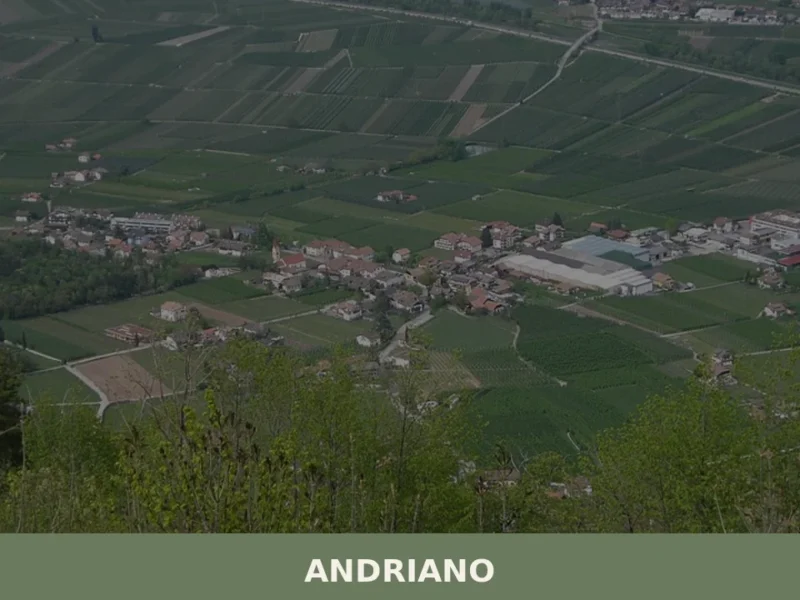
Andriano
At 274 metres above sea level, on the left bank of the Adige river, Andriano has 1,025 inhabitants spread between the historic centre and the farmsteads scattered among rows of vines. The municipality, one of the smallest in South Tyrol by area, extends entirely across flat ground along the alluvial strip connecting Bolzano to Merano. […]
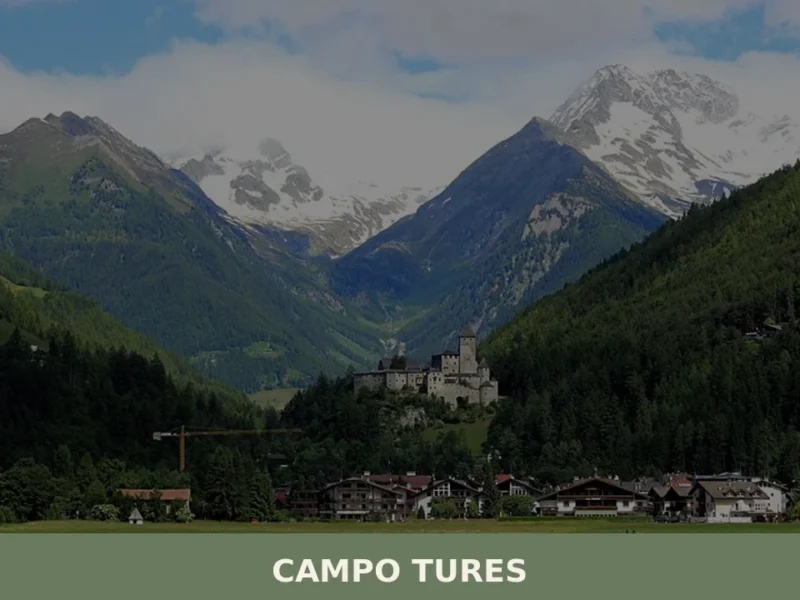
Campo Tures
Tures Castle, first documented in 1136, dominates Campo Tures from a rocky spur at the entrance to the Tures Valley, a side valley of the Aurina Valley. The village has 5,321 inhabitants, spread across an elevation of 864 metres, in a basin where the Aurino torrent slows before continuing south. Understanding what to see in […]
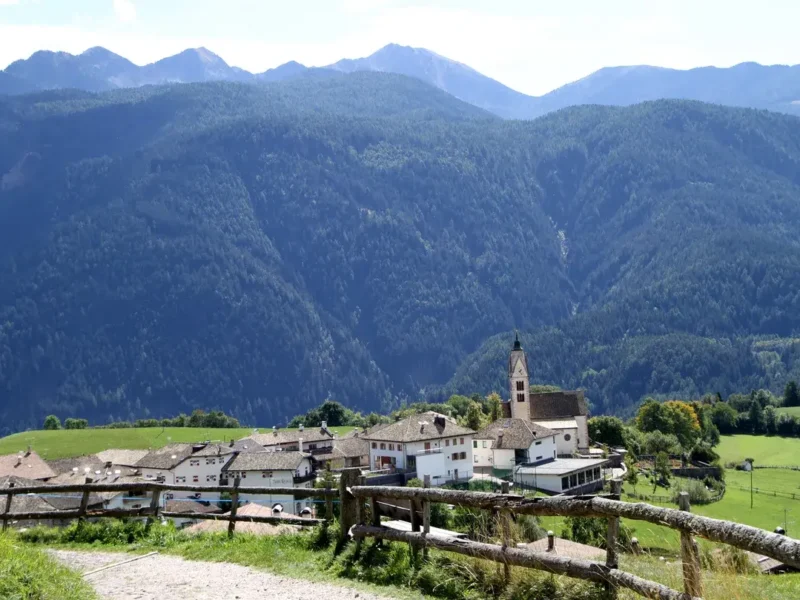
Anterivo
Anterivo has 393 inhabitants and sits at 1,209 metres above sea level, in the far south-east of Alto Adige (South Tyrol), on the linguistic border between the German-speaking and Romance-speaking worlds. The municipality — one of the smallest in the province of Bolzano — occupies a south-facing slope of the Val di Fiemme, separated from […]


📝 Incorrect information or updates?
Help us keep the Badia page accurate and up to date.