


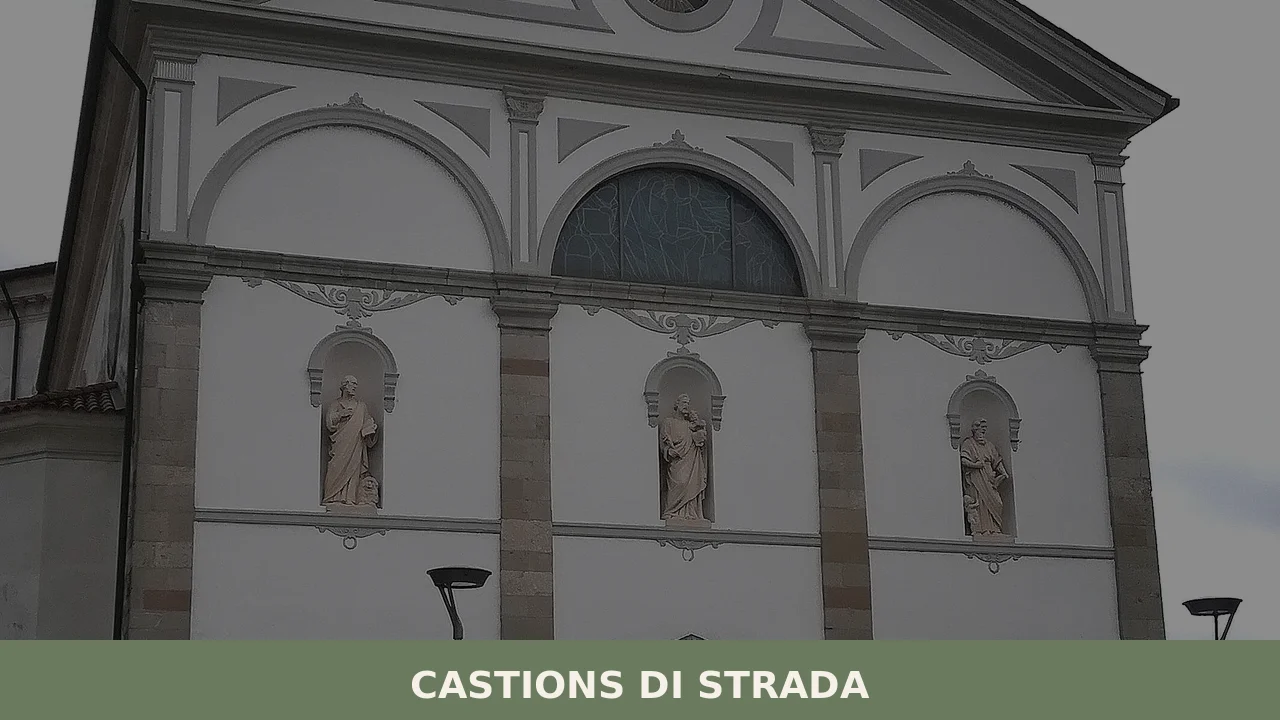
Castions di Strada
A straight road cuts across the Friulian plain at twenty-three metres above sea level, and along that route — the ancient road that connected Aquileia to Concordia Sagittaria — a settlement grew whose very name declares its reason for being. Castions di Strada owes its identity to that Roman road, to a network of drainage […]
Discover Castions di Strada
A straight road cuts across the Friulian plain at twenty-three metres above sea level, and along that route — the ancient road that connected Aquileia to Concordia Sagittaria — a settlement grew whose very name declares its reason for being. Castions di Strada owes its identity to that Roman road, to a network of drainage canals, and to an agricultural vocation that still marks the landscape today with fields of maize, vineyards, and surviving rows of mulberry trees. Asking what to see in Castions di Strada means crossing a territory where the history of the Bassa Friulana can be read in the stones of its churches, in regulated ditches, and in the rural festivals that punctuate the year.
History and origins of Castions di Strada
The place name “Castions” most likely derives from the Latin castellum or castrum, a reference to a fortified structure or garrison established along the Roman road that crossed the plain between Aquileia and Concordia.
The specification “di Strada” was officially added in the post-unification period to distinguish the municipality from its namesake Castions di Zoppola, in the province of Pordenone, and it reaffirms the fundamental link between the settlement and the road axis that determined its birth. The area, already frequented in pre-Roman times, acquired logistical importance during the Roman colonisation of Friuli, when the plain between Palmanova and Cervignano was organised according to the centuriation system, whose traces are still recognisable in the regular geometry of the fields.
In the Middle Ages, the territory of Castions fell within the orbit of the Patriarchate of Aquileia, the great ecclesiastical and political entity that governed much of Friuli until 1420, the year in which the Serenissima Republic of Venice imposed its rule over the region. Under Venice, Castions di Strada remained a rural centre of modest size, tied to the agricultural economy and to water management in a plain prone to frequent waterlogging.
The systematic reclamation of the land — begun in the sixteenth century and intensified in the following centuries — progressively transformed the area into cultivable ground, attracting new settlers and consolidating the inhabited centre. The transition to the Habsburg Empire, after 1797 and the fall of Venice, did not substantially alter the socioeconomic structure of the village.
With its annexation to the Kingdom of Italy in 1866, Castions di Strada underwent a slow modernisation: the construction of the Udine-Cervignano railway, the opening of municipal schools, and the gradual improvement of the road network changed the face of the territory without erasing its peasant roots. During the First World War, the proximity to the Isonzo front made the area a strategic rear zone; the Second World War brought further damage and evacuations.
Post-war reconstruction coincided with the industrialisation of the Bassa Friulana and a partial rural exodus. Today the municipality has approximately 3,850 inhabitants distributed between the main town and its hamlets, maintaining a stable demographic profile and an economy that combines agriculture with services and small-scale artisan enterprise.
What to see in Castions di Strada: 5 key attractions
1. Parish Church of San Giuseppe
Dedicated to the patron saint of the village, whose feast day falls on 19 March, the parish church of San Giuseppe is the main religious building for the community of Castions di Strada. The current structure is the result of interventions carried out between the eighteenth and nineteenth centuries, with a façade that follows the sober lines of Friulian lowland ecclesiastical architecture. Inside, it preserves a marble high altar and several canvases from the Venetian school that document the devotional taste of the Bassa Friulana. The bell tower, visible from several kilometres across the surrounding plain, serves as a landmark for those arriving along the provincial road and represents the most recognisable vertical element in the town’s profile.
2. Villa Vela and the historic centre
The oldest part of the settlement clusters around a system of rural courtyards and noble residences that bear witness to the social stratification of the Friulian countryside under the Serenissima and later under the Habsburgs. Among these, Villa Vela stands out for its typology as a manor house with adjoining rural outbuildings, an architectural model widespread across the Udinese plain where the villa was not merely a noble residence but a centre of agricultural management. Walking through the historic centre of Castions means observing stone portals, brick walls, converted barns, and courtyards that retain the functional layout of the old farming estates.
3. Traces of Roman centuriation
One of the most distinctive aspects of the territory of Castions di Strada is the persistence in the agrarian landscape of the lines of Roman centuriation, the system by which Rome subdivided and assigned land to settlers. Seen from above — or simply by cycling along the country roads — the orthogonal grid of fields, ditches, and cart tracks reveals a geometry dating back over two thousand years. This grid is particularly legible in the area between Castions, Morsano, and Gonars, and constitutes a landscape document of great interest for those studying the territorial organisation of the Aquileian hinterland.
4. Network of drainage canals
The Bassa Friulana is a land of managed water, and Castions di Strada is a concrete example of this. The network of canals, irrigation channels, and ditches that crosses the municipal territory is the result of centuries of hydraulic work, from Venetian-era reclamation to the interventions of the Consorzio di Bonifica Pianura Friulana. Along these canals, riparian vegetation of willows, alders, and reed beds supports a small but notable fauna — grey herons, moorhens, kingfishers — rare in a context that appears purely agricultural. For visitors interested in landscape, a walk along the canal banks offers a view of the plain that no paved road can provide.
5. Churches of the hamlets
The municipal territory includes several hamlets — among them Morsano di Strada and Grions — each with its own church or chapel documenting the popular devotion of the Friulian countryside. These buildings, generally modest in size, feature architectural elements ranging from late Baroque to rural Neoclassical, with interiors containing votive frescoes, wooden altars, and processional statues. Visiting them means understanding how religious practice shaped the territory not only spiritually but also urbanistically, assigning to each settlement its own point of gathering and identity.
What to eat in Castions di Strada: local cuisine and products
The gastronomic tradition of Castions di Strada belongs to the broader chapter of Friulian lowland cooking, a cuisine born from the need to turn what the land and livestock provided into sustenance in a continental climate, with harsh winters and hot summers.
The influence of nearby Aquileia and the farming culture of the Bassa Friulana produced a cuisine where maize, pork, garden vegetables, and dairy are the fundamental ingredients. This is not a cuisine of display but of substance, designed to fuel work in the fields and to mark communal occasions.
At the centre of the Friulian table in this area is polenta, traditionally prepared with white or yellow maize flour and served as an accompaniment to every course, from meat to cheese. Frico, the signature dish of Friuli Venezia Giulia documented since the fifteenth century, is made with Montasio cheese at various stages of ageing — sometimes mixed with potatoes — and cooked in a pan until it forms a golden, crispy crust.
In winter, tables are enriched with brovada, white turnips preserved in grape pomace and then slow-cooked, often paired with musetto, a boiled sausage made from pig’s snout with a soft texture and a bold flavour.
Among the local products, Montasio cheese — recognised as a DOP (Protected Designation of Origin) — is the most renowned and well-documented: produced in Friuli Venezia Giulia and Veneto, it takes its name from the Montasio plateau in the Julian Alps and is used fresh, medium-aged, or mature. The Udinese plain also contributes to the production of maize destined for polenta, a crop that has defined the region’s agrarian landscape from the seventeenth century onwards. In the autumn months, private gardens and small local markets offer radicchio, beans, and squash, the base ingredients for soups such as minestrone alla friulana, prepared with seasonal vegetables and often thickened with barley or rice.
The patron feast of San Giuseppe, on 19 March, is the most significant gastronomic occasion of the year for the community, with food stalls and home-made preparations. During autumn, village festivals dedicated to polenta, mushrooms, or brovada enliven several municipalities across the Bassa Friulana, and Castions is no exception. To purchase local products, the weekly markets in nearby towns — Palmanova, Cervignano del Friuli — offer cheeses, cured meats, and vegetables grown in the surrounding plain.
Some farms in the area practise direct sales, particularly for wine and dairy products.
The territory of Castions di Strada falls within the production zone of the Friuli Grave DOC designation, one of the most extensive wine-producing areas of Friuli Venezia Giulia, covering the plain between Pordenone and Udine. White wines are produced here from Friulano (Tocai), Pinot Grigio, and Sauvignon grapes, and reds from Merlot, Cabernet Franc, and Refosco dal Peduncolo Rosso. Refosco, in particular, is an indigenous grape variety that yields a red wine with deep colour and pronounced tannins, well suited to accompany the robust dishes of the local cuisine. Several wineries in the area welcome visitors for tastings by appointment.
When to visit Castions di Strada: the best time
The Friulian plain has a continental climate with marked temperature swings: winters can be cold and foggy, with temperatures dropping below zero between December and February, while summers are hot and sometimes humid, with peaks of 33–35 degrees in July and August. The most favourable periods for visiting Castions di Strada are spring — from April to June, when the fields are green and temperatures mild — and autumn, from September to November, the season of harvests, village festivals, and foliage colours along the canals. The patron feast of San Giuseppe, on 19 March, offers an opportunity to meet the local community during a moment of celebration.
Those who prefer a quieter experience will find in the weekdays of October and November a silent countryside free of tourist flows, ideal for cycling along the white gravel roads of the centuriation grid.
Summer suits those who wish to combine the visit with excursions to the Adriatic coast — Grado and Lignano Sabbiadoro are less than forty minutes away — but it requires planning outings during the cooler hours of the day. In every season, the proximity to Palmanova and Aquileia makes it possible to build day itineraries that integrate a visit to Castions with stops in centres of greater historical and artistic appeal.
How to get to Castions di Strada
Castions di Strada is located along Strada Regionale 352, which connects Palmanova to Cervignano del Friuli, in a position easily accessible from the motorway network of Friuli Venezia Giulia. The most convenient exit from the A4 motorway (Turin–Trieste) is Palmanova, from which Castions is approximately 8 kilometres to the south. From Udine, the provincial capital, the journey is about 25 kilometres, reachable in half an hour via the SR 352 or the SP 95. From Trieste the distance is approximately 75 kilometres, just over an hour’s drive via the A4 and the Palmanova exit.
The nearest railway station with regular service is Cervignano del Friuli-Aquileia-Grado, located on the Venice–Trieste line, approximately 10 kilometres from the centre of Castions.
From there it is necessary to continue by local bus or private transport. Trieste-Ronchi dei Legionari Airport is about 30 kilometres away and is the most convenient airport for those arriving by air; Venice Marco Polo Airport is approximately 130 kilometres away. The intercity bus service operated by TPL FVG connects Castions to the larger centres of the province, although with limited frequencies on public holidays.
Other villages to discover in Friuli Venezia Giulia
Those visiting Castions di Strada have the opportunity to include this stop in a broader itinerary through Friuli Venezia Giulia, a region where within a few kilometres you pass from the reclaimed plain to the moraine hills and on to the pre-Alpine foothills.
To the south, just ten kilometres away, lies Aquileia, a UNESCO site with its early Christian basilica and the remains of the Roman forum: a shift from the rural dimension of Castions to the monumental scale of one of the most important cities of the Western Roman Empire. Combining the two visits — the centuriated countryside and the city that organised that centuriation — gives a complete picture of the territorial history of the Bassa Friulana.
In the opposite direction, heading north, ascending the plain and then the first pre-Alpine slopes, you reach in just over an hour Artegna, a village dominated by the Forte hill where the remains of a medieval castle and the church of Santo Stefano stand.
The contrast is stark: where Castions is horizontal, agricultural, marked by regulated water, Artegna is vertical, set on a moraine ridge, linked to a history of defence and territorial control. This dual register — plain and hill, reclamation and fortress — is one of the keys to understanding the complexity of Friuli, a region that in fewer than one hundred kilometres offers radically different landscapes and histories. The Aquileia–Castions–Artegna route can be covered in a single day, with total driving times of under two hours.
In Friuli Venezia Giulia More villages to discover
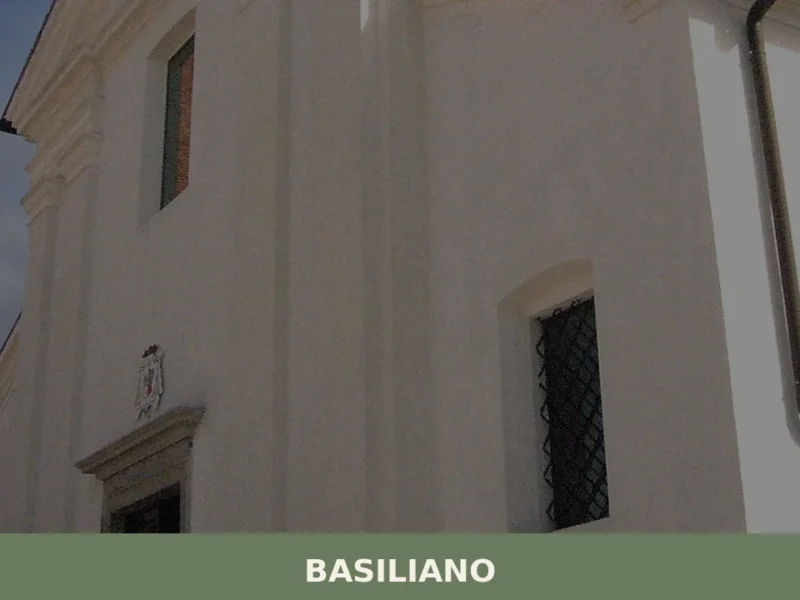
Basiliano
In 1309, a notarial deed drawn up in Udine recorded the transfer of certain feudal rights relating to the territory of Basiliano, confirming the existence of a settlement already organised along the route connecting Udine to Codroipo. Today that route partly coincides with regional road 464, and anyone travelling along it crosses a plain where […]
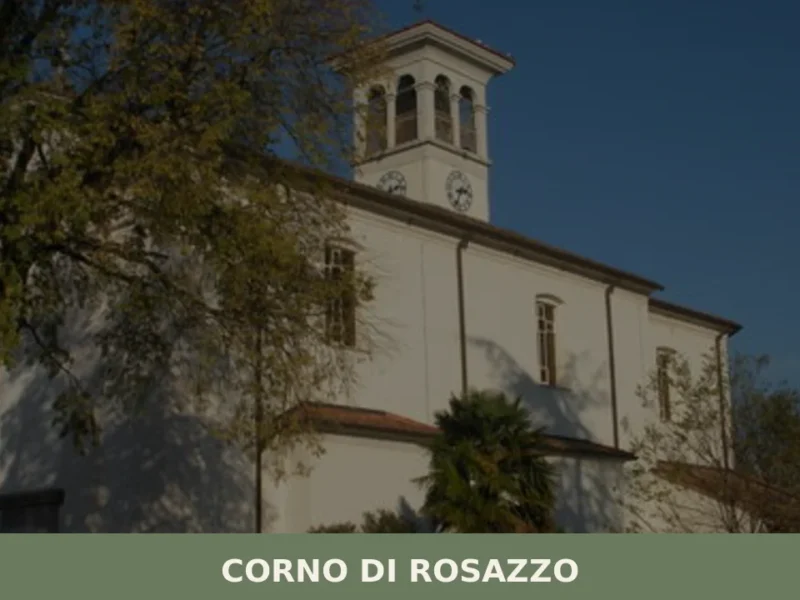
Corno di Rosazzo
In 1070, a deed of donation by the Patriarch of Aquileia mentioned the name Corno di Rosazzo for the first time, linking it to a parish church and a territory already organized around viticulture and cereal farming. Today that territory extends over just twenty square kilometres across the Colli Orientali del Friuli, at 88 metres […]
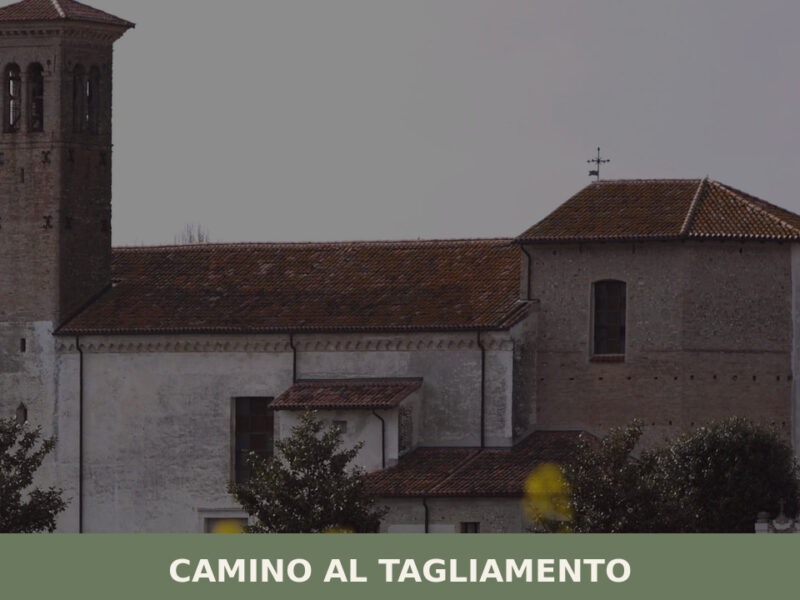
Camino al Tagliamento
A guide to Camino al Tagliamento in Friuli Venezia Giulia — its medieval parish church, the Tagliamento riverbed, rural hamlets, and Friulian food traditions.

📝 Incorrect information or updates?
Help us keep the Castions di Strada page accurate and up to date.