


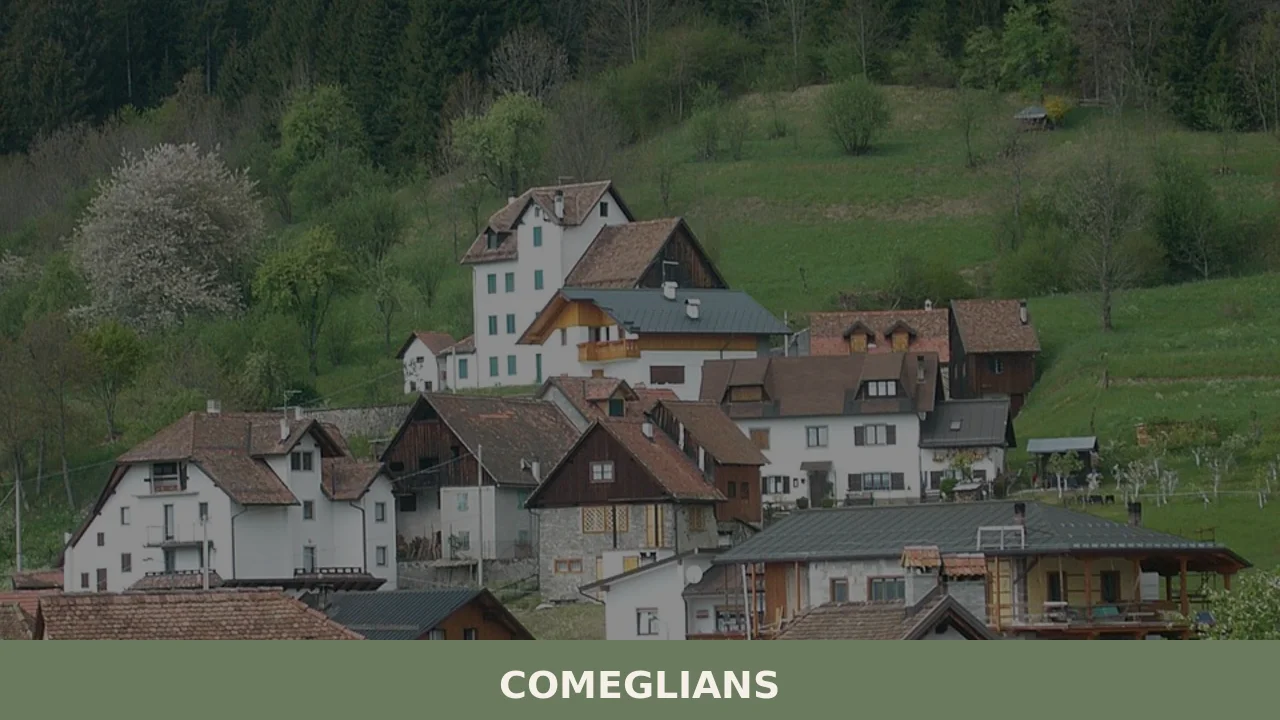
Comeglians
In the valley of the Degano torrent, along the road that climbs from Tolmezzo toward the Monte Croce Carnico pass, Comeglians marks a precise point on the map of Carnia: 553 metres above sea level, 533 inhabitants spread across the main village and the hamlets of Povolaro, Maranzanis, Tualis, and Calgaretto. The municipality is documented […]
Discover Comeglians
In the valley of the Degano torrent, along the road that climbs from Tolmezzo toward the Monte Croce Carnico pass, Comeglians marks a precise point on the map of Carnia: 553 metres above sea level, 533 inhabitants spread across the main village and the hamlets of Povolaro, Maranzanis, Tualis, and Calgaretto. The municipality is documented as early as the medieval period as a transit point toward territories beyond the Alps, and its economy relied for centuries on cattle rearing, the timber trade, and the weaving of woollen cloth. Anyone looking for what to see in Comeglians will find a settlement that preserves local stone architecture, fountains, devotional frescoes, and layers of history legible on house façades and in parish registers.
History and origins of Comeglians
The place name Comeglians has prompted several etymological hypotheses.
The most widely accepted traces it to the Latin cumilianus or comilianum, derived from a Roman personal name — probably a Comilius or Comelius — with the suffix -anus indicating a landed estate. This type of toponymic formation is consistent with that of many other Friulian centres founded on Roman praedial names, confirming an organised presence in the territory as early as the imperial age. During the Lombard and later Frankish periods, Carnia was reorganised into gastaldiae, and Comeglians fell within the administrative orbit of the Patriarchate of Aquileia, which throughout the Middle Ages exercised both temporal and spiritual jurisdiction over these valleys.
The medieval period saw the territory organised into vicinie, community assemblies that regulated the use of forests, pastures, and waterways. Comeglians, like other Carnic centres, enjoyed a degree of administrative autonomy under the Patriarchate, an autonomy that was partly confirmed even after the transition to the Republic of Venice in 1420. The Carnic communities retained the right to manage collective resources and elect their own representatives, a system that continued until the Napoleonic reforms at the beginning of the nineteenth century. The Serenissima recognised the strategic importance of Carnia as a border area and a commercial transit zone toward Habsburg territories, and Comeglians benefited from its position along the Degano route.
With the annexation to the Kingdom of Italy in 1866, Comeglians underwent the same transformations common to the entire Friulian mountain region: seasonal and then permanent emigration toward the plains, the Belgian and French mines, Argentina, and other overseas countries.
The population, which exceeded a thousand residents in the late nineteenth century, gradually declined to the current 533 inhabitants. The Friuli earthquake of 6 May 1976, with its epicentre in the foothill municipalities, also caused damage in Carnia and required structural reinforcement work on several buildings in the centre. Post-earthquake reconstruction partly redefined the village’s appearance, but the historic urban fabric of the higher hamlets retained its original layout, with houses built close together and shared courtyards that document the social organisation of Carnic communities.
What to see in Comeglians: 5 essential attractions
1. Parish Church of San Nicola
The parish church of San Nicola, dedicated to the village’s patron saint celebrated on 6 December, stands in the central part of Comeglians. The current building is the result of interventions carried out between the seventeenth and eighteenth centuries, with a sober façade and a square-plan bell tower that dominates the village’s profile as seen from the valley. Inside, a polychrome marble high altar and several canvases from the Venetian school bear witness to the cultural links between Carnia and the Friulian-Venetian plain. The single nave, spacious and bright, reflects the architectural standards of eighteenth-century Carnic churches. A visit allows one to read in the arrangement of the sacred furnishings the traces of local popular devotion.
2. The hamlet of Tualis
A few minutes from the main village, climbing the eastern slope, you reach Tualis, a hamlet that preserves one of the most compact and legible building clusters in the municipality. The houses in local stone, with wooden balconies and pitched roofs, line narrow lanes following a layout that responds to both defensive and climatic needs: the dwellings shield one another from wind and snow. Several buildings feature carved stone portals with inscribed dates and owners’ initials, an epigraphic repertoire that makes it possible to reconstruct the family history of the settlement. Tualis offers a direct view of Carnic vernacular architecture without any museum mediation.
3. Devotional frescoes and votive shrines
Walking along the roads between the hamlets of Comeglians, on house walls, at crossroads, and along the paths connecting settlements, you encounter devotional frescoes and votive shrines — the small religious aedicules that dot the entire Carnic territory. These wall paintings, some dating to the sixteenth and seventeenth centuries, depict Madonnas, patron saints, and scenes of the Passion. Their function was twofold: spiritual protection of domestic spaces and crossing points, and route-marking across a territory where paths could become uncertain under snow. Each fresco bears the marks of time and restoration work, and constitutes a visual document of popular religious commissions.
4. The course of the Degano torrent
The Degano torrent crosses the municipal territory of Comeglians with a wide, gravelly bed typical of Alpine watercourses with a torrential regime. Its waters, fed by snowmelt and rainfall, have shaped the valley and conditioned human settlement: the inhabited centres sit on river terraces, sheltered from flooding. The banks of the Degano are accessible at several points and offer flat routes suitable for walks. The fish fauna includes species typical of cold mountain waters. The relationship between the village and its torrent is a constant in local life, from the timber floating practised until the twentieth century to the current recreational use of the riverbanks.
5. Trails to the malghe and high pastures
From the territory of Comeglians, several marked trails lead toward the malghe (mountain dairies) and high-altitude pastures used during summer transhumance. These routes, once daily working paths for shepherds and cheesemakers, pass through beech and spruce forests before opening onto high-altitude meadows. The malghe still in operation produce cheese using handed-down techniques, and some can be reached in two to three hours of walking. The trail network connects to the CAI path system of Carnia, allowing crossings into neighbouring valleys.
Walking these routes means passing through the vegetation belts that extend from the valley floor to the alpine zone, watching the landscape change metre by metre.
What to eat in Comeglians: traditional cuisine and local products
The cuisine of Comeglians is that of Carnia, a food tradition shaped by altitude, long winters, and the need to preserve supplies for months. The agropastoral economy produced a gastronomic repertoire based on few ingredients — maize and barley flour, dairy products, preserved pork, wild herbs, and dried legumes — processed using techniques that favour smoking, drying, and ageing. The proximity to the Austrian border and Slovenian tradition is perceptible in certain preparations that share ingredients and methods with cuisines from across the Alps.
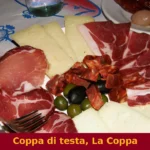
The most representative dish of the Carnic tradition is cjarsòns, a filled pasta resembling a large raviolo, whose filling varies from family to family and village to village. In the Comeglians area, the stuffing may include potatoes, aromatic herbs, smoked ricotta, raisins, cinnamon, and cocoa — a sweet-savoury combination that surprises on first tasting. Cjarsòns are dressed with melted butter and grated smoked ricotta. Another widespread dish is polenta, made with maize flour or with blends of maize and barley, served as an accompaniment to aged cheeses or game.
The thick and hearty bean and barley soups formed the basis of daily winter nourishment.
Among the dairy products of the Carnic area, malga cheese stands out, made from the milk of cows on summer pasture and processed directly at the alpine dairies. Smoked ricotta, locally called scuete fumade, is a product obtained by smoking fresh ricotta with beech or juniper wood, a process that gives it an intense flavour and extends its shelf life. The smoking tradition is documented throughout Carnia and responds to the historical need to preserve food during the cold months. Milk and its derivatives are the pillar of local food production, directly linked to the transhumance practice that still characterises the municipality’s rural economy today.
The gastronomic event most closely tied to the Carnic tradition is the cjarsòns festival, held in several municipalities in the area during the summer months, generally between June and August. In Comeglians and the surrounding hamlets, village fairs offer the chance to taste local dishes prepared according to family recipes. Dairy products from the malghe can be purchased directly from farms in the area and at markets held periodically in the centres of the Degano valley. Tolmezzo, the main town of Carnia about fifteen kilometres away, hosts a weekly market where products from the surrounding valleys can be found.
On the beverage front, Friuli Venezia Giulia is a region with a great winemaking tradition, but wine production is concentrated in the hilly and lowland areas of the region.
In the Carnic valleys, including the territory of Comeglians, the traditional drink was rather home-brewed beer and fruit distillates, particularly grappas made from grape pomace or local fruits. Today the municipality of Comeglians falls within the distribution area of Friulian wines, but local consumption still favours dairy products and distillates as the most fitting expressions of the mountain territory.
When to visit Comeglians: the best time of year
The summer season, from June to September, is the period when Comeglians offers the best conditions for exploring the territory on foot: the malghe are active, the trails are passable, and the long days allow excursions to the high pastures. July and August are the busiest months, with village fairs and hamlet festivals enlivening the evenings. The patron feast of San Nicola, on 6 December, falls instead in the middle of winter and offers an occasion to experience the village in its most intimate dimension, with religious celebrations and community rites linked to Advent.
Autumn, between October and November, is the season when herds descend from the malghe and the woodland colours shift: beeches turn red and orange, and larches take on golden tones before shedding their needles.
It is a quiet period, with few visitors and temperatures already sharp in the morning. Winter transforms the valley with snow, which in normal years covers the valley floor from December to March: those seeking silence and the atmosphere of Carnic mountains in winter will find in Comeglians a base for snowshoe walks through the surrounding forests. Spring, between April and May, brings the thaw and the flowering of meadows, but higher trails may remain snow-covered well into June.
How to reach Comeglians
Comeglians is reached by car via the A23 Palmanova-Tarvisio motorway, exiting at the Carnia-Tolmezzo toll station, from which you continue on regional road 355 toward Ovaro and then Comeglians: the distance from the toll station is approximately 18 kilometres, drivable in twenty minutes. From Udine, the provincial capital about 65 kilometres away, the journey takes about one hour. From Trieste, the distance is approximately 150 kilometres and the travel time is one hour and forty minutes.
The nearest railway station is Carnia, on the Udine-Tarvisio line, located about 15 kilometres from the village.
From the station, you can continue with bus services operated by the Friuli Venezia Giulia regional public transport network, which connect Tolmezzo and the centres of the Degano valley with varying frequency depending on the season. The nearest airport is the Trieste-Friuli Venezia Giulia at Ronchi dei Legionari, approximately 130 kilometres away and reachable in an hour and a half. Venice Marco Polo Airport is approximately 180 kilometres away.
Other villages to discover in Friuli Venezia Giulia
Those visiting Comeglians and Carnia can extend their exploration of Friuli Venezia Giulia toward the hilly and foothill areas of the region, where other smaller centres preserve architecture and traditions of considerable interest. Buja, in the morainic hills north of Udine, is a municipality that underwent extensive reconstruction after the 1976 earthquake and today presents a territory spread across numerous hamlets, with rebuilt churches and a hilly landscape cultivated with vineyards and meadows.
From Comeglians, Buja can be reached in about fifty minutes by car along the main road toward Tolmezzo and then the Udine plain.
To the east, Attimis offers a different setting: located in the Natisone Valleys, it is known for the ruins of its two castles — Upper and Lower — which overlook the settlement and document the medieval defensive system of eastern Friuli. The distance from Comeglians is approximately seventy kilometres, drivable in an hour and fifteen minutes. An itinerary linking Comeglians, Buja, and Attimis allows you to cross three distinct environments of the region — the Carnic mountains, the morainic hills, and the eastern pre-Alpine valleys — reading in the architecture and landscapes the different responses that Friulian communities have given to the territory they inhabit.
In Friuli Venezia Giulia More villages to discover
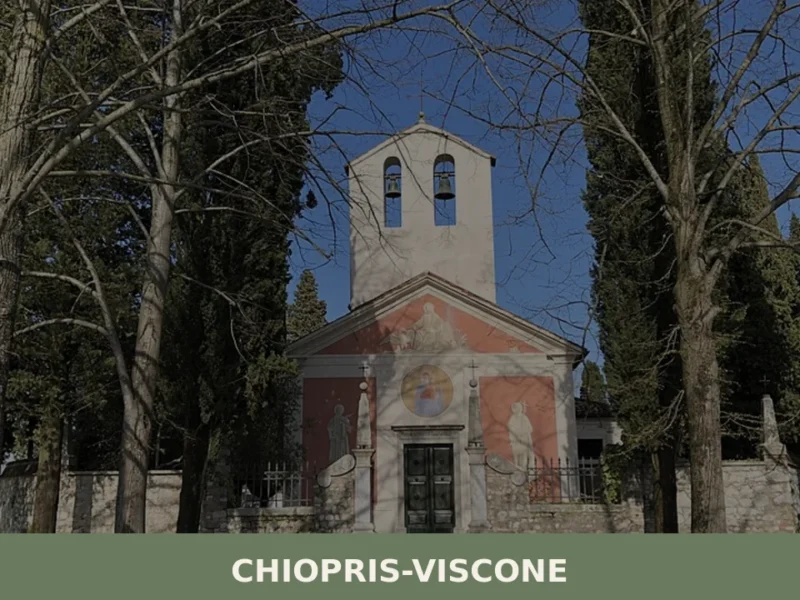
Chiopris-Viscone
Two hamlets, two bell towers, two patron saints — and a single road running through both, the provincial route from Palmanova towards the Slovenian border. Anyone arriving in Chiopris-Viscone for the first time immediately notices this duality: the municipality, created in 1928 through the administrative merger of two distinct settlements, still retains a twin-centre layout, […]
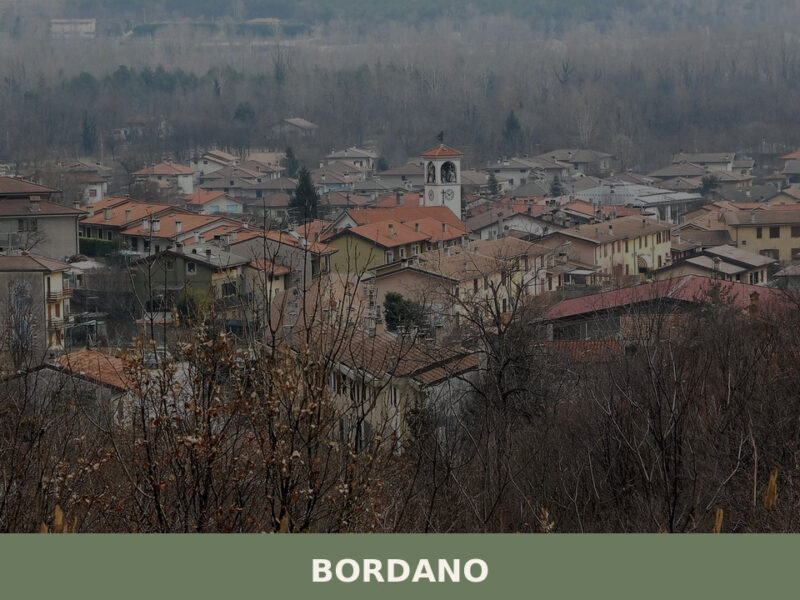
Bordano
Bordano, the Village of Butterflies in Friuli Venezia Giulia, pairs over 100 painted murals with genuine alpine biodiversity. A guide to its trails, lake, food, and art.
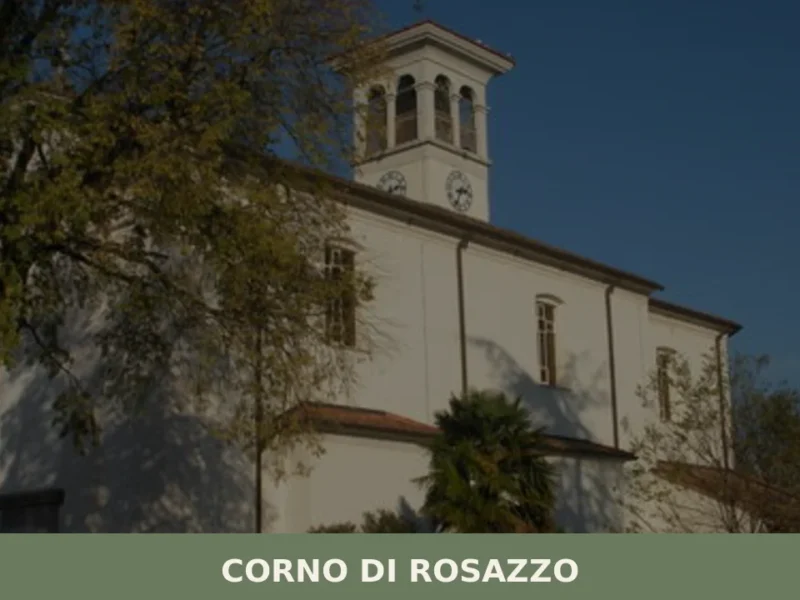
Corno di Rosazzo
In 1070, a deed of donation by the Patriarch of Aquileia mentioned the name Corno di Rosazzo for the first time, linking it to a parish church and a territory already organized around viticulture and cereal farming. Today that territory extends over just twenty square kilometres across the Colli Orientali del Friuli, at 88 metres […]
📝 Incorrect information or updates?
Help us keep the Comeglians page accurate and up to date.