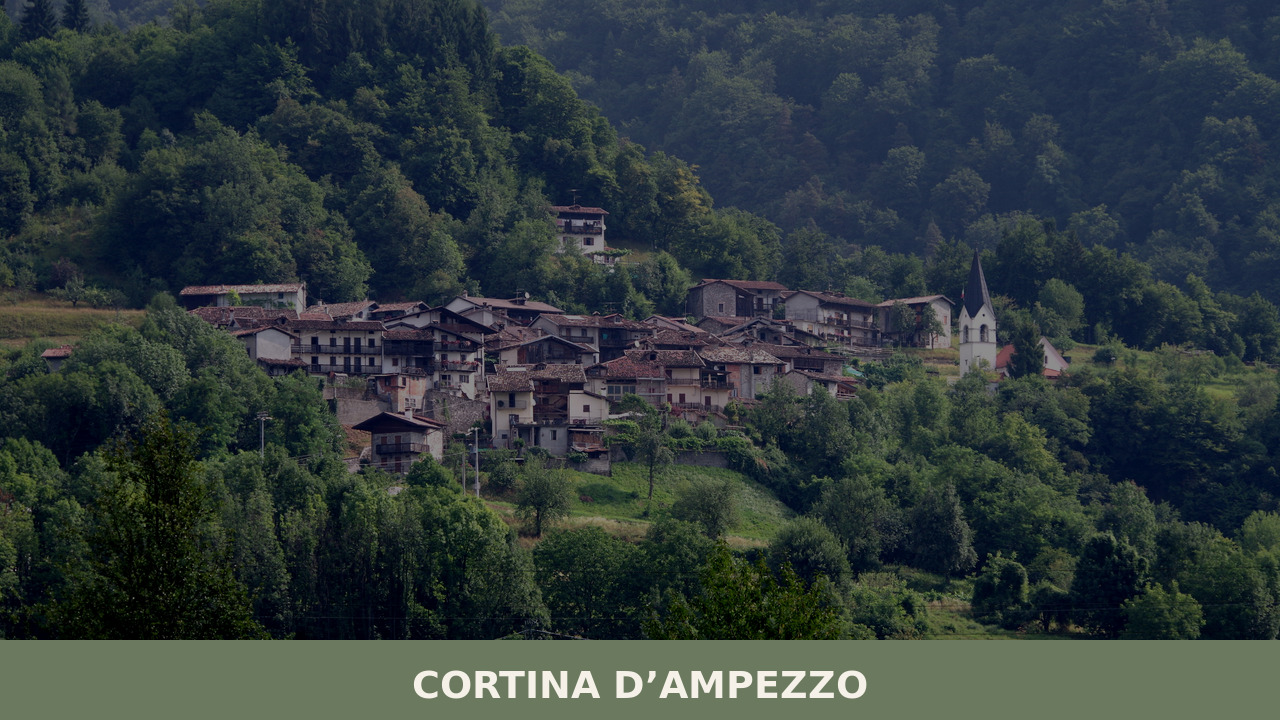
A complete guide to what to see in Cortina d’Ampezzo — from Dolomite peaks and WWI tunnels to Ladin cuisine and centuries-old communal traditions.
Morning light hits the bell tower of the Basilica dei Santi Filippo e Giacomo at an angle that turns its pale stone almost gold, while the sharp silhouettes of the Dolomite peaks — Tofane, Cristallo, Sorapis — frame every street and courtyard like a geological amphitheatre. At 1,224 metres above sea level, with roughly 5,546 inhabitants, this is a town defined not by its celebrity but by the raw verticality of the landscape pressing in on all sides. Understanding what to see in Cortina d’Ampezzo means understanding how stone, altitude, and centuries of Alpine culture have shaped a single place.
The name “Ampezzo” likely derives from the Latin ambitium, referring to a place between two rivers — a geographical descriptor that still holds, as the Boite river runs through the valley floor. The area has been inhabited since at least the Mesolithic period, with archaeological finds indicating early hunter-gatherer camps in the surrounding high pastures. By the medieval period, Cortina was part of the Cadore region, a territory that shifted between the Patriarchate of Aquileia, the Republic of Venice, and the Habsburg Empire with the regularity of Alpine weather.
For over four centuries — from 1511 to 1918 — Cortina belonged to Austria, a legacy still legible in the architecture, in bilingual family names, and in the Ladin language spoken by a portion of the population. The community governed itself through the Regole d’Ampezzo, a system of collective land management dating to at least the thirteenth century that persists today, overseeing thousands of hectares of forest and pasture. This is not a quaint remnant; the Regole remain a legally recognised body and one of the oldest continuously functioning communal land institutions in Europe.
The twentieth century brought two transformative events: the devastation of World War I, which carved trenches and tunnels directly into the surrounding peaks, and the 1956 Winter Olympics, which established Cortina’s international profile. The town is set to host events during the 2026 Milan–Cortina Winter Olympics, drawing a direct line across seven decades of competitive winter sport in the same valley.
The parish church, with its distinctive white bell tower rising 71 metres, anchors the centre of town. The current structure dates to the eighteenth century, built over an earlier medieval church. Inside, the altarpieces and carved wooden furnishings reflect the Tyrolean artistic tradition — restrained, precise, and shaped by the same timber that surrounds the valley.
The Cinque Torri — five rock towers southwest of Cortina — rise from an alpine meadow like broken columns. Accessible by chairlift or on foot, the area also preserves reconstructed World War I trenches and open-air museum installations. The geology here is pure Dolomite: pale limestone and dolomite rock formed from ancient coral reefs, now lifted nearly 2,400 metres into the sky.
Housed within the Ciasa de ra Regoles in the town centre, this collection holds works by de Chirico, Morandi, De Pisis, and Sironi, among others. It is an unexpected concentration of twentieth-century Italian art at altitude, assembled through the personal passion of local collector Mario Rimoldi and donated to the Regole d’Ampezzo.
A cable car ascends to 2,778 metres on Lagazuoi, where Italian and Austro-Hungarian forces fought a war of mines and counter-mines between 1915 and 1917. Visitors can walk through restored tunnels blasted directly into the rock face, emerging at openings that look straight down the valley — a visceral encounter with the absurdity of high-altitude trench warfare.
Reached by a marked trail (roughly two hours from Passo Tre Croci), this glacial lake is distinguished by its intense milky turquoise colour, caused by suspended mineral particles. The trail traverses exposed ledges with fixed cables and is not for those uncomfortable with heights, but the lake itself — enclosed by vertical rock walls — rewards the effort with a silence broken only by falling stone.
The cuisine of Cortina reflects its position at the crossroads of Venetian and Tyrolean traditions. Casunziei — half-moon-shaped ravioli filled with beetroot or pumpkin and dressed with melted butter, smoked ricotta, and poppy seeds — are the signature first course. Canederli (bread dumplings with speck or cheese) appear on nearly every menu, alongside game dishes featuring venison and chamois during autumn. Barley soups and polenta served with wild mushrooms round out a table defined by altitude, cold winters, and limited arable land.
Local dairy production centres on Schiz, a fresh, lightly salted cheese typically pan-fried, and aged mountain cheeses from the malghe — seasonal high-pasture dairies that still operate during summer months. The Regole d’Ampezzo manage much of the surrounding forest and pastureland, maintaining the agricultural cycle that feeds these traditions. For provisions, the weekly market in Corso Italia offers local producers alongside more commercial vendors.
Winter, from December through March, is the obvious season for skiing, with the Cortina ski area offering over 100 kilometres of pistes across several interconnected zones, including Tofana and Faloria. The town fills during Christmas week and Carnival. But summer — particularly late June through September — opens up a different landscape entirely: over 400 kilometres of marked hiking trails, via ferratas on the surrounding peaks, and mountain refuges serving meals at altitudes above 2,000 metres.
Autumn, often overlooked, is arguably the most visually striking period. The larch forests turn a deep amber in October, and the crowds thin dramatically. Temperatures at 1,224 metres can drop below freezing at night by late September, so layered clothing is essential year-round. The Cortina Ultratrail in June and the Coppa d’Oro delle Dolomiti vintage car rally in summer are among the events that draw specific crowds without overwhelming the town.
Cortina sits along the SS51, the main road connecting Belluno to the south with Dobbiaco (Toblach) and the Puster Valley to the north. From Venice, the drive takes approximately two hours (roughly 160 km) via the A27 motorway to Belluno, then continuing north on the SS51. From Innsbruck, the route through the Brenner Pass and the Puster Valley covers about 165 km. Milan is roughly four hours away by car (around 400 km via the A4 and A27).
The nearest railway station with regular service is Calalzo di Cadore, about 35 km south, connected to Venice by Trenitalia regional trains. From Calalzo, Dolomiti Bus operates a shuttle to Cortina. The closest airports are Venice Marco Polo (about 160 km), Treviso (145 km), and Innsbruck (165 km). No train line reaches Cortina directly — the historic rail corridor was dismantled decades ago, though its route now serves as a popular cycling and walking path along the valley floor.
Italy’s network of small communities stretches from Alpine valleys to Mediterranean coastlines, each carrying its own layered history. Far to the south, the lakeside village of Lesina in Puglia occupies a narrow strip of land between its lagoon and the Adriatic — a landscape as horizontal and water-defined as Cortina’s is vertical and rock-bound. The contrast is instructive: both communities have shaped their identity around a single dominant geographical feature.
In the interior of southern Italy, Vinchiaturo in Molise offers another register entirely — a quiet hill town along ancient transhumance routes, where the rhythms of pastoral life have left traces in the local architecture and cuisine. Exploring these villages alongside Cortina reveals the extraordinary range of terrain, climate, and human adaptation contained within a single country.
📝 Incorrect information or updates?
Help us keep the Cortina d’Ampezzo page accurate and up to date.


