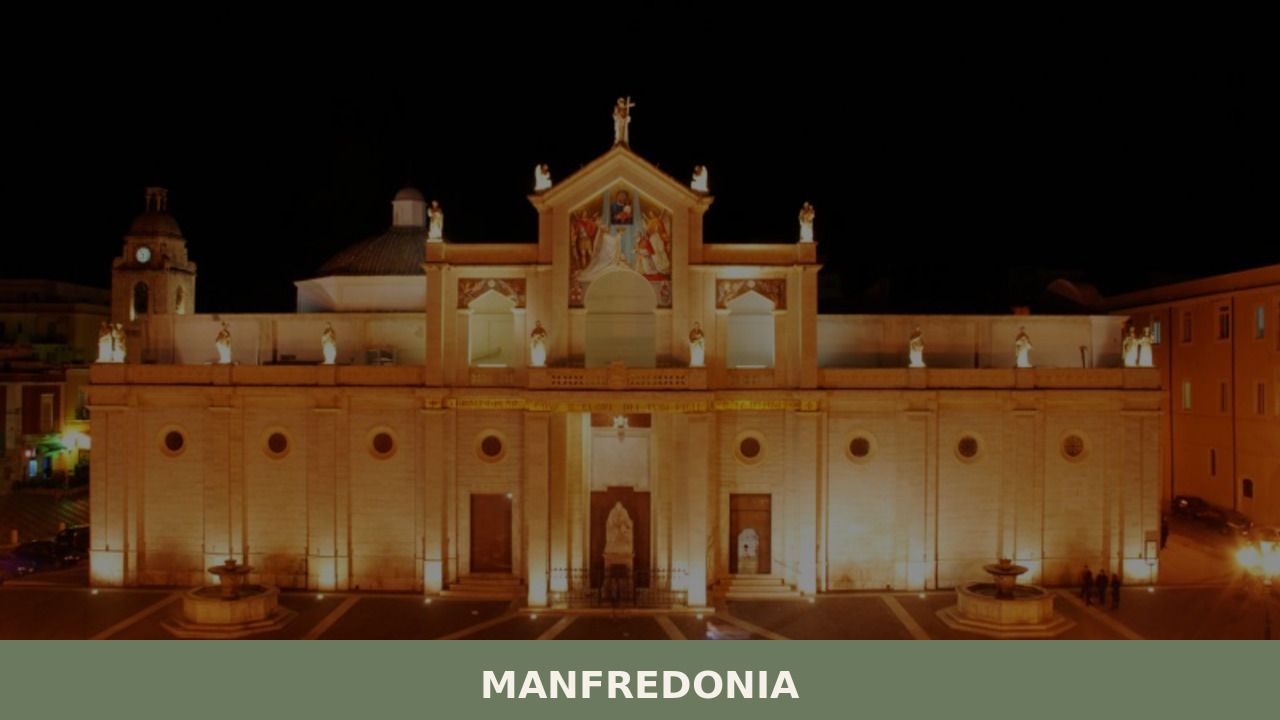
A port city founded by King Manfred on the Gargano coast, Manfredonia holds a medieval castle, pre-Roman carved stele, and one of Puglia’s oldest carnivals.
Salt air carries across the harbour at dawn, mixing with diesel from the fishing boats and the faint sweetness of bread baking somewhere behind the lungomare. Nets lie heaped on the quay in tangled pyramids, drying before the next run into the Gulf. Manfredonia wakes slowly, a working port city of nearly 54,000 people pressed between the Adriatic and the pale limestone flanks of the Gargano. For anyone asking what to see in Manfredonia, the answer begins here — at the waterfront, where the Castello Svevo-Angioino rises from the breakwater like a stone fist, and the city’s layered centuries come into focus.
The city owes its name — and its existence — to King Manfred of Sicily, the Hohenstaufen ruler who founded it around 1256. Manfred needed a new port after the ancient city of Siponto, a few kilometres to the south, had been devastated by earthquakes and rendered unusable by the progressive silting of its harbour. He relocated the surviving population to a site closer to the deep water of the Gulf, laid out a grid of streets, and began construction of the castle that still anchors the city’s northeastern corner. The name “Manfredonia” is a direct echo of its founder — a rare instance of a medieval Italian city carrying a personal royal stamp that has survived into the modern era.
Siponto itself had been a significant Roman and early Christian centre, home to a bishopric and a port that connected the Adriatic trade routes to the interior of the Capitanata plain. When Manfred relocated its people, he inherited that ecclesiastical and commercial importance. The Angevins, who defeated and killed Manfred at the Battle of Benevento in 1266, completed the castle he had started, adding the massive round corner towers that define its silhouette today. Ottoman raids struck the city hard in 1620, when a Turkish fleet sacked Manfredonia, burning much of the town and forcing a prolonged reconstruction that gave the centre its current Baroque and late-Renaissance character.
Across the centuries, Manfredonia remained the primary gateway between the Gargano promontory and the flat wheat-growing plains of the Province of Foggia. That dual identity — maritime and agricultural, coastal and connected to the interior — still shapes the city. The harbour handles commercial and fishing traffic; the surrounding countryside produces grain, olive oil, and wine. It is a city that has been destroyed and rebuilt several times over, and the geology of each era lies exposed in its walls.
Built by Manfred and expanded by Charles I of Anjou, the castle now houses the Museo Nazionale Archeologico. Its most significant holdings are the stele daunie — carved limestone slabs dating to the 7th–6th centuries BCE, recovered from the Siponto necropolis. These flat, human-shaped stones bear incised scenes of warfare, hunting, and funerary ritual, and represent one of the most distinctive pre-Roman artistic traditions in southern Italy.
Three kilometres south of the modern city, the Romanesque basilica of Santa Maria Maggiore di Siponto stands alone on a flat expanse of grass near the ancient harbour site. Built in the 11th–12th centuries over an earlier early Christian church, its square plan and blind arcading reflect Apulian Romanesque at its most austere. In 2016, artist Edoardo Tresoldi installed a wire-mesh reconstruction of the vanished basilica nave above the ruins — a transparent ghost of architecture that has become one of Puglia’s most photographed contemporary artworks.
Manfredonia’s cathedral, dedicated to San Lorenzo Maiorano, was rebuilt in the 17th century following the Ottoman sack. Its interior houses a carved wooden icon of the Madonna known as the Madonna di Siponto, a Byzantine-era devotional image that was carried north from the old city. The façade is plain, almost industrial in its austerity, but the interior opens into a deep barrel-vaulted nave lined with side chapels.
Manfredonia’s seafront promenade runs for roughly two kilometres along the Gulf, connecting the castle to the commercial port. Early mornings bring the best theatre: fishing boats returning through the harbour mouth, crates of squid and red mullet stacked on the quay, and the sharp exchange of prices at the informal fish market. The view across the water takes in the full sweep of the Gargano coast, from Mattinata to Vieste on clear days.
Dating to the Angevin period and later reworked in Gothic and Baroque phases, San Domenico preserves a 14th-century carved stone portal and fragments of medieval frescoes in the transept. The adjoining cloister, partially restored, is one of the few surviving medieval conventual spaces in the Capitanata. It sits in the old quarter, on a street narrow enough that balconies on opposite sides nearly touch.
Manfredonia’s kitchen reflects its geography — seafood from the Adriatic set against the grain and vegetable culture of the Tavoliere plain. The city’s defining dish is ciambotto, a dense fish stew built from whatever the boats bring in: cuttlefish, mussels, rockfish, tomato, garlic, and a heavy pour of local olive oil. Bread is serious here — large, golden-crusted loaves of pane di Monte Sant’Angelo from the Gargano, baked in wood-fired ovens and designed to last a week. Street food centres on panzerotti — deep-fried pockets of dough filled with mozzarella and tomato — and sgagliozze, slabs of fried polenta sold from paper cones.
The surrounding territory produces extra-virgin olive oil from Ogliarola Garganica olives, along with caciocavallo podolico, a pear-shaped aged cheese made from the milk of the semi-wild Podolica cattle that graze the Gargano slopes. At the weekly market and in the small trattorie along Via Maddalena and the harbour zone, menus follow the calendar: sea urchins in winter, lampascioni (wild hyacinth bulbs) in early spring, grilled octopus through the summer months. This is cooking that depends on proximity and season, not elaboration.
Manfredonia sits at just 5 metres above sea level, fully exposed to the Gulf, and the climate is typically Mediterranean — hot, dry summers and mild winters with occasional sharp winds from the north. July and August bring temperatures regularly above 30°C and heavy Italian holiday crowds; the beaches south toward Zapponeta fill quickly. The most revealing months to visit are May, June, September, and early October, when the light is long but the heat is tolerable and the city functions at its normal working pace rather than its tourist one.
The most significant annual event is the Carnival of Manfredonia, one of the oldest and most elaborate in Puglia, running for several weeks in February and March. Allegorical floats parade through the centre, and the city’s population swells noticeably. The feast of the Madonna di Siponto, celebrated in late August and early September, draws processions from the cathedral to the old Siponto church. For those interested in Manfredonia’s archaeological heritage, the quieter winter months allow extended, uncrowded access to the castle museum and the Siponto park.
Manfredonia lies in the Province of Foggia, at the southern base of the Gargano promontory. By car, the most direct route from the north follows the A14 Autostrada Adriatica to Foggia, then the SS89 east for approximately 40 km to Manfredonia — a drive of about 35 minutes from the motorway exit. From Bari, the distance is roughly 170 km (around two hours via the A14 and SS89). From Naples, count on approximately 220 km and three hours of driving, mostly on the A16 and then the A14.
The nearest mainline railway station is Foggia, which is served by Trenitalia’s high-speed Frecciarossa and Frecciargento services from Rome (roughly three hours), Milan, and Bologna. From Foggia station, regional buses operated by the local transit authority connect to Manfredonia in approximately 50 minutes. The nearest commercial airport is Bari Karol Wojtyła (BRI), about 160 km to the southeast; Foggia’s smaller Gino Lisa airport handles limited domestic traffic. Car rental at Bari airport is the most practical option for flexible exploration of the Gargano and Capitanata.
Manfredonia serves as a natural starting point for wider exploration of the Capitanata and the Subappennino Dauno — the low mountain chain that forms the western spine of the Province of Foggia. Inland, roughly 80 km to the southwest, Ascoli Satriano guards one of Puglia’s most extraordinary archaeological finds: the painted marble griffins and other polychrome funerary objects of the 4th century BCE, now displayed in the town’s civic museum. The drive passes through the flat, wheat-golden Tavoliere, crossing a landscape that has barely changed in character since the Roman agrarian colonies.
Further into the Dauno mountains, near the border with Campania, the small hill village of Accadia occupies a ridge at over 650 metres, offering a stark altitude and climate contrast with Manfredonia’s sea-level flatness. Its partially abandoned Rione Fossi — a medieval quarter carved into the rock — is one of the most atmospheric ghost-neighbourhood landscapes in southern Italy. Together, these two inland settlements reveal a Puglia that most coastal visitors never encounter: vertical, sparse, and shaped by geology rather than the sea.
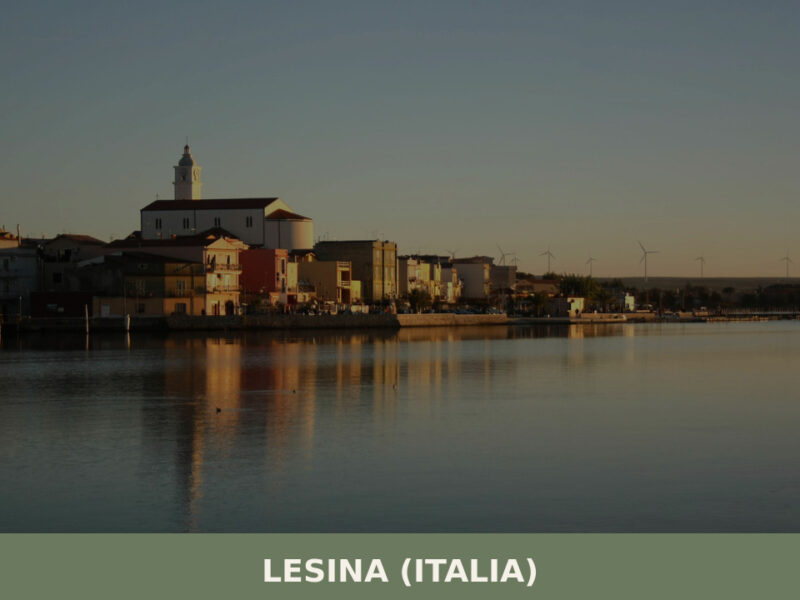
Lesina sits between Italy's second-largest coastal lagoon and the Adriatic Sea. A guide to its lagoon ecology, eel fishing traditions, and quiet historic centre.
A hilltop village of 1,357 inhabitants in the Province of Foggia. Explore Casalnuovo Monterotaro's stone lanes, rural landscape, and the traditions of inland Puglia.
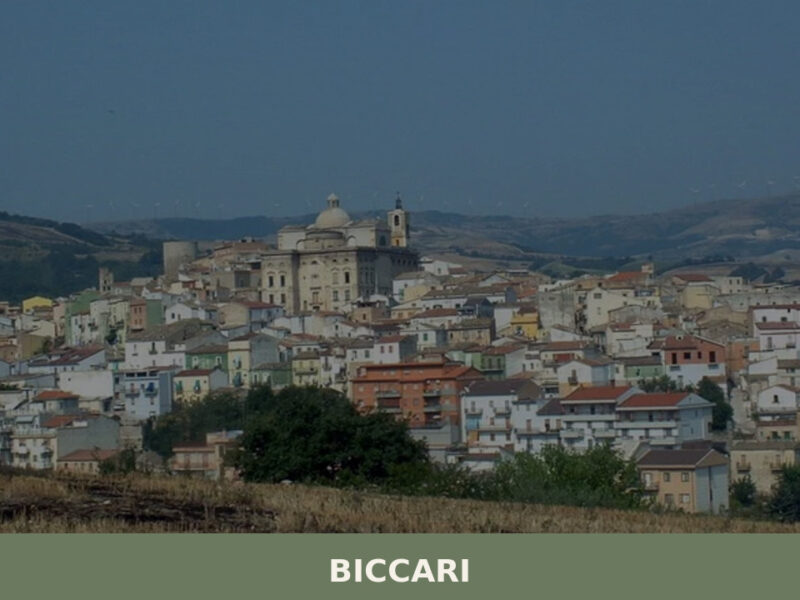
Discover Biccari, a charming hilltop village in Puglia's Daunian Mountains. Explore its Norman tower, mountain lake, forest trails, and authentic southern Italian cuisine.
📝 Incorrect information or updates?
Help us keep the Manfredonia page accurate and up to date.


