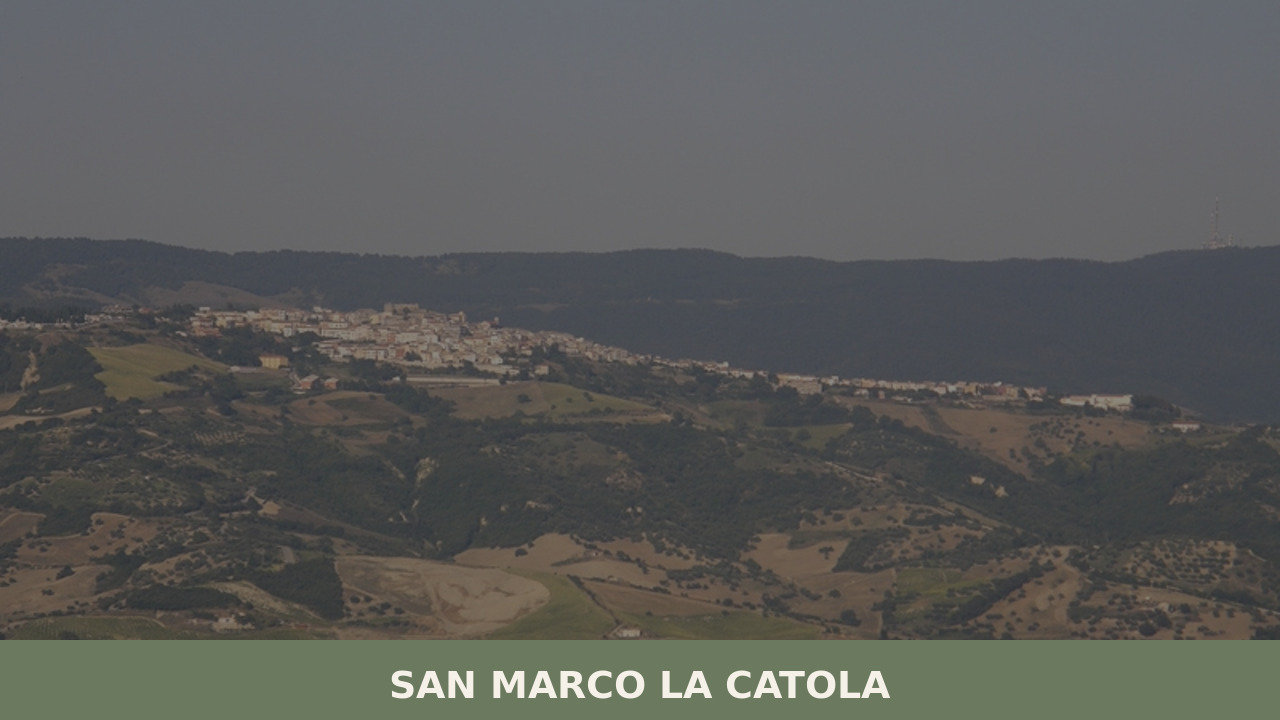
A quiet hill village at 683 metres in the Daunia mountains of Puglia. Discover what to see in San Marco la Catola, from its medieval core to the Fortore valley.
Morning fog lifts off the Daunia Sub-Appennine ridge and the first thing you hear is a dog barking somewhere below the old quarter, its echo bouncing between stone walls. At 683 metres above sea level, the air here carries a sharpness that the lowland towns of the Foggia plain never know. Fewer than 900 people live in San Marco la Catola, and most mornings the streets belong to pensioners, stray cats, and the smell of woodsmoke. If you are wondering what to see in San Marco la Catola, the answer begins with this silence — a village where time deposits itself in layers you can read like sediment.
The settlement’s origins are tied to the broader pattern of fortification along the Daunia mountains during the early medieval period. The name itself is revealing: “San Marco” refers to the patron saint, Mark the Evangelist, while “la Catola” likely derives from the Greek-Byzantine word katole, meaning descent or slope — a reference to the village’s position on a hillside that drops steeply toward the Fortore river valley. Byzantine influence in the Daunia Sub-Appennine was significant between the 9th and 11th centuries, and place names throughout the area preserve that linguistic residue. The village fell within the broader administrative zone of the Province of Foggia, which has governed these mountain communities for centuries.
Under Norman rule in the 11th and 12th centuries, San Marco la Catola became part of the feudal network that reorganised southern Italy. The village was fortified, as were dozens of similar hilltop settlements along the mountain chain separating Puglia from Campania and Molise. Feudal lordship changed hands repeatedly over the centuries — passing through Angevin, Aragonese, and later Bourbon control — each transition leaving its mark on the built environment but rarely on the population count, which has remained small for as long as records exist.
The 20th century brought the familiar story of southern Italian emigration. San Marco la Catola’s population peaked in the early 1900s and has declined steadily since, dropping to its current 879 inhabitants. What remains is a village whose medieval street plan is largely intact, its fabric compressed and legible — a settlement that never grew large enough to erase its own past.
The old quarter is a tight mesh of narrow alleys, external staircases, and houses built directly into the rock face. Stone archways connect buildings across lanes barely wide enough for two people to pass. The layout follows the medieval logic of defence and drainage — every slope, every turn has a practical origin. Walking it takes thirty minutes, but reading it takes longer.
Dedicated to San Marco Evangelista, the parish church anchors the upper part of the village. Its stone façade is plain, almost austere — characteristic of Daunia mountain churches that prioritised structural solidity over ornament. Inside, the nave holds wooden altarpieces and devotional statues accumulated across several centuries, each reflecting the limited but persistent wealth of a small agricultural community.
At the highest point of the settlement, remnants of the medieval fortification are visible in wall fragments and the irregular footprint of the hilltop. The castle served as the feudal seat during the Norman and subsequent periods. What survives is fragmentary but legible — enough to understand why this particular ridge was chosen and how the village grew outward from its defensive core.
From the edge of the village, the land falls away sharply to reveal the Fortore river basin and the surrounding Daunia mountains. On clear days the view extends across a corrugated landscape of forested ridges and cultivated terraces. This is not a manicured overlook — it is simply where the village ends and the topography begins, offering an unmediated reading of the terrain that shaped settlement here.
Footpaths radiating from the village lead to small rural chapels and farmsteads scattered across the surrounding hills. These routes — once the daily paths of shepherds and woodcutters — pass through mixed oak and beech forest typical of the Daunia Sub-Appennine at this altitude. The chapels, modest structures often locked, mark boundaries between former feudal properties and seasonal grazing zones.
The cooking here follows the mountain tradition of the Daunia Sub-Appennine: hearty, pork-based, shaped by long winters at altitude. Handmade pasta — orecchiette, cavatelli, and laganelle — is dressed with ragù of mixed meats or with wild greens foraged from surrounding fields. Lamb, raised on the hill pastures, appears roasted or braised with local herbs. Cardoncelli mushrooms, which grow wild on the calcareous soils of the region, are a seasonal ingredient prized across Puglia. Preserved meats, particularly soppressata and capocollo, are produced domestically and reflect recipes handed down through families rather than commercial standardisation.
Bread is central to the diet. The Daunia mountain villages traditionally baked large loaves in communal wood-fired ovens — a practice that persists in modified form. Local olive oil, while less celebrated than the coastal Puglia varieties, carries a more robust, peppery character due to the altitude and cooler climate. The village does not have a wide restaurant scene — this is a settlement of 879 people — but the few trattorie and agriturismi in and around San Marco la Catola serve the kind of cooking that is impossible to replicate outside its context: food made from what grows within walking distance.
Late spring (May to mid-June) and early autumn (September to October) offer the most rewarding conditions. In spring, the surrounding hillsides are covered in wildflowers and the forests are dense with new growth. Autumn brings mushroom season, the olive harvest, and a clarity of light over the Fortore valley that sharpens every ridge and shadow. Summers at 683 metres are significantly cooler than on the Foggia plain below — a relief when Tavoliere temperatures regularly exceed 35°C — but the village is at its quietest, with many residents visiting relatives elsewhere.
The feast of San Marco Evangelista, the patron saint, is the principal annual event, drawing the community together for a procession, a mass, and communal eating. Winter can be severe — snowfall is not uncommon at this altitude in the Daunia mountains — but for those who appreciate solitude and bare-branched landscapes, the village in January has a stark, photographic quality. Visitors should note that services are limited: plan fuel, provisions, and accommodation in advance, particularly outside summer months.
San Marco la Catola sits in the western reaches of the Province of Foggia, close to the border with Campania and Molise. By car from Foggia, the drive takes approximately one hour via the SS17 and provincial roads climbing into the Daunia Sub-Appennine — roughly 60 kilometres of increasingly winding road. From Naples, the distance is about 140 kilometres (approximately two hours) via the A16 motorway toward Benevento, then north on secondary roads. From Bari, allow around two and a half hours (190 km) via the A14 and A16.
The nearest railway station with regular service is Lucera or Foggia, from where local bus services or a rental car are necessary to reach the village. The closest airports are Bari Karol Wojtyła (approximately 200 km) and Naples Capodichino (approximately 160 km). There is no direct public transport to San Marco la Catola — a car is effectively essential. Roads are well-maintained but narrow and steep in the final approach; drive with patience, particularly in wet conditions or after dark.
The Daunia mountains are only one face of Puglia. For a radically different landscape within the same region, the Gargano promontory offers coastal villages where the sea replaces the valley as the dominant presence. Peschici, perched on white cliffs above the Adriatic, is a useful counterpoint to San Marco la Catola — both are small, both are built on rock, but one looks inward toward mountains and the other outward toward open water. The contrast sharpens your understanding of how geography determines everything about a place: its food, its architecture, its temperament.
Closer to home in the Province of Foggia, Casalnuovo Monterotaro shares San Marco la Catola’s position in the Daunia foothills and its quiet, depopulated character. Visiting both villages on the same trip reveals the micro-variations that distinguish even neighbouring communities: slight differences in dialect, in bread-making, in the angle of light through a particular street. These are not interchangeable places. They are individual, specific, and worth the winding roads that connect them.
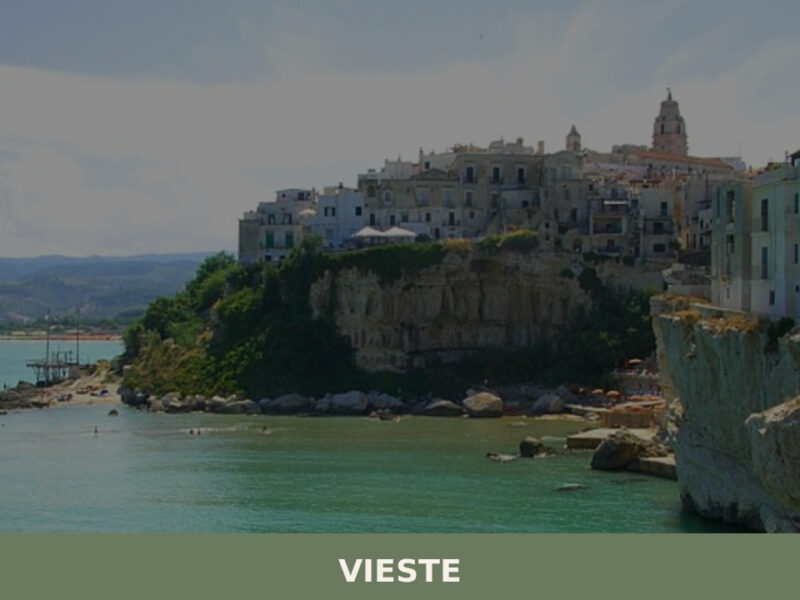
Perched on a narrow rocky peninsula that juts dramatically into the Adriatic Sea, Vieste is the easternmost town of the Gargano promontory and one of Puglia’s most captivating coastal destinations. With its whitewashed old town, sea-carved cliffs, and golden beaches stretching for kilometres, this village of around 13,400 inhabitants in the province of Foggia rewards […]
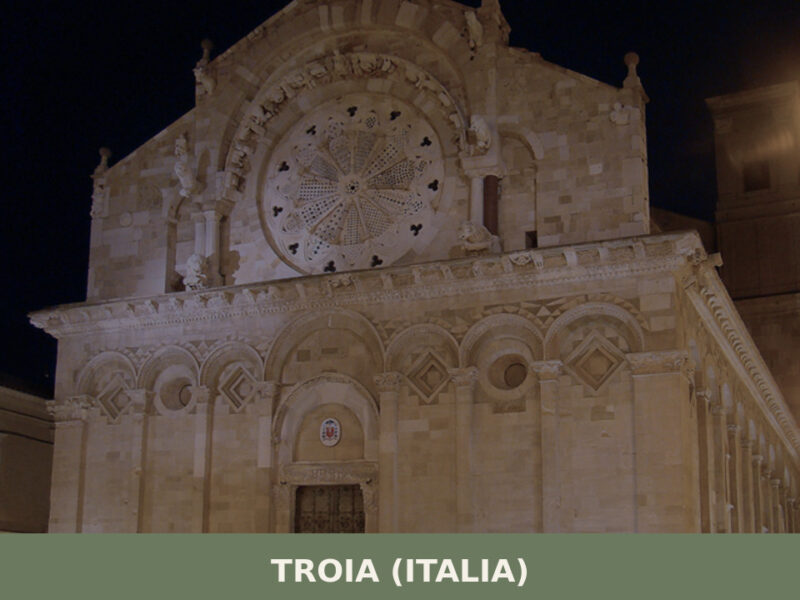
Are you ready to discover one of the most fascinating villages of Troia Puglia? Hidden among the gentle hills of the Dauno Sub-Apennines, this medieval jewel will amaze you with its historical, architectural and cultural richness. Troia Puglia is not just a tourist destination, but a true journey through time that will take you back […]
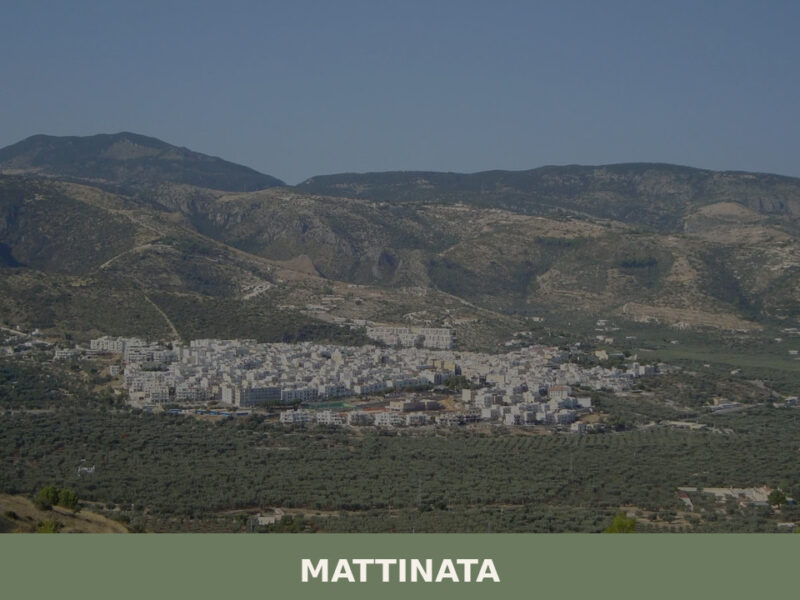
Perched on the sun-drenched slopes of the Gargano promontory, Mattinata is a dazzling white jewel overlooking the Adriatic Sea. With just 5,976 inhabitants and sitting at 75 metres above sea level in the province of Foggia, this coastal village captivates visitors with its pristine bays, ancient olive groves, and a way of life shaped by […]
📝 Incorrect information or updates?
Help us keep the San Marco la Catola page accurate and up to date.


